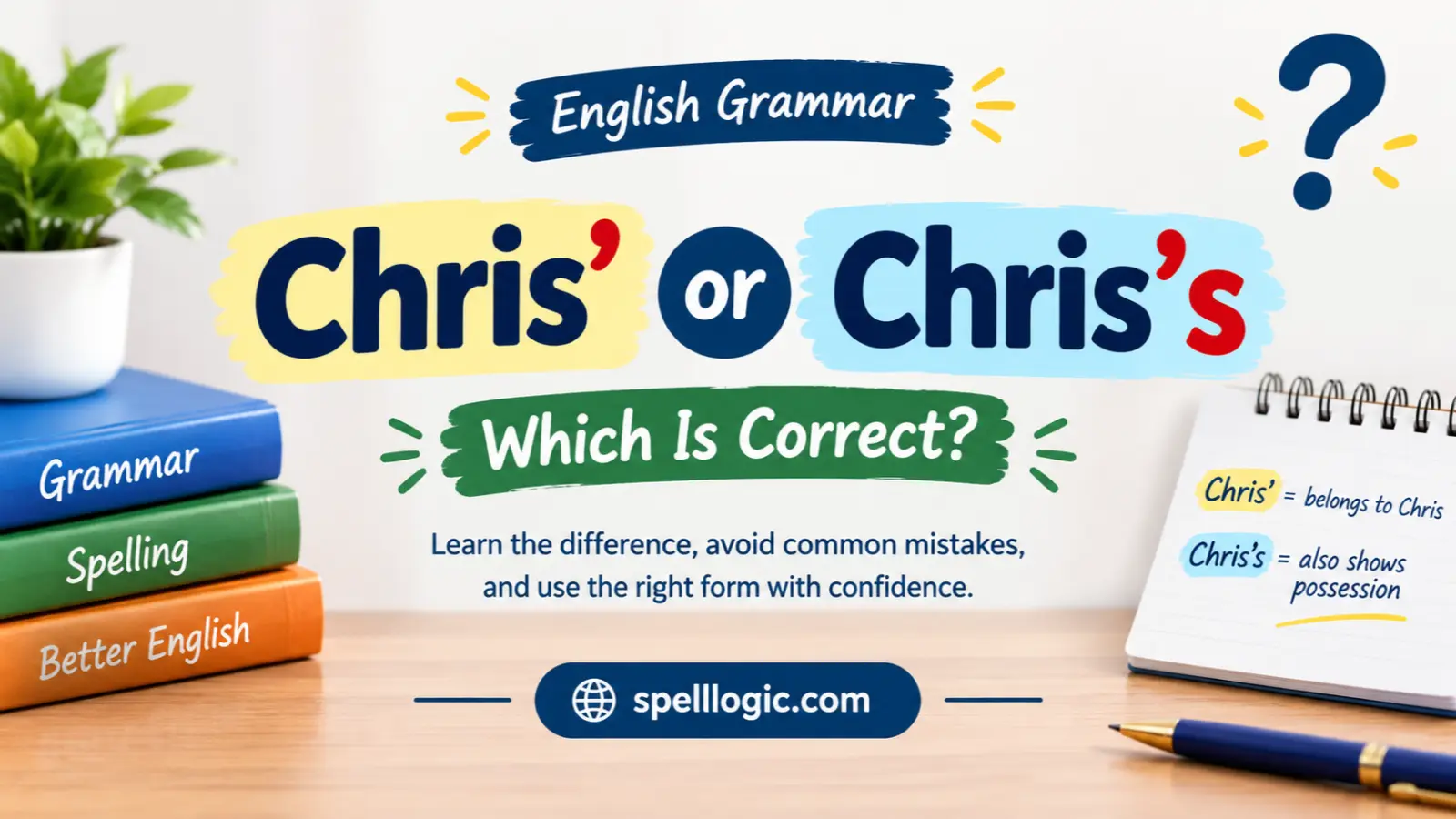
English learners often feel unsure when a name such as Chris needs to show possession. Should you write Chris’ book or Chris’s book? Both forms can be seen in real English, which makes chris’ or chris’s a common grammar question. The confusion usually comes from different style guides and from the fact that Chris ends in the letters.
The choice becomes easier once you understand possessive nouns and style differences. In this guide, we will explain chris’ or chris’s in simple English, show when each form is appropriate, and give practical examples you can use in school, work, and everyday writing.
Why “chris’ or chris’s” Are Confusing
The question chris’ or chris’s can be confusing because both forms are used to show that something belongs to Chris. Unlike many confusing word pairs, these forms do not represent two different meanings. They are two ways of writing the possessive form of the same name.
Similar pronunciation
In most standard English pronunciation, the possessive ending does not create a major difference in how the name is spoken. Speakers normally pronounce the possessive naturally according to the context. This means learners cannot always decide which spelling is correct just by listening.
Similar spelling
The name Chris already ends in s. That creates the main spelling problem. Writers know that singular nouns often take ‘s in the possessive, but they may also remember a rule about words ending in s taking only an apostrophe.
Context confusion
Style matters in chris’ or chris’s. Some editorial systems prefer Chris’s, while some styles allow or prefer Chris’ for names ending in s. Therefore, the right choice can depend on the publication, teacher, employer, or style guide you are following.
Common learner mistakes
A frequent mistake is treating the two forms as if one means something different. Another mistake is using an apostrophe without understanding possession. Learners may also switch forms within the same document. Consistency is important, especially in formal writing.
“chris’ or chris’s” Explained Simply
The simplest explanation of chris’ or chris’s is this: both forms can express possession, but different style guides use different rules for singular proper names ending in s.
One-line distinction: Chris’s follows the common singular possessive pattern, while Chris’ is an accepted alternative in some style systems.
For example:
- Chris’s car is parked outside.
- Chris’ car is parked outside.
Both sentences can be correct depending on the style being followed. When a teacher, company, newspaper, or academic institution gives you a style guide, follow that guide consistently.
A useful answer to chris’ or chris’s is therefore not simply “one is always correct.” Instead, ask which style your writing requires. In general-purpose modern English, Chris’s is a safe and widely accepted choice for a singular person named Chris.
Understanding Homophones in English
When learners study chris’ or chris’s, they sometimes assume the forms are homophones. They are not. The difference is grammatical and stylistic rather than a difference between two unrelated words.
What Are Homophones?
Homophones are words that sound the same but have different meanings or spellings. For example, right and write sound alike, but they have different meanings.
The forms in chris’ or chris’s are possessive spellings of the same proper name, so they should not be classified as a typical homophone pair.
Why Homophones Cause Confusion
Homophones can cause mistakes because listening alone does not tell you which spelling to choose. For example, a learner hearing “write” cannot know from sound alone whether the speaker means write or right.
That is different from chris’ or chris’s, where the main issue is the written possessive form rather than two different vocabulary items.
What Does “Chris’” Mean?
Definition and Core Meaning
Chris’ is a possessive form of the singular name Chris. It indicates that something belongs to, is connected with, or is associated with Chris. Some style guides use an apostrophe alone after a singular proper name ending in s.
For example, Chris’ jacket means the jacket belonging to Chris.
The important point in chris’ or chris’s is that the apostrophe does not change the basic meaning. It simply marks possession.
Origin and Historical Use
The use of apostrophes to indicate possession developed over the history of English spelling. Rules have never been completely uniform, and modern style guides continue to differ about names ending in s.
As a result, Chris’ has a long-established place in edited English. It is especially familiar in styles that simplify possessives of names ending in s.
Modern Usage and Synonyms
There is no true synonym for the possessive form itself, but writers can sometimes avoid the issue by rewriting the sentence.
For example:
- Chris’ decision was final.
- The decision made by Chris was final.
The second sentence avoids the possessive apostrophe entirely.
In practical writing, Chris’ may be suitable when your chosen style guide recommends or permits the form. The key lesson in chris’ or chris’s is to check the style rules rather than assuming that one spelling is universally required.
Example Sentences
- Chris’ office is on the second floor.
- I borrowed Chris’ notebook.
- The team followed Chris’ plan.
- Chris’ presentation was clear and useful.
What Does “Chris’s” Mean?
Definition and Core Meaning
Chris’s is also the possessive form of the singular name Chris. It shows that something belongs to Chris or is related to Chris. Many modern style guides use ‘s for singular proper names, even when the name ends in s.
For example, Chris’s laptop means the laptop belonging to Chris.
When considering chris’ or chris’s, this form is often the clearest choice for learners because it follows the familiar pattern used with many singular nouns and names.
Origin and Historical Context
English possessive spelling has changed over time, and style guides have developed different conventions. Some systems distinguish between singular and plural nouns ending in s, while others give special rules for proper names.
Because of these historical and editorial differences, Chris’s and Chris’ can both appear in published English.
Modern Usage and Synonyms
Chris’s is common in general, academic, business, and informal writing. If you are not required to follow a special house style, it is usually a straightforward choice.
Instead of Chris’s idea, you can also write the idea from Chris or the idea proposed by Chris, although these alternatives may sound less natural in some contexts.
Example Sentences
- Chris’s phone is ringing.
- We visited Chris’s house yesterday.
- Chris’s answer was correct.
- I agreed with Chris’s suggestion.
For learners deciding chris’ or chris’s, the practical takeaway is that Chris’s is widely accepted and often preferred when a singular name needs a possessive form.
chris’ or chris’s: Key Differences at a Glance
| Word | Part of Speech | Meaning | Example Context |
|---|---|---|---|
| Chris’ | Possessive proper noun | Belonging to or associated with Chris | Chris’ car is new. |
| Chris’s | Possessive proper noun | Belonging to or associated with Chris | Chris’s car is new. |
The table shows why chris’ or chris’s is primarily a style question. The meaning of the two forms is essentially the same when they are used as possessives of the singular name Chris.
One important distinction is between a singular name and a plural noun. For a plural noun such as students, the standard possessive is students’, not students’s. That rule should not be automatically transferred to a singular name such as Chris.
How to Remember the Difference Between Chris’ and Chris’s
The easiest way to remember chris’ or chris’s is to think about the word as a singular person’s name.
Easy memory tricks
Memory trick 1: Chris is one person, so Chris’s follows the familiar singular possessive pattern.
Memory trick 2: If your style guide says that singular names ending in s take only an apostrophe, use Chris’.
Memory trick 3: Do not mix styles randomly. Pick the required convention and use it throughout your document.
Association techniques
Connect Chris’s with other singular possessives such as James’s, Alex’s, or the teacher’s when your chosen style uses ‘s. Connect Chris’ with a style rule rather than with a different meaning.
One memorable example
Imagine a sentence on a school notice: “Chris’s project won first prize.” The project belongs to Chris. If your school style prefers the shorter possessive form, the same idea may appear as “Chris’ project won first prize.”
The meaning stays the same. The spelling convention changes.
Common Mistakes and Confusions
A common error in chris’ or chris’s is believing that Chris’ means something different from Chris’s. In possessive use, that is generally not true.
Wrong example 1
✘ Chris’ book is on the desk. — This is not necessarily wrong. It can be correct under a style guide that uses an apostrophe alone for singular names ending in s.
✔ Chris’s book is on the desk. — This is also correct and is widely accepted.
The lesson is that labeling Chris’ as automatically wrong can mislead learners.
Wrong example 2
✘ Chris’s’ book is on the desk.
✔ Chris’s book is on the desk.
Do not add two possessive endings. One correctly formed possessive is enough.
Wrong example 3
✘ Chris book is on the desk.
✔ Chris’s book is on the desk.
✔ Chris’ book is on the desk.
Without a possessive marker, the relationship between Chris and the book is not clearly expressed in standard written English.
Another common confusion
Do not confuse a possessive apostrophe with a contraction. In Chris’s book, the ‘s marks possession. In a sentence such as Chris’s happy, the ‘s may be a contraction of Chris is. Context tells you which meaning applies.
Examples Section: Correct and Incorrect Usage
The following examples make chris’ or chris’s easier to apply in real writing.
✔ Correct: Chris’s new computer is fast.
✘ Incorrect: Chris’s’ new computer is fast.
The first sentence uses one possessive ending. The second adds an unnecessary apostrophe.
✔ Correct: Chris’ new computer is fast.
This can also be correct when the selected style guide permits the apostrophe-only form for singular names ending in s.
✘ Incorrect: Chris new computer is fast.
The sentence needs a possessive marker unless it is rewritten in another way.
✔ Correct: I spoke with Chris about Chris’s project.
This uses the common ‘s convention.
✔ Correct: I spoke with Chris about Chris’ project.
This can be correct under a style that uses an apostrophe alone after names ending in s.
✘ Incorrect: I spoke with Chris about Chris’s’ project.
The double ending is incorrect.
When checking chris’ or chris’s, remember that correctness includes both grammar and style consistency.
Self Assessment: Test Your Knowledge
Fill in each blank with Chris’, Chris’s, or another suitable form.
- ________ bicycle is outside the house.
- We discussed ________ new idea during the meeting.
- I found ________ keys on the table.
- The teacher praised ________ project.
Before checking the answers, decide which possessive convention you would use. Remember that both possessive forms may be accepted depending on the style guide.
Self Assessment Answers
- Chris’s bicycle is outside the house.
Chris’ bicycle can also be acceptable under a style guide that uses the apostrophe-only form. - We discussed Chris’s new idea during the meeting.
Chris’ new idea may also be acceptable under the appropriate style. - I found Chris’s keys on the table.
Chris’ keys can also be correct according to style. - The teacher praised Chris’s project.
Chris’ project is another possible form under the relevant convention.
The important lesson is not to memorize a false rule that says one form is always wrong. In chris’ or chris’s, style and consistency matter.
FAQs
1. Is Chris’s grammatically correct?
Yes. Chris’s is a standard possessive form for the singular name Chris and is widely used in modern English.
2. Is Chris’ grammatically correct?
Yes. Chris’ is also accepted by some style guides for singular proper names ending in s.
3. Which is more common, Chris’ or Chris’s?
Usage varies by publication and style guide. Chris’s is a common general-purpose choice, while Chris’ remains standard in styles that prefer the apostrophe-only form.
4. Should I use Chris’ or Chris’s in formal writing?
Follow the style guide required by your school, employer, publisher, or organization. If no guide is specified, Chris’s is a clear and widely accepted choice.
5. Is Chris’ a plural form?
No. Chris’ is not a plural form of Chris. It is a possessive spelling used for a singular name under certain style conventions.
6. Are Chris’ and Chris’s pronounced differently?
The spelling conventions do not create two different meanings. Pronunciation can vary naturally by speaker and context, but the main difference here is written style.
7. Can I avoid the apostrophe completely?
Yes, sometimes. You can rewrite a sentence using a phrase such as the project by Chris or the car belonging to Chris. However, the possessive form is usually shorter and more natural.
Final Conclusion
Understanding chris’ or chris’s becomes much easier when you remember that both forms can show possession for the singular name Chris. In chris’ or chris’s, the main difference is not meaning but style. Chris’s follows the common singular possessive pattern and is a widely accepted choice in modern English. Chris’ is also correct in style systems that use only an apostrophe after singular proper names ending in s. Therefore, the best choice depends on the writing standard you need to follow.
In everyday writing, choosing Chris’s is often a simple and safe option when no specific style guide has been provided. In professional, academic, or published work, however, consistency is more important than switching between forms. Check the relevant style guide and use its rule throughout your document.
Also remember that Chris’ or Chris’s does not describe two different people or two different meanings. Both forms can communicate the same possessive relationship. Avoid double apostrophes, do not confuse possession with contractions, and remember that plural possessives follow their own rules.
Once you understand this pattern, similar questions about names ending in s become much easier. Keep practicing with real sentences, check the style required for your writing, and you will become more confident using possessive names correctly.