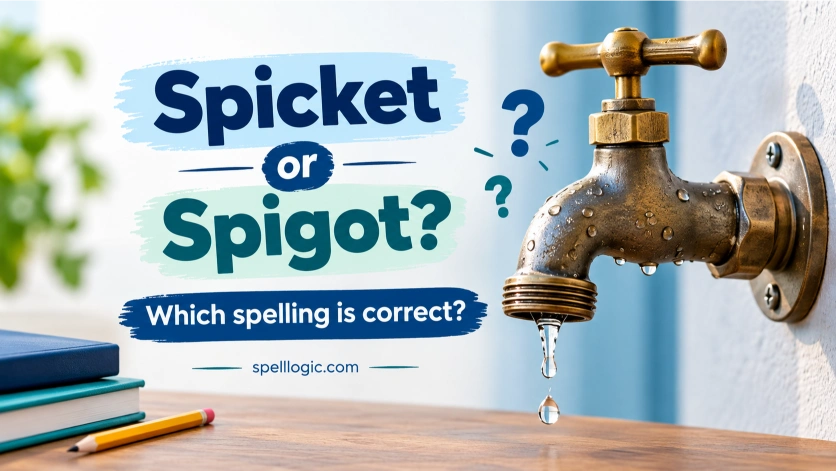
Spicket or spigot is a common spelling question, especially when English learners hear the word before seeing it in writing. Both forms are associated with a tap or valve used to control the flow of water or another liquid. The confusion happens because the two forms look and sound very similar, and spicket is also used in some regional varieties of English. However, spigot is the standard spelling used in general modern English.
Cambridge Dictionary defines a spigot as a device that controls the flow of liquid, particularly from a container or pipe. (Cambridge Dictionary) Understanding this distinction can help you write accurately in school, business, technical documents, and everyday communication.
Why “Spicket” and “Spigot” Are Confusing
The main reason spicket or spigot causes confusion is that the two forms are extremely close in appearance and pronunciation. When people hear the word in conversation, the sound can make it difficult to know whether the middle consonant should be written with c-k or g.
Similar pronunciation
The pronunciation of spigot is commonly represented as /ˈspɪɡ.ət/. The first syllable sounds like spig, while the second syllable is unstressed. (Cambridge Dictionary)
In some speech varieties, the word may sound closer to the spelling spicket. This can naturally lead speakers to use the form they think matches what they hear.
Similar spelling
Both forms begin with sp and contain similar vowel sounds. The major spelling difference is in the middle:
- spicket → contains ck
- spigot → contains g
This small difference is easy to overlook.
Context confusion
The word usually refers to a water outlet, tap, faucet, or valve. For example, you might hear someone talking about the outdoor tap used to connect a garden hose.
Because spicket or spigot can refer to essentially the same object in everyday usage, the context does not normally help you choose the spelling.
Common learner mistakes
English learners may write spicket because the k sound seems natural. Others may remember the word incorrectly after hearing it spoken.
For formal and general-purpose writing, spigot is the safest standard form.
Spicket vs Spigot Explained Simply
The easiest explanation of spicket or spigot is this:
Spicket is a regional or variant form found in some varieties of English, while spigot is the standard spelling generally preferred in modern writing.
One-line distinction
Spicket or spigot usually refers to the same type of tap or valve, but spigot is the standard spelling for general English writing.
Example sentences
- Please turn off the spigot after watering the garden.
- The plumber replaced the leaking outdoor spigot.
So, when you are unsure which spelling to use, choose spigot.
Understanding Homophones in English
What Are Homophones?
Homophones are words that have the same or very similar pronunciation but have different spellings and meanings.
For example:
- right = correct
- write = to form words with letters
These words can sound the same in many varieties of English, but their meanings and spellings are different.
Spicket or spigot is not a classic homophone pair because the forms are not normally treated as two completely separate words with unrelated meanings. Instead, the confusion is mainly connected with spelling, pronunciation, and regional usage.
Why Homophones Cause Confusion
When learners hear a word before learning its written form, they often choose a spelling based on the sounds they hear. English spelling does not always represent pronunciation in a simple one-to-one way. That is why learners can easily confuse similar forms.
For example, someone may hear a pronunciation close to “spicket” and naturally assume that spicket must be the correct spelling.
What Does “Spicket” Mean?
Definition and Core Meaning
When discussing spicket or spigot, spicket is generally encountered as a regional or variant form referring to a tap, faucet, or water outlet.
It is not the spelling you should normally choose when writing standard English for a broad audience. Some dictionaries and regional-language sources recognize the form, so calling it completely meaningless would be inaccurate. The Dictionaries of the Scots Language, for example, records spicket as a noun meaning a spigot and also as an outdoor tap. (Dictionaries of the Scots Language)
Origin and Historical Use
The history of spicket or spigot is interesting because the less common spelling is not simply a random modern typing error. Historical and dialectal forms related to spicket have existed for a long time.
The Dictionaries of the Scots Language identifies spicket as an alteration of English spigot and records historical examples going back centuries. (Dictionaries of the Scots Language)
Therefore, the form has a real history in English and Scots usage, even though spigot is the standard choice in general modern writing.
Modern Usage and Synonyms
Today, spicket may appear in:
- Regional speech
- Informal writing
- Dialectal English
- Personal or local usage
- Historical or dialect discussions
Possible synonyms include:
- faucet
- tap
- valve
- water outlet
- outdoor tap
Example Sentences
Because spicket can be recognized as a regional form, you may encounter sentences such as:
- “The old spicket needs to be repaired.”
- “Turn the spicket off before connecting the hose.”
For standard writing, however, replace spicket with spigot.
What Does “Spigot” Mean?
Definition and Core Meaning
When comparing spicket or spigot, spigot is the standard word used for a device that controls the flow of liquid. Cambridge Dictionary defines it as a device used to control liquid flow from something such as a barrel, and it also gives spigot as a term for a tap, especially outside a building in American English. (Cambridge Dictionary)
In everyday American English, people commonly use spigot for an outdoor water tap where a garden hose can be attached.
Origin and Historical Context
The word spigot has a long history in English. Dictionary.com dates the English word to the Middle English period and traces it through Old French and Old Provençal, with a connection to a Latin word meaning “ear of grain.” (Dictionary.com)
Historically, a spigot could refer to a plug or device used to control liquid from a cask or barrel. Over time, the word developed broader meanings connected with taps, valves, and controlled liquid flow.
Modern Usage and Synonyms
In modern English, spigot can refer to:
- An outdoor water tap
- A faucet or valve
- A device controlling liquid flow
- A plug or fitting associated with a pipe
- A figurative source of something that can be turned on or off
Cambridge also records figurative uses such as a “money spigot,” where the word describes a controlled source or flow of something other than liquid. (Cambridge Dictionary)
Common synonyms include:
- faucet
- tap
- valve
- outlet
- water tap
Example Sentences
- Please close the spigot when you finish watering the plants.
- The garden hose is connected to the outdoor spigot.
- The barrel has a small spigot for releasing the liquid.
- The plumber repaired the leaking spigot.
Spicket vs Spigot: Key Differences at a Glance
| Word | Part of Speech | Meaning | Example Context |
|---|---|---|---|
| Spicket | Noun | Regional or variant form referring to a tap or spigot | “The old spicket is leaking.” |
| Spigot | Noun | A tap, valve, or device controlling liquid flow | “Turn off the spigot.” |
The key point in spicket or spigot is that the two forms can refer to the same object, but their status in standard writing is different. Spigot is the form most appropriate for general, professional, academic, and international English.
How to Remember the Difference Between Spicket and Spigot
Remembering spicket or spigot becomes easier when you connect the standard spelling with the word big.
Easy memory tricks
Think:
spigot → big → i
The word spigot contains the letters i-g-o, including the g that you need to remember.
Another trick is:
A spigot gives a flow.
Both spigot and gives contain the letter g. This is not an etymological rule, but it can be a useful memory association.
Association techniques
Picture an outdoor water tap with a garden hose attached to it. Then write:
garden → water → spigot
This creates a mental connection between the object and its standard spelling.
One memorable example
Turn the spigot off before the garden becomes a swimming pool.
Whenever you imagine that sentence, remember that the standard spelling is spigot, not spicket.
Common Mistakes and Confusions
The most common problem with spicket or spigot is using the less standard spelling in formal writing.
Wrong example
✘ Please turn off the spicket before leaving.
Correct version
✔ Please turn off the spigot before leaving.
Explanation
Although spicket is recognized in some regional and historical usage, spigot is the standard form that readers are most likely to expect.
Another common mistake
✘ The garden hose is attached to the water spicket.
✔ The garden hose is attached to the water spigot.
The meaning is clear in both sentences, but the second sentence uses the standard spelling.
A regional-use point
It is also important not to assume that every person who says spicket is simply making a spelling mistake. Regional varieties of English can preserve words or pronunciations that are less common in standard written English. The Dictionaries of the Scots Language documents spicket as a regional word, while other references describe it as a regional or variant form. (Dictionaries of the Scots Language)
Examples Section: Correct and Incorrect Usage
Here are practical examples to make spicket or spigot easier to understand.
Example 1
✔ Correct: Turn off the spigot when you finish washing the car.
✘ Incorrect for standard writing: Turn off the spicket when you finish washing the car.
Why? The standard spelling is spigot.
Example 2
✔ Correct: The outdoor spigot is leaking.
✘ Incorrect for standard writing: The outdoor spicket is leaking.
Why? The second spelling may be understood regionally, but spigot is the preferred general form.
Example 3
✔ Correct: We need to connect the hose to the spigot.
✘ Incorrect for standard writing: We need to connect the hose to the spicket.
Why? Use spigot when writing for a broad audience.
Example 4
✔ Correct: The plumber replaced the broken spigot.
✘ Incorrect for standard writing: The plumber replaced the broken spicket.
Why? Spigot is the conventional spelling in standard English.
Example 5
✔ Correct: Water was coming out of the outdoor spigot.
✘ Incorrect for standard writing: Water was coming out of the outdoor spicket.
The meaning is understandable in the second sentence, but the spelling is not the preferred standard form.
Self Assessment: Test Your Knowledge
Complete each sentence with spicket or spigot.
- Please turn off the garden ______ before you leave.
- The plumber repaired the leaking outdoor ______.
- We connected the hose to the water ______.
- Which spelling should you normally use in formal English: spicket or spigot?
Self Assessment Answers
- spigot
- spigot
- spigot
- spigot
If you answered all four correctly, you have understood the main distinction between spicket or spigot.
FAQs
1. Is spicket or spigot correct?
For standard modern English, spigot is the preferred spelling. Spicket is found as a regional or variant form in some varieties of English. (Dictionaries of the Scots Language)
2. What does spigot mean?
A spigot is a tap, valve, or similar device used to control the flow of liquid. It is commonly used for an outdoor water tap. (Cambridge Dictionary)
3. Is spicket a real word?
Yes, spicket has historical and regional usage. The Dictionaries of the Scots Language records it as a noun meaning a spigot or outdoor tap. However, it is not the preferred spelling for general standard English. (Dictionaries of the Scots Language)
4. Is spigot the same as a faucet?
They can refer to similar devices, but usage varies by region and context. In American English, spigot often refers specifically to an outdoor tap, while faucet is commonly used for indoor water fixtures. Cambridge lists spigot as a synonym of faucet. (Cambridge Dictionary)
5. How do you spell the outdoor water tap?
The standard spelling is spigot. For example: “Attach the hose to the outdoor spigot.”
6. Why do some people say spicket?
Regional pronunciation and historical language variation help explain why spicket continues to appear in some communities. The form is documented in regional English and Scots usage. (Dictionaries of the Scots Language)
7. Should I use spicket in formal writing?
It is better to use spigot in formal, academic, professional, technical, and general-purpose writing because it is the standard form most readers expect.
Final Conclusion: Using “Spicket” and “Spigot” Correctly
Understanding spicket or spigot is a useful small step toward more accurate English spelling. Both forms are connected with a tap, valve, or device that controls liquid flow, but they do not have exactly the same status in modern standard English. Spigot is the standard spelling and is the safest choice for school assignments, professional documents, websites, product descriptions, and other formal writing. Spicket, meanwhile, has genuine historical and regional usage and may still be heard or written in certain communities. (Dictionaries of the Scots Language)
The easiest way to remember the standard form is to connect spigot with an outdoor water tap. Imagine a garden hose attached to a spigot, and remember the g in the middle. When you see or hear the alternative form, recognize that it may reflect regional usage rather than assuming that the speaker does not know English.
For everyday communication, knowing this distinction helps you choose the spelling that will be understood and accepted most widely. Whenever you are writing for a broad audience, choose spigot. With a little practice and a simple memory association, this commonly confused word pair becomes much easier to handle. Keep learning these small differences, because mastering them can make your English clearer, more natural, and more confident.