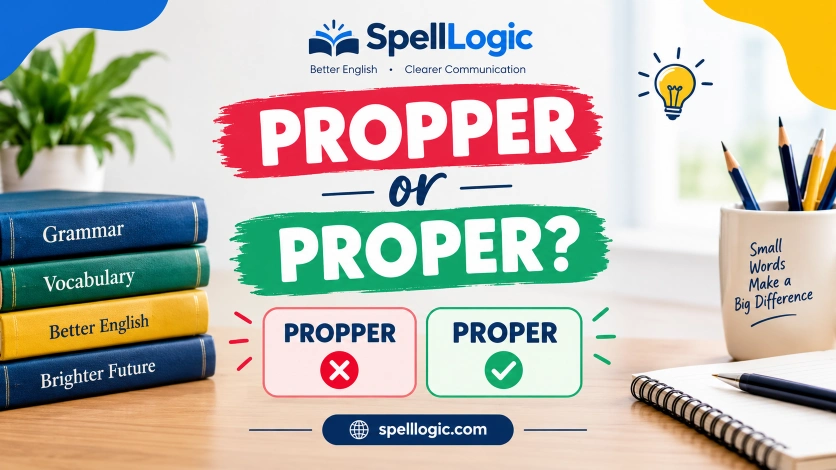
English spelling can be confusing, especially when a word sounds familiar but its written form is uncertain. Propper or proper is a common spelling question because both forms look similar, and the extra p can seem natural to learners. However, only one of these spellings is correct in standard English.
Learning the difference is useful because the correct spelling helps you write clearly and professionally in emails, schoolwork, articles, applications, and everyday communication. In this guide, you will learn the meaning of each form, understand why the spelling mistake happens, see practical examples, and discover simple memory tricks that make the correct spelling easier to remember.
Why “Propper” and “Proper” Are Confusing
The question of propper or proper usually comes from a simple spelling mistake. English learners may hear the word pronounced clearly but are unsure whether it needs one p or two.
Similar pronunciation
The two forms are often pronounced as if they were the same word. Because pronunciation does not clearly tell you whether there is one p or two in the spelling, learners may choose the wrong form when writing.
Similar spelling
The forms look almost identical. The only important difference is the additional p in the incorrect form. When a learner knows the sound and meaning but has not memorized the spelling, adding a second consonant can feel reasonable.
Context confusion
The word is used in many contexts. You might talk about proper behavior, proper grammar, proper clothing, proper preparation, or a proper explanation. Seeing the word frequently does not always prevent a spelling error.
Common learner mistakes
A common mistake is to write propper because the writer assumes that the consonant should be doubled. This can happen especially when learners compare the word with English words that do use doubled consonants.
Propper vs Proper Explained Simply
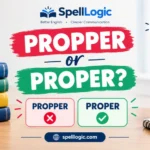
When comparing propper or proper, the answer is straightforward: proper is the standard English spelling, while propper is generally a misspelling.
One-line distinction: Proper is the correct English word; propper is not the standard spelling.
Two examples make the difference clearer:
- We need to use the proper equipment for the job.
- Please follow the proper procedure when completing the form.
So, in simple terms, propper means no standard English word in ordinary usage, while proper means suitable, correct, appropriate, or acceptable according to a particular standard or situation.
Understanding Homophones in English
The issue of propper or proper is sometimes incorrectly described as a homophone problem. In reality, the main issue is spelling because the two forms are not two standard English words with separate meanings.
What Are Homophones?
Homophones are words that have the same or very similar pronunciation but have different meanings and spellings.
For example:
- right = correct or opposite of left
- write = to form words with letters
They sound alike in many varieties of English, but their meanings and spellings are different.
Why Homophones Cause Confusion
Homophones can make learners depend too much on pronunciation when choosing a spelling. For example, hearing right does not tell you whether the speaker means right or write. With propper or proper, however, the situation is different because the extra p does not create a standard alternative word with another meaning.
What Does “Propper” Mean?
Definition and Core Meaning
In standard modern English, propper is not the normal spelling of the word people usually intend. When someone writes it, they generally mean proper.
Therefore, if you are asking whether propper or proper should be used in ordinary English writing, choose proper.
The incorrect form can appear in usernames, names, historical documents, or other special contexts, but these uses do not make it the standard spelling of the common adjective.
Origin and Historical Use
The form propper is not the standard modern spelling of the common English adjective meaning suitable or correct. English spelling has changed over centuries, and unusual forms may occasionally appear in historical or specialized sources. However, modern learners should not treat such rare appearances as evidence that the spelling is correct for everyday English.
Modern Usage and Synonyms
For normal communication, replace the misspelling with proper. Depending on the sentence, useful alternatives can include:
- correct
- suitable
- appropriate
- suitable
- acceptable
- fitting
- respectable
For example, instead of writing “Use propper grammar,” write “Use proper grammar.”
Example sentences
The following sentences demonstrate how the incorrect form should be avoided:
- ✘ Please use propper punctuation.
- ✘ He did not receive propper training.
- ✘ We need propper instructions.
- ✘ She wore propper safety equipment.
In each case, the intended word is proper.
What Does “Proper” Mean?
Definition and Core Meaning
Proper is a standard English adjective with several related meanings. It can describe something that is correct, suitable, appropriate, acceptable, or done according to an expected standard.
For example:
- You should wear proper safety equipment.
- We need a proper explanation.
- She gave the problem proper attention.
- The machine needs proper maintenance.
The exact meaning depends on context, but the general idea is that something meets an expected standard or is appropriate for a situation.
Origin and Historical Context
The adjective proper has a long history in English. It developed through Middle English from Anglo-French and ultimately from Latin roots associated with what belongs specifically or suitably to something. Over time, its meanings expanded to include ideas such as suitable, correct, appropriate, and socially acceptable.
This historical development helps explain why the word is now used in many different situations.
Modern Usage and Synonyms
Today, proper is common in both spoken and written English. It can describe behavior, methods, preparation, language, equipment, clothing, procedures, or manners.
Depending on context, synonyms include:
- correct
- appropriate
- suitable
- fitting
- suitable
- acceptable
- appropriate
- orderly
Example sentences
- Please follow the proper instructions.
- He finally received proper training.
- We need to find the proper solution.
- The students were taught proper pronunciation.
- Make sure the door is closed properly before leaving.
Notice that proper can also form the adverb properly, meaning in a correct or suitable way.
Propper vs Proper: Key Differences at a Glance
| Word | Part of Speech | Meaning | Example Context |
|---|---|---|---|
| Propper | Not standard in ordinary usage | Usually a misspelling of the intended word | Avoid in normal English writing |
| Proper | Adjective | Correct, suitable, appropriate, or acceptable | “Use the proper method.” |
The most important point in propper or proper is that proper is the standard spelling you should use when you mean “correct,” “suitable,” or “appropriate.”
How to Remember the Difference Between Propper and Proper
A few simple techniques can make the correct spelling easier to remember.
Easy memory tricks
Remember this simple rule:
Proper has one P in the middle.
Break the word visually into:
P + ROPER
The word begins with P, followed by ROPER. You do not need to insert another p.
Association technique
Associate proper with words such as:
- proper grammar
- proper behavior
- proper clothing
- proper procedure
- proper preparation
Seeing the correct spelling repeatedly in familiar phrases strengthens your spelling memory.
One memorable example
Remember:
Use the proper word with proper spelling.
If you are ever unsure about propper or proper, think about the common phrase proper English. It uses only one p after the initial letter.
Common Mistakes and Confusions
Wrong example 1
✘ We need propper documentation.
Correct: We need proper documentation.
Explanation: The adjective describing the documentation is spelled proper.
Wrong example 2
✘ Please give me a propper explanation.
Correct: Please give me a proper explanation.
Explanation: The meaning is “clear, suitable, or satisfactory,” so the standard spelling is proper.
Wrong example 3
✘ He needs propper training before starting the job.
Correct: He needs proper training before starting the job.
Explanation: Training that meets the necessary standard is described as proper.
Wrong example 4
✘ She did not receive propper instructions.
Correct: She did not receive proper instructions.
Explanation: Again, the extra p is unnecessary.
Examples Section: Correct and Incorrect Usage
Here are several examples to reinforce the spelling difference.
✔ Correct: Please use the proper format for your application.
✘ Incorrect: Please use the propper format for your application.
✔ Correct: The equipment must be handled with proper care.
✘ Incorrect: The equipment must be handled with propper care.
✔ Correct: Students should learn proper grammar.
✘ Incorrect: Students should learn propper grammar.
✔ Correct: We followed the proper procedure.
✘ Incorrect: We followed the propper procedure.
✔ Correct: Make sure you have the proper tools.
✘ Incorrect: Make sure you have the propper tools.
✔ Correct: He gave a proper answer to the question.
✘ Incorrect: He gave a propper answer to the question.
These examples show that the choice is consistent. In standard English, the correct spelling is proper.
Self Assessment: Test Your Knowledge
Fill in each blank with the correct form.
- Please use the ______ procedure when operating the machine.
- The students need ______ guidance before beginning the project.
- She was not given ______ instructions for the task.
- Wearing ______ safety equipment is important at work.
Self Assessment Answers
- proper
- proper
- proper
- proper
If you answered all four correctly, you understand the basic spelling rule. Whenever you are deciding between propper or proper, choose proper for standard English.
FAQs
Is “propper” a correct English word?
In ordinary modern English, propper is not the standard spelling of the adjective people usually intend. The correct spelling is proper.
Is “proper” the correct spelling?
Yes. Proper is the standard spelling when you mean correct, suitable, appropriate, or acceptable.
Why do people write “propper”?
People may add the second p because the pronunciation does not reveal the spelling and because English contains many words with doubled consonants. It is usually simply a spelling error.
Are “propper” and “proper” homophones?
Not in the usual grammatical sense. Proper is the standard English word, while propper is generally a misspelling rather than a separate standard word with a different meaning.
What does “proper” mean?
Proper can mean correct, suitable, appropriate, acceptable, or according to an expected standard. Its exact meaning depends on the context.
Can “proper” be used as a noun?
Usually, proper is an adjective. However, it can occur in special expressions and grammatical contexts, such as the proper, where it can refer to the central or main part of something. In everyday learner writing, its most common role is as an adjective.
How can I remember the spelling?
Remember that proper has only one p after the first letter. Think of familiar phrases such as proper English, proper grammar, and proper procedure.
Final Conclusion: Using “Propper” and “Proper” Correctly
Understanding propper or proper is useful because this small spelling difference can affect the clarity and correctness of your English writing. The main rule is simple: proper is the standard English spelling. It is an adjective that can mean correct, suitable, appropriate, acceptable, or suitable for a particular situation. The form propper is generally a misspelling when the intended word is proper.
The easiest way to remember the difference is to focus on the spelling of proper itself. It begins with p and contains only one additional p in the word. You can reinforce this memory by using familiar expressions such as proper grammar, proper preparation, proper behavior, and proper procedure. When you see the word in books, websites, school materials, or professional documents, pay attention to its spelling.
If you have ever written the wrong form, do not worry. Spelling mistakes are a normal part of learning English. With regular reading, writing practice, and attention to common word patterns, the correct form becomes automatic. Keep choosing proper, and your English writing will become clearer and more accurate with practice.