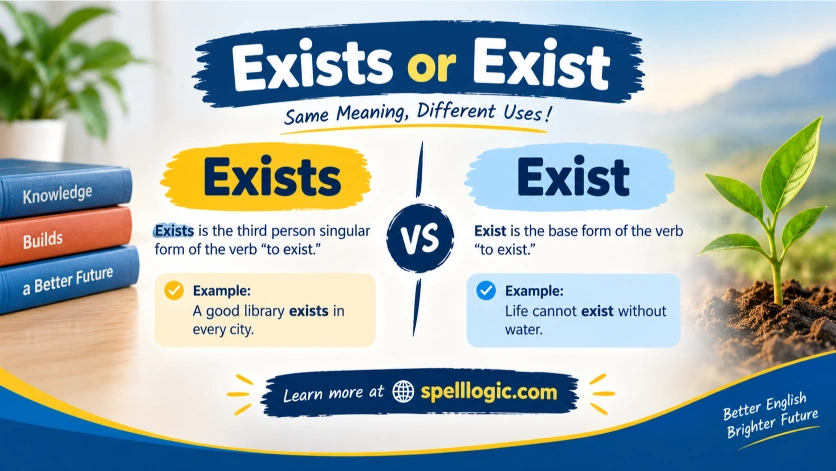
English learners often wonder whether to use exists or exist when talking about something that is real, present, or available. The confusion happens because both forms come from the same verb, exist, but they are used with different subjects. Choosing the correct form depends mainly on whether the subject is singular or plural and, in some cases, whether the sentence uses a helping verb.
Understanding exists or exist is important because subject–verb agreement affects both grammar and clarity. Once you understand this simple rule, choosing between the two becomes much easier. This guide explains the difference with clear rules, examples, common mistakes, and a short practice test.
Why “exists or exist” Are Confusing
The main reason exists or exist causes confusion is that both forms belong to the verb exist. Their meanings are closely connected, but their grammatical forms are different.
Here are the main reasons learners mix them up:
- Similar pronunciation: The two forms sound very similar because they come from the same verb. However, the ending is different, and the final sound in exists is pronounced as part of an extra syllable.
- Similar spelling: The spelling of exists is simply exist with -s added. This small difference can be easy to overlook.
- Context confusion: Learners may focus on the meaning of the sentence rather than the subject. The subject determines which verb form is needed.
- Common learner mistakes: A frequent error is adding -s after plural subjects or forgetting -s after singular third-person subjects.
For example, “The problem exists” is correct because the problem is singular. On the other hand, “Problems exist” is correct because problems is plural.
“exists or exist” Explained Simply
The basic rule for exists or exist is straightforward:
- Exists is generally used with a singular third-person subject in the simple present.
- Exist is used with plural subjects, the pronouns I and you, and after modal verbs or certain auxiliary constructions.
One-line distinction: Exists goes with a singular third-person subject, while exist is used with plural subjects and with forms that require the base verb.
For example:
- “A solution exists for this problem.”
- “Several solutions exist for this problem.”
So, the choice between exists or exist depends on grammar rather than on a difference in basic meaning.
Understanding Homophones in English
What Are Homophones?
Homophones are words that have the same pronunciation but different meanings, spellings, or grammatical functions. For example, flower and flour sound alike but have different meanings.
It is important to note that exists and exist are not true homophones. They are different grammatical forms of the same verb and do not have exactly the same pronunciation.
Why Homophones Cause Confusion
Homophones can confuse learners because listening alone may not reveal which spelling is correct. For instance, flower and flour require context to determine the intended word.
With exists or exist, however, the issue is mainly verb agreement, not homophony. Learners need to look at the subject and the structure of the sentence.
What Does “Exists” Mean?
Definition and Core Meaning
Exists is the third-person singular present form of the verb exist. It means that something is real, present, available, or continues to be in a particular state.
In simple terms, exists means “is real” or “is present” when the subject is singular and third person.
For example:
- “A solution exists.”
- “The company exists today.”
- “A similar tradition exists in many cultures.”
- “The possibility still exists.”
The form exists is normally used with singular subjects such as he, she, it, or a singular noun.
Origin and Historical Use
The verb exist comes through French from Latin existere or exsistere, meaning “to stand forth,” “appear,” or “come into being.” Over time, English developed exist as a verb describing the state of being real or having actual presence.
The -s in exists is not a separate word. It is the grammatical ending used with a third-person singular subject in the simple present.
Modern Usage and Synonyms
Today, exists is common in everyday English, academic writing, science, philosophy, business, and technology.
Depending on the context, possible synonyms include:
- is real
- is present
- remains
- occurs
- survives
- lives
- is available
These synonyms are not always interchangeable, so context still matters.
Examples
- “The evidence exists, but it is difficult to find.”
- “A serious problem exists within the system.”
- “The museum exists to preserve local history.”
- “No simple answer exists.”
- “A strong connection exists between the two ideas.”
Remember that exists normally requires a singular third-person subject in a simple present sentence.
What Does “Exist” Mean?
Definition and Core Meaning
Exist is the base form of the verb. It means to be real, to have actual presence, or to continue to live or be present.
The form exist is used with plural subjects and with I and you in the simple present. It is also used after modal verbs such as can, may, might, should, and will.
Examples include:
- “Many possibilities exist.”
- “I believe such opportunities exist.”
- “You cannot prove that these creatures exist.”
- “Several alternatives exist.”
The important point when choosing between exists or exist is to identify the subject and check whether another verb or modal requires the base form.
Origin and Historical Context
Like exists, the word exist ultimately traces back to Latin existere/exsistere. English adopted the word through French, and its modern meaning developed around being real, having being, or being present.
Because exist is the base form, it also appears in many grammatical constructions where an additional -s is not allowed.
Modern Usage and Synonyms
Exist is widely used in ordinary and formal English. Common related expressions include:
- exist in nature
- exist today
- exist independently
- exist in theory
- exist in practice
- exist alongside something
Depending on the context, related words may include:
- be
- live
- remain
- occur
- survive
- be present
Examples
- “Many different explanations exist.”
- “Do ghosts exist?”
- “Several types of renewable energy exist.”
- “These rules exist for a reason.”
- “Better options may exist.”
When deciding exists or exist, remember that a plural subject normally takes exist, while a singular third-person subject takes exists in the simple present.
“exists or exist”: Key Differences at a Glance
| Word | Part of Speech | Meaning | Example Context |
|---|---|---|---|
| Exists | Verb, third-person singular present | Is real, present, or available | “A solution exists.” |
| Exist | Base verb / present form | To be real, present, or available | “Several solutions exist.” |
The most important distinction is grammatical. Both forms describe the same basic idea of being real or present, but the subject or sentence structure determines which form is correct.
For example, compare these sentences:
- “The problem exists.” — singular subject
- “The problems exist.” — plural subject
- “The problem may exist.” — modal verb requires the base form
- “Do these problems exist?” — auxiliary do requires the base form
This is the key to understanding exists or exist without memorizing dozens of separate rules.
How to Remember the Difference Between “exists or exist”
Learning exists or exist becomes easier when you connect the forms to a simple grammar pattern.
Easy Memory Tricks
1. Singular = add -s
Think:
One thing → exists
Example: “A problem exists.”
2. Plural = no -s
Think:
More than one → exist
Example: “Problems exist.”
3. Helping verb = base form
After words such as can, may, might, will, should, do, and does, use exist, not exists.
Examples:
- “A solution may exist.”
- “Does a solution exist?”
- “Several solutions can exist.”
Association Techniques
You can remember the difference by connecting the -s in exists with the -s commonly found on singular third-person verbs:
- He works.
- She studies.
- It exists.
By contrast:
- They work.
- We study.
- They exist.
One Memorable Example
Remember this pair:
“A reason exists, but many reasons exist.”
The first sentence has one reason, so exists is correct. The second has several reasons, so exist is correct.
Common Mistakes and Confusions
Many learners make errors because they choose the verb based on the noun closest to it rather than the actual subject.
Wrong Example 1
✘ “Many reasons exists for this problem.”
Correct Version
✔ “Many reasons exist for this problem.”
Explanation: Reasons is plural, so the verb does not take -s.
Wrong Example 2
✘ “A possible explanation exist.”
Correct Version
✔ “A possible explanation exists.”
Explanation: Explanation is a singular third-person subject, so the simple present verb takes -s.
Wrong Example 3
✘ “Does a solution exists?”
Correct Version
✔ “Does a solution exist?”
Explanation: After the auxiliary verb does, use the base form of the main verb.
Wrong Example 4
✘ “Several options may exists.”
Correct Version
✔ “Several options may exist.”
Explanation: A modal verb such as may is followed by the base form.
Understanding these patterns will make choosing between exists or exist much easier.
Examples Section: Correct and Incorrect Usage
Example 1
✔ Correct: “A better method exists.”
✘ Incorrect: “A better method exist.”
Why? Method is singular, so the simple present form needs -s.
Example 2
✔ Correct: “Better methods exist.”
✘ Incorrect: “Better methods exists.”
Why? Methods is plural, so use the base form.
Example 3
✔ Correct: “Does this opportunity exist?”
✘ Incorrect: “Does this opportunity exists?”
Why? The auxiliary does already carries the third-person singular marking, so the main verb stays in its base form.
Example 4
✔ Correct: “Several opportunities can exist at the same time.”
✘ Incorrect: “Several opportunities can exists at the same time.”
Why? The modal can must be followed by the base form.
Example 5
✔ Correct: “A difference exists between the two methods.”
✘ Incorrect: “A difference exist between the two methods.”
Why? Difference is singular.
Example 6
✔ Correct: “Important differences exist between the two methods.”
✘ Incorrect: “Important differences exists between the two methods.”
Why? Differences is plural.
These examples show that exists or exist is primarily a question of subject–verb agreement and sentence structure.
Self Assessment: Test Your Knowledge
Fill in each blank with exists or exist.
- A simple solution ______ for this problem.
- Several possible solutions ______ for this problem.
- Does a connection ______ between these two ideas?
- Many opportunities may ______ in the future.
Self Assessment Answers
- exists — “A simple solution exists for this problem.”
- exist — “Several possible solutions exist for this problem.”
- exist — “Does a connection exist between these two ideas?”
- exist — “Many opportunities may exist in the future.”
The easiest way to check your answer is to identify the subject and look for an auxiliary or modal verb. This quick habit can prevent most errors involving exists or exist.
FAQs
1. What is the main difference between “exists” and “exist”?
Exists is normally used with a singular third-person subject in the simple present. Exist is used with plural subjects, I, you, and after auxiliaries or modal verbs.
2. Is “exists” singular or plural?
Exists is the third-person singular present form of exist. For example, “The possibility exists.”
3. Is “exist” grammatically correct with a singular subject?
Yes, in certain structures. For example, “Does a problem exist?” and “A problem may exist.” After does or a modal verb, use exist.
4. Should I say “Does it exist” or “Does it exists”?
The correct form is “Does it exist?” The auxiliary does is followed by the base verb.
5. Should I say “Many problems exist” or “Many problems exists”?
The correct sentence is “Many problems exist.” The subject problems is plural.
6. Can “exist” be used after “can”?
Yes. Say “can exist,” not “can exists.” Modal verbs such as can, could, may, might, and will are followed by the base verb.
7. Are “exists” and “exist” homophones?
No. They are different forms of the same verb and are pronounced differently. The main issue between them is grammatical agreement rather than homophony.
Final Conclusion: Using “exists or exist” Correctly
Understanding exists or exist is much easier when you focus on one central idea: the subject and the sentence structure determine the correct verb form. Use exists with a singular third-person subject in the simple present, as in “The problem exists.” Use exist with plural subjects, I, and you, as in “Several problems exist.” Also remember that auxiliaries and modal verbs require the base form: “Does it exist?” and “It may exist.”
A useful memory trick is simple: one thing usually takes the -s form, while multiple things take the base form. However, do not add -s after does, can, may, might, or similar helping verbs. For example, “Does a solution exist?” is correct, not “Does a solution exists?”
With regular practice, the choice between exists or exist will quickly become automatic. When you are unsure, pause and identify the subject first. Then check whether a helping or modal verb comes before the main verb. These two steps will help you write clearer, more accurate English and avoid one of the most common subject–verb agreement mistakes. Keep practicing with real sentences, and your grammar confidence will continue to grow.