English learners sometimes find a and b or c confusing because the words and and or can connect several ideas in different ways. The difficulty becomes greater when a sentence does not clearly show which words belong together. For example, “You can choose A and B or C” may be understood in more than one way.
The intended meaning could be “choose both A and B, or choose C,” or it could mean “choose A, plus either B or C.” Understanding a and b or c is important because a small change in grouping, punctuation, or wording can change the meaning of an entire sentence. This guide explains the pattern in simple English.
Why “A and B” and “B or C” Are Confusing
The expression a and b or c is confusing because it contains two different coordinating conjunctions: and and or. These conjunctions perform different jobs.
Similar Pronunciation
The individual words and and or are short and common, so learners may focus on pronunciation rather than meaning. In fast speech, and is often reduced to a weak sound. This can make the relationship between items harder to notice.
However, pronunciation is not the main problem here. The real issue is logical grouping.
Similar Spelling
There is no true spelling similarity between and and or. They are simply short, frequently used conjunctions. Because both can connect words, phrases, or clauses, learners sometimes treat them as interchangeable.
They are not interchangeable.
- And normally joins things that are included together.
- Or normally presents alternatives or choices.
Context Confusion
Context is especially important with a and b or c.
Consider this sentence:
You need a passport and a visa or an identity card.
A reader might understand it as:
- (passport and visa) or identity card, meaning the first choice requires two documents, while the second requires one; or
- passport and (visa or identity card), meaning a passport is required together with one of two additional documents.
Both readings are possible without more context.
Common Learner Mistakes
Learners often make these mistakes:
- assuming and always comes before or in meaning;
- assuming the reader will automatically understand the intended grouping;
- using a long sentence when a clearer sentence would be better;
- failing to use parentheses in technical or mathematical writing;
- thinking punctuation alone always solves ambiguity;
- changing or to and without considering how the meaning changes.
The key lesson is that a and b or c needs context when the intended grouping is not obvious.
A and B or C Explained Simply
The simplest way to understand a and b or c is to look at the two possible groupings.
Simple explanation:
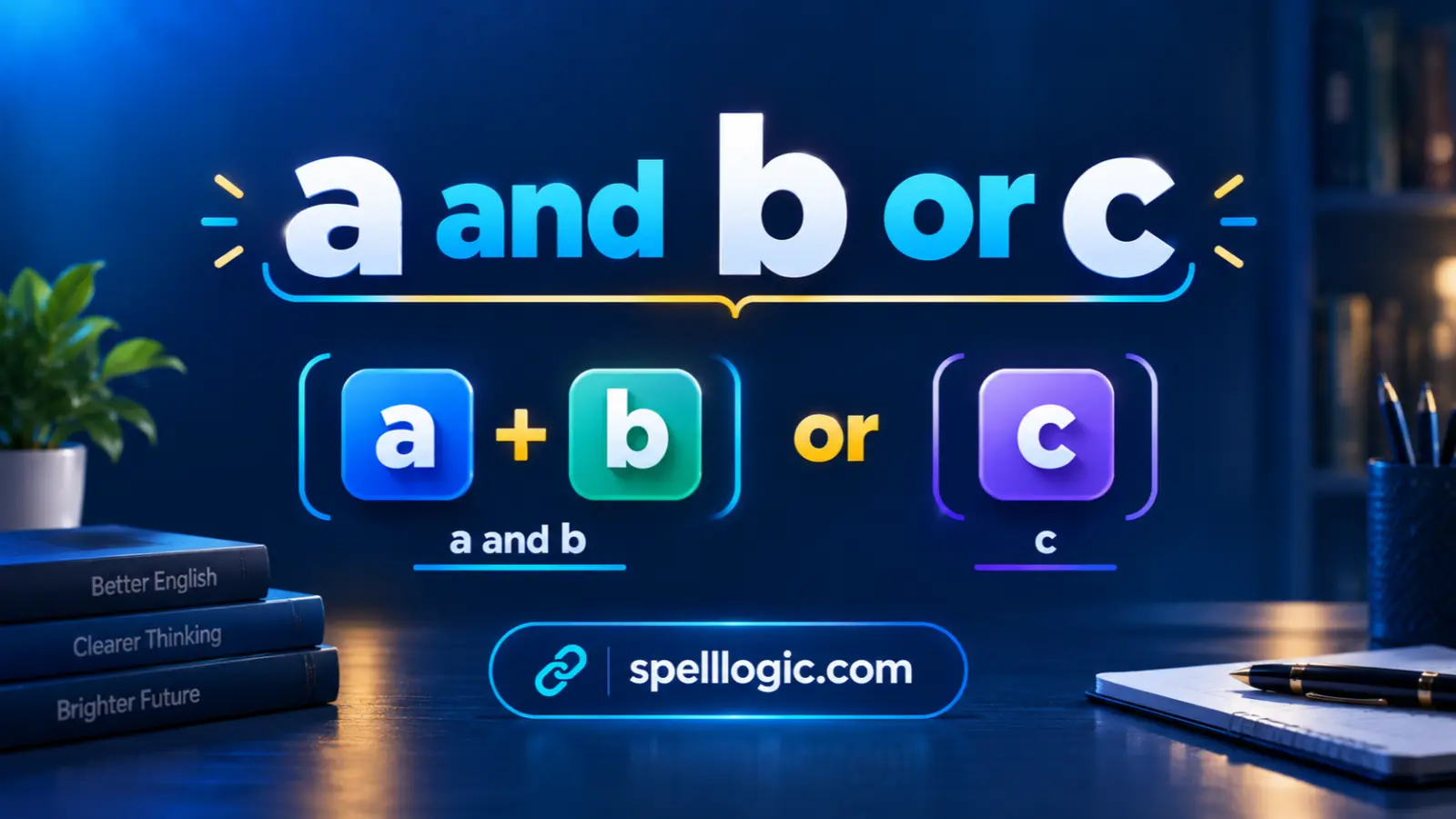
One interpretation is (A and B) or C. Another is A and (B or C).
One-line distinction:
And combines items, while or normally presents alternatives.
For example:
- You can choose tea and coffee or juice.
- You need a pen and either a pencil or a marker.
In the first sentence, the grouping may be unclear. In the second, the word either makes the intended alternatives easier to understand.
A useful pattern is:
A and B means A together with B, while B or C means a choice between B and C.
Therefore, when a sentence contains a and b or c, ask yourself: Which items are supposed to stay together?
Understanding Homophones in English
What Are Homophones?
Homophones are words that have the same pronunciation, or nearly the same pronunciation, but have different meanings or spellings.
For example:
- right = correct
- write = put words on paper
They sound alike in many varieties of English, but they have different meanings.
The conjunctions in a and b or c are not homophones. They are simply words that can create different relationships between ideas.
Why Homophones Cause Confusion
Homophones can confuse learners because listening alone may not reveal which word a speaker means.
For instance, right and write can sound identical, so the surrounding context helps identify the intended word.
With a and b or c, the problem is different. The words are distinguishable in speech, but the relationship between the connected items may be unclear.
What Does “A and B” Mean?
Definition and Core Meaning
A and B represents a combination of two items, ideas, people, actions, or conditions.
The conjunction and generally indicates that both connected elements are included.
For example:
Sarah bought apples and oranges.
This normally tells us that Sarah bought both kinds of fruit.
Similarly:
Please bring your passport and ticket.
The sentence normally asks the person to bring both items.
When discussing a and b or c, the A and B part can be treated as one combined group if the context supports that reading.
Origin and Historical Use
The conjunction and is one of the oldest and most frequently used connecting words in English. It has roots in Old English, where related forms were used to connect words and clauses.
Over time, its form changed into the modern and. Its central function has remained remarkably stable: it connects elements that are presented together.
Modern Usage and Synonyms
In modern English, and can connect:
- nouns: tea and coffee
- adjectives: large and comfortable
- verbs: read and write
- phrases: at home and at work
- clauses: She arrived and sat down
Depending on context, related expressions can include:
- together with
- along with
- as well as
- plus
These alternatives do not always work in exactly the same grammatical position, so and remains the most common choice.
Example Sentences
Tom and Maria attended the meeting.
The package contains a book and a notebook.
We need time and patience.
She washed the dishes and cleaned the kitchen.
In each case, and connects elements that belong together.
What Does “B or C” Mean?
Definition and Core Meaning
B or C normally presents alternatives. It tells the reader that one possibility is B and another possibility is C.
For example:
Would you like tea or coffee?
The speaker presents two choices.
Another example is:
You can call me or send me an email.
Here, the two actions are presented as alternatives.
In everyday English, or can sometimes be inclusive, meaning that both options may be possible. In other contexts, especially instructions and formal logic, the intended meaning may need to be stated explicitly.
Origin and Historical Context
The conjunction or also has a long history in English. It developed from earlier Germanic forms and has been used to express alternatives for centuries.
Its basic modern function remains the same: it connects alternatives or possibilities.
Modern Usage and Synonyms
Today, or is commonly used to show:
- alternatives;
- choices;
- possibilities;
- corrections;
- approximate alternatives.
Related expressions include:
- alternatively
- either
- otherwise
- instead
However, these words cannot simply replace or in every sentence.
Example Sentences
You can take the bus or the train.
We can meet today or tomorrow.
Is the answer A or B?
Bring a notebook or a tablet.
These examples show how or presents alternatives.
A and B or C: Key Differences at a Glance
The important point is that a and b or c does not always have one fixed interpretation. Its meaning depends on grouping and context.
| Word | Part of Speech | Meaning | Example Context |
|---|---|---|---|
| A | Variable/item | First item or idea | Choose A |
| B | Variable/item | Second item or idea | Choose B |
| C | Variable/item | Third item or idea | Choose C |
| and | Coordinating conjunction | Combines elements | A and B |
| or | Coordinating conjunction | Presents alternatives | B or C |
| (A and B) or C | Combined structure | A+B together, or C | Choose both A and B, or C |
| A and (B or C) | Combined structure | A together with one alternative | Choose A plus B or C |
This table shows why a and b or c can become ambiguous. The letters A, B, and C are placeholders, so the actual meaning depends on what each letter represents.
How to Remember the Difference Between A and B and B or C
A simple memory trick is:
AND = add together.
OR = offer a choice.
Think of and as a joining word. If you say:
bread and butter
you normally mean the two things together.
Now think of or as a choice word:
tea or coffee
You are normally presenting alternatives.
Association Techniques
Use these mental associations:
- AND → together
- OR → alternative
- AND → combine
- OR → choose
When you see a and b or c, do not immediately decide how the words group. First identify the intended relationship.
Ask:
- Are A and B supposed to be together?
- Is C an alternative to the pair?
- Is A required together with either B or C?
- Would parentheses or clearer wording remove the ambiguity?
One Memorable Example
Imagine a shopping list:
Buy apples and bananas or oranges.
Ask what the writer means.
If the intended meaning is (apples and bananas) or oranges, the buyer can choose the pair or the single item.
If the intended meaning is apples and (bananas or oranges), apples are required, but the second fruit is a choice.
The words are identical, but the grouping changes the meaning.
Common Mistakes and Confusions
One common mistake with a and b or c is assuming that readers automatically know the intended grouping.
Mistake 1: Unclear Grouping
✘ Incorrect or unclear:
Bring a passport and visa or ID card.
The reader may not know whether the ID card replaces both documents or only the visa.
✔ Clearer:
Bring either a passport and visa, or an ID card.
Or, if a passport is always required:
Bring a passport and either a visa or an ID card.
Mistake 2: Treating And and Or as Interchangeable
✘ Incorrect:
You can select tea and coffee.
If the speaker intends only one drink, and changes the meaning.
✔ Correct:
You can select tea or coffee.
Mistake 3: Adding Unnecessary Complexity
✘ Unclear:
Students who complete A and B or C may receive a certificate.
✔ Clearer:
Students who complete both A and B, or who complete C, may receive a certificate.
This version makes the intended grouping explicit.
Mistake 4: Relying Only on Punctuation
Punctuation can help, but it should not be expected to solve every logical ambiguity.
When the meaning matters, rewrite the sentence so that the relationship is unmistakable.
Examples Section: Correct and Incorrect Usage
Example 1
✔ Correct:
You may choose apples and bananas, or you may choose oranges.
The sentence clearly separates the two choices.
✘ Incorrect or unclear:
You may choose apples and bananas or oranges.
The sentence may be grammatically acceptable, but the intended grouping is not completely obvious.
Example 2
✔ Correct:
You need a notebook and either a pen or a pencil.
Here, the notebook is required, while the writing instrument is an alternative.
✘ Incorrect or unclear:
You need a notebook and a pen or pencil.
This can be understood, but the structure is less explicit.
Example 3
✔ Correct:
Choose either A and B, or C.
The word either helps show that the pair and the single option are alternatives.
✘ Incorrect or unclear:
Choose A and B or C.
The reader has to determine the grouping from context.
Example 4
✔ Correct:
You can travel by bus or train.
This clearly presents two transportation choices.
✘ Incorrect:
You can travel by bus and train if you want only one method.
Here, and contradicts the intended single-choice meaning.
Example 5
✔ Correct:
Bring your passport and either your visa or residence card.
This structure makes the required item and alternative items easy to identify.
✘ Incorrect or unclear:
Bring your passport and visa or residence card.
The reader may interpret the document requirements differently.
Example 6
✔ Correct:
We can meet on Monday or Tuesday.
The alternatives are clear.
✘ Incorrect:
We can meet on Monday and Tuesday if only one meeting is intended.
The conjunction and normally suggests both days.
Self Assessment: Test Your Knowledge
Fill in the blanks with and or or.
- Would you like tea ___ coffee?
- Please bring your passport ___ ticket.
- You can choose apples ___ bananas.
- The student needs a notebook ___ either a pen ___ a pencil.
Now consider the grouping in this sentence:
You need A and B or C.
What are the two possible interpretations?
Self Assessment Answers
- or — Tea and coffee are presented as alternatives.
- and — The sentence normally asks for both items.
- or — Apples and bananas are presented as choices.
- and, or — The notebook is combined with a choice between a pen and a pencil.
For the grouping question, two possible readings are:
- (A and B) or C
- A and (B or C)
The correct interpretation depends on the writer’s intended meaning and the surrounding context.
FAQs
1. What does “a and b or c” mean?
It can have more than one interpretation. It may mean (A and B) or C, or it may mean A and (B or C). Context determines the intended meaning.
2. Is “and” different from “or”?
Yes. And generally connects things that are included together, while or generally presents alternatives.
3. Can “a and b or c” be ambiguous?
Yes. If the grouping is not clear, readers may understand the sentence differently. Rewriting the sentence can remove the ambiguity.
4. Should I use parentheses with “a and b or c”?
Parentheses are especially useful in mathematics, programming, formal logic, and technical writing. They show exactly which elements belong together.
5. What is the difference between “A and B or C” and “A and (B or C)”?
The first can be ambiguous. The second explicitly means A together with either B or C.
6. What does “(A and B) or C” mean?
It means A and B are treated as one combined option, while C is the alternative.
7. How can English learners avoid this confusion?
Use words such as both, either, and either…or, or rewrite a complicated sentence into two shorter sentences. Clear grouping is more important than keeping a sentence short.
Final Conclusion: Using A and B and B or C Correctly
Understanding a and b or c is mainly about understanding how and and or connect ideas. And normally combines items, while or normally presents alternatives. The challenge appears when both conjunctions occur in the same structure because the reader may not know which elements should be grouped together. For example, (A and B) or C means that A and B form one option and C forms another. In contrast, A and (B or C) means that A is combined with either B or C. These meanings can be very different even though the same basic words appear.
For everyday English, context often helps readers understand the intended meaning. However, when instructions, contracts, technical documents, academic writing, mathematics, or software logic are involved, clarity becomes especially important. Use both when you mean two items together and either…or when you want to highlight alternatives. Parentheses can also make grouping immediately clear in formal contexts.
The easiest memory rule is simple: AND means together; OR means an alternative. When you encounter a sentence containing both, pause and ask which items belong together. If the answer is not obvious, rewrite the sentence rather than making the reader guess. With regular practice, learners can recognize these structures quickly and express their ideas more precisely. Clear English is not only about correct grammar; it is also about making your intended meaning easy for others to understand.