Many English learners wonder whether all is singular or plural. The confusion happens because all can refer to one whole thing or to many people or objects. Sometimes it takes a singular verb, and other times it takes a plural verb. This makes it seem unpredictable, especially for beginners.
However, the rule is actually quite simple once you understand what all refers to in a sentence. Learning this difference will help you write and speak English more accurately, improve your grammar, and avoid common mistakes in everyday conversations, school assignments, and professional writing.
Why “All Is Singular” and “All Is Plural” Are Confusing
Many people believe all is always plural because it often refers to multiple people or things. In reality, all can be either singular or plural depending on the noun it replaces or describes.
Similar Pronunciation
There is no pronunciation difference because the word all remains the same.
Similar Spelling
The spelling never changes. Only the verb that follows changes according to the meaning.
Context Confusion
The meaning depends on whether all refers to:
- One complete thing or amount (singular)
- Several people or objects (plural)
For example:
- All the cake is gone. (One cake → singular)
- All the cookies are gone. (Many cookies → plural)
Common Learner Mistakes
Learners often write:
- ❌ All the information are useful.
- ❌ All the furniture are new.
These nouns are uncountable, so they require singular verbs.
Correct versions:
- ✔ All the information is useful.
- ✔ All the furniture is new.
All Is Singular vs All Is Plural Explained Simply
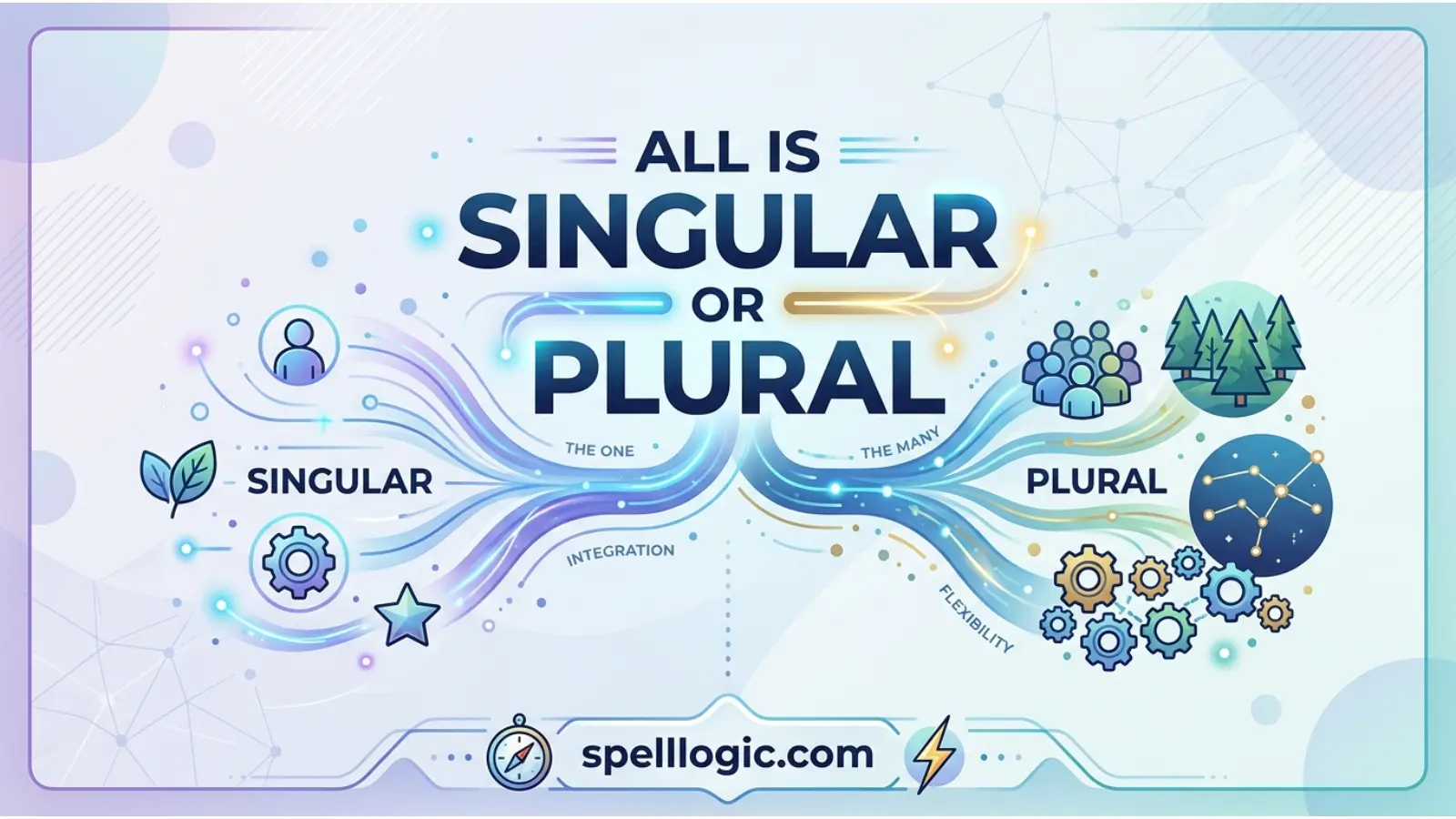
The word all does not have one fixed number.
- All is singular when it refers to one whole thing or an uncountable noun.
- All is plural when it refers to several countable people or things.
One-Line Distinction
All is singular when referring to one whole amount, while all is plural when referring to multiple countable items.
Examples
Singular
- All the milk is fresh.
- All the money is missing.
Plural
- All the students are ready.
- All the books are on the table.
Understanding Homophones in English
Although all is singular and all is plural are not homophones, learners often confuse them because the same word changes its grammar depending on context.
What Are Homophones?
Homophones are words that sound alike but have different meanings or spellings.
Example:
- Sea
- See
These words sound identical but have different meanings.
Why Homophones Cause Confusion
English contains many words that sound the same or look similar. Learners sometimes expect one grammar rule to apply everywhere.
For example:
- I can see the sea.
Similarly, learners think all always uses are, but that is not true.
What Does “All Is Singular” Mean?
Definition and Core Meaning
All is singular when it refers to:
- A whole amount
- An uncountable noun
- One complete idea
- One entire object
In these cases, use a singular verb.
Examples:
- All the food is ready.
- All the water is clean.
Origin and Historical Use
The word all comes from Old English eall, meaning “the whole” or “every part.” It has been used for centuries to describe complete amounts as well as groups.
Modern Usage and Synonyms
Depending on context, it can mean:
- The whole
- The entire amount
- Everything
Example Sentences
- All the work is finished.
- All the furniture is expensive.
- All the advice is helpful.
- All the equipment is working properly.
What Does “All Is Plural” Mean?
Definition and Core Meaning
All is plural when it refers to more than one countable person, place, animal, or thing.
Use a plural verb.
Examples:
- All the players are ready.
- All the cars are parked outside.
Origin and Historical Context
Historically, all has always been flexible. English speakers naturally matched the verb to whatever noun followed.
Modern Usage and Synonyms
Depending on context, it can mean:
- Everyone
- Every one of them
- Every item
- The entire group
Example Sentences
- All the children are laughing.
- All the teachers are present.
- All my friends are here.
- All the apples are ripe.
All Is Singular vs All Is Plural: Key Differences at a Glance
| Word | Part of Speech | Meaning | Example Context |
|---|---|---|---|
| All (Singular) | Determiner / Pronoun | Refers to one complete amount or uncountable noun | All the water is cold. |
| All (Plural) | Determiner / Pronoun | Refers to multiple countable nouns | All the students are studying. |
How to Remember the Difference
Learning this rule is easier than it seems.
Easy Memory Tricks
- Look at the noun after all.
- If it is uncountable, use is.
- If it is countable and plural, use are.
Association Technique
Think:
One whole thing = IS
Many things = ARE
Memorable Example
- All the cake is delicious.
- All the cakes are delicious.
Notice how changing cake to cakes changes the verb.
Common Mistakes and Confusions
Mistake 1
❌ All the news are true.
✔ All the news is true.
Explanation: News is an uncountable noun.
Mistake 2
❌ All the furniture are old.
✔ All the furniture is old.
Explanation: Furniture is singular in grammar.
Mistake 3
❌ All my friend is coming.
✔ All my friends are coming.
Explanation: Friends is plural.
Mistake 4
❌ All the bread are fresh.
✔ All the bread is fresh.
Explanation: Bread is treated as an uncountable noun.
Examples: Correct and Incorrect Usage
Example 1
✔ Correct: All the milk is fresh.
✘ Incorrect: All the milk are fresh.
Example 2
✔ Correct: All the children are excited.
✘ Incorrect: All the children is excited.
Example 3
✔ Correct: All the information is accurate.
✘ Incorrect: All the information are accurate.
Example 4
✔ Correct: All the flowers are beautiful.
✘ Incorrect: All the flowers is beautiful.
Example 5
✔ Correct: All the rice is cooked.
✘ Incorrect: All the rice are cooked.
Example 6
✔ Correct: All the players are warming up.
✘ Incorrect: All the players is warming up.
Self Assessment: Test Your Knowledge
Fill in the blanks with is or are.
- All the furniture _____ new.
- All the students _____ waiting.
- All the juice _____ finished.
- All the books _____ on the shelf.
Self Assessment Answers
- is
- are
- is
- are
FAQs
Is all always singular?
No. It can be singular or plural depending on the noun it refers to.
When should I use all is?
Use all is when talking about one whole amount or an uncountable noun.
Example:
- All the sugar is gone.
When should I use all are?
Use all are when referring to multiple countable people or things.
Example:
- All the players are ready.
Is all the information are correct?
No.
Correct:
- All the information is correct.
Why does all change between is and are?
Because the verb agrees with the noun, not with the word all itself.
Can all be both a pronoun and a determiner?
Yes. It can function as both depending on the sentence.
How can I remember the rule easily?
Check the noun after all:
- Uncountable = is
- Countable plural = are
Final Conclusion
Understanding whether all is singular or plural depends on what the word “all” represents in a sentence. The word itself can work with both singular and plural verbs, which is why many English learners find it confusing. When “all” refers to everything as one complete idea, condition, or situation, use “all is.” Common examples include “All is well” and “All is forgiven.” However, when “all” refers to several people, animals, or objects, use “all are.” For example, “All are welcome” and “All are ready.”
The easiest way to remember the difference is to focus on the meaning instead of the word “all” alone. Ask yourself whether you are talking about one complete thing or many separate things. One whole idea takes is, while a group of individuals takes are.
Mastering this small grammar rule can improve your speaking and writing skills. With regular practice and attention to context, choosing between “all is” and “all are” becomes natural. Keep learning, keep practicing, and soon these confusing grammar choices will become simple parts of your everyday English.