Many English learners become confused by response and respond because the words look alike, sound similar, and come from the same root. However, they serve different purposes in a sentence. Using the wrong one can make your writing sound unnatural or grammatically incorrect.
Whether you are writing emails, having conversations, or answering exam questions, knowing when to use response and when to use respond is essential. This guide explains both words in simple English, provides plenty of examples, and offers practical memory tips so you can confidently choose the correct word every time.
Why “Response” and “Respond” Are Confusing
Many people mistakenly use response and respond interchangeably because they are closely related in meaning.
Similar Pronunciation
Both words begin with respond-, making them sound very similar in everyday speech.
Similar Spelling
The only major difference is the ending:
- response ends with -se
- respond ends with -d
Because the spellings are almost identical, learners often confuse them.
Context Confusion
Both words relate to answering or reacting.
For example:
- I need your response.
- Please respond soon.
Since both involve replying, choosing the correct form can be difficult.
Common Learner Mistakes
Many learners write sentences like:
- ❌ Please response to my email.
- ❌ I received your respond.
These mistakes happen because one word is a noun, while the other is a verb.
Response vs Respond Explained Simply
The easiest way to understand these words is to remember their grammatical roles.
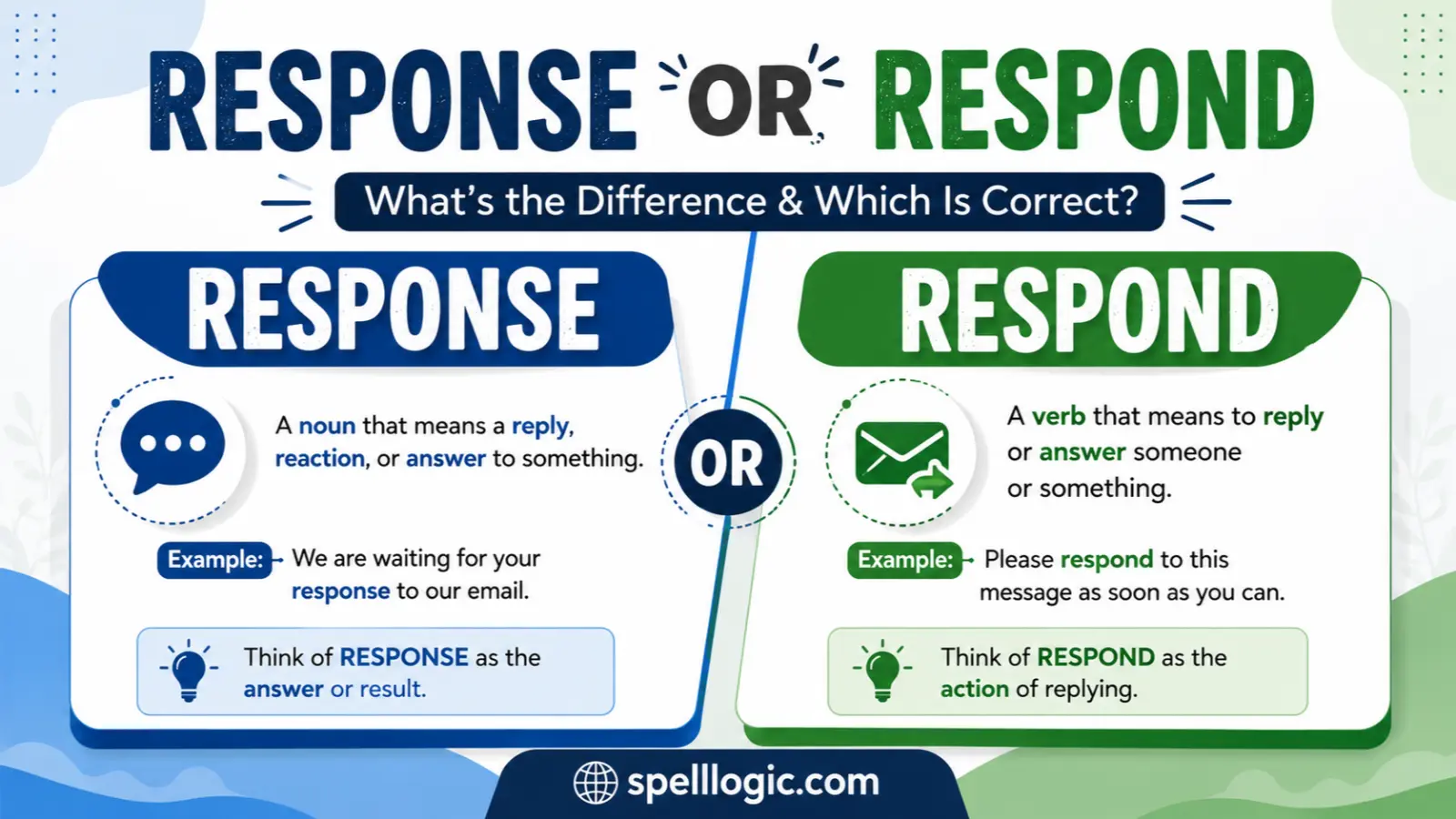
Response means an answer or reaction, while respond means to answer or react.
One-Line Distinction
Response is a thing (noun), while respond is an action (verb).
Examples
- She gave a quick response to my question.
- Please respond before Friday.
Another pair of examples:
- His response surprised everyone.
- He didn’t respond to the message.
Understanding Homophones in English
Although response and respond are not homophones, they are commonly confused because of their similar sound and shared meaning.
What Are Homophones?
Homophones are words that sound the same but have different meanings and spellings.
Example:
- Sea
- See
They sound alike but mean different things.
Why Homophones Cause Confusion
When two words sound similar, learners may remember the pronunciation but forget the spelling or grammar.
Example:
- Their
- There
Even though response and respond are not true homophones, they create a similar type of confusion because they belong to the same word family.
What Does “Response” Mean?
Definition and Core Meaning
Response is a noun.
It refers to an answer, reply, reaction, or feedback.
Origin and Historical Use
The word comes from the Latin respondere, meaning to answer or promise in return. It entered English through Old French and has been used for centuries to describe replies and reactions.
Modern Usage and Synonyms
Today, response appears in conversations, business writing, education, science, and customer service.
Common synonyms include:
- Reply
- Answer
- Reaction
- Feedback
- Return
- Acknowledgment
Key Points
- It is a noun.
- It refers to an answer or reaction.
- It can describe spoken, written, or physical reactions.
- It often follows words like your, his, their, or the.
Example Sentences
- Thank you for your quick response.
- The audience’s response was positive.
- We are waiting for the manager’s response.
- Her response solved the problem immediately.
What Does “Respond” Mean?
Definition and Core Meaning
Respond is a verb.
It means to answer, reply, react, or take action after something happens.
Origin and Historical Context
Like response, respond comes from the Latin word respondere. English speakers have used it for hundreds of years to describe answering questions, letters, messages, and situations.
Modern Usage and Synonyms
Today, respond is used in formal and informal English.
Common synonyms include:
- Reply
- Answer
- React
- Acknowledge
- Return
- Address
Key Points
- It is a verb.
- It describes an action.
- It often follows a subject.
- It can be followed by to.
Example Sentences
- Please respond to my email.
- She didn’t respond immediately.
- The company will respond within two days.
- He refused to respond to the question.
Response vs Respond: Key Differences at a Glance
| Word | Part of Speech | Meaning | Example Context |
|---|---|---|---|
| Response | Noun | An answer or reaction | Thank you for your response. |
| Respond | Verb | To answer or react | Please respond quickly. |
How to Remember the Difference Between Response and Respond
Learning these words is easy when you focus on their endings.
Easy Memory Tricks
- Response = Something you receive.
- Respond = Something you do.
Association Technique
Think of this sentence:
You respond by giving a response.
The action comes first.
The thing you give is the response.
Memorable Example
The teacher asked a question.
- The student responded.
- The student’s response was correct.
Common Mistakes and Confusions
Here are mistakes many English learners make.
Wrong
❌ Please response to this email.
Correct
✔ Please respond to this email.
Explanation:
An action needs a verb.
Wrong
❌ I liked your respond.
Correct
✔ I liked your response.
Explanation:
A thing requires a noun.
Wrong
❌ She will response tomorrow.
Correct
✔ She will respond tomorrow.
Explanation:
After will, use the base verb.
Wrong
❌ His respond was polite.
Correct
✔ His response was polite.
Explanation:
The sentence needs a noun after his.
Examples Section: Correct and Incorrect Usage
Example 1
✔ Correct: Thank you for your response.
✘ Incorrect: Thank you for your respond.
Example 2
✔ Correct: Please respond as soon as possible.
✘ Incorrect: Please response as soon as possible.
Example 3
✔ Correct: Her response impressed the interviewer.
✘ Incorrect: Her respond impressed the interviewer.
Example 4
✔ Correct: The doctor responded quickly.
✘ Incorrect: The doctor response quickly.
Example 5
✔ Correct: We appreciated everyone’s response.
✘ Incorrect: We appreciated everyone’s respond.
Example 6
✔ Correct: He didn’t respond to the invitation.
✘ Incorrect: He didn’t response to the invitation.
Self Assessment: Test Your Knowledge
Fill in the blanks with response or respond.
- Please ________ before Monday.
- Thank you for your quick ________.
- She didn’t ________ to the phone call.
- His ________ made everyone smile.
Self Assessment Answers
- respond
- response
- respond
- response
FAQs
1. What is the difference between response and respond?
Response is a noun meaning an answer or reaction, while respond is a verb meaning to answer or react.
2. Is “response” a verb?
No. Response is always a noun.
3. Is “respond” a noun?
No. Respond is a verb.
4. Which is correct: “Please respond” or “Please response”?
Please respond is correct because the sentence requires a verb.
5. Can response and reply be used interchangeably?
Often yes. Both can mean an answer, but response may also describe a reaction, while reply usually refers to answering someone directly.
6. Which word is more formal?
Both words are common in formal and informal English. They are frequently used in business emails, academic writing, customer service, and everyday conversations.
7. How can I remember the difference easily?
Remember this simple sentence:
You respond by giving a response.
Final Conclusion: Using “Response” and “Respond” Correctly
Understanding the difference between response and respond is much easier once you know that they have different grammatical roles. Response is a noun, so it refers to the answer, reply, or reaction itself. Respond is a verb, so it describes the action of answering or reacting. Although these words share the same origin and have closely related meanings, they cannot replace each other in a sentence without causing grammatical errors. A simple way to remember them is to think, “You respond by giving a response.” This connects the action with the result and helps you choose the correct word naturally.
In everyday English, you will encounter these words in emails, classroom discussions, customer service, interviews, business communication, and casual conversations. Paying attention to whether you need an action or a thing will help you select the correct form every time. Practice by reading authentic English texts, writing your own sentences, and checking whether the word should function as a verb or a noun. The more you use these words correctly, the more natural your English will become. Keep learning, stay curious, and remember that mastering small differences like response and respond is an important step toward speaking and writing English with confidence.