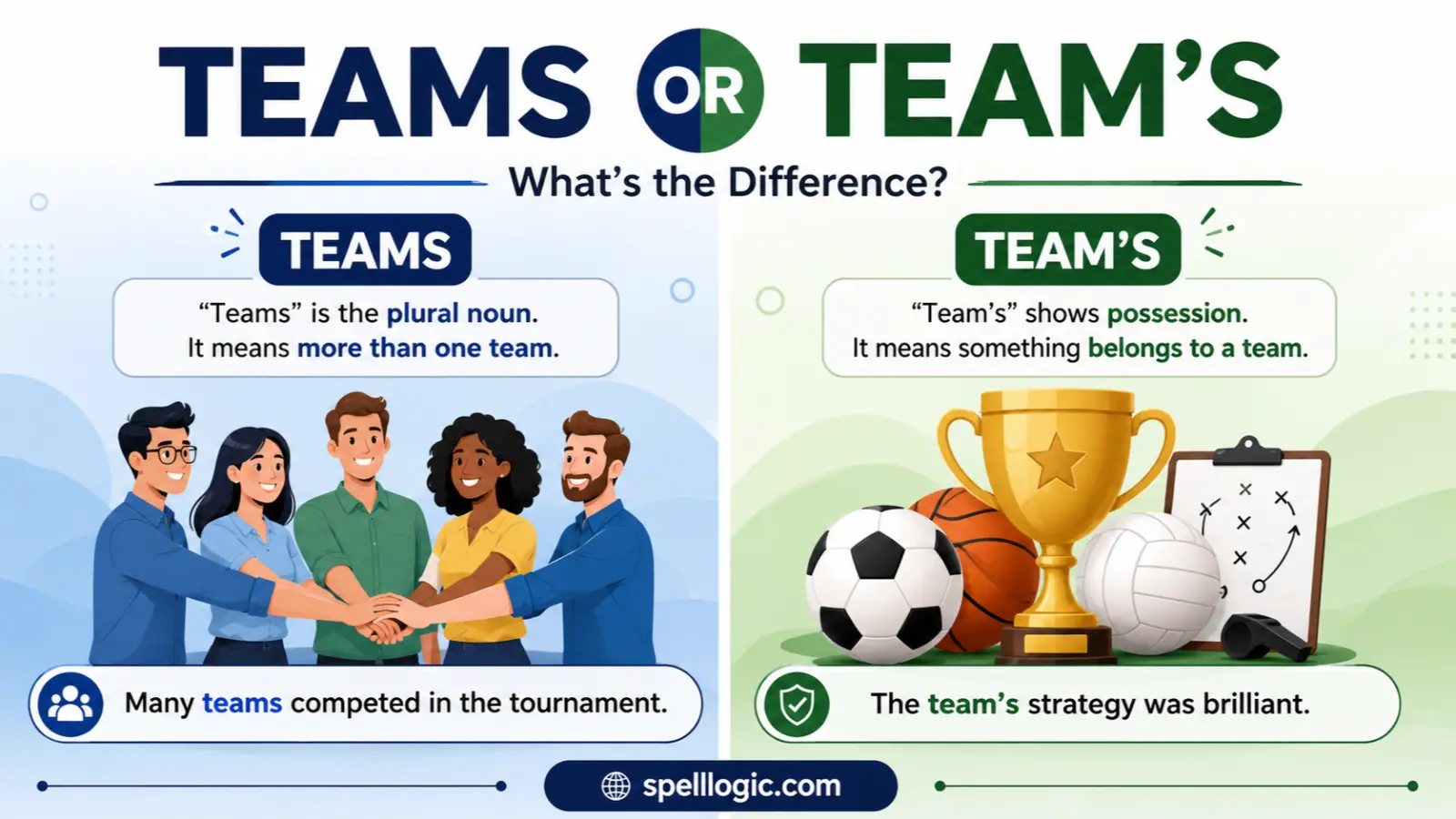
Many English learners become confused by teams and team’s because the two words look almost identical and sound the same when spoken. However, they have completely different grammatical functions. One is simply the plural form of team, while the other shows possession.
Using the wrong form can make your writing look incorrect, especially in emails, school assignments, and professional documents. Fortunately, the difference is easy to understand once you know a simple grammar rule. In this guide, you’ll learn exactly when to use teams and team’s, along with examples, memory tips, common mistakes, and practice questions to help you use both forms confidently.
Why “Teams” and “Team’s” Are Confusing
Many people mix up teams and team’s because they are pronounced the same but serve different grammatical purposes.
Similar Pronunciation
Both words sound like “teemz.” Since there is no difference in pronunciation, listeners cannot tell which spelling is intended without context.
Similar Spelling
The only visible difference is the apostrophe (‘). This tiny punctuation mark completely changes the meaning.
Context Confusion
Writers often forget whether they need a plural noun or a possessive noun. This confusion commonly appears in reports, emails, sports articles, and workplace communication.
Common Learner Mistakes
- Adding an apostrophe just because a word ends in s.
- Using team’s when talking about multiple teams.
- Forgetting that apostrophes usually show ownership, not plurality.
Teams vs Team’s Explained Simply
The difference is straightforward.
- Teams is the plural form of team, meaning more than one team.
- Team’s is the possessive form of team, meaning something belongs to one team.
One-Line Distinction
Teams means multiple groups, while team’s means something belongs to one team.
Example Sentences
- Teams competed in the national championship.
- The team’s captain gave an inspiring speech.
Another way to remember it:
Teams means many groups, while team’s means one group’s possession.
Understanding Homophones in English
Although teams and team’s are not true dictionary homophones because one is a grammatical form, they sound identical in everyday speech.
What Are Homophones?
Homophones are words that have the same pronunciation but different meanings and spellings.
Example:
- Sea
- See
These words sound alike but have different meanings.
Why Homophones Cause Confusion
English learners often rely on pronunciation. Since many words sound identical but have different spellings and meanings, it’s easy to choose the wrong form while writing.
For example:
- They’re going home.
- Their house is nearby.
Both begin with the same sound but serve different purposes.
What Does “Teams” Mean?
Definition and Core Meaning
Teams is the plural noun of team.
It refers to two or more groups of people working or playing together toward a common goal.
Origin and Historical Use
The word team comes from Old English tēam, originally referring to a group of animals pulling together. Over time, its meaning expanded to include groups of people cooperating for work, sports, education, and business.
Modern Usage and Synonyms
Today, teams appears frequently in:
- Sports
- Business
- Education
- Technology
- Gaming
Synonyms include:
- Groups
- Squads
- Crews
- Units
- Parties
Example Sentences
- Several teams entered the tournament.
- The company created cross-functional teams.
- Both teams played exceptionally well.
- Our school has five sports teams.
What Does “Team’s” Mean?
Definition and Core Meaning
Team’s is the singular possessive form of team.
It shows that something belongs to or is associated with one team.
Origin and Historical Context
English has used apostrophes to indicate possession for centuries. Adding ‘s to a singular noun shows ownership or relationship.
Examples include:
- Student’s notebook
- Company’s policy
- Team’s coach
Modern Usage and Synonyms
Team’s commonly appears when discussing:
- Achievements
- Equipment
- Strategy
- Performance
- Leadership
Instead of synonyms, you can often rewrite it using of the team.
Examples:
- The team’s logo.
- The logo of the team.
Example Sentences
- The team’s performance impressed everyone.
- Our team’s coach prepared an excellent strategy.
- The team’s uniforms arrived yesterday.
- Everyone praised the team’s effort.
Teams vs Team’s: Key Differences at a Glance
| Word | Part of Speech | Meaning | Example Context |
|---|---|---|---|
| Teams | Plural noun | More than one team | Several teams joined the competition. |
| Team’s | Singular possessive noun | Something belongs to one team | The team’s coach celebrated the victory. |
How to Remember the Difference Between Teams and Team’s
Learning this rule is easier than it seems.
Easy Memory Tricks
- No apostrophe = more than one team.
- Apostrophe + s = one team’s ownership.
Association Techniques
Think:
- Teams = many groups
- Team’s = team owns something
One Memorable Example
- Teams won trophies.
- The team’s trophy was displayed in the school lobby.
If ownership exists, use the apostrophe.
Common Mistakes and Confusions
Here are mistakes learners frequently make.
Wrong
❌ The team’s are warming up.
Correct
✔ The teams are warming up.
Explanation: More than one team is playing.
Wrong
❌ The teams mascot is very popular.
Correct
✔ The team’s mascot is very popular.
Explanation: The mascot belongs to one team.
Wrong
❌ Three team’s qualified for the finals.
Correct
✔ Three teams qualified for the finals.
Explanation: No ownership is involved.
Wrong
❌ Our teams captain inspired us.
Correct
✔ Our team’s captain inspired us.
Explanation: The captain belongs to one team.
Examples Section: Correct and Incorrect Usage
Example 1
✔ Correct: The team’s coach announced the lineup.
✘ Incorrect: The teams coach announced the lineup.
Example 2
✔ Correct: Four teams reached the semifinals.
✘ Incorrect: Four team’s reached the semifinals.
Example 3
✔ Correct: The team’s strategy worked perfectly.
✘ Incorrect: The teams strategy worked perfectly.
Example 4
✔ Correct: Several teams volunteered for the charity event.
✘ Incorrect: Several team’s volunteered for the charity event.
Example 5
✔ Correct: The team’s equipment arrived on time.
✘ Incorrect: The teams equipment arrived on time.
Example 6
✔ Correct: All the teams celebrated together.
✘ Incorrect: All the team’s celebrated together.
Self Assessment: Test Your Knowledge
Fill in the blanks with teams or team’s.
- The ______ captain thanked the fans.
- Three ______ competed in the final round.
- Our ______ performance exceeded expectations.
- The school formed new sports ______ this year.
Self Assessment Answers
- team’s
- teams
- team’s
- teams
FAQs
Is teams plural?
Yes. Teams is the plural form of team and refers to more than one group.
What does team’s mean?
It is the singular possessive form, showing that something belongs to one team.
Is team’s the same as teams?
No. Teams is plural, while team’s shows possession.
Can team’s refer to multiple teams?
No. For multiple teams showing possession, use teams’ with the apostrophe after the s.
Which form is correct: “the teams coach” or “the team’s coach”?
The team’s coach is correct because the coach belongs to one team.
Why do people confuse these words?
They sound exactly alike in speech, but the apostrophe changes the grammatical meaning.
Is it wrong to use an apostrophe to make a plural?
Yes. In standard English, apostrophes should not be used simply to make ordinary nouns plural.
Final Conclusion: Using “Teams” and “Team’s” Correctly
Understanding the difference between teams and team’s is an important step toward writing clear and accurate English. Although these two forms sound exactly the same, they have different jobs in a sentence. Teams is simply the plural form of team, so you use it whenever you are talking about more than one group. Team’s, on the other hand, is the singular possessive form, showing that something belongs to one team, such as the team’s coach, the team’s strategy, or the team’s success.
A helpful way to remember the rule is to check whether ownership is involved. If you can replace the phrase with of the team, then team’s is usually the correct choice. If you are simply counting multiple groups, use teams without an apostrophe. Reading your sentence aloud and asking, “Am I talking about many teams or something owned by one team?” can quickly guide you to the right spelling.
Mastering small grammar differences like this improves your confidence in writing emails, essays, reports, and everyday messages. The more you practice with real examples, the more natural these forms will become. Keep learning, keep practicing, and remember that every grammar rule you master brings you one step closer to fluent and accurate English.