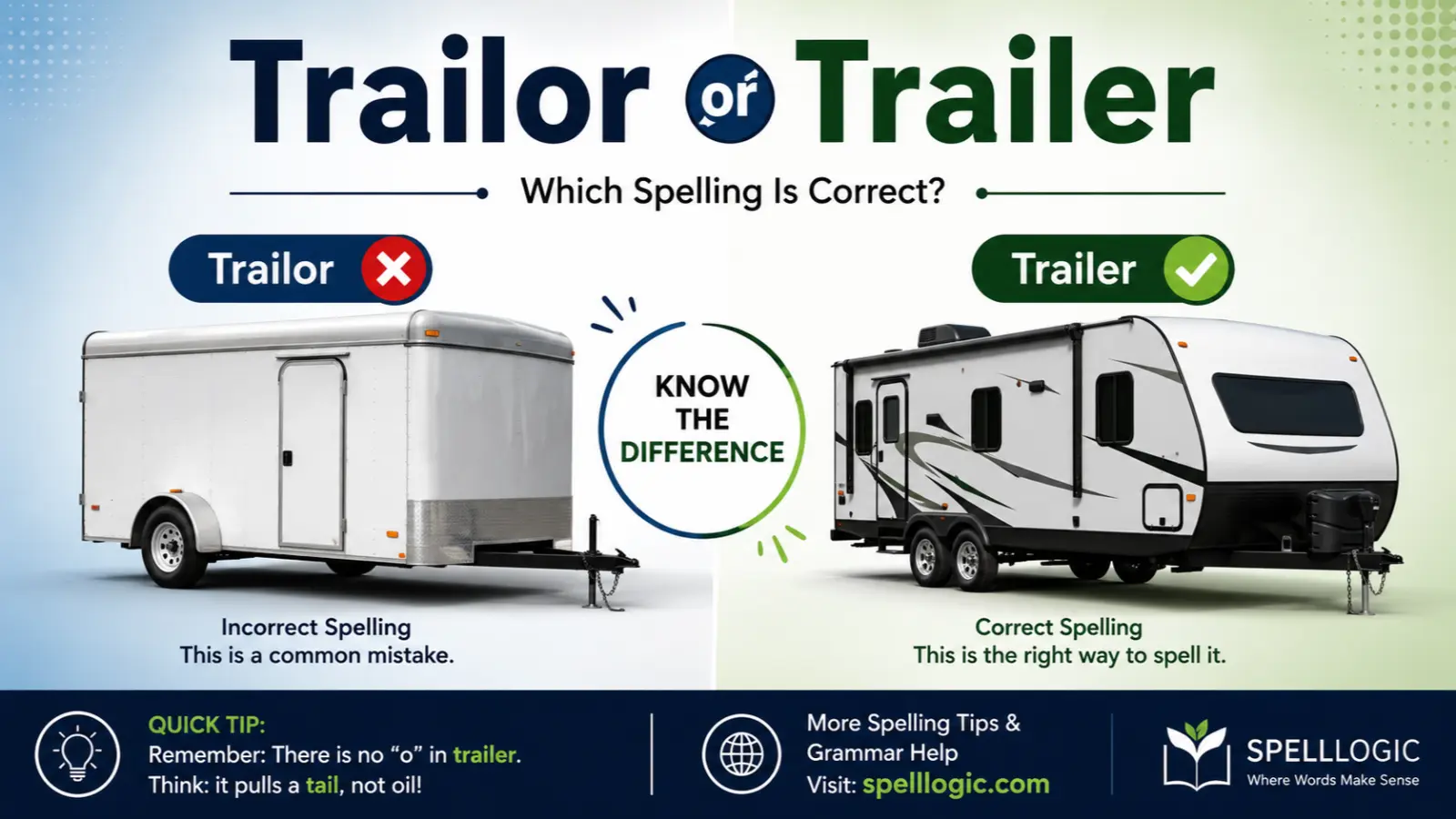
Many English learners become confused by the words trailor and trailer because they look almost identical and sound the same when spoken. It is easy to assume that both spellings are correct, especially when typing quickly or reading informal content online. However, only one of these words is accepted in standard English.
Understanding the correct spelling will improve your writing, help you avoid common mistakes, and make your communication more professional. In this guide, you’ll learn the difference between trailor and trailer, discover why people confuse them, and find simple memory tricks to remember the correct form forever.
Why “Trailor” and “Trailer” Are Confusing
Many learners accidentally write trailor instead of trailer because the two spellings are very similar.
Similar Pronunciation
- Both are pronounced almost exactly the same.
- Since the pronunciation does not change, many people guess the spelling incorrectly.
Similar Spelling
- Only one letter differs:
- Trailor ❌
- Trailer ✅
This tiny difference makes typing errors common.
Context Confusion
People often see the word in different situations:
- Movie trailer
- Travel trailer
- Horse trailer
- Utility trailer
Because they hear the word more often than they write it, they may remember the spelling incorrectly.
Common Learner Mistakes
Many English learners:
- Think trailor is an alternative spelling.
- Assume both spellings are acceptable.
- Copy the incorrect spelling from social media or online forums.
Important: In modern English, trailer is the only correct spelling.
Trailor vs Trailer Explained Simply
The difference is very straightforward.
- Trailor is a misspelling.
- Trailer is the correct English word.
One-line distinction
Trailor is incorrect, while trailer is the correct spelling used in all forms of English.
Example Sentences
- The movie trailer was exciting.
- We bought a camping trailer for our vacation.
Notice that trailor should never replace trailer in formal writing.
Understanding Homophones in English
What Are Homophones?
Homophones are words that sound the same but have different meanings or spellings.
Example:
- Sea
- See
Although they sound identical, they have different meanings.
Trailor and trailer are not true homophones because “trailor” is not a real English word. Instead, this is a spelling mistake involving a correctly spelled word.
Why Homophones Cause Confusion
English spelling is not always predictable.
For example:
- Their
- There
- They’re
All sound alike but have different meanings.
Similarly, many learners spell trailer as trailor because they rely on pronunciation instead of correct spelling.
What Does “Trailor” Mean?
Definition and Core Meaning
Trailor has no meaning in standard English.
It is simply a misspelling of trailer.
Origin and Historical Use
- No recognized historical usage.
- Not listed as a standard English word in major dictionaries.
- Usually appears because of typing mistakes or spelling confusion.
Modern Usage and Synonyms
Since trailor is not a real word, it has:
- No accepted meaning
- No synonyms
- No grammatical role
Example Sentences
❌ We rented a trailor.
❌ The new movie trailor looks amazing.
Both examples should use trailer instead.
What Does “Trailer” Mean?
Definition and Core Meaning
A trailer is something that follows or is pulled behind another object.
Depending on the context, it may refer to:
- A vehicle pulled by another vehicle
- A short promotional video for a movie or game
- A mobile home
- A transport unit for carrying goods
Origin and Historical Context
The word comes from the English verb trail, meaning to follow behind.
As transportation developed, the noun trailer became the standard term for vehicles that are pulled.
Later, the entertainment industry adopted the word for promotional videos because they originally appeared after feature films.
Modern Usage and Synonyms
Possible synonyms include:
- Caravan (British English, in some contexts)
- Tow trailer
- Utility trailer
- Promotional preview (for films)
Example Sentences
- We attached the trailer to the truck.
- The movie trailer gained millions of views.
- They bought a camping trailer.
- The horse trailer was parked outside.
Trailor vs Trailer: Key Differences at a Glance
| Word | Part of Speech | Meaning | Example Context |
|---|---|---|---|
| Trailor | None | Incorrect spelling | ❌ We rented a trailor. |
| Trailer | Noun | A vehicle, mobile home, or promotional video | ✅ The trailer looked fantastic. |
How to Remember the Difference Between Trailor and Trailer
Here are some simple memory tricks.
Easy Memory Tricks
- Trailer ends with “ER.”
- Think of ER in towER—both end with ER.
Association Technique
Remember this sentence:
Every movie trailer ends with ER.
If your spelling ends in OR, it’s wrong.
Memorable Example
The movie trailer entertained everyone before the film began.
If you remember movie trailers, you’ll remember the correct spelling.
Common Mistakes and Confusions
Wrong Example
❌ I watched the new movie trailor.
Correct Version
✔ I watched the new movie trailer.
Explanation:
“Trailer” is the accepted spelling.
Wrong Example
❌ We bought a camping trailor.
Correct Version
✔ We bought a camping trailer.
Explanation:
Only trailer is correct.
Wrong Example
❌ The horse trailor needs repairs.
Correct Version
✔ The horse trailer needs repairs.
Explanation:
Replace trailor with trailer every time.
Examples Section: Correct and Incorrect Usage
Example 1
✔ Correct: The trailer arrived this morning.
✘ Incorrect: The trailor arrived this morning.
Example 2
✔ Correct: We watched the movie trailer online.
✘ Incorrect: We watched the movie trailor online.
Example 3
✔ Correct: Their travel trailer has two bedrooms.
✘ Incorrect: Their travel trailor has two bedrooms.
Example 4
✔ Correct: The truck pulled a heavy trailer.
✘ Incorrect: The truck pulled a heavy trailor.
Self Assessment: Test Your Knowledge
Fill in the blanks.
1.
We watched the new movie ________ yesterday.
2.
The truck pulled a large ________.
3.
Which spelling is correct?
Trailor / Trailer
4.
The camping ________ has a small kitchen.
Self Assessment Answers
- trailer
- trailer
- Trailer
- trailer
FAQs
1. Is trailor a real English word?
No. It is a common misspelling of trailer.
2. Which spelling is correct: trailor or trailer?
Trailer is the only correct spelling.
3. Why do people write trailor?
People often spell it based on pronunciation rather than the correct written form.
4. Does trailer have more than one meaning?
Yes. It can refer to a vehicle, a mobile home, or a promotional video for a movie, television show, or game.
5. Is trailer used in both British and American English?
Yes. Both varieties of English use trailer, although some vehicle-related meanings may vary by region.
6. Can I use trailor in formal writing?
No. Always use trailer in academic, professional, and everyday writing.
7. How can I remember the correct spelling?
Remember that trailer ends with ER, just like many common English nouns. Avoid using trailor, which is incorrect.
Final Conclusion: Using “Trailor” and “Trailer” Correctly
Knowing the difference between trailor and trailer is much simpler than it first appears. The key point is that trailor is not a correct English word, while trailer is the standard spelling accepted in dictionaries, schools, workplaces, and professional writing. Whether you are talking about a movie preview, a camping vehicle, a utility trailer, or a mobile home, trailer is always the word you should use.
Many learners make this mistake because English pronunciation does not always match spelling. Since trailor sounds almost identical to trailer, it is easy to type the wrong letters without noticing. Fortunately, a simple memory trick can help: Trailer ends with “ER,” and that’s the ending you’ll see in every dictionary and every correctly written sentence. The more you read books, news articles, and other reliable English sources, the more familiar the correct spelling will become.
Whenever you write emails, school assignments, blog posts, or social media updates, take a moment to check that you have written trailer, not trailor. Small spelling improvements like this make your English look more polished and professional. Keep practicing, pay attention to commonly confused words, and remember that every correction brings you one step closer to writing confident, accurate English.