Many English learners feel confused about weekday and weekdays because both words refer to the working days of the week. However, they are not used in exactly the same way. The difference is simple once you understand when to use the singular form and when to use the plural form.
Using the correct word makes your writing and speaking sound more natural and grammatically accurate. In this guide, you’ll learn the meanings of weekday and weekdays, see practical examples, discover common mistakes, and pick up easy memory tips that will help you use these words correctly in everyday English.
Why “Weekday” and “Weekdays” Are Confusing
Many learners accidentally interchange weekday and weekdays because they describe the same group of days but differ in number.
Similar Pronunciation
Both words sound nearly identical. The only difference is the “s” at the end of weekdays, which can be difficult to notice in fast speech.
Similar Spelling
The spelling is almost the same. The plural form simply adds -s to the singular word.
Context Confusion
People often see phrases like:
- on a weekday
- on weekdays
Since both are correct in different situations, learners sometimes choose the wrong one.
Common Learner Mistakes
Some frequent mistakes include:
- Using weekday when talking about a regular schedule.
- Using weekdays when referring to one specific day.
- Forgetting that singular and plural nouns require different grammar.
Weekday vs Weekdays Explained Simply
The difference is straightforward.
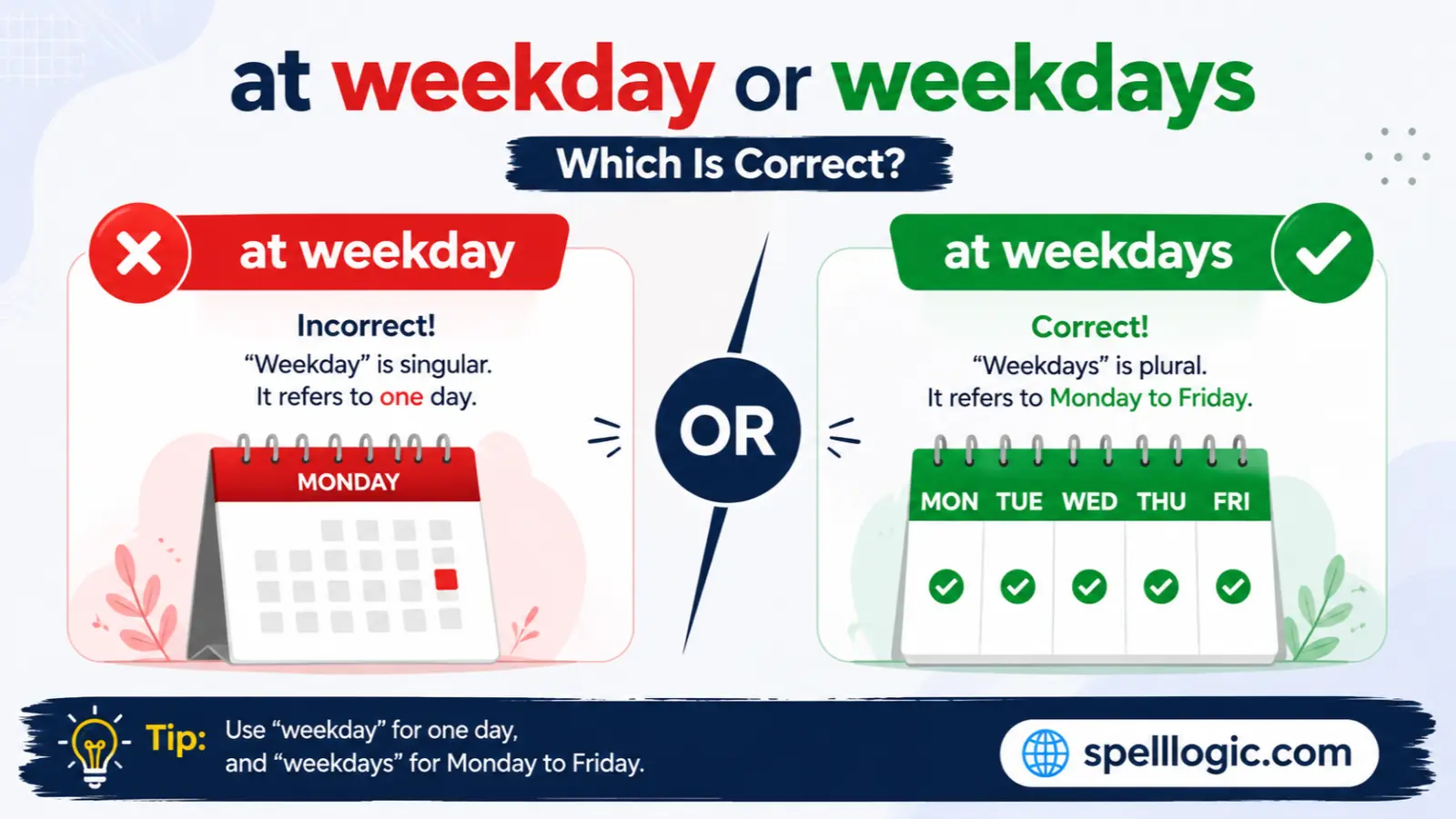
Weekday means one working day of the week (usually Monday to Friday).
Weekdays means more than one working day or the working days in general.
One-line Distinction
Weekday refers to a single day, while weekdays refers to multiple working days.
Examples
- Weekday means one working day, while weekdays means the working days of the week.
- I usually finish work early on a weekday.
- The library opens earlier on weekdays.
Understanding Homophones in English
Although weekday and weekdays are not homophones, learners often confuse similar-looking and similar-sounding words in English.
What Are Homophones?
Homophones are words that sound alike but have different meanings and spellings.
Example:
- Sea and see
Although they sound the same, they have different meanings.
Why Homophones Cause Confusion
English contains many words with similar sounds. Learners often rely on pronunciation instead of grammar or context.
For example:
- Their
- There
- They’re
These words sound alike but have different meanings and uses.
Similarly, weekday and weekdays are not homophones, but their nearly identical pronunciation makes them easy to confuse.
What Does “Weekday” Mean?
Definition and Core Meaning
A weekday is one day from Monday through Friday, excluding Saturday and Sunday.
It refers to a single working day.
Origin and Historical Use
The word combines:
- Week
- Day
It has been used for centuries to distinguish working days from weekends.
Modern Usage and Synonyms
Today, weekday commonly appears in:
- Business schedules
- School calendars
- Office hours
- Transportation timetables
Similar words include:
- Working day
- Business day (in some contexts)
Key Points
- Singular noun
- Refers to one working day
- Usually Monday through Friday
- Used with a, every, each, or this
Example Sentences
- Monday is a busy weekday.
- Every weekday, she walks to work.
- This weekday has been unusually quiet.
- A typical weekday begins at 8 a.m.
What Does “Weekdays” Mean?
Definition and Core Meaning
Weekdays is the plural form of weekday.
It refers to multiple working days or Monday through Friday as a group.
Origin and Historical Context
As English developed, the plural ending -s was added to indicate more than one weekday.
The meaning has remained consistent in modern English.
Modern Usage and Synonyms
You’ll often hear:
- On weekdays
- During weekdays
- Weekdays only
Possible synonyms include:
- Working days
- Business days (depending on context)
Key Points
- Plural noun
- Refers to Monday through Friday collectively
- Used for routines and schedules
- Common in advertisements and notices
Example Sentences
- The gym opens at 6 a.m. on weekdays.
- Traffic is heavier on weekdays.
- She works weekdays and relaxes on weekends.
- Public offices are open on weekdays.
Weekday vs Weekdays: Key Differences at a Glance
| Word | Part of Speech | Meaning | Example Context |
|---|---|---|---|
| Weekday | Singular noun | One working day | Monday is a busy weekday. |
| Weekdays | Plural noun | Multiple working days or Monday–Friday collectively | The office is open on weekdays. |
How to Remember the Difference Between Weekday and Weekdays
Here are some simple tricks.
Easy Memory Tricks
- No S = One day.
- S = Several days.
Association Techniques
Think about these examples:
- One apple → singular
- Many apples → plural
The same idea applies to:
- Weekday
- Weekdays
One Memorable Example
Imagine your calendar.
- Tuesday alone is a weekday.
- Monday to Friday together are weekdays.
Remember:
One day = Weekday. Many days = Weekdays.
Common Mistakes and Confusions
Wrong Example
❌ I go to school every weekdays.
✔ I go to school every weekday.
Explanation: “Every” is followed by a singular countable noun.
Wrong Example
❌ The office is open on weekday.
✔ The office is open on weekdays.
Explanation: The sentence refers to all working days.
Wrong Example
❌ She exercises on every weekdays.
✔ She exercises on every weekday.
Explanation: “Every” takes the singular form.
Wrong Example
❌ We stay home on weekday.
✔ We stay home on weekdays.
Explanation: The sentence refers to many working days.
Examples Section: Correct and Incorrect Usage
Example 1
✔ Correct: Every weekday, I read the news.
✘ Incorrect: Every weekdays, I read the news.
Example 2
✔ Correct: The café is crowded on weekdays.
✘ Incorrect: The café is crowded on weekday.
Example 3
✔ Correct: Friday is my favorite weekday.
✘ Incorrect: Friday is my favorite weekdays.
Example 4
✔ Correct: We travel less on weekdays.
✘ Incorrect: We travel less on weekday.
Example 5
✔ Correct: Each weekday starts with a team meeting.
✘ Incorrect: Each weekdays starts with a team meeting.
Self Assessment: Test Your Knowledge
Fill in the blanks.
- Monday is a busy __________.
- The office is open only on __________.
- Every __________, I practice English.
- Traffic is heavier on __________ than on weekends.
Self Assessment Answers
- weekday
- weekdays
- weekday
- weekdays
FAQs
1. Is it “weekday” or “weekdays”?
Use weekday for one working day and weekdays for more than one or for Monday through Friday as a group.
2. What counts as a weekday?
In most countries, weekdays are Monday through Friday.
3. Can I say “every weekdays”?
No. The correct expression is every weekday because every is followed by a singular noun.
4. Is “on weekdays” correct?
Yes. It means during the working days of the week.
5. Is Friday a weekday?
Yes. Friday is generally considered a weekday.
6. Are weekdays the same everywhere?
Not always. While many countries consider Monday to Friday as weekdays, some regions have different workweeks. Always consider local customs if discussing schedules internationally.
7. Which is more common in everyday English?
Both are common. Weekday is used when referring to one specific working day, while weekdays is more common when talking about routines, business hours, or regular weekly schedules.
Final Conclusion: Using “Weekday” and “Weekdays” Correctly
Understanding the difference between weekday and weekdays is easier than it first appears. The key is to remember that weekday is the singular form and refers to one working day, while weekdays is the plural form and refers to several working days or Monday through Friday collectively. This simple distinction helps you write and speak English more naturally, whether you’re discussing work schedules, school routines, office hours, or travel plans.
A useful memory tip is to focus on the final “s.” If you’re talking about one day, choose weekday. If you’re talking about multiple days or a regular Monday-to-Friday pattern, choose weekdays. Also remember that words like every, each, and a are followed by the singular form, while expressions such as on weekdays or during weekdays refer to multiple working days.
By practicing with real-life examples and paying attention to context, you’ll quickly develop confidence in choosing the correct word. Small grammar details like this make a big difference in clear communication. Keep reading, writing, and speaking English every day, and you’ll find that distinctions like weekday versus weekdays soon become second nature. Every new word you master brings you one step closer to fluent, accurate, and confident English.