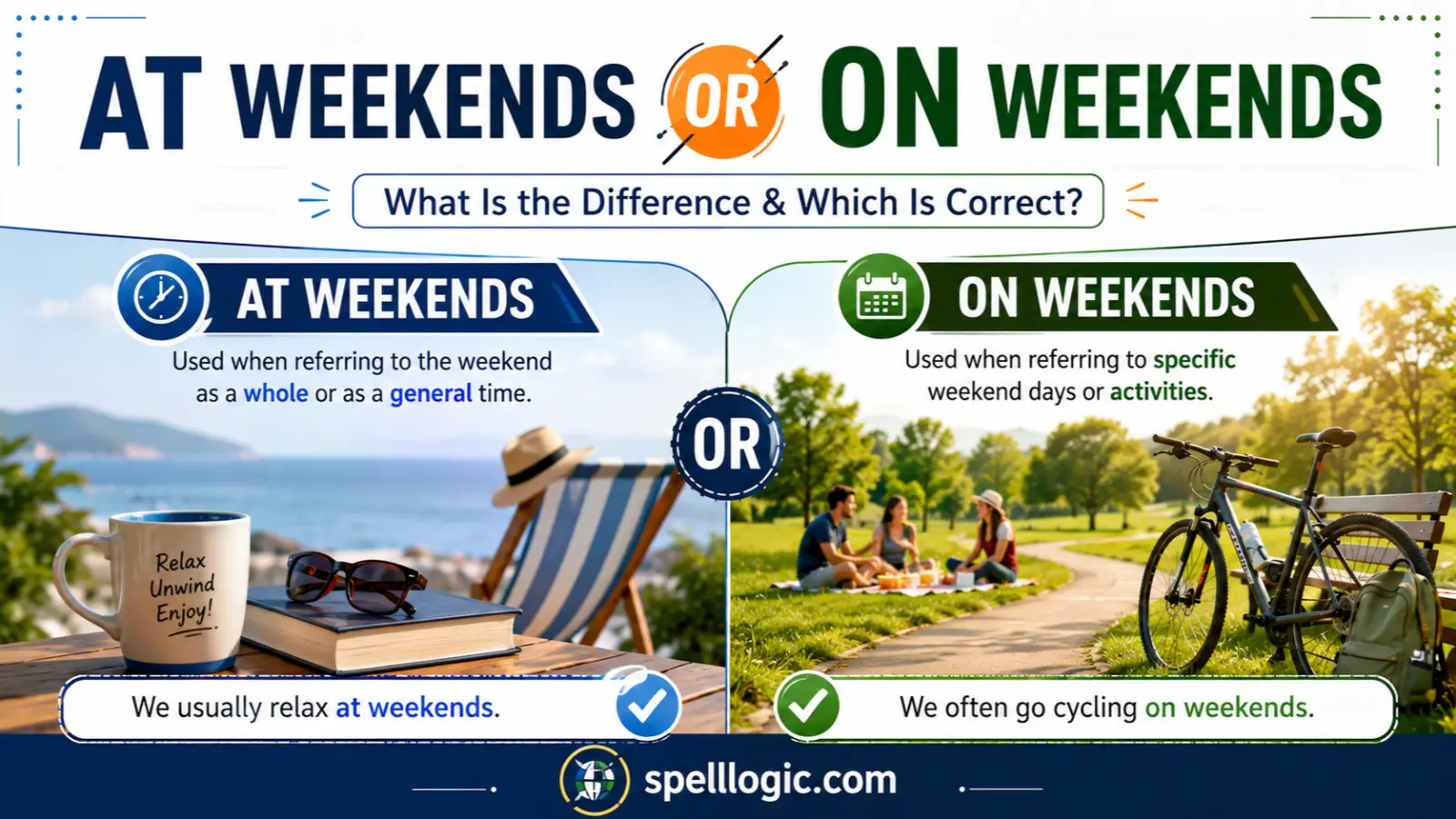
Many English learners wonder whether they should say at weekends or on weekends. Both expressions are correct, but they are used in different varieties of English. This often causes confusion because learners hear both forms in movies, books, online lessons, and everyday conversations.
Understanding the difference helps you sound more natural and communicate more confidently. The good news is that the meanings are the same. The main difference is regional usage rather than grammar. In this guide, you’ll learn when to use each expression, how native speakers use them, common mistakes to avoid, and simple tips to remember the correct form.
Why “At Weekends” and “On Weekends” Are Confusing
Many learners believe one expression is correct and the other is wrong. In reality, both are grammatically acceptable, but they belong to different English dialects.
Similar Pronunciation
Both phrases sound very similar because only the preposition changes. This makes them easy to mix up in spoken English.
Similar Spelling
The expressions share the word weekends, with only at and on changing.
Context Confusion
Both phrases describe something that happens regularly during weekends.
For example:
- I work at weekends.
- I work on weekends.
Both sentences have the same meaning.
Common Learner Mistakes
- Thinking at weekends is incorrect.
- Believing on weekends is the only acceptable form.
- Mixing British and American English in formal writing.
- Using in weekends, which is incorrect.
At Weekends vs On Weekends Explained Simply
The difference is mainly regional.
- At weekends is the preferred expression in British English.
- On weekends is the preferred expression in American English.
One-Line Distinction
“At weekends” is British English, while “on weekends” is American English.
Example Sentences
- I usually visit my grandparents at weekends. (British English)
- We play basketball on weekends. (American English)
Another pair:
- She works at weekends.
- She works on weekends.
Both are correct depending on the variety of English you use.
Understanding Homophones in English
Although at weekends and on weekends are not homophones, learners often confuse them because they have identical meanings in different English varieties.
What Are Homophones?
Homophones are words that sound the same but have different meanings or spellings.
Example:
- Sea
- See
These words sound alike but have different meanings.
Why Homophones Cause Confusion
English contains many words that sound alike, making it easy to misunderstand or misspell them.
Example:
- I can see the ocean.
- The sea is calm today.
Similarly, learners confuse at weekends and on weekends because both describe the same time period but are used in different regional English.
What Does “At Weekends” Mean?
Definition and Core Meaning
At weekends means during weekends on a regular basis.
It is the standard expression in British English.
Origin and Historical Use
British English has long used at with recurring periods such as:
- at night
- at Christmas
- at weekends
This usage has remained common throughout the UK.
Modern Usage and Synonyms
Common alternatives include:
- during weekends
- every weekend
- on the weekend (less common in British English)
- at the weekend (for one specific weekend)
Key Points
- Used mainly in British English.
- Refers to repeated weekends.
- Suitable in speech and writing.
Example Sentences
- I usually relax at weekends.
- My parents travel at weekends.
- The museum is busiest at weekends.
- She studies English at weekends.
What Does “On Weekends” Mean?
Definition and Core Meaning
On weekends means during weekends regularly or habitually.
It is the standard American English expression.
Origin and Historical Context
American English commonly uses on with days and time periods.
Examples include:
- on Monday
- on Sundays
- on weekends
This pattern has become the standard throughout North America.
Modern Usage and Synonyms
Similar expressions include:
- every weekend
- during weekends
- over the weekend (for one weekend)
- on the weekend (for a specific weekend)
Key Points
- Common in American English.
- Refers to recurring weekends.
- Used in everyday conversation and formal writing.
Example Sentences
- We go hiking on weekends.
- She volunteers on weekends.
- The library opens late on weekends.
- I enjoy cooking on weekends.
At Weekends vs On Weekends: Key Differences at a Glance
| Word | Part of Speech | Meaning | Example Context |
|---|---|---|---|
| At weekends | Prepositional phrase | During weekends regularly (British English) | I work at weekends. |
| On weekends | Prepositional phrase | During weekends regularly (American English) | We travel on weekends. |
How to Remember the Difference Between At Weekends and On Weekends
Here are some simple tricks.
Easy Memory Tricks
- Think UK = At weekends.
- Think USA = On weekends.
Association Techniques
Imagine:
- A London newspaper says: At weekends.
- A New York newspaper says: On weekends.
This visual association helps you remember which version belongs to which variety of English.
One Memorable Example
British people relax at weekends, while Americans relax on weekends.
The activity is the same—the regional preference changes.
Common Mistakes and Confusions
Wrong
❌ I play football in weekends.
Correct
✔ I play football at weekends. (British English)
✔ I play football on weekends. (American English)
Explanation: Never use in weekends.
Wrong
❌ I usually study on weekends in a British English exam.
Correct
✔ I usually study at weekends.
Explanation: Match your English variety.
Wrong
❌ We travel at weekend every week.
Correct
✔ We travel at weekends.
Explanation: Use the plural when talking about repeated weekends.
Wrong
❌ I work in the weekends.
Correct
✔ I work on weekends.
Explanation: The preposition in is incorrect here.
Examples Section: Correct and Incorrect Usage
Example 1
✔ Correct: I visit my grandparents at weekends.
✘ Incorrect: I visit my grandparents in weekends.
Example 2
✔ Correct: We go camping on weekends.
✘ Incorrect: We go camping at weekends in an American English textbook.
Example 3
✔ Correct: She studies French at weekends.
✘ Incorrect: She studies French in the weekends.
Example 4
✔ Correct: My brother works on weekends.
✘ Incorrect: My brother works in weekends.
Self Assessment: Test Your Knowledge
Fill in the blanks.
- My family usually goes shopping ________ weekends. (British English)
- We play baseball ________ weekends. (American English)
- She often reads books ________ weekends in London.
- They travel ________ weekends in New York.
Self Assessment Answers
- at
- on
- at
- on
FAQs
1. Is “at weekend” grammatically correct?
Yes. It is the standard expression in British English.
2. Is “on weekends” correct?
Yes. It is the standard expression in American English.
3. Which expression should English learners use?
Use the version that matches the English variety you are learning. Be consistent.
4. Can I use “in weekends”?
No. This expression is not standard English.
5. What is the difference between “at weekends” and “at the weekend”?
At weekends refers to repeated weekends, while at the weekend usually refers to a particular weekend in British English.
6. Is “on the weekend” different from “on weekends”?
Yes. On the weekend often refers to one specific weekend, while on weekends refers to weekends in general.
7. Which form appears more often online?
Both are common, but on weekends appears more frequently because American English has a large global presence. At weekends remains standard and widely used in British English.
Final Conclusion: Using “At Weekends” and “On Weekends” Correctly
Choosing between at weekends and on weekends is much easier once you understand that both expressions are correct. The key difference is not meaning but regional preference. At weekends is the natural choice in British English, while on weekends is preferred in American English. Both phrases describe activities that happen regularly during weekends, so you do not need to worry about changing the meaning of your sentence. Instead, focus on using the version that matches the type of English you are learning or writing.
A helpful way to remember the distinction is to connect at weekends with the United Kingdom and on weekends with the United States. This simple memory trick can help you avoid mixing language varieties in essays, exams, or professional communication. Also remember that in weekends is not considered correct in standard English, so it should be avoided.
As you continue learning English, pay attention to how native speakers use time expressions in books, news articles, podcasts, and conversations. The more examples you read and hear, the more natural these phrases will become. Practice writing your own sentences using both forms, and always stay consistent with either British or American English. With regular practice, choosing between at weekends and on weekends will soon become second nature, helping you speak and write with greater confidence and accuracy.