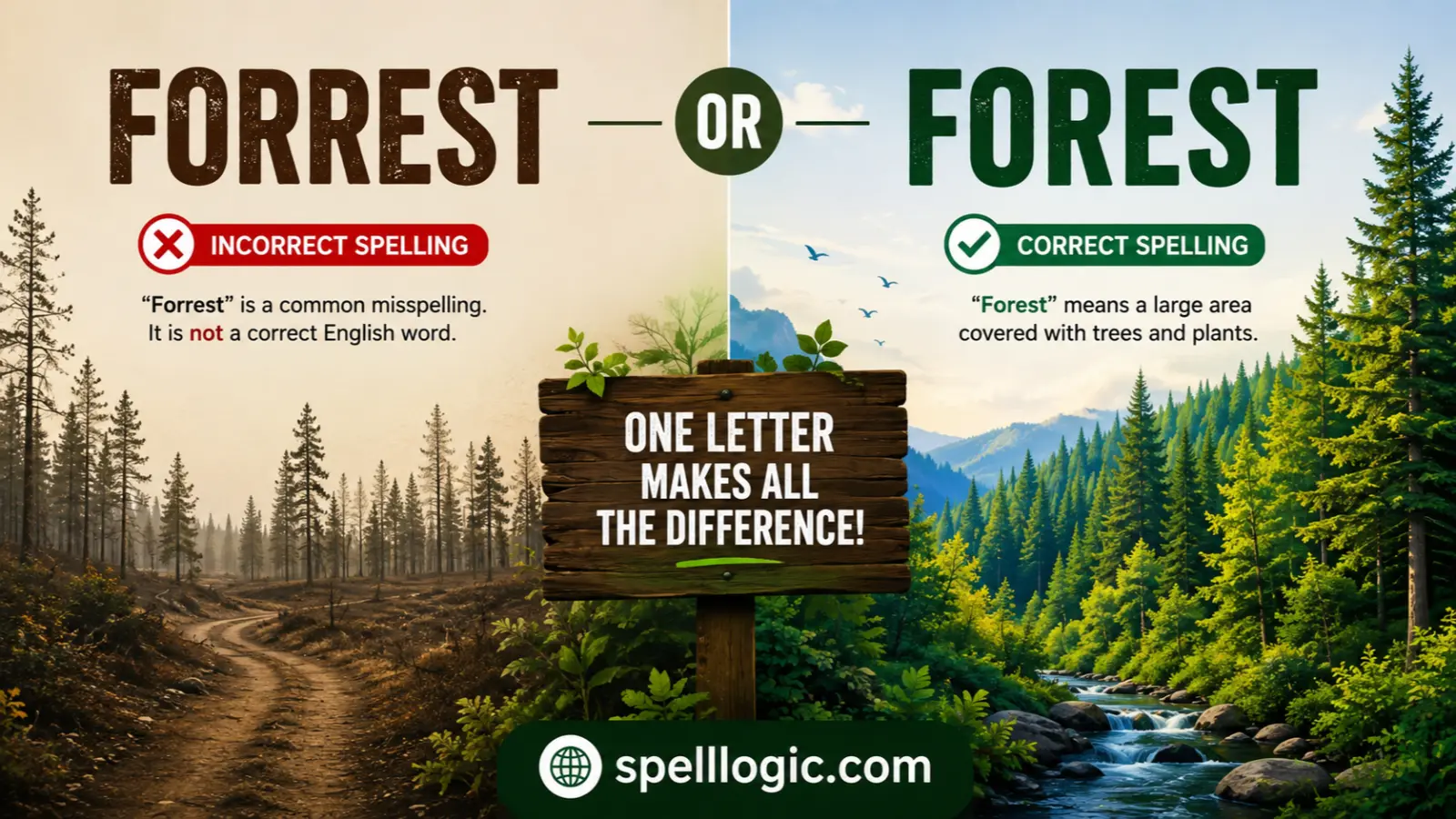
English learners often notice that one extra letter can change the status of a word completely. That is exactly what happens with “forrest or forest.” They look almost identical, and in many accents they sound the same or very similar. However, they do not have the same role in standard English.
One spelling is normally used for a natural area filled with trees, while the other is mainly used as a personal or family name. This distinction matters in essays, emails, schoolwork, and everyday writing. Understanding the difference also helps learners recognize how spelling, capitalization, meaning, and context work together in English.
Why “forrest or forest” Are Confusing
The main reason people mix up forrest or forest is their extremely similar appearance. Both contain the letters f-o-r-e-s-t, and the first form adds another r. When someone is writing quickly, that extra letter can easily appear by mistake.
Similar pronunciation
In many varieties of English, the two forms are pronounced the same or almost the same. This makes the spelling problem harder because listening does not always tell you which form to write.
For example, if someone says, “We walked through the forest,” you cannot depend only on the sound to identify the spelling. You need to understand the meaning and context.
Similar spelling
The standard word for a large area covered mainly by trees is spelled with one r: forest. The phrase forrest or forest is best solved by checking whether you mean a name or a wooded place.
This small spelling difference is easy to miss, especially for learners who are still developing English spelling habits.
Context confusion
Context usually solves the problem. When learners ask about forrest or forest, the subject of the sentence usually gives the answer. If the sentence describes trees, wildlife, nature, hiking, or woodland, the intended word is almost certainly forest. If it refers to a person or family, Forrest may be a proper name.
Common learner mistakes
A common mistake is adding a second r because the word seems as though it should contain one. This is one reason forrest or forest appears in spelling questions. Another mistake is treating the name spelling as an alternative spelling of the natural place. In standard modern English, these uses should not normally be treated as interchangeable.
“Forrest or Forest” Explained Simply
The simplest way to understand forrest or forest is to separate the common noun from the proper name.
One-line distinction: Forest is the standard word for a wooded area; Forrest is mainly a personal or family name.
For example, forrest or forest can be tested by asking whether the sentence names a person or describes woodland:
- We spent the afternoon walking through the forest.
- Forrest joined the team after lunch.
So, “forrest or forest” can be remembered as a difference between a name and a nature word. If you mean trees and woodland, use forest. If you are writing someone’s established name, preserve the spelling Forrest.
Understanding Homophones in English
Words that sound alike can create spelling problems because English spelling does not always match pronunciation. That is especially useful to remember when studying forrest or forest. Learners therefore need to use meaning, grammar, and context rather than sound alone.
What Are Homophones?
Homophones are words that have the same pronunciation, or nearly the same pronunciation in some accents, but different meanings or spellings. A familiar example is two, to, and too.
For this pair, pronunciation can be especially unhelpful because the common name and the ordinary nature word may sound identical in many accents. However, they are not interchangeable spellings.
Why Homophones Cause Confusion
When two forms sound alike, a learner may choose a spelling based on memory rather than meaning. For instance, hearing a sentence about woodland does not automatically reveal whether the speaker means the common noun or is mentioning a person’s name.
The best solution is to look at the sentence. Ask: Is this word naming a place or naming a person? That simple question often gives you the answer.
What Does “forrest” Mean?
Definition and Core Meaning
In standard English, Forrest is primarily a proper name. It can be used as a first name or surname. It is not normally the standard spelling for a wooded area.
Because proper names belong to particular people or families, their spelling should be preserved. If someone’s official name is Forrest, changing it to Forest would be incorrect even though the two forms are closely related.
Origin and Historical Use
The name Forrest is historically connected with the word forest. As a surname, it developed from a term associated with someone who lived near or worked in a forest. Surnames often developed from occupations, locations, physical features, or places where families lived.
Over time, the spelling became established as a family name and later as a given name. One famous example is Forrest Gump, the fictional character from the novel and film of the same name. This familiar name can make forrest or forest easier to remember.
Modern Usage and Synonyms
Because it is generally a proper name, Forrest does not have ordinary synonyms in the way a common noun does. In forrest or forest, the name form should be kept when it identifies a person.
Key points:
- Forrest is usually a first name or surname.
- It begins with a capital letter when used as a name.
- Its spelling should remain unchanged when referring to a specific person.
- It is historically related to the word associated with wooded land.
- It is not the normal spelling for a natural wooded area.
Example Sentences
- Forrest lives near the university.
- My colleague, Forrest, enjoys hiking.
- The author Forrest wrote about his childhood.
- Forrest is a family name in several English-speaking communities.
What Does “forest” Mean?
Definition and Core Meaning
Forest is a common noun referring to a large area of land covered mainly by trees and other vegetation. Forests can support many plants, animals, insects, and microorganisms. They are important parts of natural ecosystems and can be found in many climates.
The word can also be used in broader expressions, such as rainforest, forest floor, and forest fire.
Origin and Historical Context
The English word forest came through Old French and Latin sources and has been used in English for centuries. Its history is separate from the spelling choice learners face in forrest or forest. Historically, it could refer not only to wooded land but also to land designated for hunting or managed under particular laws.
Today, its most common meaning is the natural or managed area dominated by trees.
Modern Usage and Synonyms
Depending on context, related words include woodland, woods, grove, and timberland. These alternatives can help learners understand the meaning needed in forrest or forest questions.
Key points:
- Forest is a common noun.
- It normally refers to a wooded area.
- It can be singular or plural: forest and forests.
- It is usually written with one r.
- It appears in environmental, geographical, scientific, and everyday contexts.
Example Sentences
- The hikers entered the forest before sunrise.
- Many birds live in the forest.
- The government is working to protect the forest.
- We could see a dense forest from the mountain.
“forrest or forest”: Key Differences at a Glance
| Word | Part of Speech | Meaning | Example Context |
|---|---|---|---|
| Forrest | Proper noun | Usually a person’s first name or surname | Forrest arrived early. |
| forest | Common noun | A large area covered mainly by trees | We walked through the forest. |
This table captures the central distinction.
The capitalization is also an important clue. A person’s name normally begins with a capital letter, while the common noun is lowercase unless it begins a sentence or appears in a title.
How to Remember the Difference Between “forrest or forest”
A few simple memory tricks can make the spelling easier when reviewing forrest or forest.
Easy memory tricks
1. One R = trees
Remember: forest is the ordinary nature word. It has only one r.
2. Two Rs = a name
If you see Forrest with two r’s, think of a person’s name, such as a first name or surname.
3. Check capitalization
A capital F can signal that you are looking at a proper name. However, capitalization alone is not enough because Forest could also appear at the beginning of a sentence. Always check the meaning.
Association techniques
Connect the spelling to a visual image. Imagine a green wooded area and write forest underneath it. Then imagine a person wearing a name tag that says Forrest. Repeating these two images can help your brain separate the spellings.
One memorable example
Think of this sentence:
Forrest walked through the forest.
The person is Forrest, while the wooded area is the forest. The sentence contains both forms, so it is an excellent memory aid.
Common Mistakes and Confusions
Mistake 1: Using the name spelling for woodland
✘ We camped in the Forrest last weekend.
This is incorrect if Forrest is not the name of a specific person or place.
✔ We camped in the forest last weekend.
The sentence describes a wooded area, so the common noun is required.
Mistake 2: Changing a person’s name
✘ Forest called me yesterday.
✔ Forrest called me yesterday.
If the person’s established name is Forrest, you must preserve that spelling.
Mistake 3: Assuming the extra letter is optional
Some learners think both spellings can describe trees. In standard usage, that is not a safe assumption. Use forest for the natural area and reserve Forrest mainly for names.
Mistake 4: Choosing by sound alone
Because pronunciation can be identical or very close, listening is not enough. Always consider what the word means in the sentence.
Examples Section: Correct and Incorrect Usage
Here are several examples that show the difference clearly.
✔ Correct: The children explored the forest with their teacher.
✘ Incorrect: The children explored the Forrest with their teacher.
The first sentence refers to woodland, so the lowercase common noun is correct.
✔ Correct: Forrest sent an email to his manager.
✘ Incorrect: Forest sent an email to his manager.
If the person’s name is Forrest, the double-r spelling must be retained.
✔ Correct: We saw deer moving through the forest.
✘ Incorrect: We saw deer moving through the Forrest.
Animals, trees, hiking, and nature strongly indicate the common noun.
✔ Correct: Forrest is my new neighbor.
✘ Incorrect: Forest is my new neighbor.
Here the word identifies a person, so the proper-name spelling is appropriate.
Self Assessment: Test Your Knowledge
Fill in each blank with Forrest or forest. This is a quick forrest or forest check.
- We walked through the dense ________ after lunch.
- ________ introduced himself to the new students.
- Many wild animals depend on the ________ for food and shelter.
- My friend ________ enjoys photography and hiking.
Self Assessment Answers
- forest — The sentence describes a wooded area.
- Forrest — The word is used as a person’s name.
- forest — Food and shelter are being discussed in a natural wooded ecosystem.
- Forrest — The blank refers to a person’s name.
A useful test is to replace the blank mentally with a wooded area or a person’s name. If the first meaning fits, choose the common noun. If the second fits, use the proper name.
FAQs About “forrest or forest”
1. Is “forrest” a correct English word?
Yes, Forrest can be a correct spelling when it is a person’s first name or surname. It is not normally the standard spelling of the common noun referring to a wooded area.
2. Which spelling is correct for a wooded area?
Use forest when you mean a large area covered mainly by trees. For example, “The hikers entered the forest.”
3. Are “forrest” and “forest” pronounced the same?
They can be pronounced the same or very similarly in many English accents. That is why context and spelling are important.
4. Is Forrest a name?
Yes. Forrest is used as both a given name and a surname. Proper names keep their established spelling.
5. Why does Forrest have two r’s?
The spelling developed as a name form related historically to forest. Over time, it became established as a surname and given name.
6. Can I write “Forrest” when talking about nature?
Normally, no. If you mean a wooded area, write forest. Use Forrest when referring to a person or another proper name with that spelling.
7. What is an easy way to remember the spelling?
Remember: one R for the trees, two Rs for the name. This rule makes forrest or forest easier to recall. Then check the meaning before you write.
Final Conclusion: Using “forrest or forest” Correctly
Understanding “forrest or forest” is simple once you focus on meaning instead of pronunciation. Forest is the standard common noun for a large wooded area, while Forrest is mainly used as a person’s first name or surname. Although the two forms look almost identical and may sound the same in many accents, they perform different jobs in writing. This is why spelling matters, especially in school assignments, professional communication, articles, stories, and other formal writing.
When you are unsure, use a quick memory rule: one R means trees; two Rs usually mean a name. You can also look at capitalization and, most importantly, the context of the sentence. For example, “We walked through the forest” clearly describes nature, while “Forrest called me” identifies a person. English has many words and names that sound alike but are written differently, so learning to use context is an important skill. Keep checking meaning, spelling, and sentence purpose, and you will become more confident in choosing the correct form.