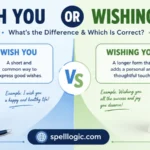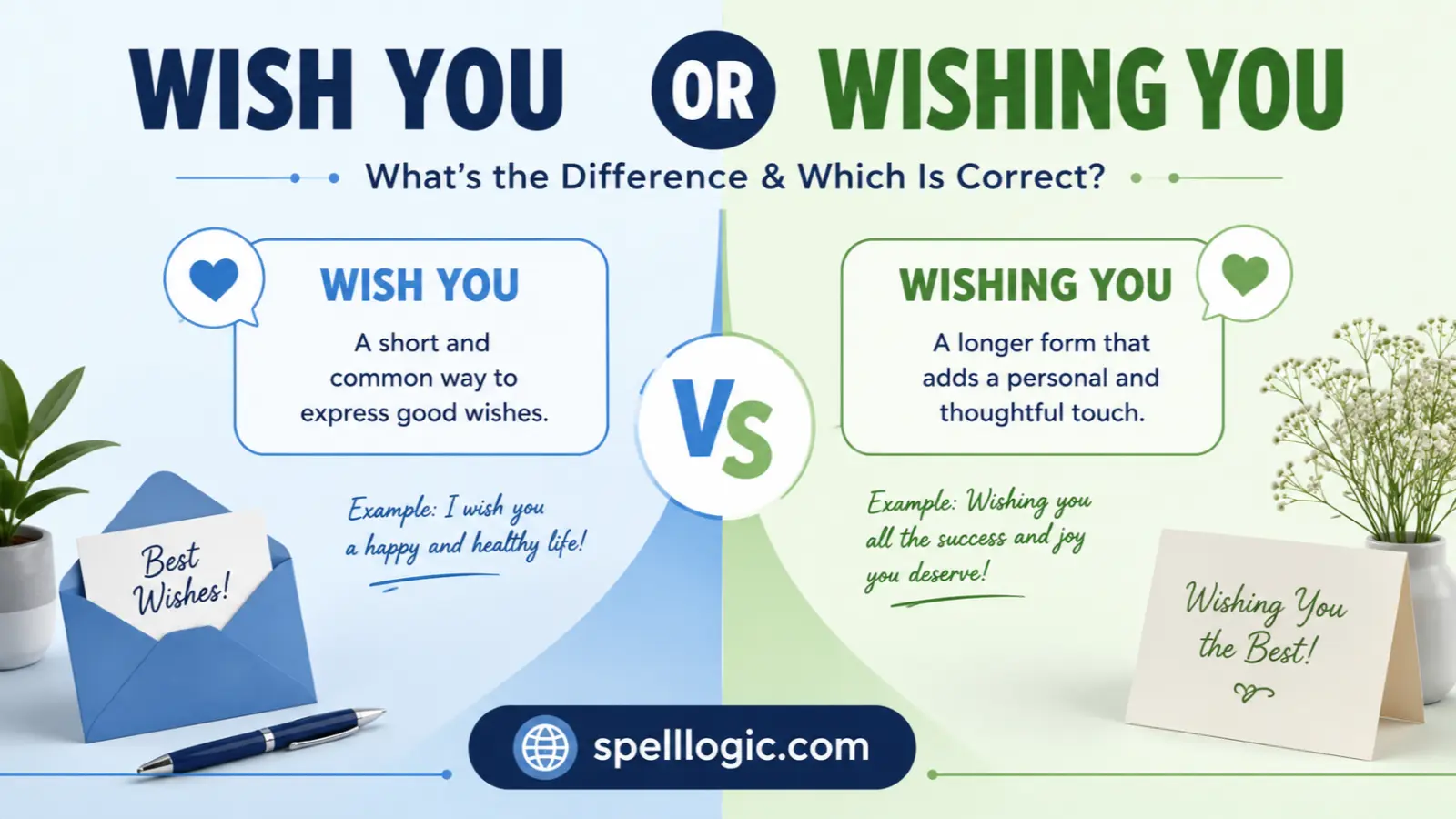
English learners often hesitate between wish you or wishing you when writing greetings, messages, emails, cards, and social posts. Both forms contain the verb wish, but they do not work in exactly the same grammatical structure.
Most direct greetings use “wish you” as part of a complete expression such as “I wish you success,” while “wishing you” is commonly used as a shortened greeting, especially at the beginning or end of a message. Understanding the difference will help you choose the right form confidently.
The keyphrase wish you or wishing you appears often in everyday greetings.
Why “Wish You” and “Wishing You” Are Confusing
The expressions wish you or wishing you are easy to mix up because both communicate a positive hope for another person. They often appear with the same nouns, including success, happiness, luck, health, and a happy birthday. As a result, learners may assume that the two forms can always replace each other.
Similar pronunciation
The words sound familiar because they share the same base verb, wish. The main difference is the ending: wish remains in its base form in “wish you,” while wishing uses the present participle form.
Similar spelling
The forms wish you or wishing you share the same base verb.
Context confusion
Context is one of the biggest reasons learners struggle with wish you or wishing you. A sentence with a clear subject usually takes “wish you,” while a greeting can naturally begin with “wishing you.”
For example:
- “I wish you a wonderful holiday.”
- “Wishing you a wonderful holiday!”
Both can express a warm message, but their grammatical structures are different.
Common learner mistakes
A common mistake is treating “wishing you” as though it were a complete sentence in every situation. In formal grammar, it is usually a shortened form of a longer expression. Another mistake is adding unnecessary words, such as “I wishing you good luck.”
Remember wish you or wishing you when checking the verb pattern.
Wish You vs Wishing You Explained Simply
The easiest way to understand wish you or wishing you is to focus on sentence structure.
Wish you normally follows a subject, such as I, we, or another noun: “I wish you success.”
Wishing you is an -ing form commonly used in greetings, cards, emails, and short messages: “Wishing you success.”
One-line distinction
For wish you or wishing you, grammar decides the best form.
“Wish you” usually forms part of a sentence with a subject, while “wishing you” is commonly used as a shortened greeting or message.
Two example sentences
- “I wish you all the best in your new job.”
- “Wishing you all the best in your new job!”
In the first sentence, I is the subject. In the second, the greeting is an elliptical expression, meaning that some words are understood rather than stated.
Understanding Homophones in English
Although learners sometimes group confusing expressions together as homophones, wish you or wishing you are not homophones. They are different grammatical forms of the same verb.
What Are Homophones?
Homophones are words that sound the same but have different meanings, spellings, or both.
For example:
- right — correct
- write — to form words with a pen or keyboard
They sound alike, but their meanings and spellings differ.
Why Homophones Cause Confusion
Homophones can cause confusion because listeners cannot always tell which word a speaker means until they see the context. For example, “I want to write it right” contains two words that sound alike but have different meanings.
The confusion with wish you or wishing you is different because the two expressions are not homophones. Their main issue is grammatical form and sentence structure.
What Does “Wish You” Mean?
Definition and Core Meaning
Wish you means expressing a hope, desire, or positive thought for another person. It commonly appears after a subject, especially I or we.
For example:
- “I wish you good luck.”
- “We wish you a safe journey.”
- “I wish you every success.”
- “We wish you a happy birthday.”
In wish you or wishing you, this form is especially useful when you want to write a complete grammatical sentence.
Origin and Historical Use
The verb wish has a long history of expressing desire or hope. Over time, it developed into many common expressions used for greetings, blessings, and polite good intentions.
The structure “I wish you…” has become a standard English pattern for expressing a positive hope for someone.
The history behind wish you or wishing you helps explain why both patterns remain familiar.
Modern Usage and Synonyms
Today, wish you or wishing you appears frequently in personal and professional communication. “Wish you” is particularly common when the sentence includes a clear subject.
Related expressions include:
- hope you have
- want you to have
- send you my best wishes
- hope that you enjoy
- offer my best wishes
However, these expressions are not always interchangeable. For instance, “I hope you have a great day” is grammatically different from “I wish you a great day.”
Example Sentences
- “I wish you success in your studies.”
- “We wish you a pleasant stay.”
- “I wish you a very happy birthday.”
- “Our team wishes you continued success.”
- “I wish you good health and happiness.”
When deciding between wish you or wishing you, ask whether you are writing a full sentence with a subject. If you are, “wish you” is often the natural choice.
What Does “Wishing You” Mean?
Definition and Core Meaning
Wishing you is an -ing form of wish commonly used in greetings and messages. It expresses the same basic positive intention as “I wish you,” but it often appears as a shortened, warm expression.
For example:
- “Wishing you a happy birthday!”
- “Wishing you a wonderful weekend!”
- “Wishing you success in your new role!”
- “Wishing you a safe journey!”
In wish you or wishing you, “wishing you” is particularly common in cards, emails, announcements, and friendly messages.
Origin and Historical Context
The -ing form can describe an ongoing action or function within different sentence structures. In greetings, however, “wishing you…” is often an elliptical expression. The complete wording is understood from context.
For example:
“Wishing you a happy birthday!”
can be understood as a shortened form of a message expressing “I am wishing you…” or, more naturally in meaning, “I wish you a happy birthday.”
Modern Usage and Synonyms
Modern English speakers frequently use wishing you because it sounds warm and personal. It is especially popular in:
- birthday cards
- holiday greetings
- wedding messages
- business emails
- farewell notes
- congratulations
- seasonal messages
In greeting language, wish you or wishing you often appears in short messages.
Related expressions include:
- sending you my best wishes
- hoping you have
- best wishes for
- may you have
- I hope you enjoy
For modern messages, wish you or wishing you can both express warmth.
Example Sentences
- “Wishing you a joyful holiday season.”
- “Wishing you all the best for your future.”
- “Wishing you a successful year ahead.”
- “Wishing you peace and happiness.”
- “Wishing you a safe and enjoyable trip.”
When considering wish you or wishing you, remember that “wishing you” is very natural as a greeting, but it should not automatically replace “wish you” inside every sentence.
Wish You vs Wishing You: Key Differences at a Glance
| Word | Part of Speech | Meaning | Example Context |
|---|---|---|---|
| Wish you | Verb phrase | Express a hope or positive desire for someone | “I wish you good luck.” |
| Wishing you | -ing verb phrase used in an elliptical greeting | Express a current or intended good wish | “Wishing you good luck!” |
How to Remember the Difference Between Wish You and Wishing You
Remembering wish you or wishing you becomes easier if you connect each form with a simple pattern.
Easy memory tricks
Think “I + wish.”
If you can put I or we before the expression, “wish you” will often work:
- “I wish you success.”
- “We wish you happiness.”
Think “Greeting = wishing.”
If the expression stands alone as a friendly greeting, “wishing you” is often natural:
- “Wishing you a happy birthday!”
- “Wishing you all the best!”
Association techniques
Connect wish with a complete sentence and wishing with a greeting card.
One memorable example
Imagine writing a birthday card. You can write:
“I wish you a wonderful birthday.”
“Wishing you a wonderful birthday!”
Or:
Both communicate a positive birthday message, but the sentence structures differ.
Common Mistakes and Confusions
Learners often make mistakes because they focus on meaning rather than grammar. The expressions may communicate nearly the same idea, but their structures are not identical.
Wrong example 1
✘ “I wishing you good luck.”
Correct version
✔ “I wish you good luck.”
Explanation: After the subject I, use the base verb wish, not wishing, in this structure.
Wrong example 2
✘ “Wishing you a great day, I hope you enjoy it.”
This is not necessarily grammatically wrong, but the opening can sound less direct depending on the context.
Better version
✔ “I wish you a great day. I hope you enjoy it.”
Wrong example 3
✘ “I am wish you success.”
Correct version
✔ “I wish you success.”
Or, in a different grammatical structure:
✔ “I am wishing you success.”
The second version is possible, but it is less common than the simple “I wish you…” structure in ordinary greetings.
Another common confusion
Some learners believe that “wishing you” is incorrect because it lacks a subject. In greetings, however, shortened or elliptical expressions are common. Therefore, “Wishing you all the best!” is perfectly natural in cards and messages.
Understanding wish you or wishing you means recognizing both grammar and context rather than labeling one form as universally correct.
Examples Section: Correct and Incorrect Usage
Example 1
✔ Correct: “I wish you good luck on your exam.”
✘ Incorrect: “I wishing you good luck on your exam.”
The first sentence has the correct verb form after the subject I.
Example 2
✔ Correct: “Wishing you a happy birthday!”
✘ Incorrect: “Wishing I you a happy birthday!”
The greeting uses the natural shortened pattern “wishing you.”
Example 3
✔ Correct: “We wish you a safe journey.”
✘ Incorrect: “We wishing you a safe journey.”
Use the base form wish after we in this simple present structure.
Example 4
The final contrast in wish you or wishing you is clear from these patterns.
✔ Correct: “Wishing you all the best in your new job!”
✘ Incorrect: “I wishing you all the best in your new job.”
The natural complete version is “I wish you all the best in your new job.”
These examples show why wish you or wishing you should be selected according to sentence structure and context.
Self Assessment: Test Your Knowledge
Fill in each blank with wish you or wishing you.
- I ______ a very happy birthday.
- ______ you success in your new position!
- We ______ a safe and pleasant journey.
- ______ you all the best for the future!
Self Assessment Answers
These answers reinforce the difference between wish you or wishing you.
- wish you — “I wish you a very happy birthday.”
- Wishing you — “Wishing you success in your new position!”
- wish you — “We wish you a safe and pleasant journey.”
- Wishing you — “Wishing you all the best for the future!”
A useful rule for wish you or wishing you is to look for the subject. If I or we directly introduces the verb, “wish” is generally the appropriate form. If the phrase works as a standalone greeting, “wishing” is often a natural choice.
FAQs About “Wish You and Wishing You”
The following answers clarify common wish you or wishing you questions.
1. Is “wish you” grammatically correct?
Yes. “Wish you” is grammatically correct when it appears in an appropriate sentence structure, such as “I wish you success.”
2. Is “wishing you” correct in English?
Yes. “Wishing you…” is very common in greetings, cards, emails, and short messages, such as “Wishing you a happy birthday!”
3. Which is more formal, “wish you” or “wishing you”?
Both can be appropriate. “I wish you…” is a complete sentence and can sound polished in professional writing. “Wishing you…” is also widely used in professional greetings and sign-offs.
4. Can I write “wishing you all the best”?
Yes. “Wishing you all the best” is a natural and widely accepted expression.
5. Should I say “I wish you” or “I wishing you”?
Use “I wish you” for the simple present structure. “I wishing you” is incorrect because wishing cannot directly follow I without an auxiliary verb.
6. Is “wish you a happy birthday” correct?
It is understandable and common in informal messages, but “I wish you a happy birthday” is the complete grammatical sentence. “Wishing you a happy birthday!” is also natural as a greeting.
7. Are “wish you” and “wishing you” interchangeable?
When learning wish you or wishing you, focus on structure rather than meaning alone.
Not in every grammatical context. They can communicate a similar good wish, but their sentence structures differ. Choose according to whether you are writing a complete sentence or a shortened greeting.
Final Conclusion: Using “Wish You” and “Wishing You” Correctly
Understanding wish you or wishing you is mainly about recognizing sentence structure rather than memorizing two completely different meanings. “Wish you” is normally used with a subject in a complete sentence, especially in expressions such as “I wish you success,” “We wish you good health,” or “I wish you a happy birthday.” “Wishing you,” on the other hand, is an -ing expression commonly used as a warm, shortened greeting: “Wishing you a wonderful day!” A simple memory trick is to connect “wish” with “I” or “we” and “wishing” with greeting cards and standalone messages.
Also remember that these expressions are not homophones; their difference comes from grammar and usage. Once you notice the subject and the context, choosing between them becomes much easier. Keep practicing with wish you or wishing you in everyday examples, and these friendly expressions will soon feel natural and effortless in your English writing.