English learners often wonder whether the plural of person can be both people and peoples. The answer is yes, but these forms do not have the same meaning in every situation. Understanding is important because choosing the wrong form can make a sentence sound unnatural or change its meaning. In everyday English, people is by far the more common plural of person.
However, peoples has a special use when we talk about separate nations, ethnic groups, or communities. Once you understand this distinction, the choice becomes much easier. This guide explains the difference with clear rules, examples, memory tips, and practice questions.
Why “People or Peoples” Are Confusing
The question people or peoples usually comes from uncertainty about plural forms in English.
The confusion happens because both forms are related to the noun person, and both can refer to more than one individual. However, they are used at different levels of meaning.
- Similar pronunciation: Both forms begin with the same sound, so learners may focus on the ending rather than the meaning.
- Similar spelling: The two words share the same base form, with peoples simply adding -s.
- Context confusion: In ordinary conversation, people usually means multiple individuals. In academic, historical, political, or cultural writing, peoples can mean distinct groups.
- Common learner mistakes: A learner may add -s automatically because many English nouns form plurals that way. Another common mistake is using peoples when simply talking about several people.
The key is to look at what the noun describes. If you mean individual human beings in general, use people. If you mean several distinct groups or nations, peoples may be appropriate.
People vs Peoples Explained Simply
The choice between people or peoples depends on whether you mean individuals or distinct groups.
The simplest way to understand the difference is to ask whether you mean individuals or separate groups.
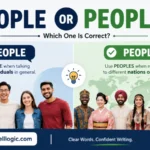
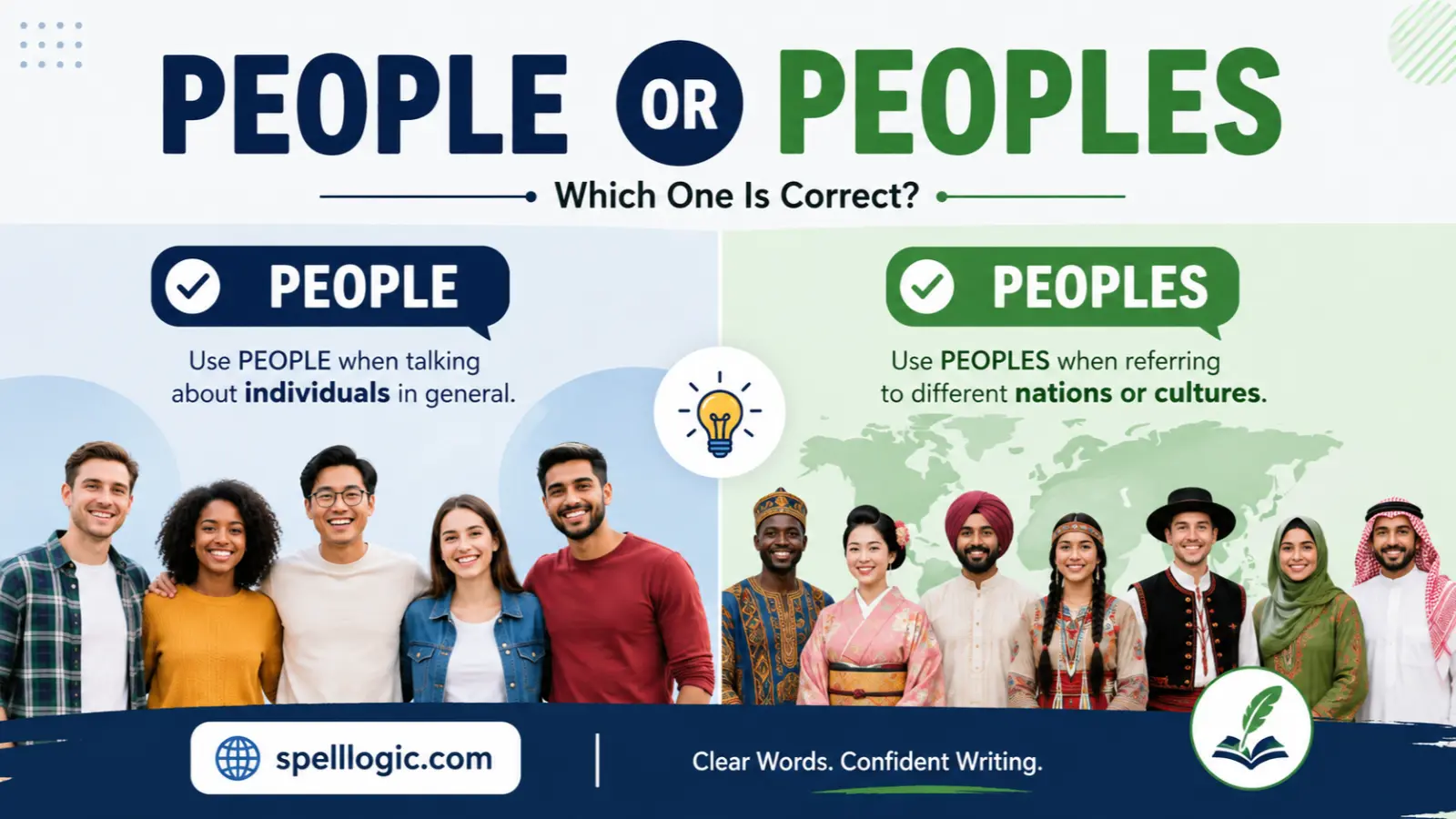
One-line distinction: People usually means multiple persons, while peoples means multiple distinct populations, nations, ethnic groups, or cultural communities.
For example:
- People means more than one person: Many people attended the meeting.
- Peoples means separate groups: The museum celebrates the indigenous peoples of the region.
A useful rule is that people is the normal plural of person in everyday English. Peoples is a special plural used when the word people itself represents a particular population or community.
Understanding Homophones in English
Although people or peoples are not homophones, their close spelling can still confuse learners.
What Are Homophones?
The phrase people or peoples is useful here because it shows that similar-looking words can have different grammatical roles.
Homophones are words that have the same pronunciation but different meanings and spellings. For example, right and write sound alike but have different meanings.
People and peoples are not true homophones because the extra -s changes the pronunciation. Still, learners can confuse them because the words are closely related and often appear in similar contexts.
Why Homophones Cause Confusion
Learners considering people or peoples should always check the meaning provided by the sentence.
Sound alone does not always tell us which English word to choose. For instance, a learner may know that person becomes people but may not know when peoples is acceptable. Context provides the answer.
Compare these sentences:
- The people in the room were quiet.
- The indigenous peoples of the continent have diverse traditions.
The first sentence focuses on individuals. The second emphasizes separate communities.
What Does “People” Mean?
In most everyday questions about people or peoples, the answer is people when individual humans are meant.
Definition and Core Meaning
For people or peoples, the basic everyday meaning belongs to people.
People is the usual plural of person. It refers to two or more human beings considered individually or collectively.
Examples include:
- Three people are waiting outside.
- Many people enjoy reading.
- The people in our neighborhood are friendly.
- People need clean water and safe homes.
In most everyday situations, people is the correct choice when you are talking about more than one person.
Origin and Historical Use
The history of people or peoples reflects the older collective meaning of people.
The word people has a long history in English and comes through Old French pople from Latin populus, meaning a population or community. Over time, English developed people as an irregular plural of person for ordinary reference to human beings.
Modern Usage and Synonyms
Modern English makes people or peoples easier to choose when you identify whether the reference is individual or collective.
In modern English, people can refer to:
- Individual human beings: Five people arrived.
- Humans in general: People learn in different ways.
- Residents of a place: The people of the town welcomed visitors.
- Members of a community: Local people supported the project.
Example Sentences
- A lot of people use smartphones every day.
- The people at the front desk were helpful.
- Several people joined the discussion.
- People often make mistakes when learning a new language.
When the intended meaning is simply “more than one person,” people is the natural choice.
What Does “Peoples” Mean?
Definition and Core Meaning
The special use of people or peoples becomes clear when separate communities are being discussed.
Peoples is the plural of people when people means a distinct population, nation, ethnic group, or cultural community. It is not normally used just to mean “many persons.”
For example:
- The museum studies the indigenous peoples of North America.
- The agreement protects the rights of several peoples.
- Ancient peoples developed different systems of writing.
Here, each people represents a distinct group, and peoples refers to more than one such group.
Origin and Historical Context
The use of peoples developed from the older collective meaning of people, where a people could mean a nation or organized community. This sense remains important in historical, legal, anthropological, political, and cultural writing.
Modern Usage and Synonyms
When choosing people or peoples, consider whether words such as nations or communities could replace the intended meaning.
Common contexts for peoples include:
- Indigenous or tribal communities
- Ethnic populations
- Distinct nations or national groups
- Historical civilizations
- Communities with separate cultural identities
Example Sentences
The following examples make the distinction in people or peoples easier to recognize.
- The rights of indigenous peoples should be respected.
- Several ancient peoples lived in the region.
- The festival brings together different peoples and cultures.
- Historians study how neighboring peoples interacted.
The important point is that peoples identifies more than one distinct group, not merely a large number of individuals.
People vs Peoples: Key Differences at a Glance
A quick comparison makes people or peoples easier to remember.
| Word | Part of Speech | Meaning | Example Context |
|---|---|---|---|
| People | Plural noun | More than one person; humans generally | Many people attended the event. |
| Peoples | Plural noun | More than one distinct population or community | The rights of indigenous peoples matter. |
Therefore, if you are counting individuals, choose people. If you are comparing or discussing separate populations, choose peoples.
How to Remember the Difference Between People and Peoples
A simple memory rule can solve most people or peoples questions.
A few simple memory techniques can make this distinction easier.
1. Think “persons” for People
This substitution test is especially helpful when deciding people or peoples in everyday sentences.
When you can replace the word with persons or individuals, people is usually correct.
- Ten people attended.
- Ten persons attended.
The second version is more formal, but the meaning is similar.
2. Think “groups” for Peoples
The groups test provides another quick way to choose between people or peoples.
When you can replace the word with groups, nations, or communities, peoples may be correct.
- The indigenous peoples of the region
- The indigenous groups of the region
The word peoples highlights separate identities.
3. Remember the Extra “S”
The extra s in people or peoples can remind you of separate groups.
Think of the extra s as standing for separate groups. This is not a formal grammar rule, but it is a useful memory association.
One Memorable Example
This example brings the meaning of people or peoples together in one sentence.
Imagine a conference attended by 500 individuals from five different cultural communities. You can say:
Five hundred people attended the conference, representing five different peoples.
The first people counts individuals. The second peoples counts distinct communities.
Common Mistakes and Confusions
Most errors with people or peoples happen when learners treat the two forms as interchangeable.
Many learners make the same errors when choosing between these forms.
Mistake 1: Adding “-s” to Mean Many Persons
✘ There were many peoples at the bus station.
✔ There were many people at the bus station.
Why? The sentence describes individual persons, not distinct ethnic or cultural groups.
Mistake 2: Using “People” for Separate Nations
✘ The treaty recognizes the different people of the region.
✔ The treaty recognizes the different peoples of the region.
Why? The sentence refers to multiple distinct populations.
Mistake 3: Treating “Peoples” as the Normal Plural
✘ How many peoples are in your classroom?
✔ How many people are in your classroom?
Why? A classroom contains individual students, so people is appropriate.
Mistake 4: Assuming “Peoples” Is Always Wrong
✘ Peoples is never correct.
✔ The rights of indigenous peoples are protected.
Why? Peoples is correct when it refers to separate populations or communities.
Examples Section: Correct and Incorrect Usage
The examples below reinforce the difference between people or peoples in real sentences.
Example 1: Everyday Conversation
✔ Correct: There were many people at the concert.
✘ Incorrect: There were many peoples at the concert.
The sentence is about individual attendees, so people is the natural choice.
Example 2: Cultural Groups
✔ Correct: The exhibition explores the traditions of several peoples.
✘ Incorrect: The exhibition explores the traditions of several people.
The intended meaning is separate cultural groups, so peoples is appropriate.
Example 3: Counting Individuals
✔ Correct: Twenty people applied for the job.
✘ Incorrect: Twenty peoples applied for the job.
Job applicants are individual persons, not separate populations.
Example 4: Historical Communities
✔ Correct: Ancient peoples built settlements near the river.
✘ Incorrect: Ancient people built settlements near the river.
The sentence is clearer with peoples when the writer means several distinct ancient groups.
Example 5: General Human Behavior
✔ Correct: People learn languages in different ways.
✘ Incorrect: Peoples learn languages in different ways.
The statement discusses humans generally, not separate communities.
Self Assessment: Test Your Knowledge
Use the questions below to check how well you understand people or peoples.
Fill in each blank with people or peoples.
- Many ______ attended the public meeting.
- The rights of indigenous ______ are discussed in the report.
- How many ______ work in this office?
- Several ancient ______ lived along the river.
Self Assessment Answers
The answers confirm the key rule for people or peoples.
- people — The sentence refers to individual attendees.
- peoples — The sentence refers to distinct indigenous communities.
- people — The office has individual workers.
- peoples — The sentence refers to separate ancient groups.
FAQs About “People and Peoples”
These common questions about people or peoples address frequent learner concerns.
1. Is “people” the plural of “person”?
Yes. People is the most common plural of person. For example, One person came early becomes Two people came early.
2. Is “peoples” grammatically correct?
Yes. Peoples is correct when people means a distinct nation, ethnic group, cultural community, or population and you are referring to more than one such group.
3. When should I use “people” instead of “peoples”?
Use people when you mean two or more individual human beings or humans in general. This is the normal choice in everyday English.
4. Can “peoples” mean a large number of people?
Usually, no. If you simply mean a large number of individuals, use people. Peoples normally emphasizes separate groups or populations.
5. Is “persons” also a plural of “person”?
Yes. Persons is grammatically correct, but it is more formal and is common in legal, official, or administrative contexts. In ordinary conversation, people is much more natural.
6. What is the difference between “people” and “peoples” in history?
In historical writing, people can refer to a population or community, while peoples usually refers to multiple distinct populations or communities.
7. Which form is more common in everyday English?
People is much more common. Most learners should use people unless the context clearly refers to separate nations, ethnic groups, or cultural communities.
Final Conclusion: Using “People” and “Peoples” Correctly
Knowing the difference between people or peoples becomes simple once you focus on the meaning rather than the spelling. People is the normal plural of person and is used when talking about two or more individuals, humans generally, or people in an everyday group. For example, we say, Many people attended the meeting and People enjoy different kinds of music.
Peoples, on the other hand, is a special plural of people used when referring to several distinct populations, nations, ethnic groups, or cultural communities. You might read about indigenous peoples, ancient peoples, or different peoples and cultures. A useful memory trick is to connect people with individual persons and peoples with separate groups.
If you are counting individuals, choose people. If you are comparing distinct communities, peoples may be the right choice. With regular practice and attention to context, English learners can make this choice confidently. Keep reading, writing, and checking examples, and these two forms will soon feel natural.