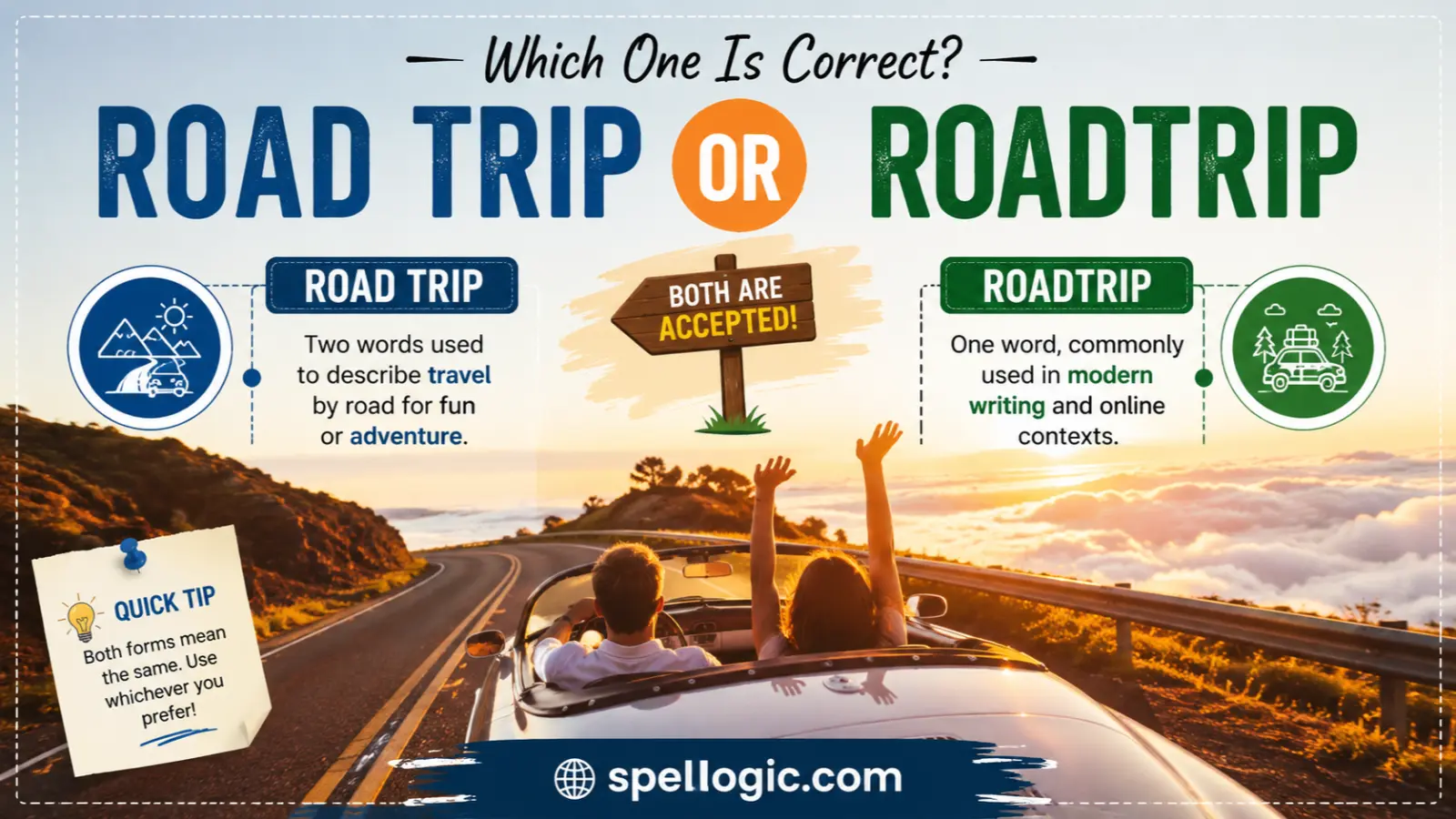
English learners often wonder whether road trip or roadtrip is the correct spelling. The confusion is understandable because both forms look almost identical, sound the same, and refer to the same idea. However, standard English normally treats this expression as two words: road trip.
The closed form roadtrip is sometimes seen informally, but it is not the standard spelling in most edited English. Learning this small difference can improve your writing, search queries, travel plans, and everyday communication. Once you understand how the expression works, choosing the correct form becomes easy. If you searched for road trip or roadtrip, this is the spelling rule to remember.
Why “road trip or roadtrip” Are Confusing
The main reason road trip or roadtrip causes confusion is that English frequently changes phrases into compound words. Learners may see compounds such as “roadside,” “roadway,” and “roadmap” and naturally assume that this expression should also be written as one word. That is why road trip or roadtrip can look like a difficult choice at first.
Similar pronunciation
Both forms are normally pronounced in the same way. When people speak, there is no clear sound that tells a listener whether the writer used one word or two. As a result, learners must rely on spelling and context.
Similar spelling
The two forms contain exactly the same letters. The only visible difference is the space. That small difference can be easy to overlook, especially when reading quickly or typing on a phone.
Context confusion
Travel blogs, social media posts, advertisements, and informal messages may use nonstandard closed compounds. Seeing “roadtrip” online can make learners think it is equally acceptable in formal writing. Standard dictionaries and edited publications generally prefer the open compound “road trip.” For learners checking road trip or roadtrip, the space is the important detail.
Common learner mistakes
A common mistake is to assume that a familiar phrase becomes one word simply because it is used frequently. Another mistake is to treat informal internet spelling as a standard dictionary form. For careful writing, choose the established form. In standard English, road trip or roadtrip is mainly a question of conventional spelling.
Road trip vs roadtrip Explained Simply
The simple answer is that road trip is the standard form in English. It is a noun phrase made from the noun “road” and the noun “trip.” It describes a journey made by car or another road vehicle, usually for pleasure or exploration.
One-line distinction: Road trip is the standard spelling; roadtrip is a nonstandard or informal closed spelling that should generally be avoided in formal English.
For example:
- We are planning a road trip along the coast.
- Our summer road trip will last ten days.
So, road trip or roadtrip has a straightforward answer: use “road trip” when you want standard English. When comparing road trip or roadtrip, pronunciation does not provide the answer.
Understanding Homophones in English
What Are Homophones?
Homophones are words that have the same pronunciation but different meanings or spellings. For example, “two,” “to,” and “too” sound alike but have different functions and meanings.
However, road trip or roadtrip is not actually a homophone problem. The two forms are pronounced alike because one is simply the closed spelling of the same expression. The issue is spelling rather than pronunciation.
Why Homophones Cause Confusion
Pronunciation alone cannot always tell English learners which spelling to choose. For example, someone may hear “I want to go there too” and need to know from context whether “to” or “too” is intended.
A similar spelling challenge occurs here: when speakers say the phrase, the listener cannot hear the space between “road” and “trip.” Writers therefore need to know the conventional written form. A quick search for road trip or roadtrip may show both forms, especially online.
What Does “road trip” Mean?
Definition and Core Meaning
A road trip is a journey taken by road, usually in a car, van, or similar vehicle. The journey often involves visiting several places and enjoying the travel experience itself, rather than simply reaching one destination.
In the question road trip or roadtrip, the standard noun is “road trip.”
The expression can describe both short and long journeys. A road trip might last a few hours, several days, or even weeks. The safest answer to road trip or roadtrip is the two-word form.
Origin and Historical Use
The expression developed naturally from “road” and “trip.” As automobile travel became common, the term became established for recreational journeys by road. The two-word form remains standard.
English has many open compounds, so keeping the words separate is not unusual. Similar patterns appear in expressions such as “bus stop,” “train station,” and “school trip.” This distinction makes road trip or roadtrip easier to use confidently.
Modern Usage and Synonyms
Today, road trip is common in everyday conversation, travel writing, journalism, and online content.
Depending on the context, related expressions include:
- driving holiday
- car journey
- road journey
- driving tour
- cross-country drive
- long drive
They are not always exact synonyms. “Driving holiday” emphasizes the vacation, while “road trip” often emphasizes the journey itself. For an English learner, road trip or roadtrip is a useful example of compound-word spelling.
Example Sentences
- My friends and I took a road trip through the mountains.
- She is organizing a road trip for the summer.
The standard spelling is therefore clear whenever you write the noun in a formal or carefully edited context. The phrase road trip or roadtrip often appears in travel-related searches.
What Does “roadtrip” Mean?
Definition and Core Meaning
Roadtrip is generally understood as an informal closed spelling of “road trip.” People may use it online, in usernames, hashtags, captions, or casual messages. However, it is not the preferred standard form for ordinary English prose.
In other words, the meaning does not change. The difference is mainly one of spelling and standard usage. If your goal is accurate English, choose road trip or roadtrip carefully.
Origin and Historical Context
The closed form reflects a general English tendency to turn familiar combinations into compounds. Examples include “notebook” and “bedroom.”
However, not every combination follows that path. “Road trip” remains conventionally open in standard English. This is the key point to remember about road trip or roadtrip.
Modern Usage and Synonyms
You may encounter “roadtrip” in informal digital writing. A social media user might write a caption such as “Best roadtrip ever!” This does not necessarily mean the writer is following formal spelling conventions.
For standard writing, use:
- road trip
- driving holiday
- car journey
- road journey
- driving tour
When accuracy matters, the two-word form is the safer choice. Many learners ask road trip or roadtrip because the spoken phrase sounds identical.
Example Sentences
- Informal online writing may contain “We had an amazing roadtrip.”
- A carefully edited article should normally say “We had an amazing road trip.”
- A brand or social media account may use “roadtrip” as a creative label.
Therefore, when deciding between road trip or roadtrip, remember that the closed form may appear in informal contexts, but it is not the preferred standard spelling.
Road trip vs roadtrip: Key Differences at a Glance
| Word | Part of Speech | Meaning | Example Context |
|---|---|---|---|
| Road trip | Noun phrase | A journey by road, often for pleasure | “We planned a road trip across the country.” |
| Roadtrip | Informal/nonstandard spelling | Same intended meaning as “road trip” | “Roadtrip!” in a casual social media caption |
The table makes the central point easy to remember: the meaning is essentially the same, but standard English prefers the open form. The standard answer for road trip or roadtrip does not depend on the length of the journey.
How to Remember the Difference Between Road trip and roadtrip
A useful memory trick is to think of road trip as two simple ideas joined together:
road + trip = road trip
You are taking a trip on a road, so keep the two words visible.
Easy memory tricks
- Remember the phrase as “a trip by road.”
- Think of “road” as describing the type of “trip.”
- Use the two-word form in essays, emails, reports, and articles.
- Treat “roadtrip” as an informal internet-style spelling rather than your default choice.
Association techniques
Connect road trip with other familiar two-word travel expressions:
- train journey
- bus trip
- car journey
- weekend trip
- school trip
Seeing these expressions as separate words can help you remember the conventional pattern. In edited English, road trip or roadtrip should normally be resolved in favor of the open form.
One memorable example
Think: “Our road trip starts on Friday.” The phrase describes one trip, but it is written with two words. The examples above show how road trip or roadtrip works in real sentences.
Common Mistakes and Confusions
One frequent mistake is writing the expression as one word in formal content.
Wrong: We are planning a roadtrip across the country.
Correct: We are planning a road trip across the country.
The problem is not the meaning. Most readers will understand “roadtrip.” The issue is that standard edited English normally uses the open form. Keep this spelling rule in mind when writing about road trip or roadtrip.
Another mistake is assuming that every popular online spelling is standard. Social media contains many informal forms, so it is not always a guide to formal English.
A third mistake is assuming that the expression must become one word because other “road” compounds are closed. English compound spelling is not completely predictable. The main lesson from road trip or roadtrip is that familiar usage does not always determine standard spelling.
Examples Section: Correct and Incorrect Usage
Example 1
✔ Correct: We are taking a road trip to the coast.
✘ Incorrect: We are taking a roadtrip to the coast.
Explanation: Use the standard two-word noun phrase in formal and general writing.
Example 2
✔ Correct: Our road trip begins tomorrow morning.
✘ Incorrect: Our roadtrip begins tomorrow morning.
Explanation: The standard spelling keeps “road” and “trip” separate.
Example 3
✔ Correct: They shared photos from their road trip.
✘ Incorrect: They shared photos from their roadtrip.
Explanation: Edited articles and professional content should normally use the open form.
Example 4
✔ Correct: We planned a three-day road trip through the countryside.
✘ Incorrect: We planned a three-day roadtrip through the countryside.
Explanation: “Road trip” remains two words even when another adjective describes the journey.
Example 5
✔ Correct: Her road trip was full of unexpected adventures.
✘ Incorrect: Her roadtrip was full of unexpected adventures.
Explanation: The standard noun phrase is written separately.
Self Assessment: Test Your Knowledge
Fill in each blank with road trip or roadtrip.
- We are going on a long ________ next month.
- Their ________ across the country lasted two weeks.
- The travel article describes an exciting ________ through the mountains.
- Which spelling is preferred in standard English: ________ or ________?
Self Assessment Answers
- road trip
- road trip
- road trip
- road trip, not roadtrip, is preferred in standard English.
FAQs About “road trip and roadtrip”
Is “road trip” one word or two?
“Road trip” is normally written as two words. It is the standard spelling used in careful English writing.
Is “roadtrip” grammatically correct?
“Roadtrip” is understandable and appears in informal writing, but it is generally not the preferred standard spelling. Use “road trip” when accuracy matters.
Why do people write “roadtrip”?
People may write the closed form because the expression is familiar, because they are following informal internet usage, or because they assume common phrases should become compound words.
Is road trip a noun?
Yes. “Road trip” is a noun phrase referring to a journey made by road, often for enjoyment or exploration.
Can I use “road trip” in formal writing?
Yes. “Road trip” is suitable for essays, articles, business content, travel writing, and other standard forms of English.
Are “road trip” and “roadtrip” pronounced differently?
No. They are normally pronounced the same way. The important difference is their written form and level of standardness.
Should I use “roadtrip” on social media?
You may see or use the closed form in informal branding, hashtags, or creative captions, but “road trip” is still the safer standard spelling in ordinary text.
Final Conclusion: Using “road trip” and “roadtrip” Correctly
Understanding road trip or roadtrip is easier once you separate pronunciation from spelling. Both forms are usually intended to describe the same kind of journey: traveling by road, often for fun, exploration, or a holiday. However, standard English normally writes the expression as road trip, with a space. The form roadtrip can appear in informal online communication, social media, creative branding, or other casual settings, but it should not be your first choice in formal or carefully edited writing.
The easiest memory trick is simple: think of the expression as “a trip by road.” Because “road” describes the “trip,” keep the two words separate. You can also connect it with other familiar expressions such as “car journey,” “bus trip,” and “school trip.” When writing an essay, article, email, report, or professional webpage, choose road trip.
Language becomes easier when you learn these small spelling patterns in context. The next time you need to describe a long drive filled with interesting places, remember the simple rule: road trip is the standard choice. Keep practicing, keep reading, and these confusing word forms will soon become much easier to use correctly. Finally, remember road trip or roadtrip whenever you write about a journey by car.