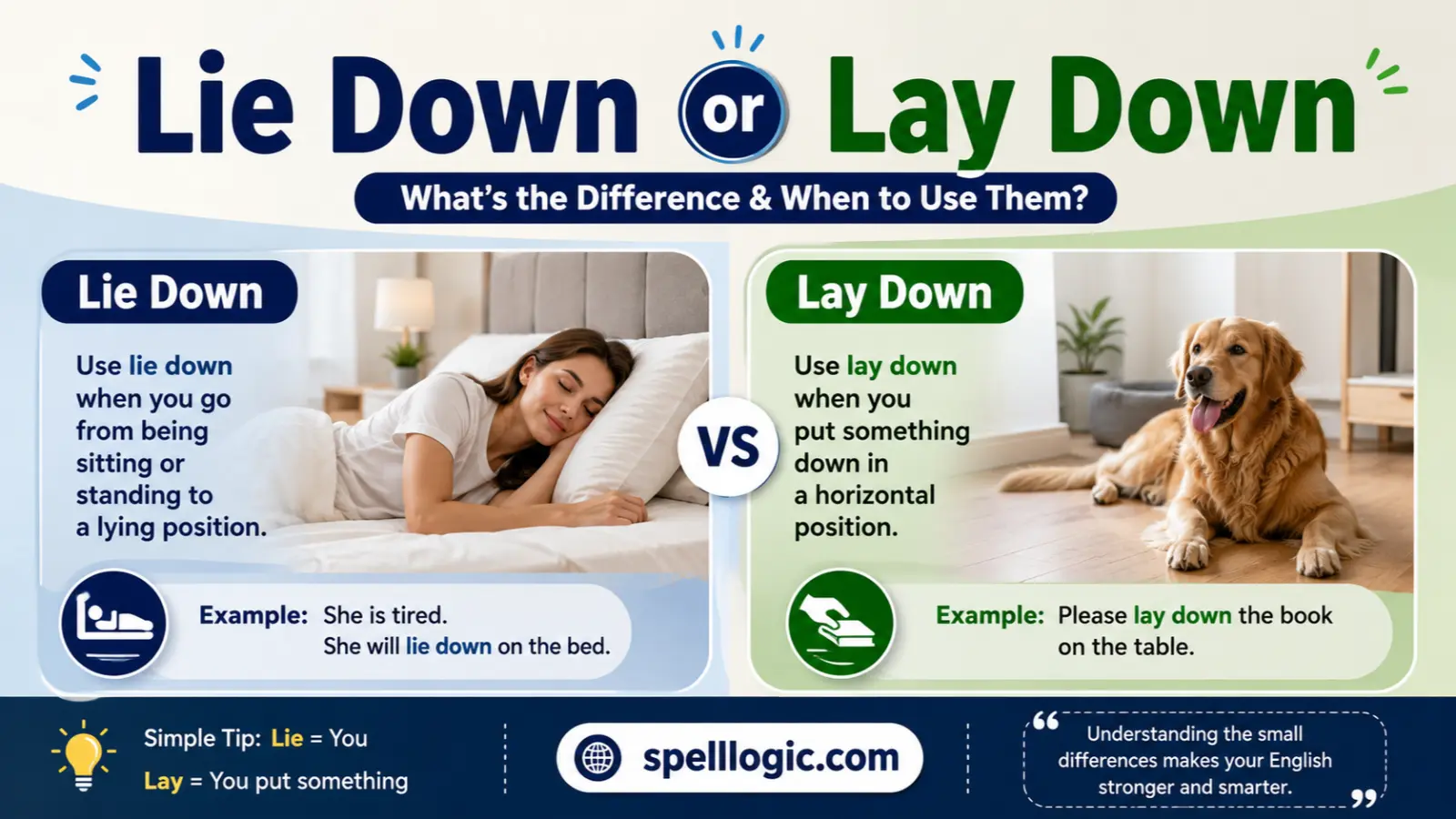
Lie down or lay down is a common English grammar question because both expressions describe putting your body in a resting position. The confusion becomes stronger because lay is also the past tense of lie, while lay can be a present-tense verb with an object. As a result, even experienced English speakers sometimes use these forms incorrectly.
Understanding the difference is important because the correct choice depends on whether someone is resting themselves or placing something somewhere. Once you learn this simple grammar rule and connect it with a few easy examples, the difference becomes much easier to remember and use naturally in everyday English.
Why “Lie Down or Lay Down” Are Confusing
The expressions lie down or lay down are frequently mixed up because the verbs lie and lay look and sound very similar. However, they do not work in exactly the same way.
Similar Pronunciation
In many accents, lie and lay are easy to confuse when spoken quickly. Their similar sounds can make learners choose the wrong verb when writing.
Similar Spelling
Both words contain only three letters and begin with “l.” More importantly, lay has a special relationship with lie because it is the past-tense form of lie.
For example:
- Present: I lie on the sofa.
- Past: Yesterday, I lay on the sofa.
This change creates one of the biggest problems for English learners.
Context Confusion
The meaning and grammar depend on what comes after the verb. Lie normally describes a person or animal resting or being in a horizontal position. Lay normally means to put or place something somewhere and therefore usually needs a direct object.
Compare:
- I lie down after work.
- I lay the blanket down on the floor.
The first sentence describes what the subject does to themselves. The second describes an action performed on an object.
Common Learner Mistakes
A common mistake is saying, “I am going to lay down,” when the intended meaning is “I am going to rest.” In standard English, lay needs an object in this present-tense use.
Another source of confusion is the past tense:
- Today: I lie down.
- Yesterday: I lay down.
- I have lain down.
The forms change according to tense, which makes this verb pair especially challenging.
“Lie Down or Lay Down” Explained Simply
The simplest way to understand lie down or lay down is to ask: Is the person resting, or are they placing something?
Lie down means to move your body into a horizontal or resting position.
Lay down means to put or place something somewhere.
One-Line Distinction
Lie = rest yourself; lay = put something somewhere.
Two Example Sentences
- I am tired, so I will lie down for a few minutes.
- Please lay down the books on the table.
A useful rule is:
If there is an object receiving the action, use lay in the present tense.
For example, in “Lay the phone down,” the phone receives the action. In “Lie down,” there is no direct object.
Understanding Homophones in English
Although lie and lay are not exact homophones in their present forms, learners often experience them as a similar-sounding verb pair. Their connection becomes especially confusing because lay is the past form of lie.
What Are Homophones?
Homophones are words that sound the same but have different meanings, spellings, or grammatical functions.
For example:
- right = correct
- write = to form words with a pen or keyboard
These words sound alike but have different meanings and spellings.
Why Homophones Cause Confusion
Similar-sounding words can be difficult to distinguish when learners mainly depend on pronunciation. Verb forms create an additional problem because English does not always use a predictable pattern for past tense.
The pair lie/lay/lain is a good example. Learners may remember the words individually but struggle to select the correct form in a sentence.
What Does “Lie Down” Mean?
Definition and Core Meaning
Lie down means to place your own body in a horizontal or resting position. It is an intransitive verb phrase, which means it normally does not take a direct object.
You can lie down on a bed, sofa, floor, or other suitable surface.
Examples:
- I need to lie down after the long journey.
- The child decided to lie down on the couch.
- Please lie down and relax.
- The dog likes to lie down near the fireplace.
Origin and Historical Use
The verb lie has a long history in English and comes from an Old English verb associated with being in a resting or horizontal position. Its basic meaning has remained relatively stable over centuries.
The phrase lie down developed naturally from this basic idea. It describes the movement or action of becoming horizontal.
One important point is that lie in this context is different from another English verb, lie, meaning “to say something untrue.” The two verbs have different histories and grammatical patterns.
Modern Usage and Synonyms
In modern English, lie down is common in everyday conversation and writing.
Related words and expressions include:
- recline
- rest
- stretch out
- relax
- take a rest
- settle down
These alternatives are not always exact replacements, but they can express a similar idea depending on the context.
More Example Sentences
- I usually lie down when I feel exhausted.
- She went upstairs to lie down for a while.
- The doctor told him to lie down.
- The cat likes to lie down in the sunlight.
- After lunch, he wanted to lie down.
Remember that lie does not normally take a direct object when it means “recline” or “rest.”
What Does “Lay Down” Mean?
Definition and Core Meaning
Lay down means to put, place, or set something in a particular position. In its present-tense use, lay is a transitive verb, so it normally requires a direct object.
For example:
- Lay down the book.
- Lay the baby down gently.
- Lay down the tools.
In each sentence, something receives the action.
Origin and Historical Context
The verb lay also has Old English roots and has long been used to describe placing or putting something somewhere. Its meaning has remained connected to the idea of deliberate placement.
The grammatical relationship between lie and lay is what causes much of the confusion. Lay is not simply an alternative present-tense form of lie. Instead, lay has its own meaning as a transitive verb and is also the past tense of lie.
Modern Usage and Synonyms
Today, lay down can have several meanings depending on context.
It can mean:
- put something on a surface
- place something carefully
- put someone or something into a resting position
- establish a rule or principle
- surrender or put down a weapon
- stop working or put something aside
For example:
- The teacher laid down the rules.
- She laid down the keys beside the door.
- The nurse laid the patient down carefully.
More Example Sentences
- Please lay down your bag here.
- He laid the documents on my desk.
- They laid down a new set of rules.
- She laid the baby down gently.
- Lay down the cards before the game begins.
Notice that the present-tense command “Lay down the cards” has an object: the cards.
“Lie Down or Lay Down”: Key Differences at a Glance
| Word | Part of Speech | Meaning | Example Context |
|---|---|---|---|
| Lie | Intransitive verb | To rest or recline | I need to lie down. |
| Lay | Transitive verb | To put or place something | Lay the book down. |
| Lay | Past tense of lie | Rested or reclined | Yesterday, I lay down. |
| Lain | Past participle of lie | Had rested or reclined | I have lain down already. |
| Laid | Past tense/past participle of lay | Put or placed | She laid the keys down. |
This table shows why the verbs can be confusing. Lay can be either a present-tense verb meaning “put” or the past tense of lie.
Therefore:
- Present resting action: I lie down.
- Present placing action: I lay the book down.
- Past resting action: I lay down.
- Past placing action: I laid the book down.
How to Remember the Difference Between Lie Down and Lay Down
The best way to remember lie down or lay down is to focus on the object rule.
Easy Memory Tricks
Think:
Lie = recline yourself.
Lay = place something.
Another useful memory trick is:
Lay needs an object.
Ask yourself, “What am I laying?”
- Lay the phone down.
- Lay the clothes down.
- Lay the baby down.
If you cannot identify an object, lie is usually the correct present-tense choice for resting.
Association Techniques
Connect lie with I:
I lie down.
Connect lay with a thing:
I lay the thing down.
This simple association helps learners distinguish the two verbs without memorizing complicated grammar terminology.
One Memorable Example
Think of this mini-dialogue:
“I am tired, so I will lie down. Please lay my jacket on the chair.”
The speaker rests themselves, so they lie. The other person places the jacket, so they lay it.
Common Mistakes and Confusions
One of the most common errors is using lay without an object when talking about resting in the present tense.
Wrong Example
✘ I am going to lay down for an hour.
Correct Version
✔ I am going to lie down for an hour.
Explanation: The speaker is resting themselves. There is no direct object, so lie is the standard present-tense choice.
Another Common Mistake
✘ Please lie the book on the table.
✔ Please lay the book on the table.
Explanation: The book receives the action. You are placing it somewhere, so lay is required.
Past-Tense Confusion
Here is an important exception:
✔ Yesterday, I lay down after dinner.
This sentence is correct because lay is the past tense of lie.
However:
✔ Yesterday, I laid the book down.
Here, laid is the past tense of lay because the verb has an object: the book.
This distinction is one of the most useful grammar points to learn.
Examples Section: Correct and Incorrect Usage
Example 1
✔ Correct: I feel tired, so I will lie down.
✘ Incorrect: I feel tired, so I will lay down.
The present action involves resting, not placing an object.
Example 2
✔ Correct: Please lay down the newspaper.
✘ Incorrect: Please lie down the newspaper.
The newspaper receives the action, so lay is correct.
Example 3
✔ Correct: Yesterday, she lay down for twenty minutes.
✘ Incorrect: Yesterday, she lied down for twenty minutes.
The past tense of lie meaning “recline” is lay, not lied.
Example 4
✔ Correct: He laid the keys down beside the door.
✘ Incorrect: He lay the keys down beside the door.
Because the keys are the object being placed, the past tense is laid.
Example 5
✔ Correct: The doctor asked me to lie down.
✘ Incorrect: The doctor asked me to lay down.
The person receiving the instruction is expected to recline.
Example 6
✔ Correct: She laid the baby down carefully.
✘ Incorrect: She lay the baby down carefully.
The baby is the object of the verb, so laid is the correct past form.
Self Assessment: Test Your Knowledge
Fill in each blank with the correct form of lie, lay, laid, or lain.
- I am exhausted, so I am going to ______ down for a while.
- Please ______ the towel down on the chair.
- Yesterday, we ______ down on the beach and watched the clouds.
- She has ______ down for a short rest.
Self Assessment Answers
- lie — The subject is resting themselves.
- lay — The towel is the object being placed.
- lay — This is the past tense of lie.
- lain — This is the past participle of lie and follows “has.”
A useful pattern is:
lie → lay → lain
For the other verb:
lay → laid → laid
Learning these complete forms is much easier than memorizing only two words.
FAQs About “Lie Down and Lay Down”
1. Is “lie down” grammatically correct?
Yes. Lie down is the standard expression when you mean to rest or recline your body.
2. Is “lay down” ever correct?
Yes. Lay down is correct when lay means “put” or “place” and has an object, such as “Lay the book down.” It can also be correct as the past tense of lie, as in “Yesterday, I lay down.”
3. Should I say “I will lie down” or “I will lay down”?
For the present or future meaning of resting, say I will lie down. The verb lie does not need a direct object in this meaning.
4. Why do people say “I am going to lay down”?
This form is common in informal speech in some varieties of English, but traditional standard grammar uses lie when the speaker means “recline.” For formal writing and careful English, use I am going to lie down.
5. Is “I lay down yesterday” correct?
Yes. In this sentence, lay is the simple past tense of lie. It means that you rested or reclined yesterday.
6. What is the difference between “laid” and “lain”?
Laid is the past tense and past participle of lay. Lain is the past participle of lie when it means “recline.”
Examples:
- She laid the book on the desk.
- She has lain down for an hour.
7. How can I remember the rule easily?
Remember: Lie = rest; lay = place. If you are resting yourself, use lie in the present tense. If you are placing an object, use lay.
Final Conclusion: Using “Lie Down and Lay Down” Correctly
Understanding lie down or lay down becomes much easier when you focus on one basic question: Are you resting yourself, or are you placing something? Use lie when the subject rests or reclines without a direct object. For example, “I need to lie down after work.” Use lay when someone places an object somewhere: “Please lay the book down.” The biggest complication is that lay is also the past tense of lie, so “Yesterday, I lay down” is completely correct. Meanwhile, the past tense of the transitive verb lay is laid, as in “She laid the book on the table.”
For everyday English, remember the simple pattern: lie–lay–lain for resting, and lay–laid–laid for placing. When you are unsure, look for the object. If there is something being placed, lay is usually the right choice. If you are describing yourself or someone else resting, lie is the standard present form. With regular practice and a few real-life examples, these forms will quickly become easier to recognize. Keep practicing, and you will be able to use these tricky English verbs with confidence.