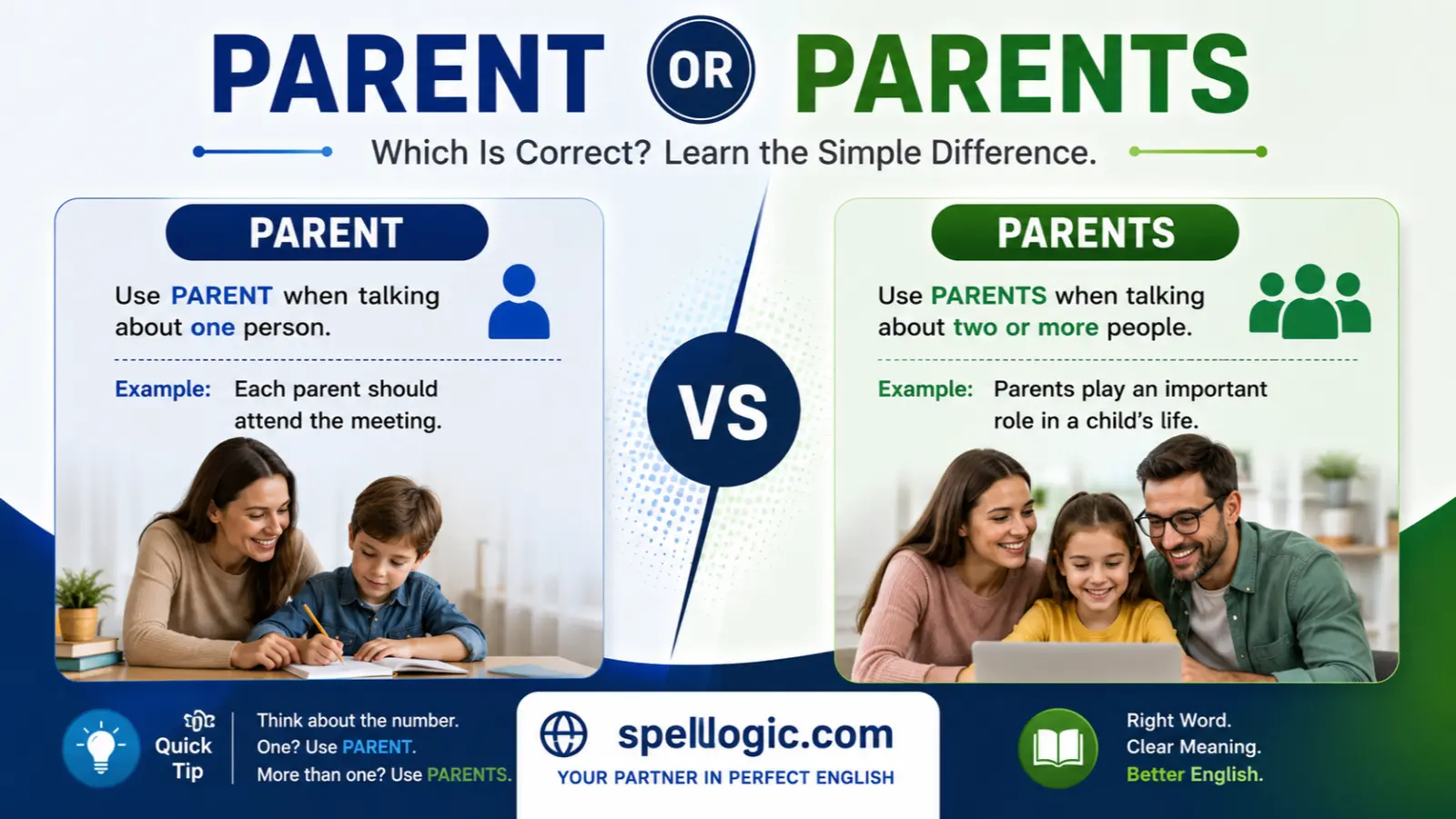
Many English learners wonder whether they should use parent or parents in a sentence. Although the two words look almost identical, they are not interchangeable in every situation. The difference is simple: parent refers to one mother or father, while parents refers to both or more than one parent.
However, choosing the correct form can still be confusing because the right choice depends on the sentence and its meaning. In this guide, you’ll learn the difference between parent and parents, see practical examples, avoid common mistakes, and gain easy tips to remember which word is correct in everyday English.
Table of Contents
- Introduction
- Why “Parent” and “Parents” Are Confusing
- Parent vs Parents Explained Simply
- Understanding Homophones in English
- What Does “Parent” Mean?
- What Does “Parents” Mean?
- Parent vs Parents: Key Differences at a Glance
- How to Remember the Difference Between Parent and Parents
- Common Mistakes and Confusions
- Examples Section: Correct and Incorrect Usage
- Self Assessment: Test Your Knowledge
- Self Assessment Answers
- FAQs About “Parent and Parents”
- Final Conclusion: Using “Parent” and “Parents” Correctly
Why “Parent” and “Parents” Are Confusing
Many learners mix up parent and parents because they are almost the same word. The only visible difference is the letter “s”, but that small change completely changes whether you’re talking about one person or more than one.
Similar Pronunciation
The words sound very similar. In fast speech, the ending -s may be difficult to hear.
Similar Spelling
The spelling differs by only one letter, making it easy to overlook when writing.
Context Confusion
Sometimes the context doesn’t clearly show whether one parent or both parents are being discussed.
Common Learner Mistakes
- Using parent when talking about both mother and father.
- Using parents when referring to only one guardian.
- Forgetting that verbs and pronouns should agree with singular or plural nouns.
Parent vs Parents Explained Simply
Parent means one mother or father, while parents means two or more parents, usually a child’s mother and father together.
One-Line Distinction
Parent is singular, while parents is plural.
Example Sentences
- Parent means one mother or father, while parents means both mother and father or multiple guardians.
- Every parent wants their child to succeed.
- My parents are celebrating their anniversary this weekend.
Understanding Homophones in English
Although parent and parents are not homophones, learners often confuse them because they sound nearly identical.
What Are Homophones?
Homophones are words that sound the same but have different meanings and spellings.
Example:
- Sea
- See
These words sound alike but have different meanings.
Why Homophones Cause Confusion
English pronunciation often makes different words sound identical or nearly identical. Learners may choose the wrong spelling because they rely on pronunciation instead of grammar.
Example:
“I can see the sea from my hotel.”
Likewise, learners may accidentally write parent instead of parents because the extra -s is easy to miss.
What Does “Parent” Mean?
Definition and Core Meaning
A parent is one person who is a mother or father of a child. The word may also refer to a legal guardian responsible for raising a child.
Origin and Historical Use
The word parent comes from the Latin word parens, meaning “father or mother.” It entered English during the Middle Ages and has been used for centuries to describe a single mother or father.
Modern Usage and Synonyms
Modern English uses parent in schools, legal documents, healthcare, education, and everyday conversations.
Synonyms
- Mother
- Father
- Guardian
- Caregiver (depending on context)
Key Points
- Refers to one person.
- Can mean mother or father.
- Used with singular verbs.
- Common in education and family discussions.
Example Sentences
- Every parent should encourage reading.
- A parent attended the teacher’s meeting.
- Each parent signed the permission form.
- The school contacted one parent about the event.
What Does “Parents” Mean?
Definition and Core Meaning
Parents refers to two or more people who are mothers or fathers. Most often, it means both the child’s mother and father together.
Origin and Historical Context
Parents is simply the plural form of parent. English forms most plurals by adding -s, and this pattern has existed for hundreds of years.
Modern Usage and Synonyms
The plural form appears frequently when discussing families, schools, communities, and parenting.
Synonyms
- Mother and father
- Guardians
- Caregivers
- Family members (in some contexts)
Key Points
- Refers to more than one parent.
- Usually means both mother and father.
- Takes plural verbs.
- Very common in everyday English.
Example Sentences
- My parents love traveling.
- The parents attended the school meeting.
- Many parents worry about online safety.
- Her parents live in another city.
Parent vs Parents: Key Differences at a Glance
| Word | Part of Speech | Meaning | Example Context |
|---|---|---|---|
| Parent | Noun (Singular) | One mother or father | Every parent wants the best for their child. |
| Parents | Noun (Plural) | Two or more mothers or fathers | My parents are very supportive. |
How to Remember the Difference Between Parent and Parents
Learning the difference is easy with a few memory tricks.
Easy Memory Tricks
- No S = One person
- Add S = More than one person
Association Technique
Think of the S as standing for Several.
- Parent → One
- Parents → Several
Memorable Example
Imagine a school meeting.
- One mother attends → One parent
- Mother and father attend → Parents
This simple picture makes the difference easy to remember.
Common Mistakes and Confusions
Wrong
❌ My parent are coming tonight.
Correct
✔ My parents are coming tonight.
Explanation: Two people require the plural noun parents and the plural verb are.
Wrong
❌ Each parents received a certificate.
Correct
✔ Each parent received a certificate.
Explanation: The word each takes a singular noun.
Wrong
❌ Every parents should help children learn.
Correct
✔ Every parent should help children learn.
Explanation: Every is followed by a singular noun.
Wrong
❌ My parent love gardening.
Correct
✔ My parents love gardening.
Explanation: The sentence refers to two people.
Examples Section: Correct and Incorrect Usage
Example 1
✔ Correct: Every parent wants their child to be happy.
✘ Incorrect: Every parents wants their child to be happy.
Example 2
✔ Correct: My parents are visiting next week.
✘ Incorrect: My parent are visiting next week.
Example 3
✔ Correct: One parent signed the form.
✘ Incorrect: One parents signed the form.
Example 4
✔ Correct: The parents thanked the teacher.
✘ Incorrect: The parent thanked the teacher. (Incorrect if both mother and father are meant.)
Self Assessment: Test Your Knowledge
Fill in the blanks with parent or parents.
- Every ________ wants their child to succeed.
- My ________ are waiting outside.
- One ________ attended the conference.
- The school invited all ________ to the meeting.
Self Assessment Answers
- parent
- parents
- parent
- parents
FAQs
Is “parent” singular or plural?
Parent is singular and refers to one mother or father.
Is “parents” always plural?
Yes. Parents is the plural form of parent.
Can I say “each parents”?
No. The correct phrase is each parent because each takes a singular noun.
When should I use “my parent”?
Use my parent when talking about only one mother or father.
When should I use “my parents”?
Use my parents when referring to both your mother and father or more than one guardian.
Is “parents” more common than “parent”?
Both are common. The correct choice depends on whether you’re referring to one person or more than one.
Are “parent” and “parents” interchangeable?
No. They have different grammatical meanings because one is singular and the other is plural.
Final Conclusion: Using “Parent” and “Parents” Correctly
Understanding the difference between parent and parents is an important step toward writing and speaking accurate English. Although these words differ by only one letter, that small change has a big impact on meaning. Parent always refers to one mother or father, while parents refers to two or more parents, most commonly a child’s mother and father together. Choosing the correct form depends entirely on how many people you are talking about.
A useful way to remember this rule is to focus on the final “s.” If you are speaking about one person, use parent. If you are referring to more than one, use parents. Also pay attention to words like each, every, and one, which require the singular form, while phrases such as my, their, or the may require either form depending on the context.
As you continue learning English, try reading books, news articles, and conversations to notice how native speakers use these words naturally. Practice writing your own sentences and check whether you are referring to one person or several. With regular practice, choosing between parent and parents will soon become automatic. Small grammar improvements like this help make your English clearer, more natural, and more confident in both writing and everyday conversation.