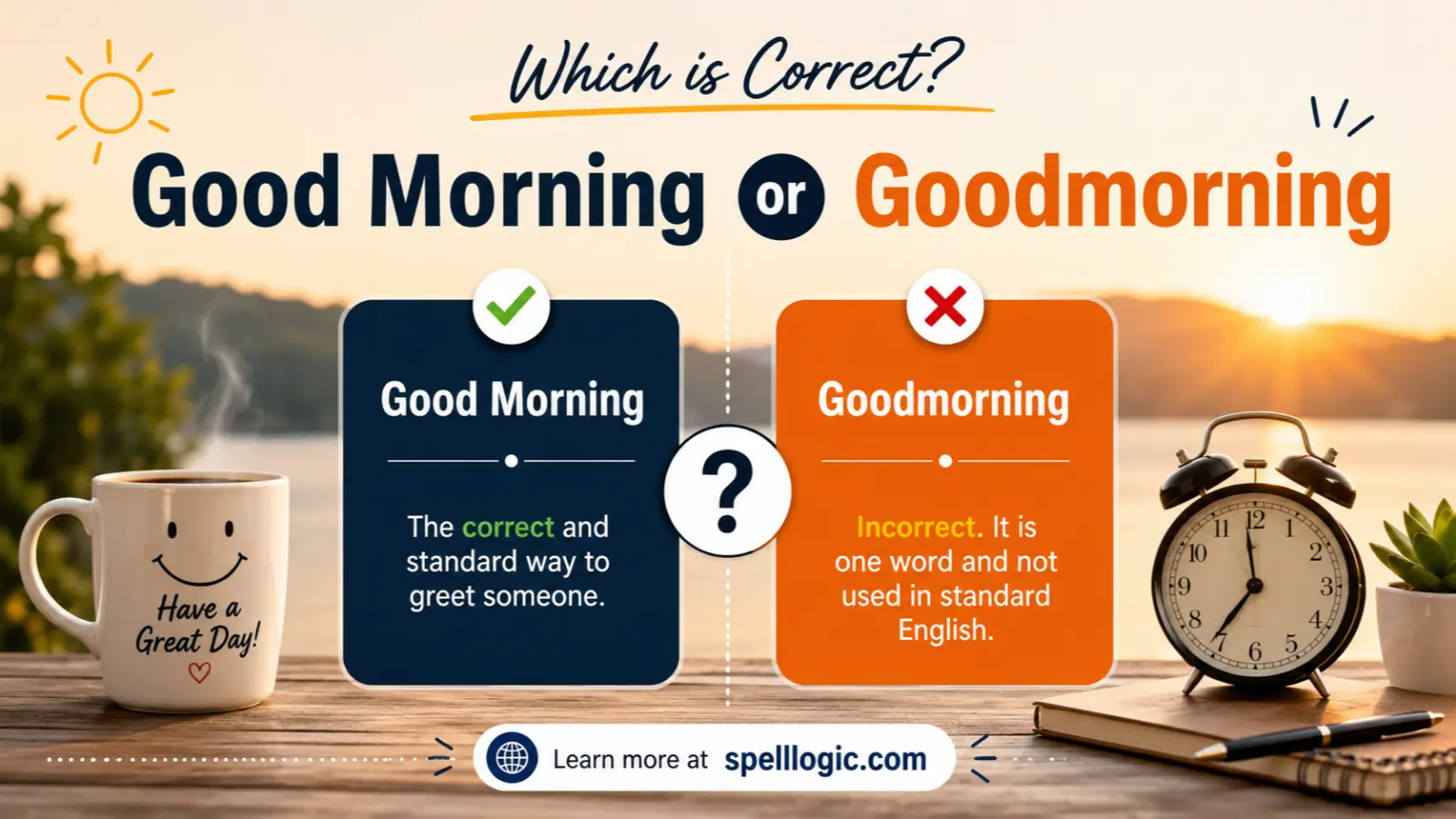
Many English learners wonder whether they should write good morning or goodmorning. Since people say the greeting quickly in everyday conversations, it can sound like a single word. This often leads to spelling mistakes in emails, text messages, school assignments, and professional writing.
Knowing the correct form helps you communicate more clearly and confidently. In this guide, you’ll learn the difference between good morning and goodmorning, discover why many people confuse them, and see practical examples that make the correct usage easy to remember.
Table of Contents
- Introduction
- Why “Good Morning” and “Goodmorning” Are Confusing
- Good Morning vs Goodmorning Explained Simply
- Understanding Homophones in English
- What Does “Good Morning” Mean?
- What Does “Goodmorning” Mean?
- Good Morning vs Goodmorning: Key Differences at a Glance
- How to Remember the Difference Between Good Morning and Goodmorning
- Common Mistakes and Confusions
- Examples Section: Correct and Incorrect Usage
- Self Assessment: Test Your Knowledge
- Self Assessment Answers
- FAQs About “Good Morning” and “Goodmorning”
- Final Conclusion: Using “Good Morning” and “Goodmorning” Correctly
Why “Good Morning” and “Goodmorning” Are Confusing
Many people accidentally write goodmorning instead of good morning. Although they sound the same, only one form is correct in standard English.
Here are the main reasons for the confusion:
Similar Pronunciation
When spoken naturally, good morning sounds like one continuous phrase. Because there is little pause between the two words, many learners assume it should be written as one word.
Similar Spelling
The only visible difference is the missing space. Since English contains many compound words like goodbye, everyone, and sometimes, learners often believe goodmorning follows the same pattern.
Context Confusion
People commonly see greetings in text messages or social media posts where spelling and spacing are ignored. This creates the false impression that goodmorning is acceptable.
Common Learner Mistakes
- Writing goodmorning in formal emails.
- Assuming it is a compound word like goodbye.
- Copying incorrect spellings from social media.
- Forgetting that greetings are usually written as separate words.
Good Morning vs Goodmorning Explained Simply
The difference is very simple.
- Good morning is the correct English greeting.
- Goodmorning is an incorrect spelling and is not accepted in standard English dictionaries.
One-Line Distinction
“Good morning” is the correct two-word greeting, while “goodmorning” is a misspelling.
Example Sentences
- Good morning means a polite greeting used before noon, while goodmorning has no accepted meaning in standard English.
- She smiled and said, “Good morning!”
- ✘ He wrote Goodmorning everyone in the official email.
Understanding Homophones in English
What Are Homophones?
Homophones are words that sound the same but have different spellings and meanings.
Example:
- Sea
- See
They sound alike but have different meanings.
Although good morning and goodmorning are not true homophones, learners often confuse them because they are pronounced almost identically.
Why Homophones Cause Confusion
English contains many words that sound alike. Learners often rely on pronunciation instead of spelling, leading to mistakes.
For example:
- They’re
- Their
- There
These sound identical but are written differently and have different meanings.
Similarly, people hear good morning as one phrase and mistakenly write goodmorning.
What Does “Good Morning” Mean?
Definition and Core Meaning
Good morning is a polite greeting used when meeting someone during the morning, usually from sunrise until around noon.
It shows friendliness, respect, and courtesy.
Origin and Historical Use
The phrase comes from combining:
- Good meaning pleasant or favorable.
- Morning referring to the early part of the day.
People have used good morning as a greeting for centuries in English-speaking countries.
Modern Usage and Synonyms
Today, good morning is used in:
- Business emails
- School classrooms
- Telephone conversations
- Public speeches
- Daily conversations
Synonyms
- Morning!
- Hello
- Greetings
- Hi (informal)
- Good day (less common)
Example Sentences
- Good morning, everyone. Welcome to today’s meeting.
- She always says good morning to her neighbors.
- The teacher greeted the class with good morning.
- We exchanged a cheerful good morning before work.
What Does “Goodmorning” Mean?
Definition and Core Meaning
Goodmorning is not a standard English word.
It is simply a spelling mistake made by combining good and morning into one word.
Origin and Historical Context
There is no official historical use of goodmorning as a recognized English word.
It occasionally appears:
- In informal social media posts
- In text messages
- As a typing error
- In usernames or hashtags
These uses do not make it correct.
Modern Usage and Synonyms
There are no accepted synonyms because goodmorning is not a valid English word.
Instead, always write:
- Good morning
Example Sentences
Incorrect:
- ✘ Goodmorning everyone.
- ✘ I sent a goodmorning message.
Correct:
- ✔ Good morning, everyone.
- ✔ I sent a good morning message.
Good Morning vs Goodmorning: Key Differences at a Glance
| Word | Part of Speech | Meaning | Example Context |
|---|---|---|---|
| Good morning | Greeting (interjection/phrase) | A polite greeting used before noon | Good morning, everyone! |
| Goodmorning | Incorrect spelling | No accepted meaning | ✘ Goodmorning everyone |
How to Remember the Difference Between Good Morning and Goodmorning
Remember these simple tricks.
Easy Memory Tricks
- Think of good and morning as two separate words.
- If you can replace morning with afternoon, you’ll notice the pattern:
- Good afternoon
- Good evening
- Good morning
None of these greetings are written as one word.
Association Techniques
Imagine greeting someone with two handshakes:
- One handshake for good
- One handshake for morning
Two greetings, two words.
One Memorable Example
If good afternoon needs a space, then good morning needs one too.
Common Mistakes and Confusions
Wrong Example
✘ Goodmorning, Sarah!
Correct Version
✔ Good morning, Sarah!
Explanation
The greeting should always be written as two separate words.
Wrong Example
✘ I received a goodmorning email.
Correct Version
✔ I received a good morning email.
Explanation
Even when the greeting describes another noun, the words remain separate.
Wrong Example
✘ Goodmorning everyone.
Correct Version
✔ Good morning, everyone.
Explanation
Adding the comma also improves punctuation.
Wrong Example
✘ She texted goodmorning.
Correct Version
✔ She texted, “Good morning.”
Explanation
Use quotation marks when writing spoken greetings.
Examples Section: Correct and Incorrect UsagExample 1
✔ Correct: Good morning, class.
✘ Incorrect: Goodmorning, class.
Example 2
✔ Correct: I always say good morning to my coworkers.
✘ Incorrect: I always say goodmorning to my coworkers.
Example 3
✔ Correct: Good morning! How are you today?
✘ Incorrect: Goodmorning! How are you today?
Example 4
✔ Correct: The email began with “Good morning.”
✘ Incorrect: The email began with “Goodmorning.”
Self Assessment: Test Your Knowledge
Fill in the blanks.
- ________, everyone! Welcome to today’s class.
- The correct spelling is ________.
- She sent a ________ message before work.
- ________ is not considered standard English.
Self Assessment Answers
- Good morning
- Good morning
- good morning
- Goodmorning
FAQs
1. Is “goodmorning” one word?
No. The correct spelling is good morning with a space.
2. Is “good morning” grammatically correct?
Yes. It is the standard English greeting used before noon.
3. Why do people write “goodmorning”?
Mostly because the phrase is spoken quickly or copied from informal social media posts.
4. Can I use “goodmorning” in professional emails?
No. Always use good morning in business, academic, and formal writing.
5. Is “Good Morning” capitalized?
Capitalize both words when they begin a sentence or appear in a title. Otherwise, write good morning in lowercase within a sentence unless style rules require capitalization.
6. Is “morning” alone acceptable?
Yes. In informal conversations, simply saying Morning! is common and natural.
7. Do dictionaries recognize “goodmorning”?
No. Standard English dictionaries recognize good morning as the correct form and treat goodmorning as a misspelling.
Final Conclusion: Using “Good Morning” and “Goodmorning” Correctly
Understanding the difference between good morning and goodmorning is straightforward once you know the basic rule. Good morning is the correct two-word greeting used to politely welcome someone during the morning hours. It appears in everyday conversations, business emails, classroom settings, and formal speeches. On the other hand, goodmorning is simply a spelling error. Although you may see it in text messages, social media posts, or informal writing, it is not accepted in standard English and should be avoided in schoolwork, professional communication, and published content.
A useful way to remember the correct spelling is to compare it with other greetings. We write good afternoon, good evening, and good night as separate words, so good morning follows the same pattern. This simple memory trick can help you avoid one of the most common spelling mistakes made by English learners.
The more you read, write, and practice correct greetings, the more natural they will become. Paying attention to small details like spacing can make your English look more polished and professional. Keep practicing with real-life examples, and you’ll soon use good morning confidently and correctly every time.