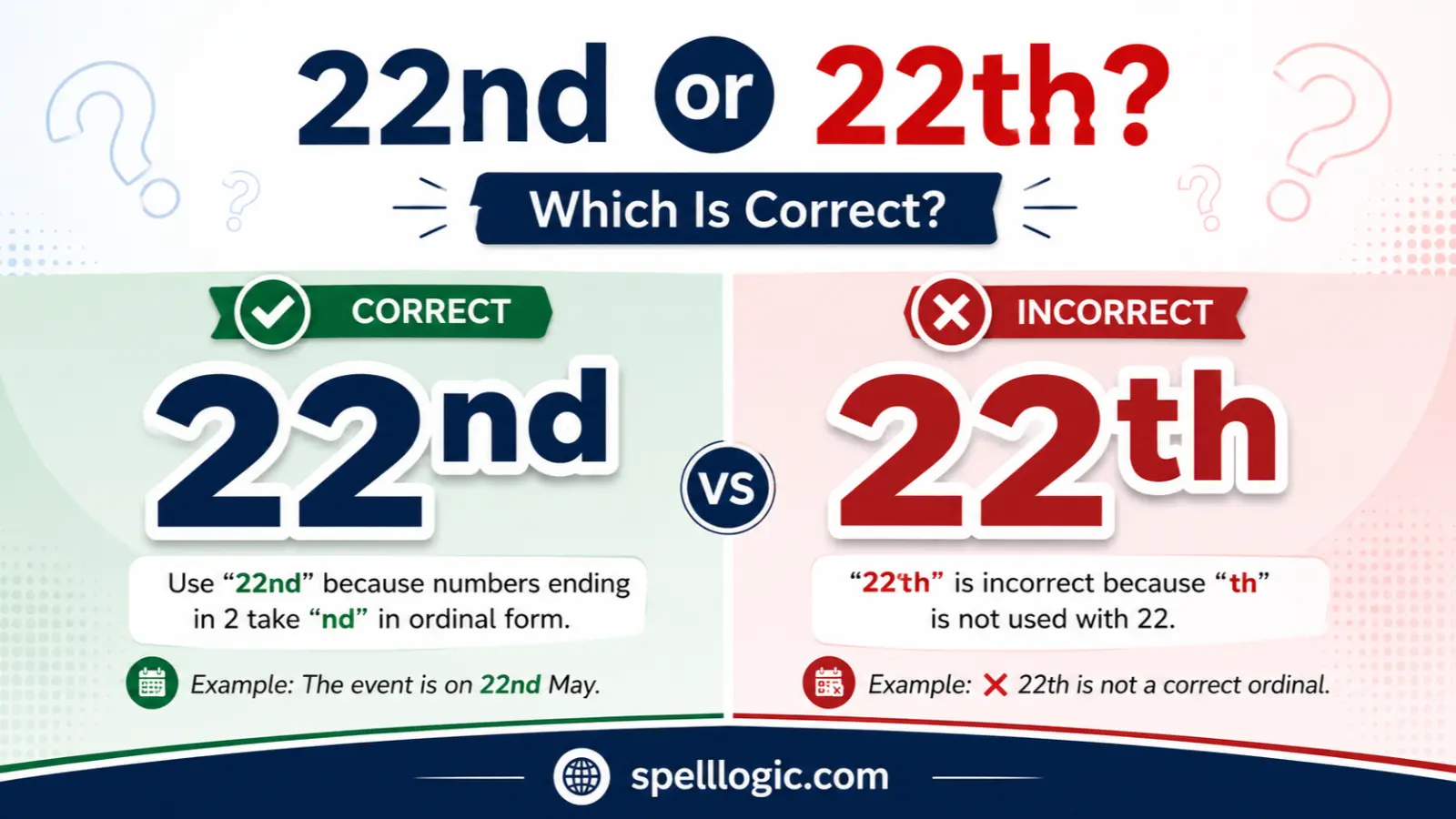
Many English learners get confused when writing ordinal numbers like 22nd and 22th. At first glance, both forms may seem reasonable because they both refer to the number 22. However, only one of them follows the correct English grammar rules. Using the wrong ordinal ending can make your writing look less accurate, especially in dates, rankings, birthdays, and official documents.
Learning the difference between 22nd and 22th is simple once you understand how ordinal numbers work. This guide explains everything in clear, easy-to-understand language with examples, tips, and practice exercises to help you remember the correct form.
Table of Contents
- Why “22nd” and “22th” Are Confusing
- 22nd vs 22th Explained Simply
- Understanding Homophones in English
- What Does “22nd” Mean?
- What Does “22th” Mean?
- 22nd vs 22th: Key Differences at a Glance
- How to Remember the Difference Between 22nd and 22th
- Common Mistakes and Confusions
- Examples Section: Correct and Incorrect Usage
- Self Assessment: Test Your Knowledge
- Self Assessment Answers
- FAQs About “22nd” and “22th”
- Final Conclusion: Using “22nd” and “22th” Correctly
Why “22nd” and “22th” Are Confusing
Many people mistakenly write 22th instead of 22nd because ordinal numbers in English do not always follow one simple pattern.
Here are the main reasons for the confusion:
Similar Pronunciation
When spoken quickly, the endings may sound similar, especially for non-native English speakers. This can make it difficult to know which suffix is correct.
Similar Spelling
Both words begin with 22, and only the ending changes. Many learners assume that adding -th works for every number.
Context Confusion
Ordinal numbers appear in many situations, including:
- Dates
- Birthdays
- Competitions
- Anniversaries
- Lists and rankings
Because people frequently see endings like 4th, 10th, and 100th, they may incorrectly write 22th.
Common Learner Mistakes
Some common errors include:
- Writing 22th of June
- Saying the twenty-twoth
- Assuming all ordinal numbers end in -th
In reality, English has specific rules for ordinal suffixes.
22nd vs 22th Explained Simply
The difference is very straightforward.
22nd is the correct ordinal form of the number 22.
22th is not a correct English word and should never be used.
One-Line Distinction
22nd means the twenty-second position or date, while 22th is an incorrect spelling.
Example Sentences
- The meeting will take place on the 22nd of August.
- She finished in 22nd place during the marathon.
Incorrect:
- The meeting is on the 22th of August.
- His birthday is on the 22th of May.
Understanding Homophones in English
Although 22nd and 22th are not true homophones, learners often confuse them because they represent the same number and look very similar.
What Are Homophones?
Homophones are words that sound alike but have different meanings or spellings.
Example:
- Sea
- See
These words sound identical but have different meanings.
Why Homophones Cause Confusion
When learners rely only on pronunciation, they may choose the wrong spelling.
Example:
Someone might hear twenty-second and mistakenly write 22th instead of 22nd.
This is why understanding spelling rules is just as important as pronunciation.
What Does “22nd” Mean?
Definition and Core Meaning
22nd is the ordinal number that represents the position after the twenty-first and before the twenty-third.
It answers questions like:
- Which one?
- Which day?
- Which position?
Origin and Historical Use
The word comes from the Old English tradition of creating ordinal numbers by modifying cardinal numbers.
English developed special endings:
- 1 → 1st
- 2 → 2nd
- 3 → 3rd
- Most others → th
Since 22 ends with 2, it takes the suffix -nd.
Modern Usage and Synonyms
You commonly see 22nd in:
- Calendar dates
- Rankings
- Birthdays
- Historical events
- Numbered lists
Similar expressions include:
- Twenty-second
- Number twenty-two
- In the twenty-second position
Example Sentences
- My birthday falls on the 22nd of October.
- The company celebrated its 22nd anniversary.
- She came 22nd in the race.
- Our office is on the 22nd floor.
What Does “22th” Mean?
Definition and Core Meaning
22th has no meaning in standard English because it is an incorrect ordinal spelling.
English dictionaries do not recognize it as a valid word.
Origin and Historical Context
The mistake usually happens because learners overapply the -th ending to every number.
For example:
- 4th
- 5th
- 6th
- 10th
This pattern does not apply to numbers ending in 1, 2, or 3, except for the special cases of 11, 12, and 13.
Modern Usage and Synonyms
There are no correct synonyms because 22th should never be used.
Instead, always write:
- 22nd
- Twenty-second
Example Sentences
Incorrect:
- ✘ Today is the 22th of December.
- ✘ He celebrated his 22th birthday.
Correct:
- ✔ Today is the 22nd of December.
- ✔ He celebrated his 22nd birthday.
22nd vs 22th: Key Differences at a Glance
| Word | Part of Speech | Meaning | Example Context |
|---|---|---|---|
| 22nd | Ordinal Number | Correct form of twenty-second | The meeting is on the 22nd. |
| 22th | Incorrect Form | Not accepted in English | ✘ The meeting is on the 22th. |
How to Remember the Difference Between 22nd and 22th
Here are a few easy tricks.
Easy Memory Tricks
- Numbers ending in 2 usually use -nd.
- Say the full word: twenty-second.
- If you hear second, think nd.
Association Techniques
Remember this sequence:
- 21st
- 22nd
- 23rd
- 24th
Notice how only 24 uses th.
One Memorable Example
Imagine reading a calendar.
You would naturally say:
Today is the twenty-second.
Since you say second, the abbreviation must be 22nd
Common Mistakes and Confusions
Wrong Example
✘ My exam is on the 22th.
Correct Version
✔ My exam is on the 22nd.
Explanation: Twenty-two becomes twenty-second, not twenty-twoth.
Wrong Example
✘ She won the 22th prize.
Correct Version
✔ She won the 22nd prize.
Explanation: The ordinal ending is -nd because the number ends in 2.
Wrong Example
✘ Today is June 22th.
Correct Version
✔ Today is June 22nd.
Explanation: Dates always follow the correct ordinal rules.
Examples Section: Correct and Incorrect Usage
Example 1
✔ Correct: My birthday is on the 22nd of March.
✘ Incorrect: My birthday is on the 22th of March.
Example 2
✔ Correct: She celebrated her 22nd birthday yesterday.
✘ Incorrect: She celebrated her 22th birthday yesterday.
Example 3
✔ Correct: The race finishes on the 22nd lap.
✘ Incorrect: The race finishes on the 22th lap.
Example 4
✔ Correct: Our reservation is for the 22nd of July.
✘ Incorrect: Our reservation is for the 22th of July.
Self Assessment: Test Your Knowledge
Fill in the blanks.
- My appointment is on the ______ of November.
- She celebrated her ______ birthday.
- We arrived on the ______ floor.
- The competition ends on the ______ day.
Self Assessment Answers
- 22nd
- 22nd
- 22nd
- 22nd
FAQs
Is 22th correct English?
No. 22th is grammatically incorrect. Always use 22nd.
Why is it 22nd instead of 22th?
Because 22 ends in 2, its ordinal form follows the same pattern as second, giving it the suffix -nd.
How do you write the ordinal form of 22?
Write it as 22nd or spell it out as twenty-second.
Is 22nd used in dates?
Yes. It is the correct form for dates, such as 22nd July or July 22nd.
What is the rule for ordinal numbers ending in 2?
Most numbers ending in 2 use -nd, except 12, which is 12th.
Can I write twenty-twoth?
No. The correct spelling is twenty-second.
How can I remember the correct form?
Think of the word second. Since 22 becomes twenty-second, the abbreviation is 22nd.
Final Conclusion: Using “22nd” and “22th” Correctly
Understanding the difference between 22nd and 22th is easier than it first appears. The important point to remember is that 22nd is the only correct ordinal form of the number 22, while 22th is simply a spelling mistake that should be avoided. English ordinal numbers follow specific patterns, and numbers ending in 2 generally take the -nd suffix, except for the special case of 12th. This is why we write 22nd, just as we write 2nd and 32nd.
In everyday English, you will see 22nd used in dates, birthdays, anniversaries, rankings, addresses, and many other situations. Using the correct form makes your writing look more professional and helps readers understand your meaning immediately. Whenever you are unsure, say the full word aloud: twenty-second. Hearing the word second is an easy reminder that the abbreviation ends with nd, not th.
A helpful memory trick is to remember the sequence 21st, 22nd, 23rd, 24th. Seeing these endings together reinforces the correct pattern. With regular practice and careful proofreading, choosing the right ordinal form will soon become automatic. Keep learning, pay attention to these small grammar details, and you’ll write English with greater confidence, accuracy, and clarity every day.