Many English learners become confused by oversite and oversight because the words look almost identical at first glance. However, there is an important difference: one is a common spelling mistake, while the other is a correct English word with more than one meaning.
Knowing which word to use helps you write more clearly in school, at work, and in everyday communication. In this guide, you’ll learn the meaning, history, pronunciation, and correct usage of oversite and oversight. By the end, you’ll know exactly when to use oversight and why oversite should usually be avoided.
Table of Contents
- Introduction
- Why “Oversite” and “Oversight” Are Confusing
- Oversite vs Oversight Explained Simply
- Understanding Homophones in English
- What Does “Oversite” Mean?
- What Does “Oversight” Mean?
- Oversite vs Oversight: Key Differences at a Glance
- How to Remember the Difference Between Oversite and Oversight
- Common Mistakes and Confusions
- Examples Section: Correct and Incorrect Usage
- Self Assessment: Test Your Knowledge
- Self Assessment Answers
- FAQs About “Oversite” and “Oversight”
- Final Conclusion: Using “Oversite” and “Oversight” Correctly
Why “Oversite” and “Oversight” Are Confusing
Many people accidentally write oversite instead of oversight. The confusion happens for several reasons.
Similar Pronunciation
The words sound very similar when spoken quickly. Some accents make the final sounds almost identical, causing spelling mistakes.
Similar Spelling
The only visible difference is the last two letters:
- Oversite
- Oversight
Because they differ by only two letters, many writers type the wrong version without noticing.
Context Confusion
People often associate site with websites, construction sites, or locations. As a result, they mistakenly believe oversite is the correct spelling when discussing supervision.
Common Learner Mistakes
English learners often:
- Replace oversight with oversite in essays.
- Think oversite refers to supervising a location.
- Assume both spellings are acceptable.
In standard English, oversight is the correct word in nearly every situation.
Oversite vs Oversight Explained Simply
The simplest way to understand the difference is this:
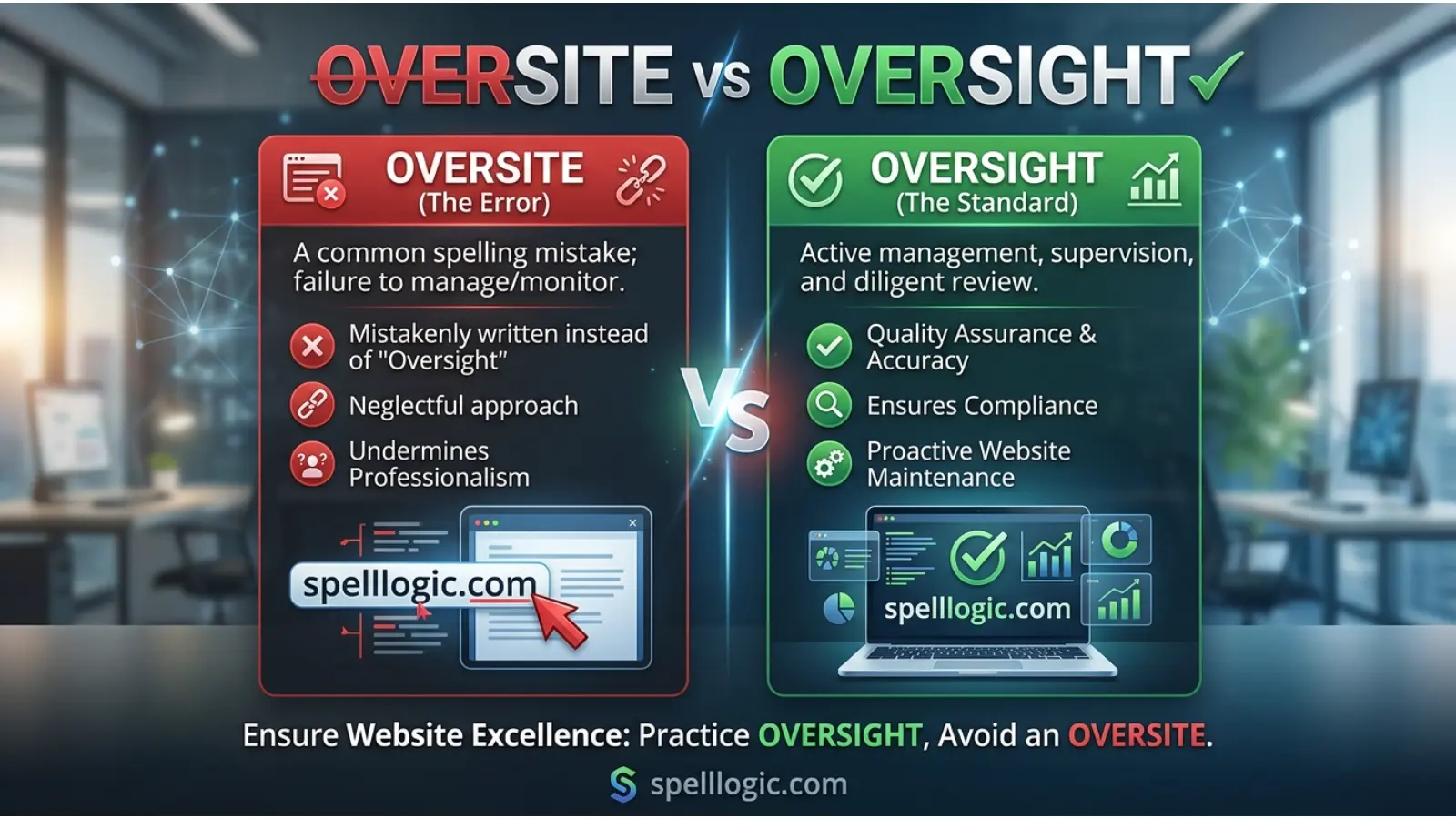
Oversite is usually a misspelling of oversight, while oversight is the correct English word.
One-Line Distinction
Oversite means nothing in standard English, while oversight means supervision or an unintentional mistake.
Example Sentences
- The project required careful oversight from experienced managers.
- Missing the typo was an unfortunate oversight.
Understanding Homophones in English
What Are Homophones?
Homophones are words that sound the same or nearly the same but have different spellings and meanings.
Example:
- Their
- There
- They’re
These words sound alike but have different meanings.
Note: Oversite and oversight are not true homophones. They simply sound similar enough that many people confuse them.
Why Homophones Cause Confusion
When listening, people often hear only the pronunciation rather than the spelling. As a result, they may choose the wrong written word.
For example:
“I need more oversight.”
Someone unfamiliar with the spelling may write:
“I need more oversite.”
What Does “Oversite” Mean?
Definition and Core Meaning
In standard dictionaries, oversite is not recognized as a correct English word.
Most of the time, it is simply a misspelling of oversight.
Occasionally, people use oversite by mistake because they associate the word with site, but this usage is considered incorrect.
Origin and Historical Use
Unlike oversight, oversite has no accepted historical development as a standard English word.
Its appearance mainly comes from typing or spelling errors.
Modern Usage and Synonyms
Since oversite is generally incorrect, it has no official synonyms.
Instead, use:
- Oversight
- Supervision
- Monitoring
- Review
- Management
Example Sentences
❌ The committee provided oversite for the project.
✔ The committee provided oversight for the project.
❌ The report was approved after careful oversite.
✔ The report was approved after careful oversight.
What Does “Oversight” Mean?
Definition and Core Meaning
Oversight has two important meanings in English.
Meaning 1: Supervision
This refers to watching, managing, or supervising work to ensure everything is done correctly.
Example:
“The board has oversight of the company’s finances.”
Meaning 2: An Unintentional Mistake
It also means forgetting or missing something accidentally.
Example:
“Leaving your name off the application was an oversight.”
Context tells readers which meaning is intended.
Origin and Historical Context
The word oversight has been part of English for centuries.
Originally, it developed from the idea of “looking over” something.
Over time, it gained two meanings:
- Careful supervision
- Accidental omission
Both meanings remain common today.
Modern Usage and Synonyms
Depending on the meaning, synonyms include:
When it Means Supervision
- Supervision
- Monitoring
- Control
- Management
- Direction
When it Means a Mistake
- Error
- Omission
- Neglect
- Slip
- Forgetfulness
Example Sentences
The government provides financial oversight.
The teacher maintained close oversight during the exam.
Failing to attach the document was an unfortunate oversight.
His spelling mistake was simply an oversight.
Oversite vs Oversight: Key Differences at a Glance
| Word | Part of Speech | Meaning | Example Context |
|---|---|---|---|
| Oversite | Not a standard English word | Usually a misspelling | “Oversite” should be corrected to oversight. |
| Oversight | Noun | Supervision or an accidental mistake | The committee exercised oversight of the project. |
How to Remember the Difference Between Oversite and Oversight
Here are some simple memory tricks.
Easy Memory Tricks
- Sight relates to seeing.
- If you supervise something, you keep it in sight.
- Therefore, oversight means watching over something.
Association Technique
Think:
Over + sight = watching over
That naturally leads to supervision.
Memorable Example
“The manager kept everything in sight through careful oversight.”
If you remember sight = seeing, you’ll rarely spell the word incorrectly.
Common Mistakes and Confusions
Wrong
The company provides excellent oversite.
Correct
The company provides excellent oversight.
Explanation: Use oversight because you’re talking about supervision.
Wrong
It was an unfortunate oversite.
Correct
It was an unfortunate oversight.
Explanation: Here, oversight means an accidental mistake.
Wrong
The committee is responsible for financial oversite.
Correct
The committee is responsible for financial oversight.
Explanation: Government and business documents always use oversight.
Examples Section: Correct and Incorrect Usage
Example 1
✔ Correct: The board provides oversight of the organization.
✘ Incorrect: The board provides oversite of the organization.
Example 2
✔ Correct: Forgetting the deadline was an oversight.
✘ Incorrect: Forgetting the deadline was an oversite.
Example 3
✔ Correct: The manager maintained close oversight throughout the project.
✘ Incorrect: The manager maintained close oversite throughout the project.
Example 4
✔ Correct: Missing one question on the test was simply an oversight.
✘ Incorrect: Missing one question on the test was simply an oversite.
Self Assessment: Test Your Knowledge
Fill in the blanks.
1.
The safety committee provides ________ for the construction project.
2.
Leaving your signature off the contract was an ________.
3.
Which spelling is correct?
Oversite or Oversight?
4.
The government exercises financial ________ over public spending.
Self Assessment Answers
- oversight
- oversight
- Oversight
- oversight
FAQs
Is “oversite” a real English word?
No. In standard English, oversite is considered a misspelling of oversight.
What does “oversight” mean?
It means either supervision or an accidental mistake, depending on the context.
Why do people write “oversite”?
Because site is a familiar English word, people sometimes spell oversight incorrectly.
Can “oversight” mean both supervision and a mistake?
Yes. English uses the same word for both meanings, and context makes the intended meaning clear.
Is “oversight” formal or informal?
It is used in both formal and everyday English, especially in business, law, education, and government.
How can I remember the correct spelling?
Think of sight as “seeing.” If someone is supervising work, they are keeping it in sight, so the correct spelling is oversight.
Is “oversight” commonly used in professional writing?
Yes. It is widely used in reports, contracts, policies, academic writing, and workplace communication.
Final Conclusion: Using “Oversite” and “Oversight” Correctly
Understanding the difference between oversite and oversight is easier than it first appears. Although the two spellings look almost identical, only oversight is the correct standard English word. It has two accepted meanings: supervision or monitoring, and an unintentional mistake or omission. In contrast, oversite is generally considered a spelling error and should be replaced with oversight in nearly all forms of writing. Whether you’re writing an academic paper, a business report, an email, or a social media post, using the correct spelling will make your communication more accurate and professional.
A helpful way to remember the difference is to focus on the word sight. Since supervision involves keeping an eye on something, oversight naturally relates to watching over people, projects, or processes. The same spelling is also used when referring to a simple mistake that happened because something was overlooked. Reading quality English content, practicing new vocabulary, and proofreading your writing can help reinforce the correct form. With regular practice, choosing oversight instead of oversite will become second nature. Keep learning, keep reading, and remember that every small improvement in your English brings you closer to confident and effective communication.