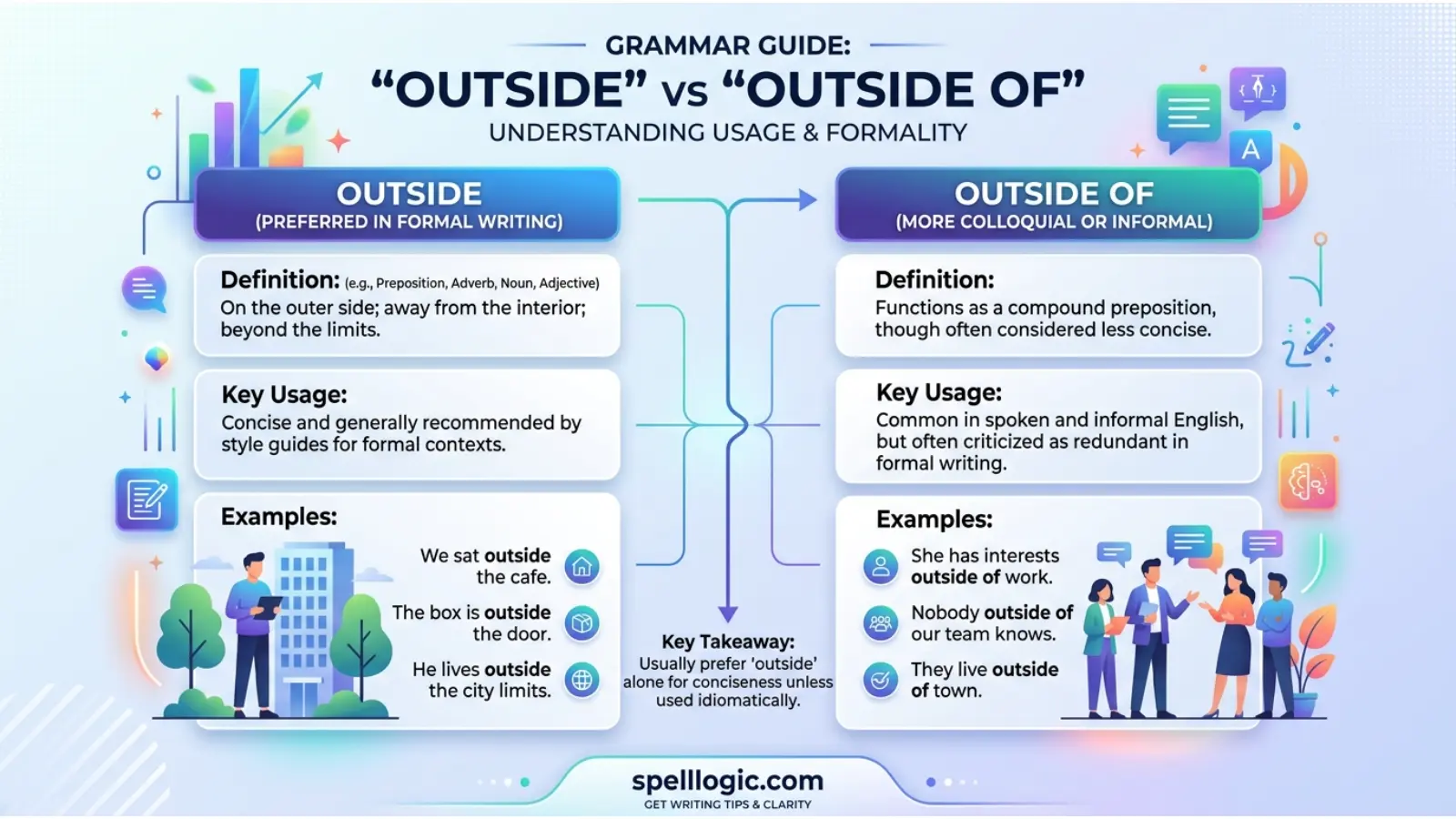
Many English learners wonder whether they should write outside or outside of. Since both expressions often appear in conversations, books, and online articles, they can seem interchangeable. In many situations, they actually mean the same thing, but there are times when one sounds more natural or is preferred in formal writing.
Understanding the difference helps you write more clearly and speak more confidently. In this guide, you’ll learn the meanings, grammar, usage, and examples of outside and outside of in simple English, making it easier to choose the correct expression every time.
Table of Contents
- Introduction
- Why “Outside” and “Outside Of” Are Confusing
- Outside vs Outside Of Explained Simply
- Understanding Homophones in English
- What Does “Outside” Mean?
- What Does “Outside Of” Mean?
- Outside vs Outside Of: Key Differences at a Glance
- How to Remember the Difference Between Outside and Outside Of
- Common Mistakes and Confusions
- Examples Section: Correct and Incorrect Usage
- Self Assessment: Test Your Knowledge
- Self Assessment Answers
- FAQs About “Outside” and “Outside Of”
- Final Conclusion: Using “Outside” and “Outside Of” Correctly
Why “Outside” and “Outside Of” Are Confusing
Many learners struggle with outside and outside of because they appear in similar situations and often have the same meaning.
Here are the main reasons for the confusion:
Similar Pronunciation
Both expressions begin with the word outside, so they sound nearly identical when spoken.
Similar Spelling
The only difference is the addition of the small preposition of.
Context Confusion
In many sentences, either expression is grammatically acceptable.
For example:
- She waited outside the building.
- She waited outside of the building.
Although both are correct, many style guides prefer outside because it is shorter and more direct.
Common Learner Mistakes
English learners often:
- Think outside of is always more correct.
- Add of even when it isn’t needed.
- Avoid outside because they believe it sounds incomplete.
In reality, outside is usually enough.
Outside vs Outside Of Explained Simply
The easiest way to understand these expressions is this:
Outside means not inside or beyond the limits of something, while outside of usually means the same thing but is more common in informal American English or when expressing exceptions.
One-line distinction
Outside is shorter and preferred in most writing, while outside of is a longer variation that is acceptable in many contexts.
Example sentences
- We waited outside the restaurant until it opened.
- She stood outside of the classroom talking to her friends.
Another example:
- Outside means beyond or not inside something, while outside of often expresses the same idea with slightly different wording.
Understanding Homophones in English
What Are Homophones?
Homophones are words that sound the same but have different meanings or spellings.
Example:
- Sea
- See
Although they sound alike, they have different meanings.
Outside and outside of are not homophones because one is simply a longer expression built from the same word.
Why Homophones Cause Confusion
When words sound alike, learners often choose the wrong spelling.
Example:
- I can see the ocean.
- The sea is calm today.
Learning the meaning of each word helps avoid mistakes.
What Does “Outside” Mean?
Definition and Core Meaning
Outside means:
- Not inside
- Beyond the limits of something
- On the exterior
- Away from an enclosed place
It can function as:
- A preposition
- An adverb
- A noun
- An adjective
Origin and Historical Use
The word outside developed from the combination of out and side during the Middle English period. It has been used for centuries to describe something located beyond an enclosed space or boundary.
Modern Usage and Synonyms
Today, outside is extremely common in everyday English.
Synonyms include:
- Beyond
- Outdoors
- Exterior
- External
- Out
Key Points
- Indicates location beyond something
- Common in both speech and writing
- Preferred in formal writing
- Often replaces outside of
Example Sentences
- The children are playing outside.
- Leave your shoes outside the door.
- Outside the city, traffic is lighter.
- We met outside the library.
What Does “Outside Of” Mean?
Definition and Core Meaning
Outside of usually means:
- Beyond
- Not inside
- Except for (especially in American English)
In many cases, it has exactly the same meaning as outside.
Example:
- Outside of work, I enjoy hiking.
Here it means apart from or except for.
Origin and Historical Context
The phrase outside of became increasingly common in American English. Over time, speakers began using it as a natural extension of outside, especially in casual conversation.
Modern Usage and Synonyms
Today, outside of appears mostly in:
- Informal speech
- American English
- Expressions meaning “except for”
Synonyms include:
- Except for
- Apart from
- Beyond
- Other than
Key Points
- Common in spoken American English
- Slightly less common in formal writing
- Can indicate an exception
- Often interchangeable with outside
Example Sentences
- Outside of school, she enjoys painting.
- Outside of a few mistakes, the report was excellent.
- The dog waited outside of the house.
- Outside of business hours, the office is closed.
Outside vs Outside Of: Key Differences at a Glance
| Word | Part of Speech | Meaning | Example Context |
|---|---|---|---|
| Outside | Preposition, adverb, adjective, noun | Beyond or not inside | We waited outside the building. |
| Outside of | Prepositional phrase | Beyond, except for, apart from | Outside of work, he volunteers. |
How to Remember the Difference Between Outside and Outside Of
Here are a few easy memory tricks.
Easy Memory Tricks
- If outside sounds complete, don’t add of.
- In formal writing, choose outside whenever possible.
- Use outside of mainly when you mean except for or when it sounds more natural in conversation.
Association Technique
Think:
Outside = Simple
Outside of = Outside + extra word
If the extra word adds no meaning, remove it.
Memorable Example
✅ We waited outside the theater.
This sentence is clear without adding of.
Common Mistakes and Confusions
Mistake 1
✘ We stayed outside of the hotel all night.
✔ We stayed outside the hotel all night.
Explanation: Both are correct, but outside is shorter and more natural.
Mistake 2
✘ Outside of everyone, she was the tallest.
✔ Among everyone, she was the tallest.
Explanation: Outside of does not fit this meaning.
Mistake 3
✘ Outside homework, I like reading.
✔ Outside of homework, I like reading.
or
✔ Apart from homework, I like reading.
Explanation: Here outside of means apart from.
Mistake 4
✘ Please wait outside of.
✔ Please wait outside.
Explanation: Outside of needs an object after it.
Examples Section: Correct and Incorrect Usage
Example 1
✔ Correct: We left our bicycles outside the garage.
✘ Incorrect: We left our bicycles outside of.
Example 2
✔ Correct: Outside of work, he enjoys photography.
✘ Incorrect: Outside work he enjoys photography. (This may sound less natural depending on context.)
Example 3
✔ Correct: The children are playing outside.
✘ Incorrect: The children are playing outside of.
Example 4
✔ Correct: Outside of a few spelling mistakes, your essay is excellent.
✘ Incorrect: Outside a few spelling mistakes, your essay is excellent.
Self Assessment: Test Your Knowledge
Fill in the blanks.
1.
Please wait ________ the office.
2.
________ a few minor issues, everything went well.
3.
The cat is sleeping ________.
4.
She spends most of her free time ________ school volunteering.
Self Assessment Answers
- outside
- Outside of
- outside
- outside of
FAQs
Yes. It is grammatically correct and widely used, especially in American English.
Which is better: “outside” or “outside of”?
In most situations, outside is shorter, clearer, and preferred in formal writing.
Can I use “outside of” to mean “except for”?
Yes. This is one of its common meanings.
Example:
Outside of one mistake, your presentation was excellent.
Is “outside of” more common in American English?
Yes. American speakers often use outside of, while British English more frequently prefers outside.
Can “outside” be an adverb?
Yes.
Example:
The children are playing outside.
Is “outside of” always interchangeable with “outside”?
No. When outside of means except for, simply replacing it with outside may change the meaning.
Which form should English learners use?
For clear and natural English, learners should generally use outside unless outside of specifically means except for or sounds more appropriate in the sentence.
Final Conclusion: Using “Outside” and “Outside Of” Correctly
Choosing between outside and outside of is easier once you understand how they are used in everyday English. In most situations, outside is the preferred choice because it is concise, natural, and widely accepted in both spoken and written English. It clearly expresses the idea of being beyond, not inside, or on the exterior of something. Outside of, on the other hand, is also grammatically correct and is especially common in American English. It often appears in informal conversation and is useful when you want to express the meaning of except for, apart from, or beyond. The key is to recognize the context. I
f removing of does not change the meaning, outside is usually the better option. If you are describing an exception, outside of may fit more naturally. A simple memory trick is to remember that outside is the default choice, while outside of is the longer version that is mainly helpful in specific situations. As you continue reading, listening, and practicing English, you’ll quickly become comfortable choosing the right expression. Keep using real examples, pay attention to context, and don’t be afraid to revise your sentences. With regular practice, these small grammar choices will become second nature, helping you write and speak English with greater confidence and accuracy.