Many English learners confuse her and hers because both words refer to a female person and look almost the same. However, they have different grammatical roles and cannot always be used in the same sentence. Using the wrong one can make your writing sound unnatural or grammatically incorrect.
The good news is that the difference is simple once you understand how each word works. In this guide, you’ll learn the meaning of her and hers, when to use each one, common mistakes to avoid, and easy tricks to remember the difference. By the end, you’ll feel much more confident using these two commonly confused English words.
Why “Her” and “Hers” Are Confusing
Many learners mix up her and hers because the words are closely related and often appear in similar situations.
Similar Pronunciation
Both words begin with the same sound, making them easy to confuse during conversations.
Similar Spelling
The only difference is the extra -s in hers, so learners often think they are interchangeable.
Context Confusion
Both words show possession or refer to a female person, but they follow different grammar rules.
Common Learner Mistakes
People often write:
- ✘ The book is her.
- ✔ The book is hers.
Or:
- ✘ I borrowed hers notebook.
- ✔ I borrowed her notebook.
Understanding each word’s role makes these mistakes easy to avoid.
Her vs Hers Explained Simply
The easiest way to understand these words is to remember their grammatical functions.
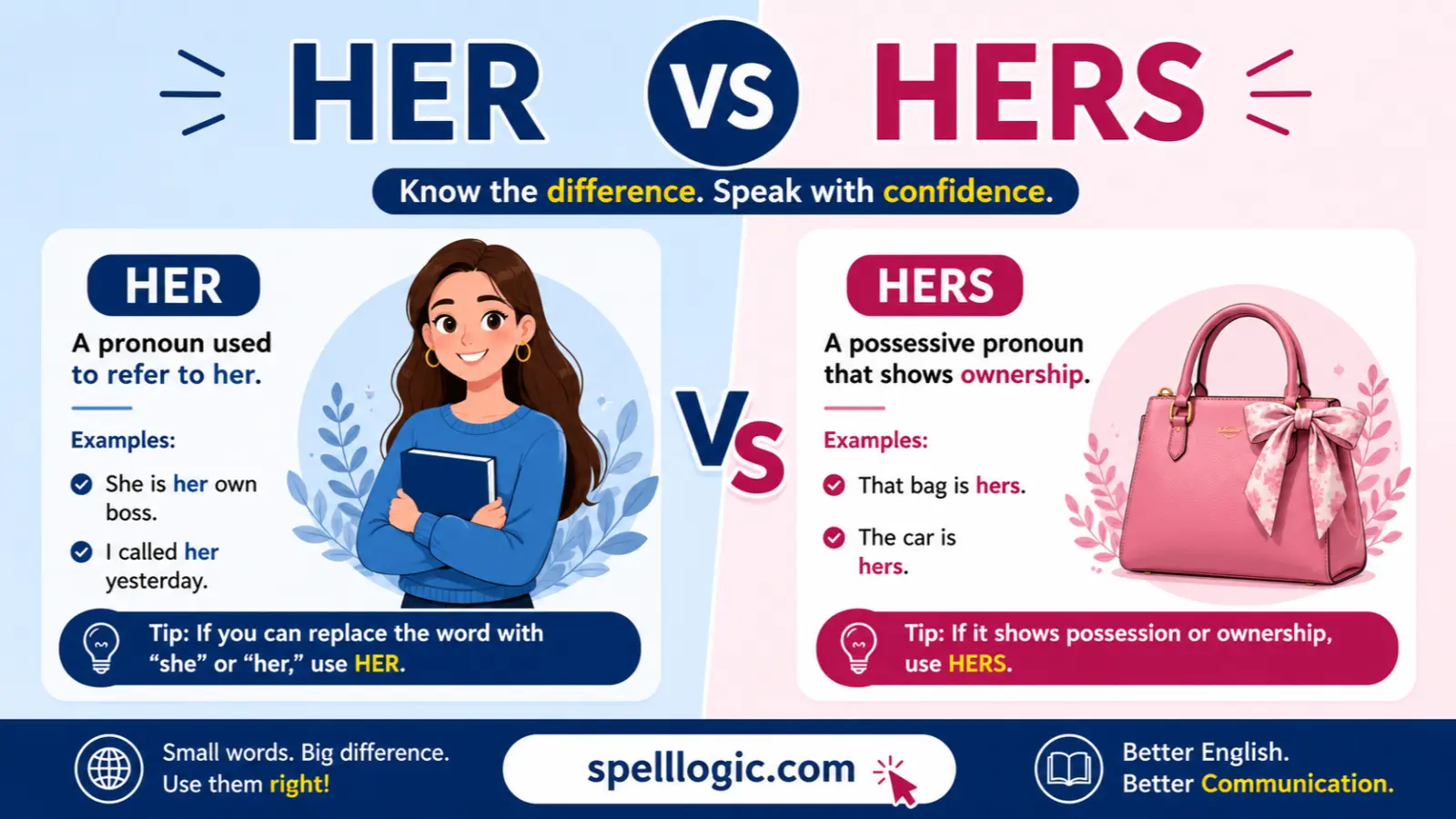
Her is used before a noun or as an object pronoun, while hers replaces a noun to show ownership.
One-line distinction
Her means “belonging to her” before a noun or refers to a female as an object, while hers means “belonging to her” without a following noun.
Examples
- Her backpack is blue.
- I gave the flowers to her.
- This backpack is hers.
- That seat is hers, not mine.
Understanding Homophones in English
What Are Homophones?
Homophones are words that sound the same but have different meanings and sometimes different spellings.
Example:
- their
- there
Although her and hers are not true homophones, they are frequently confused because they look and sound very similar.
Why Homophones Cause Confusion
English contains many words with similar pronunciation or spelling. Learners often focus on meaning instead of grammar, which leads to mistakes.
Example:
- Their house is large.
- They are waiting there.
Likewise:
- Her coat is expensive.
- The coat is hers.
What Does “Her” Mean?
Definition and Core Meaning
Her is a pronoun with two different jobs.
It can be:
- an object pronoun
- a possessive adjective (possessive determiner)
As an object pronoun, it refers to a female person receiving an action.
As a possessive adjective, it shows ownership before a noun.
Origin and Historical Use
The word her comes from Old English and has been part of the language for centuries. It evolved from earlier Germanic languages and has remained one of the most common English pronouns.
Modern Usage and Synonyms
Depending on the sentence, her may mean:
- belonging to a female
- referring to a female person
Related words include:
- she
- hers
- herself
Key Points
- Comes before a noun when showing possession.
- Can act as the object of a verb.
- Cannot replace the noun when showing ownership.
Example Sentences
- Her phone is ringing.
- I saw her yesterday.
- Everyone admired her painting.
- Please help her with the project.
What Does “Hers” Mean?
Definition and Core Meaning
Hers is a possessive pronoun.
It replaces a noun instead of appearing before one.
Origin and Historical Context
Hers developed from the possessive forms used in Middle English. The added -s helps distinguish it from her, allowing speakers to avoid repeating nouns.
Modern Usage and Synonyms
Hers is used when the noun is already understood.
Examples include:
- The red car is hers.
- This desk is hers.
Related possessive pronouns include:
- mine
- yours
- ours
- theirs
Key Points
- Shows ownership.
- Does not come before a noun.
- Replaces the noun completely.
Example Sentences
- The decision was hers.
- That jacket is hers.
- This umbrella isn’t mine; it’s hers.
- The victory was hers alone.
Her vs Hers: Key Differences at a Glance
| Word | Part of Speech | Meaning | Example Context |
|---|---|---|---|
| Her | Object pronoun; Possessive adjective | Refers to a female or shows possession before a noun | Her bag is on the table. / I called her. |
| Hers | Possessive pronoun | Shows ownership without a following noun | The bag is hers. |
How to Remember the Difference Between Her and Hers
Learning a simple memory trick makes these words much easier.
Easy Memory Tricks
- Her always comes before a noun when showing ownership.
- Hers stands alone.
- If the noun disappears, use hers.
Association Technique
Think:
- Her + noun
- Hers = the noun is hidden
Example:
- Her bicycle
- The bicycle is hers.
Memorable Example
Imagine two students.
Sarah says:
“This is her notebook.”
Later, someone asks,
“Whose notebook is this?”
You answer,
“It is hers.”
Common Mistakes and Confusions
Mistake 1
✘ The blue backpack is her.
✔ The blue backpack is hers.
Explanation: After the verb is, use the possessive pronoun.
Mistake 2
✘ I borrowed hers pencil.
✔ I borrowed her pencil.
Explanation: A noun follows, so use the possessive adjective.
Mistake 3
✘ That house belongs to her’s.
✔ That house is hers.
Explanation: Her’s is never correct.
Mistake 4
✘ We visited hers yesterday.
✔ We visited her yesterday.
Explanation: Here, her is the object pronoun.
Examples Section: Correct and Incorrect Usage
Example 1
✔ Correct: Her laptop is very fast.
✘ Incorrect: Hers laptop is very fast.
Example 2
✔ Correct: This notebook is hers.
✘ Incorrect: This notebook is her.
Example 3
✔ Correct: I met her after class.
✘ Incorrect: I met hers after class.
Example 4
✔ Correct: Her ideas impressed everyone.
✘ Incorrect: Hers ideas impressed everyone.
Example 5
✔ Correct: The final decision was hers.
✘ Incorrect: The final decision was her.
Self Assessment: Test Your Knowledge
Fill in the blanks.
- I gave the gift to ________.
- That bicycle is ________.
- ________ teacher explained the lesson well.
- This beautiful painting is ________.
Self Assessment Answers
- her
- hers
- Her
- hers
FAQs
Is “her” a possessive pronoun?
No. Her is a possessive adjective when it comes before a noun, and it can also be an object pronoun.
Is “hers” always possessive?
Yes. Hers is always a possessive pronoun.
Can I say “her book is hers”?
Yes. This sentence is completely correct because her modifies book, while hers replaces book in the second part.
Is “her’s” ever correct?
No. Her’s is never a correct English word.
Which comes before a noun: her or hers?
Always use her before a noun.
Example:
- Her jacket
- Her car
Can “hers” be followed by a noun?
No. Hers always stands alone.
Correct:
- The jacket is hers.
Incorrect:
- Hers jacket
How can I remember the difference quickly?
Remember this simple rule:
If a noun follows, use “her.” If there is no noun, use “hers.”
Final Conclusion: Using “Her” and “Hers” Correctly
Understanding the difference between her and hers is an important step toward speaking and writing English more naturally. Although these two words look very similar and both relate to a female person, they have different grammatical functions. Her works as an object pronoun and as a possessive adjective placed before a noun, while hers is a possessive pronoun that replaces the noun completely. Remember the simple rule: if a noun follows, use “her”; if no noun follows, use “hers.” This one guideline will help you avoid most common mistakes.
You’ll see these words every day in books, conversations, emails, and exams, so learning to use them correctly is worthwhile. Reading English regularly and practicing with your own sentences will make the difference feel natural over time. Whenever you’re unsure, check whether the noun is present. If it is, choose her. If the noun has already been mentioned or is understood, choose hers. With consistent practice, you’ll soon use both words confidently and accurately. Every small grammar improvement strengthens your communication skills, so keep learning, keep practicing, and enjoy becoming a more confident English speaker.