Many English learners wonder whether they should use magic or magical because both words are closely related and often appear in similar contexts. Although they share the same root, they do not have the same meaning or grammatical function. Using the wrong one can make your sentence sound unnatural or grammatically incorrect.
Fortunately, the difference is simple once you understand how each word works. In this guide, you’ll learn the meanings of magic and magical, see clear examples, discover common mistakes, and pick up easy memory tricks that will help you use both words confidently in everyday English.
Why “Magic” and “Magical” Are Confusing
Many learners mix up magic and magical because the words look and sound almost the same. However, they play different roles in a sentence.
Here are the main reasons for the confusion:
Similar Pronunciation
Both words begin with the same sound, magic, making them easy to confuse when speaking or listening.
Similar Spelling
The only noticeable difference is the ending -al in magical, which changes the word from a noun (or adjective in some cases) into a descriptive adjective.
Context Confusion
Both words describe things related to wonder, enchantment, or extraordinary experiences. Because they appear in similar situations, learners sometimes choose the wrong form.
Common Learner Mistakes
- Using magic instead of magical before a noun.
- Thinking both words are always interchangeable.
- Forgetting that magical mainly describes something, while magic often names the concept or power itself.
Magic vs Magical Explained Simply
The easiest way to understand the difference is to remember their grammatical roles.
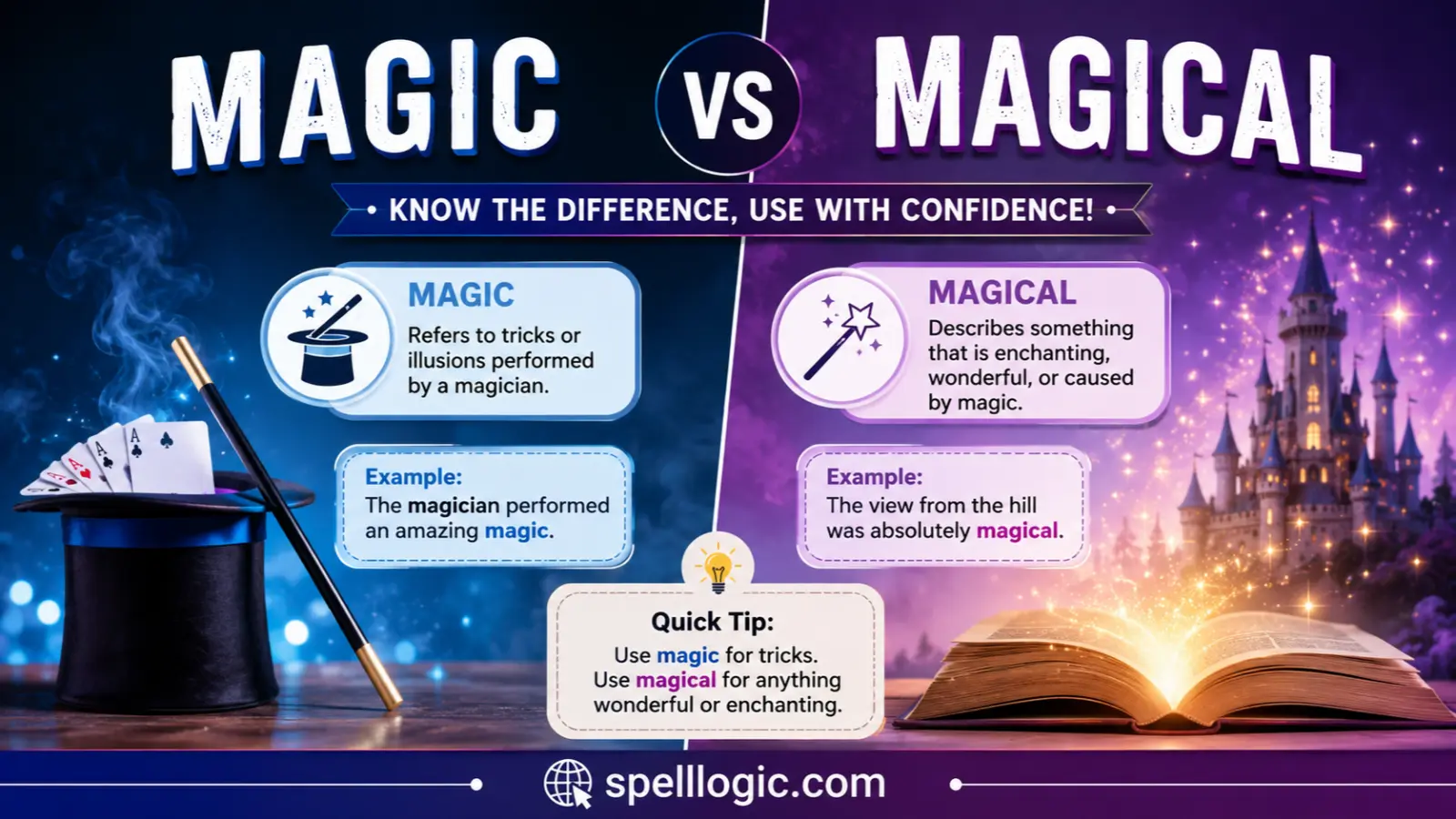
Magic refers to supernatural power, illusion, or something extraordinary.
Magical describes something that has the qualities of magic or feels wonderfully special.
One-line distinction
Magic means the power or concept, while magical describes something that has the feeling or quality of magic.
Example sentences
- Magic can make a fantasy story exciting.
- The children enjoyed a magical evening under the stars.
Another example:
- Magic means supernatural power, while magical means full of wonder or enchantment.
Understanding Homophones in English
What Are Homophones?
Homophones are words that sound the same but have different meanings and spellings.
Example:
- Sea
- See
Although they sound identical, they have completely different meanings.
Important Note: Magic and magical are not homophones. They are related words from the same root but have different grammatical forms.
Why Homophones Cause Confusion
English learners often rely on pronunciation when choosing words. As a result, words that sound alike may be mixed up.
For example:
- I can see the ocean.
- The sea is calm today.
Likewise, learners sometimes confuse magic and magical because they are closely related, even though they are not true homophones.
What Does “Magic” Mean?
Definition and Core Meaning
Magic is the power to perform impossible or supernatural acts. It can also describe entertaining tricks performed by magicians.
It may also refer to something amazingly beautiful or impressive.
Origin and Historical Use
The word magic comes from the Greek word magike, meaning the art of magicians. It entered English centuries ago and has been associated with myths, fantasy, religion, and stage performances.
Modern Usage and Synonyms
Today, magic is used in many contexts.
It can refer to:
- Supernatural powers
- Illusions
- Fantasy stories
- Something extremely wonderful
- Extraordinary success
Synonyms
- Sorcery
- Enchantment
- Wizardry
- Illusion
- Charm
- Wonder
Example Sentences
- The magician amazed everyone with his magic.
- Harry Potter learns magic at Hogwarts.
- Music has the magic to change people’s moods.
- There was magic in the air during the celebration.
What Does “Magical” Mean?
Definition and Core Meaning
Magical is an adjective that describes something as having the qualities of magic or creating a feeling of wonder, beauty, or excitement.
It does not usually refer to actual supernatural power.
Origin and Historical Context
The adjective magical developed from magic by adding the suffix -al, which turns many nouns into adjectives.
Over time, it became widely used to describe memorable or enchanting experiences.
Modern Usage and Synonyms
Today, magical commonly describes:
- Beautiful moments
- Fairy-tale settings
- Special memories
- Wonderful experiences
- Enchanting places
Synonyms
- Enchanting
- Wonderful
- Dreamlike
- Charming
- Delightful
- Mystical
Example Sentences
- We spent a magical evening by the lake.
- The snowfall created a magical landscape.
- Her smile made the moment feel magical.
- Disney creates magical experiences for visitors.
Magic vs Magical: Key Differences at a Glance
| Word | Part of Speech | Meaning | Example Context |
|---|---|---|---|
| Magic | Noun (sometimes adjective) | Supernatural power, illusion, or extraordinary force | The magician performed magic. |
| Magical | Adjective | Having the qualities of magic or creating wonder | It was a magical night. |
How to Remember the Difference Between Magic and Magical
Here are a few easy tricks.
Easy Memory Tricks
- Magic = the thing
- Magical = describes the thing
Association Technique
Think about the ending.
The ending -al often helps form adjectives.
Examples:
- Logic → Logical
- Music → Musical
- Magic → Magical
Memorable Example
- Magic filled the castle.
- The castle looked magical.
The first sentence talks about the power.
The second sentence describes the castle.
Common Mistakes and Confusions
Mistake 1
✘ It was a magic evening.
✔ It was a magical evening.
Explanation: You are describing the evening, so use the adjective.
Mistake 2
✘ She learned magical.
✔ She learned magic.
Explanation: She learned the subject or skill, not a description.
Mistake 3
✘ The magician performed magical.
✔ The magician performed magic.
Explanation: The performance involves magic itself.
Mistake 4
✘ We had a magic vacation.
✔ We had a magical vacation.
Explanation: The vacation is being described.
Examples Section: Correct and Incorrect Usage
Example 1
✔ Correct: The children believed in magic.
✘ Incorrect: The children believed in magical.
Example 2
✔ Correct: It was a magical sunset.
✘ Incorrect: It was a magic sunset.
Example 3
✔ Correct: The magician used magic to entertain the audience.
✘ Incorrect: The magician used magical to entertain the audience.
Example 4
✔ Correct: We had a magical holiday together.
✘ Incorrect: We had a magic holiday together.
Example 5
✔ Correct: Fantasy novels often include magic.
✘ Incorrect: Fantasy novels often include magical.
Example 6
✔ Correct: The garden looked magical after the rain.
✘ Incorrect: The garden looked magic after the rain.
Self Assessment: Test Your Knowledge
Fill in the blanks with magic or magical.
- The forest looked ________ in the moonlight.
- The wizard studied ancient ________.
- We enjoyed a truly ________ evening.
- The children were fascinated by the ________ tricks.
Self Assessment Answers
- magical
- magic
- magical
- magic
FAQs
1. What is the difference between magic and magical?
Magic is the power, concept, or practice of supernatural acts, while magical describes something that feels enchanting or full of wonder.
2. Is magical an adjective?
Yes. Magical is an adjective used to describe nouns.
3. Can magic be used as an adjective?
Yes, but only in certain fixed expressions such as magic trick, magic show, magic wand, and magic spell. In most descriptive situations, magical is the better choice.
4. Which word is more common in everyday English?
Both are common, but they are used differently. Magic names the concept, while magical describes experiences, places, or moments.
5. Is “magic evening” correct?
Usually, magical evening is the more natural and grammatically correct expression.
6. Can something be magical without real magic?
Yes. A beautiful sunset, a memorable vacation, or a joyful celebration can all be described as magical, even if no supernatural events occur.
7. Are magic and magical interchangeable?
No. They are closely related but have different grammatical functions and should be used according to the sentence structure.
Final Conclusion: Using “Magic” and “Magical” Correctly
Understanding the difference between magic and magical is easier than it first appears. Although the two words share the same root and are connected in meaning, they serve different purposes in English. Magic usually refers to supernatural power, illusion, or something extraordinary. It can also be used as an adjective in certain fixed expressions, such as magic trick or magic show. Magical, on the other hand, is an adjective that describes a person, place, event, or experience as enchanting, wonderful, or full of the feeling of magic. Keeping this distinction in mind will help you choose the right word naturally in both speaking and writing.
A simple memory tip is to remember that magic is the thing, while magical describes the thing. If you are talking about supernatural power or a magician’s performance, use magic. If you are describing an unforgettable holiday, a beautiful landscape, or a special moment, use magical. Reading books, watching English movies, and practicing with real-life examples will strengthen your understanding over time. Every new sentence you read or write helps build confidence. Keep practicing, pay attention to context, and soon using magic and magical correctly will become second nature.