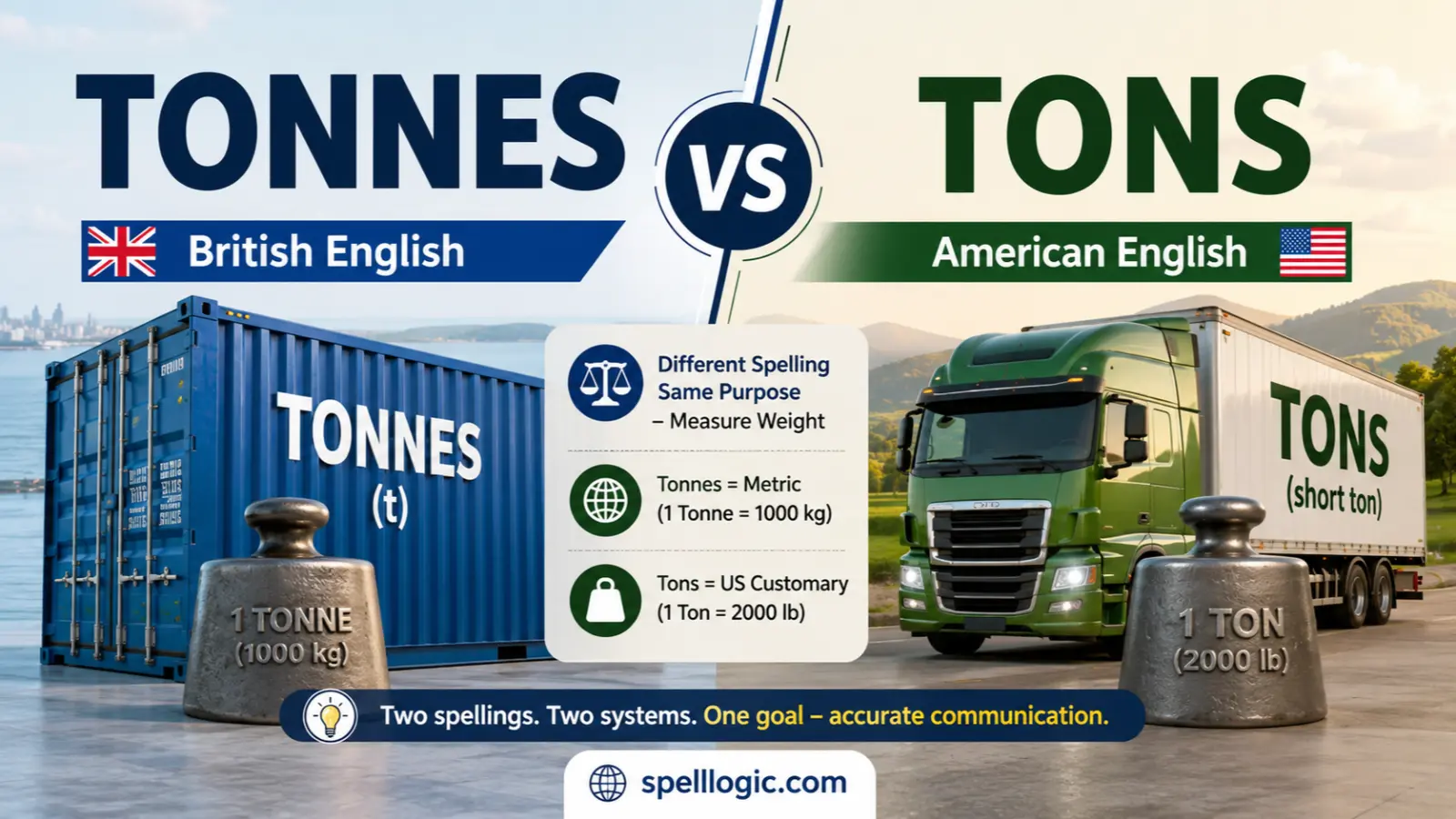
Many English learners get confused by tonnes and tons because both words describe heavy weight and sound similar in everyday conversation. However, they do not always mean the same thing. The difference mainly depends on the measurement system and the country where the word is used.
Using the wrong term can cause misunderstandings in business, shipping, engineering, and even casual writing. Learning when to use tonnes and tons will help you communicate more accurately and confidently. This guide explains both words in simple English, provides examples, and shows easy ways to remember the difference.
Why “Tonnes” and “Tons” Are Confusing
Many people think tonnes and tons are exactly the same because both describe a very large amount of weight. Although they are closely related, they belong to different measurement systems.
Here are the main reasons learners mix them up:
Similar Pronunciation
- Both words are pronounced almost the same.
- In fast speech, it is difficult to hear any difference.
Similar Spelling
- The words differ by only two letters.
- Both begin with ton, making them easy to confuse while reading.
Context Confusion
- Some countries use tonnes.
- Others use tons.
- International documents may include both measurements.
Common Learner Mistakes
- Assuming one word is simply the plural of the other.
- Using tonnes in American English.
- Using tons when writing scientific or international metric documents.
- Forgetting that different types of “ton” exist.
Tonnes vs Tons Explained Simply
The easiest way to understand these words is by remembering the measurement system.
Tonnes means metric tons, where 1 tonne equals 1,000 kilograms.
Tons usually means short tons in American English, where 1 ton equals 2,000 pounds (about 907 kilograms).
One-line Distinction
Tonnes belong to the metric system, while tons usually belong to the U.S. customary system.
Example Sentences
- The factory produces 500 tonnes of steel every week.
- The truck carried 10 tons of sand across the construction site.
Another simple explanation:
“Tonnes” means metric units of weight, while “tons” usually refers to U.S. customary units of weight.
Understanding Homophones in English
What Are Homophones?
Homophones are words that sound the same but have different meanings, spellings, or both.
Example:
- Right
- Write
These words sound identical but have different meanings.
Note: Tonnes and tons are not perfect homophones because their spellings and meanings differ, although many speakers pronounce them very similarly.
Why Homophones Cause Confusion
When words sound alike, listeners often rely on context to understand the intended meaning.
For example:
“The shipment weighed fifty tons.”
Without additional information, you may not know whether the speaker means U.S. tons or metric tonnes.
That is why written communication often specifies the measurement system.
What Does “Tonnes” Mean?
Definition and Core Meaning
A tonne is a metric unit of mass equal to exactly 1,000 kilograms.
It is commonly called a metric ton.
Origin and Historical Use
- Derived from the French word tonne.
- Introduced with the metric system.
- Used internationally for trade, shipping, science, agriculture, and manufacturing.
Modern Usage and Synonyms
Common synonyms include:
- Metric ton
- Metric tonne
- 1,000 kilograms
Key Points
- Equal to exactly 1,000 kg
- Part of the metric system
- Used in most countries worldwide
- Common in scientific writing
- Standard in international trade
Example Sentences
- Australia exported millions of tonnes of wheat last year.
- The cargo weighed over 2,000 tonnes.
- The recycling center processed hundreds of tonnes of plastic.
What Does “Tons” Mean?
Definition and Core Meaning
A ton usually refers to the short ton, which equals 2,000 pounds or approximately 907 kilograms.
However, in some contexts, ton may also refer to the long ton (2,240 pounds) in the United Kingdom, although this usage is much less common today.
Origin and Historical Context
- Comes from the Old English and French word referring to a large cask or barrel.
- Over time, it became a standard unit for measuring heavy loads.
- Different countries later adopted different definitions.
Modern Usage and Synonyms
Common synonyms include:
- Short ton
- U.S. ton
- Ton (American usage)
Key Points
- Usually equals 2,000 pounds
- Used mainly in the United States
- Common in construction, transportation, and mining
- May occasionally refer to the long ton depending on historical context
Example Sentences
- The bridge can support 25 tons.
- The crane lifted 15 tons of concrete.
- Farmers harvested several tons of corn.
Tonnes vs Tons: Key Differences at a Glance
| Word | Part of Speech | Meaning | Example Context |
|---|---|---|---|
| Tonnes | Noun | Metric unit equal to 1,000 kilograms | The ship carried 8,000 tonnes of coal. |
| Tons | Noun | Usually a U.S. unit equal to 2,000 pounds | The truck transported 20 tons of gravel. |
How to Remember the Difference Between Tonnes and Tons
Learning a simple memory trick can help.
Easy Memory Tricks
- Tonne = Metric = Most countries
- Ton = America = Pounds
Association Techniques
Think of the extra letters “ne” in tonne.
Associate them with:
- N = International
- E = Europe
Although not perfect, this reminds you that tonne belongs to the metric system used in many countries.
One Memorable Example
Imagine two trucks.
- The European truck measures its load in tonnes.
- The American truck measures its load in tons.
This picture makes the difference easier to remember.
Common Mistakes and Confusions
Here are mistakes learners often make.
Wrong
❌ The package weighs 5 tons according to the metric system.
Correct
✔ The package weighs 5 tonnes according to the metric system.
Explanation: Metric measurements use tonnes.
Wrong
❌ The American company shipped 40 tonnes of coal.
Correct
✔ The American company shipped 40 tons of coal.
Explanation: American businesses often use tons unless working with international metric standards.
Wrong
❌ One tonne equals one short ton.
Correct
✔ One tonne equals 1,000 kilograms, while one short ton equals 2,000 pounds.
Explanation: These measurements are close but not equal.
Examples Section: Correct and Incorrect Usage
Example 1
✔ Correct: The factory produces 900 tonnes of cement every day.
✘ Incorrect: The factory produces 900 tons of cement under the metric system.
Example 2
✔ Correct: The truck carried 12 tons of gravel in Texas.
✘ Incorrect: The truck carried 12 tonnes according to U.S. highway regulations.
Example 3
✔ Correct: Scientists recorded the glacier losing millions of tonnes of ice.
✘ Incorrect: Scientists recorded millions of tons in an international metric report.
Example 4
✔ Correct: The crane lifted five tons of steel.
✘ Incorrect: The crane lifted five tonnes using American weight standards.
Self Assessment: Test Your Knowledge
Fill in the blanks with tonnes or tons.
- Canada exported millions of __ of wheat.
- The American truck carried 18 __ of stone.
- One metric __ equals exactly 1,000 kilograms.
- Most international shipping documents use __ instead of U.S. tons.
Self Assessment Answers
- tonnes
- tons
- tonne
- tonnes
FAQs
1. Are tonnes and tons the same?
No. A tonne equals 1,000 kilograms, while a U.S. ton equals 2,000 pounds (about 907 kilograms).
2. Which spelling is correct: tonnes or tons?
Both are correct. The right choice depends on the measurement system and regional English you are using.
3. Which countries use tonnes?
Most countries that use the metric system, including Canada, Australia, and many European nations, use tonnes.
4. Which countries use tons?
The United States commonly uses tons, especially the short ton.
5. Is a tonne heavier than a ton?
Yes. A metric tonne (1,000 kg) is heavier than a U.S. short ton (about 907 kg).
6. What is a metric ton?
A metric ton is another name for a tonne.
7. Should I use tonnes in scientific writing?
Yes. Scientific and international publications usually prefer tonnes because they follow the metric system.
Final Conclusion: Using “Tonnes” and “Tons” Correctly
Understanding the difference between tonnes and tons is easier once you know which measurement system each word belongs to. A tonne is the standard metric unit of mass and always equals 1,000 kilograms, making it the preferred choice in most countries and in international trade, science, and engineering. A ton, on the other hand, usually refers to the U.S. short ton, which equals 2,000 pounds, although historical contexts may occasionally use the British long ton. Because these units are similar in size but not identical, choosing the correct term is important whenever accuracy matters. A simple memory tip is to associate tonne with the metric system and tons with American measurements.
Paying attention to the audience, country, and context will help you avoid common mistakes. As you continue learning English, remember that understanding measurement vocabulary is just as important as learning grammar and spelling. The more authentic examples you read and practice, the more natural these differences will become. Keep using tonnes for metric contexts and tons for U.S. customary contexts, and you’ll communicate clearly and confidently in both everyday conversations and professional writing.