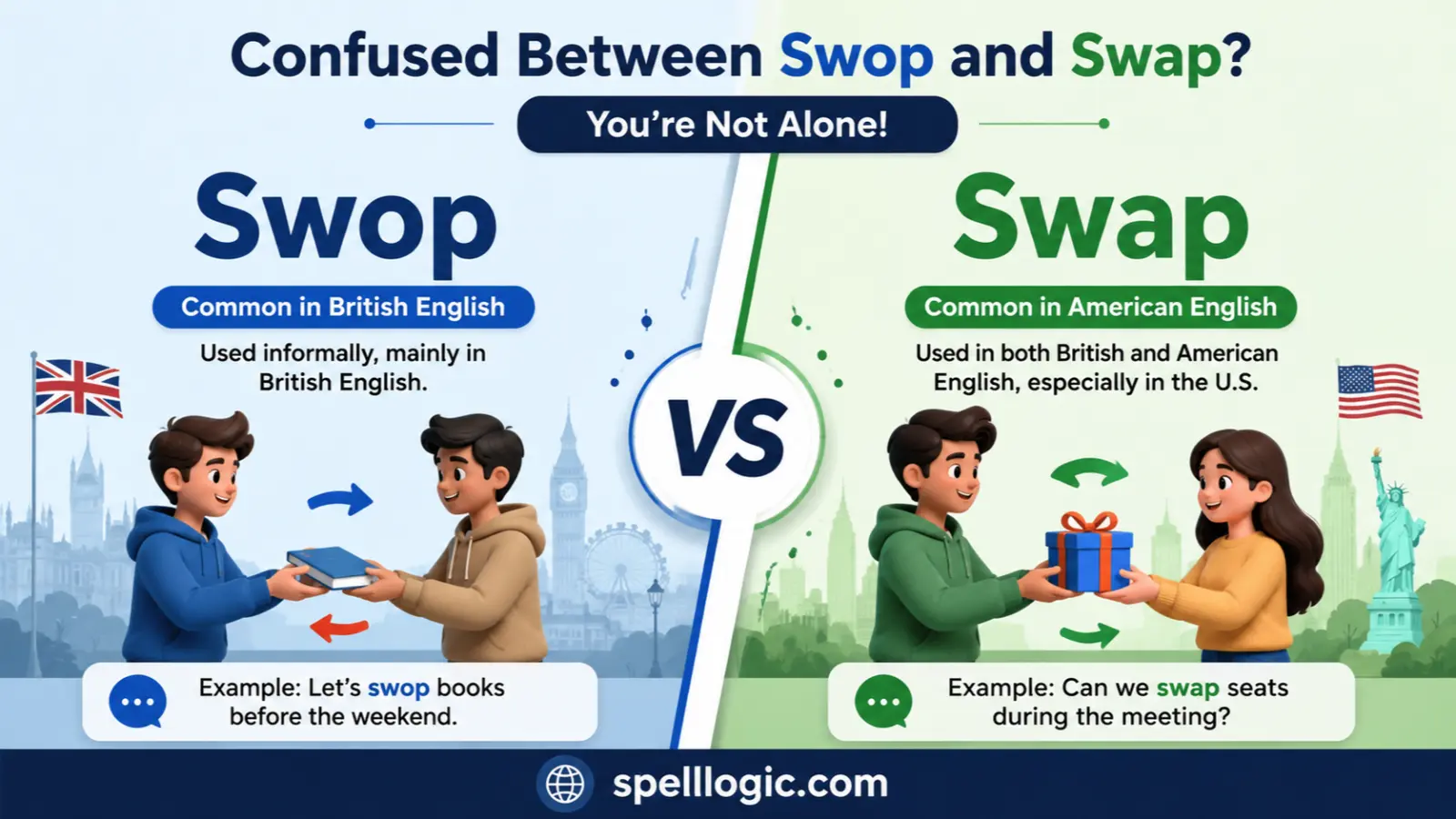
Many English learners become confused by swop and swap because both words sound almost the same and share a similar meaning. In conversations, books, and online content, you may see both spellings and wonder which one is correct. The good news is that understanding the difference is simple.
While both words refer to exchanging one thing for another, they are not equally common in modern English. Knowing when to use swap and when swop appears can help you write more naturally and avoid common mistakes. This guide explains everything you need to know in clear, simple language with practical examples.
Why “Swop” and “Swap” Are Confusing
Many people mix up swop and swap because they are extremely similar in pronunciation and meaning.
Similar Pronunciation
Both words are pronounced almost identically in everyday speech. Most native speakers pronounce them as /swɒp/ or /swɑːp/ depending on their accent.
Similar Spelling
The only difference is the middle vowel:
- Swop
- Swap
Since only one letter changes, learners often assume they are interchangeable everywhere.
Context Confusion
Both words describe exchanging one thing for another. However, swap is the standard spelling in modern English, while swop is mainly an older or less common British variant.
Common Learner Mistakes
Many learners:
- Think swop is the preferred British spelling.
- Use swop in formal writing.
- Believe both spellings are equally common today.
- Mix them without considering the audience.
Swop vs Swap Explained Simply
The easiest way to understand these words is this:
Swop means to exchange something, while swap also means to exchange something—but swap is the standard and widely accepted spelling in modern English.
One-Line Distinction
Swop is an older or uncommon spelling, while swap is the modern standard spelling.
Example Sentences
Swop
- They agreed to swop seats during the concert.
- He wanted to swop his old bicycle for a newer one.
Swap
- Let’s swap phone numbers.
- We decided to swap our lunch boxes.
Understanding Homophones in English
What Are Homophones?
Homophones are words that sound the same but may have different spellings or meanings.
Example:
- Flower
- Flour
They sound identical but have different meanings.
Although swop and swap are not perfect homophones because they represent spelling variants of the same word, they are pronounced almost the same, which causes confusion.
Why Homophones Cause Confusion
English pronunciation often stays the same even when spelling changes.
For example:
- Their
- There
- They’re
Because pronunciation gives no clue about spelling, learners often choose the wrong written form.
What Does “Swop” Mean?
Definition and Core Meaning
Swop means to exchange one thing for another.
It has exactly the same meaning as swap, but it is much less common today.
Origin and Historical Use
- Appeared mainly in British English.
- Became popular during the late 19th and early 20th centuries.
- Has largely been replaced by swap in modern English.
Today, dictionaries usually label swop as a variant spelling.
Modern Usage and Synonyms
Modern usage is uncommon.
Synonyms
- Exchange
- Trade
- Switch
- Barter
- Replace
Example Sentences
- She wanted to swop books with her friend.
- We swopped gifts after the party.
- Can we swop our seats?
Key Points
- Older spelling
- Rare in modern writing
- Mainly found in older British texts
- Same meaning as swap
What Does “Swap” Mean?
Definition and Core Meaning
Swap means to exchange one thing for another.
It is the preferred spelling in both British and American English today.
Origin and Historical Context
The word has been used for centuries to describe exchanging possessions, places, or responsibilities.
Over time, swap became the dominant spelling worldwide.
Modern Usage and Synonyms
Today, swap appears everywhere:
- Newspapers
- Business writing
- Schools
- Websites
- Everyday conversations
Synonyms
- Exchange
- Trade
- Switch
- Replace
- Exchange with
Example Sentences
- Let’s swap seats.
- We swapped jackets because it became cold.
- The children swapped toys.
Key Points
- Standard modern spelling
- Accepted worldwide
- Used in formal and informal English
- Recommended by most dictionaries
Swop vs Swap: Key Differences at a Glance
| Word | Part of Speech | Meaning | Example Context |
|---|---|---|---|
| Swop | Verb, Noun | Exchange something (older spelling) | They swopped books. |
| Swap | Verb, Noun | Exchange something (standard spelling) | We swapped phone numbers. |
How to Remember the Difference Between Swop and Swap
Here are some simple memory tricks.
Easy Memory Tricks
- Swap is the spelling you should normally use.
- Think of swap meet, a common English expression.
- Most dictionaries and style guides prefer swap.
Association Technique
Remember:
A = Accepted
The A in swap reminds you that it is the accepted modern spelling.
Memorable Example
Imagine swapping baseball cards.
You would naturally say:
“Let’s swap cards.”
That sounds natural because swap is the word used in modern English.
Common Mistakes and Confusions
Here are mistakes learners often make.
Wrong
❌ We should swop email addresses in our business report.
Correct
✔ We should swap email addresses in our business report.
Explanation:
Formal writing almost always uses swap.
Wrong
❌ The teacher asked us to swop partners.
Correct
✔ The teacher asked us to swap partners.
Explanation:
Modern educational materials prefer swap.
Wrong
❌ Everyone uses swop nowadays.
Correct
✔ Everyone uses swap nowadays.
Explanation:
Swap is the common modern spelling.
Examples Section: Correct and Incorrect Usage
Example 1
✔ Correct: Let’s swap our seats.
✘ Incorrect: Let’s swop our seats. (Not preferred in modern English.)
Example 2
✔ Correct: They swapped recipes.
✘ Incorrect: They swopped recipes in a formal report.
Example 3
✔ Correct: We can swap ideas during the meeting.
✘ Incorrect: We can swop ideas during the meeting.
Example 4
✔ Correct: The children swapped stickers.
✘ Incorrect: The children swopped stickers in their homework assignment.
Self Assessment: Test Your Knowledge
Fill in the blanks.
- Let’s ______ our phone numbers.
- Modern dictionaries usually recommend ______ instead of swop.
- The two friends decided to ______ books.
- ______ is mainly considered an older spelling.
Self Assessment Answers
- swap
- swap
- swap
- Swop
FAQs
Is swop a real English word?
Yes. It is a genuine English word but is now considered an older or uncommon spelling of swap.
Which is correct: swop or swap?
Both exist, but swap is the standard spelling used in modern English.
Is swop used in British English?
Yes, but it is uncommon today. Most British writers also use swap.
Can I use swop in formal writing?
It is better to avoid swop in formal writing and use swap instead.
Are swop and swap different in meaning?
No. They have the same meaning: to exchange one thing for another.
Why is swap more common?
Language changes over time. Swap gradually became the preferred spelling in dictionaries, education, publishing, and everyday communication.
Is swapped correct?
Yes. Swapped is the standard past tense of swap.
Final Conclusion: Using “Swop” and “Swap” Correctly
Understanding the difference between swop and swap is much easier than it first appears. Both words mean to exchange one thing for another, and historically they have been used with the same meaning. However, the key distinction lies in their modern usage. Swap is the standard spelling accepted in both British and American English, making it the best choice for everyday conversations, school assignments, professional writing, and online communication. Swop, on the other hand, survives mainly as an older or uncommon variant that you may encounter in historical texts, older British publications, or certain regional contexts.
A simple way to remember this difference is to think of the letter A in swap as standing for accepted. Whenever you need to describe exchanging seats, ideas, gifts, phone numbers, or any other items, swap is almost always the correct and natural choice. While recognizing swop can help you understand older writing, using swap will make your English sound current and fluent. The more you read, write, and practice with real-life examples, the easier this distinction will become. Keep learning, stay curious, and remember that mastering small spelling differences like swop and swap is another step toward becoming a more confident and accurate English speaker.