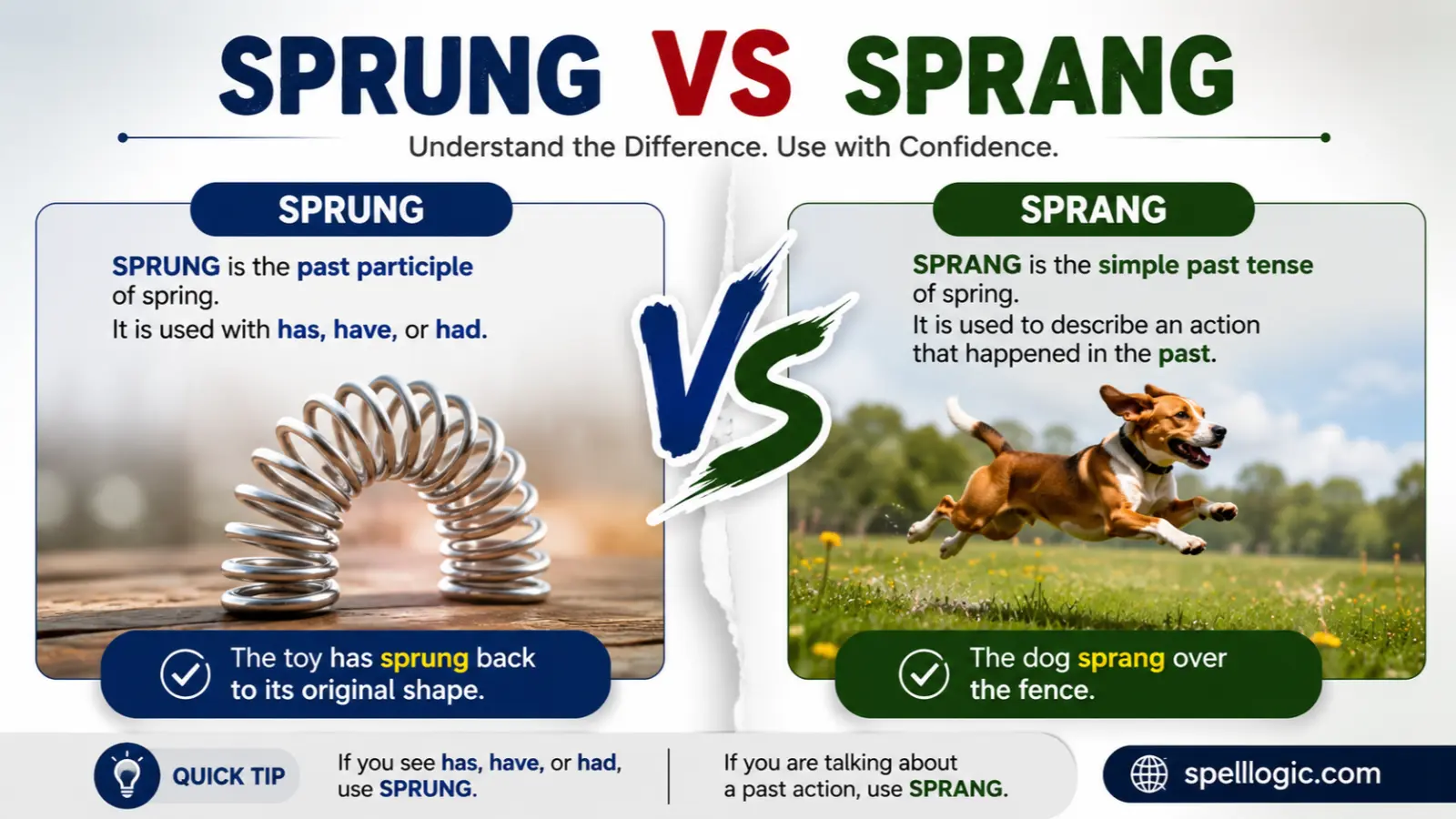
Many English learners get confused by sprung and sprang because both words come from the same verb, spring, and both describe actions that happened in the past. At first glance, they look similar and often appear in similar sentences, making it difficult to know which one is correct. However, they have different grammatical roles.
Understanding when to use sprang and when to use sprung will improve your grammar, writing, and speaking. In this guide, you’ll learn the difference in simple language, see plenty of examples, and discover easy memory tricks that will help you use both words confidently.
Why “Sprung” and “Sprang” Are Confusing
Many learners mix up sprung and sprang because they are both forms of the irregular verb spring.
Here are the main reasons for the confusion:
Similar Pronunciation
Both words begin with the same sound and differ by only one vowel, making them easy to confuse in conversation.
Similar Spelling
The spellings are nearly identical. Only the middle vowel changes from a to u.
Context Confusion
Both words describe jumping, moving suddenly, or appearing unexpectedly. Without understanding verb tenses, learners often choose the wrong form.
Common Learner Mistakes
- Using sprung instead of sprang for the simple past.
- Forgetting that sprung usually follows has, have, had, or was.
- Treating both words as interchangeable.
Understanding their grammatical roles makes choosing the correct word much easier.
Sprung vs Sprang Explained Simply
The difference is simple:
- Sprang is the simple past tense of spring.
- Sprung is the past participle of spring.
One-Line Distinction
Sprang describes an action that happened in the past, while sprung is used with helping verbs to form perfect or passive tenses.
Example Explanation
Sprang means someone jumped or moved suddenly in the past, while sprung means the action has happened or had happened.
Example Sentences
- The cat sprang onto the fence.
- The cat has sprung onto the fence many times before.
Another pair:
- She sprang out of bed when the alarm rang.
- She had sprung from her chair before anyone noticed.
Understanding Homophones in English
Although sprung and sprang are not homophones, learners often confuse them because they are closely related verb forms.
What Are Homophones?
Homophones are words that sound the same but have different meanings and spellings.
Example:
- Sea
- See
These words sound alike but mean different things.
Why Homophones Cause Confusion
When words sound similar, learners often rely on pronunciation instead of grammar.
For example:
- Their
- There
- They’re
These words sound the same but have different meanings.
Similarly, although sprung and sprang are not true homophones, their similar pronunciation and shared origin create confusion.
What Does “Sprung” Mean?
Definition and Core Meaning
Sprung is the past participle of the verb spring.
It describes an action that has happened, had happened, or has been completed when used with helping verbs.
Origin and Historical Use
The verb spring comes from Old English springan, meaning “to leap,” “burst forth,” or “rise suddenly.”
Over time, English developed the irregular forms:
- Spring
- Sprang
- Sprung
These forms have remained in modern English.
Modern Usage and Synonyms
Sprung commonly appears with:
- Has
- Have
- Had
- Was
- Were
Synonyms
- Jumped
- Leaped
- Bounced
- Burst
- Emerged
- Popped up
Key Points
- Past participle
- Used with helping verbs
- Indicates completed action
- Common in perfect tenses
Example Sentences
- The flowers have sprung from the ground.
- A leak had sprung in the pipe overnight.
- The tiger has sprung from hiding.
- New businesses have sprung up across the city.
What Does “Sprang” Mean?
Definition and Core Meaning
Sprang is the simple past tense of spring.
It describes an action that happened and finished in the past.
Origin and Historical Context
Like sprung, sprang developed from the Old English verb springan. It has been used in English literature for centuries as the simple past form.
Modern Usage and Synonyms
Synonyms
- Jumped
- Leaped
- Bounced
- Rose
- Burst
Key Points
- Simple past tense
- No helping verb needed
- Describes completed past action
- Frequently used in storytelling
Example Sentences
- The athlete sprang over the hurdle.
- A rabbit sprang from the bushes.
- The child sprang into action.
- He sprang to his feet when he heard the news.
Sprung vs Sprang: Key Differences at a Glance
| Word | Part of Speech | Meaning | Example Context |
|---|---|---|---|
| Sprang | Simple past verb | Jumped or moved suddenly in the past | The dog sprang over the fence. |
| Sprung | Past participle | Has or had jumped or appeared suddenly | The dog has sprung over the fence before. |
How to Remember the Difference Between Sprung and Sprang
Here are some easy tricks.
Memory Trick 1
Think:
Yesterday = Sprang
Example:
Yesterday the cat sprang onto the table.
Memory Trick 2
If you see:
- has
- have
- had
Use sprung.
Example:
The flowers have sprung up after the rain.
Association Technique
Remember this pattern:
- Sing → Sang → Sung
- Ring → Rang → Rung
- Spring → Sprang → Sprung
Notice how sprang matches rang, while sprung matches rung.
Memorable Example
Yesterday he sprang. Today we say he has sprung.
Common Mistakes and Confusions
Mistake 1
❌ He has sprang over the wall.
✔ He has sprung over the wall.
Explanation: After has, use the past participle.
Mistake 2
❌ The rabbit sprung from the grass yesterday.
✔ The rabbit sprang from the grass yesterday.
Explanation: A completed past action takes the simple past.
Mistake 3
❌ She had sprang before I looked.
✔ She had sprung before I looked.
Explanation: After had, use sprung.
Mistake 4
❌ The athlete has sprang into action.
✔ The athlete has sprung into action.
Explanation: Perfect tenses always require the past participle.
Examples Section: Correct and Incorrect Usage
Example 1
✔ Correct: The deer sprang across the road.
✘ Incorrect: The deer sprung across the road.
Example 2
✔ Correct: The flowers have sprung up after the rain.
✘ Incorrect: The flowers have sprang up after the rain.
Example 3
✔ Correct: He sprang from his chair when he heard the news.
✘ Incorrect: He sprung from his chair when he heard the news.
Example 4
✔ Correct: Several problems had sprung up before the meeting.
✘ Incorrect: Several problems had sprang up before the meeting.
Example 5
✔ Correct: The cat sprang onto the windowsill.
✘ Incorrect: The cat has sprang onto the windowsill.
Example 6
✔ Correct: A new opportunity has sprung from the partnership.
✘ Incorrect: A new opportunity has sprang from the partnership.
Self Assessment: Test Your Knowledge
Fill in the blanks with sprang or sprung.
- The lion ______ from behind the rock.
- The flowers have ______ up after the storm.
- She ______ to answer the phone immediately.
- Several questions had ______ during the discussion.
Self Assessment Answers
- sprang
- sprung
- sprang
- sprung
FAQs
Is “sprang” grammatically correct?
Yes. Sprang is the correct simple past tense of spring.
Is “sprung” grammatically correct?
Yes. Sprung is the correct past participle of spring.
Which comes first: sprang or sprung?
The verb forms are:
- Spring
- Sprang
- Sprung
Can I say “has sprang”?
No. The correct phrase is has sprung.
Is “sprung” used without helping verbs?
Usually no. It normally appears with has, have, had, or in passive constructions.
Why is “spring” an irregular verb?
It follows an old English pattern where the vowel changes instead of adding -ed, just like sing–sang–sung and ring–rang–rung.
How can I remember the difference easily?
Remember: Yesterday = sprang. Has/have/had = sprung.
Final Conclusion: Using “Sprung” and “Sprang” Correctly
Understanding the difference between sprung and sprang is easier than it first appears. Both words come from the irregular verb spring, but they serve different grammatical purposes. Sprang is the simple past tense and describes an action that happened at a specific time in the past, such as The cat sprang onto the fence. Sprung, on the other hand, is the past participle and is usually used with helping verbs like has, have, and had, as in The cat has sprung onto the fence many times. Once you recognize this pattern, choosing the correct form becomes much more natural.
A useful way to remember the difference is to compare spring–sprang–sprung with other irregular verbs like sing–sang–sung and ring–rang–rung. If the sentence includes a helping verb, sprung is almost always the right choice. If it simply tells what happened in the past, sprang is usually correct. Reading books, listening to native speakers, and practicing with example sentences will help reinforce these forms over time. English irregular verbs may seem challenging at first, but with regular practice and simple memory tricks, you’ll soon use sprung and sprang accurately and confidently in both writing and everyday conversation.