
Date vs Day Many English learners confuse date and day because both words relate to time and are often used in similar conversations. For example, someone may ask, “What day is it?” while another person asks, “What’s the date today?” Although these questions seem similar, they actually ask for different information.
Understanding the difference between date and day is important for everyday communication, writing schedules, making appointments, and talking about events. Once you learn how each word is used, choosing the correct one becomes much easier. This guide explains the meanings, usage, examples, and key differences between date and day in simple English.
Table of Contents
- Introduction
- Why “Date” and “Day” Are Confusing
- Date vs Day Explained Simply
- Understanding Homophones in English
- What Are Homophones?
- Why Homophones Cause Confusion
- What Does “Date” Mean?
- What Does “Day” Mean?
- Date vs Day: Key Differences at a Glance
- How to Remember the Difference Between Date and Day
- Common Mistakes and Confusions
- Examples Section: Correct and Incorrect Usage
- Self Assessment: Test Your Knowledge
- Self Assessment Answers
- FAQs About Date and Day
- Final Conclusion: Using Date and Day Correctly
Why “Date” and “Day” Are Confusing
Many learners mix up date and day for several reasons.
Similar Pronunciation
Both words begin with the same “d” sound and are often used in discussions about time and calendars. This similarity can make them easy to confuse during conversations.
Similar Spelling
The words are short and look somewhat alike. Both start with the letters “da.”
Context Confusion
A date and a day can refer to the same point in time. For example:
- Monday, July 14, 2026
Here, Monday is the day, while July 14, 2026 is the date.
Common Learner Mistakes
Learners often say:
- “What day is your birthday?” when they mean the calendar date.
- “What’s today’s day?” instead of “What day is it today?”
Because both words relate to calendars, mistakes are very common.
Date vs Day Explained Simply
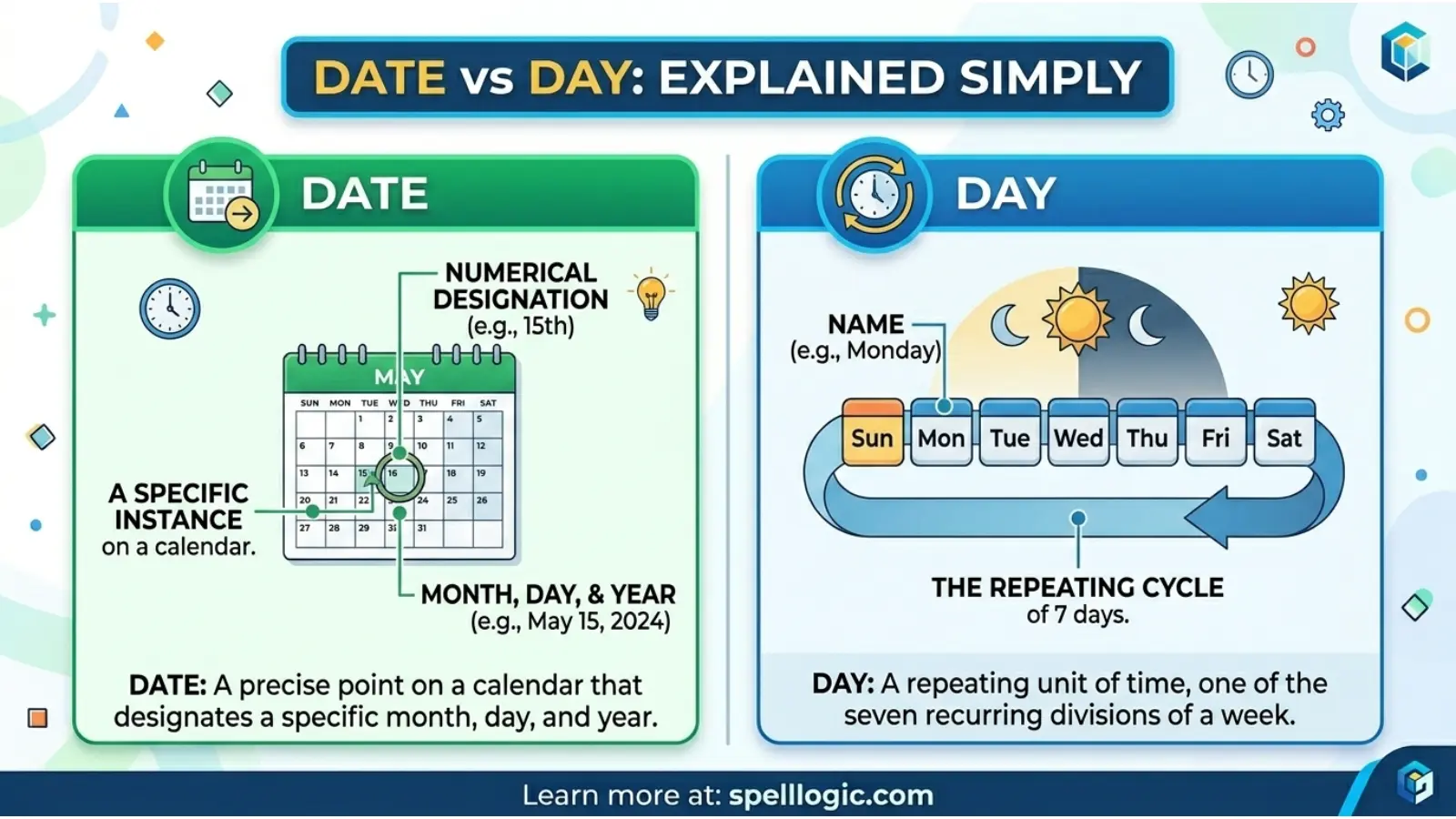
Date means a specific calendar number and time reference, while day means a particular day of the week or a 24-hour period.
One-Line Distinction
Date = calendar position.
Day = weekday or 24-hour period.
Example Sentences
- The date of the meeting is August 10.
- Today’s date is June 23, 2026.
- Today is Monday. That’s the day of the week.
- We spent the entire day at the beach.
Date means a specific calendar reference, while day means a weekday or a period of twenty-four hours.
Understanding Homophones in English
What Are Homophones?
Homophones are words that sound the same or nearly the same but have different meanings and sometimes different spellings.
Example:
- Sea
- See
Both words sound alike but have different meanings.
Why Homophones Cause Confusion
When words sound similar, learners may choose the wrong one while speaking or writing.
For example:
- Their
- There
These words sound the same but serve different purposes. Similarly, date and day belong to the same topic of time, which makes them easy to mix up even though they are not true homophones.
What Does “Date” Mean?
Definition and Core Meaning
A date is a specific day on the calendar identified by a month, day number, and often a year.
Examples:
- January 1, 2026
- March 15
- December 25, 2027
A date helps identify exactly when an event happens.
Origin and Historical Use
The word date comes from the Latin word data, meaning “given.” Over time, it became associated with recording the exact time when events occurred in documents and records.
Modern Usage and Synonyms
Today, date is commonly used for:
- Appointments
- Birthdays
- Deadlines
- Historical events
- Official documents
Synonyms:
- Calendar day
- Scheduled time
- Appointment day
- Deadline
Example Sentences
- Please write the date at the top of the page.
- What is today’s date?
- The wedding date has been confirmed.
- The project deadline date is next Friday.
Key Points About Date
- Refers to a specific calendar reference.
- Includes numbers and often a month and year.
- Used in schedules and records.
- Helps identify exact timing.
What Does “Day” Mean?
Definition and Core Meaning
A day can mean either:
- A 24-hour period.
- A day of the week such as Monday or Friday.
Origin and Historical Context
The word day comes from Old English dæg, which referred to the period of light between sunrise and sunset. Over time, it expanded to mean the full 24-hour cycle.
Modern Usage and Synonyms
Today, day is used to describe:
- Days of the week
- A 24-hour period
- Daily activities
- Periods of time
Synonyms:
- Twenty-four hours
- Weekday
- Time period
- Working day
Example Sentences
- Today is a beautiful day.
- What day is it today?
- She exercises every day.
- We spent the whole day shopping.
Key Points About Day
- Refers to a weekday or a 24-hour period.
- Does not usually include a calendar number.
- Common in everyday conversation.
- Used when discussing routines and schedules.
Date vs Day: Key Differences at a Glance
| Word | Part of Speech | Meaning | Example Context |
|---|---|---|---|
| Date | Noun | A specific calendar reference | The date is July 14, 2026. |
| Day | Noun | A weekday or 24-hour period | Today is Tuesday. |
How to Remember the Difference Between Date and Day
Learning a simple memory trick can help.
Easy Memory Tricks
Date = Digits
Both words begin with D. A date usually contains numbers or digits.
Example:
- June 23, 2026
Association Technique
Think of a calendar.
- Date = the numbered square.
- Day = the weekday name above the square.
Memorable Example
Imagine someone asks:
“What day is your birthday?”
You answer:
“It’s Saturday.”
But if someone asks:
“What’s the date of your birthday?”
You answer:
“July 14.”
This simple comparison helps you remember the difference.
Common Mistakes and Confusions
Many learners use these words incorrectly.
Mistake 1
❌ What day is today, June 23?
✔ What date is today, June 23?
Explanation: June 23 is a date, not a day.
Mistake 2
❌ What is today’s date? Monday.
✔ What is today’s day? Monday.
Explanation: Monday is a day of the week.
Mistake 3
❌ My birthday day is December 12.
✔ My birthday date is December 12.
Explanation: December 12 is a calendar date.
Mistake 4
❌ The meeting day is March 5.
✔ The meeting date is March 5.
Explanation: March 5 identifies a date.
Examples Section: Correct and Incorrect Usage
Example 1
✔ Correct: What is today’s date?
✘ Incorrect: What is today’s day if you want the calendar number?
Example 2
✔ Correct: Today is Friday.
✘ Incorrect: Today is June 20 when answering a question about the day of the week.
Example 3
✔ Correct: The event date is September 10.
✘ Incorrect: The event day is September 10.
Example 4
✔ Correct: We worked all day.
✘ Incorrect: We worked all date.
Example 5
✔ Correct: Please confirm the date of your appointment.
✘ Incorrect: Please confirm the day of your appointment if you mean the calendar date.
Example 6
✔ Correct: What day will the conference be held?
✘ Incorrect: What date will the conference be held on Monday?
Self Assessment: Test Your Knowledge
Fill in the blanks with date or day.
1.
What is today’s ______?
2.
The meeting ______ is August 15.
3.
What ______ of the week is it?
4.
We spent the entire ______ hiking in the mountains.
Self Assessment Answers
1.
What is today’s date?
2.
The meeting date is August 15.
3.
What day of the week is it?
4.
We spent the entire day hiking in the mountains.
FAQs
1. What is the main difference between date and day?
A date identifies a specific position on a calendar, while a day refers to a weekday or a 24-hour period.
2. Is a birthday a date or a day?
A birthday is usually referred to as a date, such as July 14.
3. Can day mean 24 hours?
Yes. A day often means a full twenty-four-hour period.
4. How do I ask for the calendar number?
Ask, “What is today’s date?”
5. How do I ask for the weekday?
Ask, “What day is it today?”
6. Is Monday a date?
No. Monday is a day of the week.
7. Is June 23 a day?
June 23 is a date. The corresponding day might be Monday, Tuesday, or another weekday depending on the year.
Final Conclusion: Using “Date” and “Day” Correctly
Understanding the difference between date and day is an important step toward speaking and writing English more accurately. Although these words are closely connected because they both relate to time and calendars, they serve different purposes. A date tells us the exact position on a calendar, such as June 23, 2026, while a day refers either to a weekday like Tuesday or to a complete 24-hour period. Knowing this distinction helps you communicate clearly when discussing appointments, birthdays, deadlines, schedules, and everyday activities.
A useful way to remember the difference is to think of date as something that contains numbers and day as something that contains names like Monday, Tuesday, or Wednesday. When someone asks for the date, give the calendar number. When someone asks for the day, give the weekday name. This simple memory trick can prevent many common mistakes.
The more you read, write, and practice English, the more natural these words will become. Pay attention to how native speakers use them in conversations, calendars, emails, and announcements. With regular practice, you’ll quickly master the difference between date and day and use both words with confidence in real-life situations. Keep learning, keep practicing, and remember that every small improvement brings you closer to fluency.