Many English learners struggle with situation vs circumstance because both words describe conditions or events affecting people. In everyday conversations, they often appear in similar contexts, making it difficult to know which one fits best. Although these words are closely related, they are not exact synonyms.
Understanding the difference helps you communicate more accurately in speaking, writing, and professional settings. This guide explains the meanings of situation and circumstance in simple English, provides practical examples, and shares easy memory tricks so you can choose the correct word with confidence
Table of Contents
- Introduction
- Why “Situation” and “Circumstance” Are Confusing
- Situation vs Circumstance Explained Simply
- Understanding Homophones in English
- What Does “Situation” Mean?
- What Does “Circumstance” Mean?
- Situation vs Circumstance: Key Differences at a Glance
- How to Remember the Difference Between Situation and Circumstance
- Common Mistakes and Confusions
- Examples Section: Correct and Incorrect Usage
- Self Assessment: Test Your Knowledge
- Self Assessment Answers
- FAQs About “Situation” and “Circumstance”
- Final Conclusion: Using “Situation” and “Circumstance” Correctly
Why “Situation” and “Circumstance” Are Confusing
Many people use situation and circumstance as if they mean exactly the same thing. While they are related, each word has its own focus.
Similar Pronunciation
Both words have multiple syllables and are commonly heard in formal and everyday English. However, they do not sound alike, so pronunciation is usually not the main cause of confusion.
Similar Spelling
The words are spelled differently, but they both end with “-tion” or “-stance”, and both refer to conditions or events. This similarity in meaning often causes learners to mix them up.
Context Confusion
A situation usually refers to the overall state or condition someone is in.
A circumstance refers to the specific facts, conditions, or events surrounding a situation.
Common Learner Mistakes
- Using circumstance when talking about a general condition.
- Using situation when referring to specific surrounding factors.
- Assuming both words are interchangeable in every sentence.
Situation vs Circumstance Explained Simply
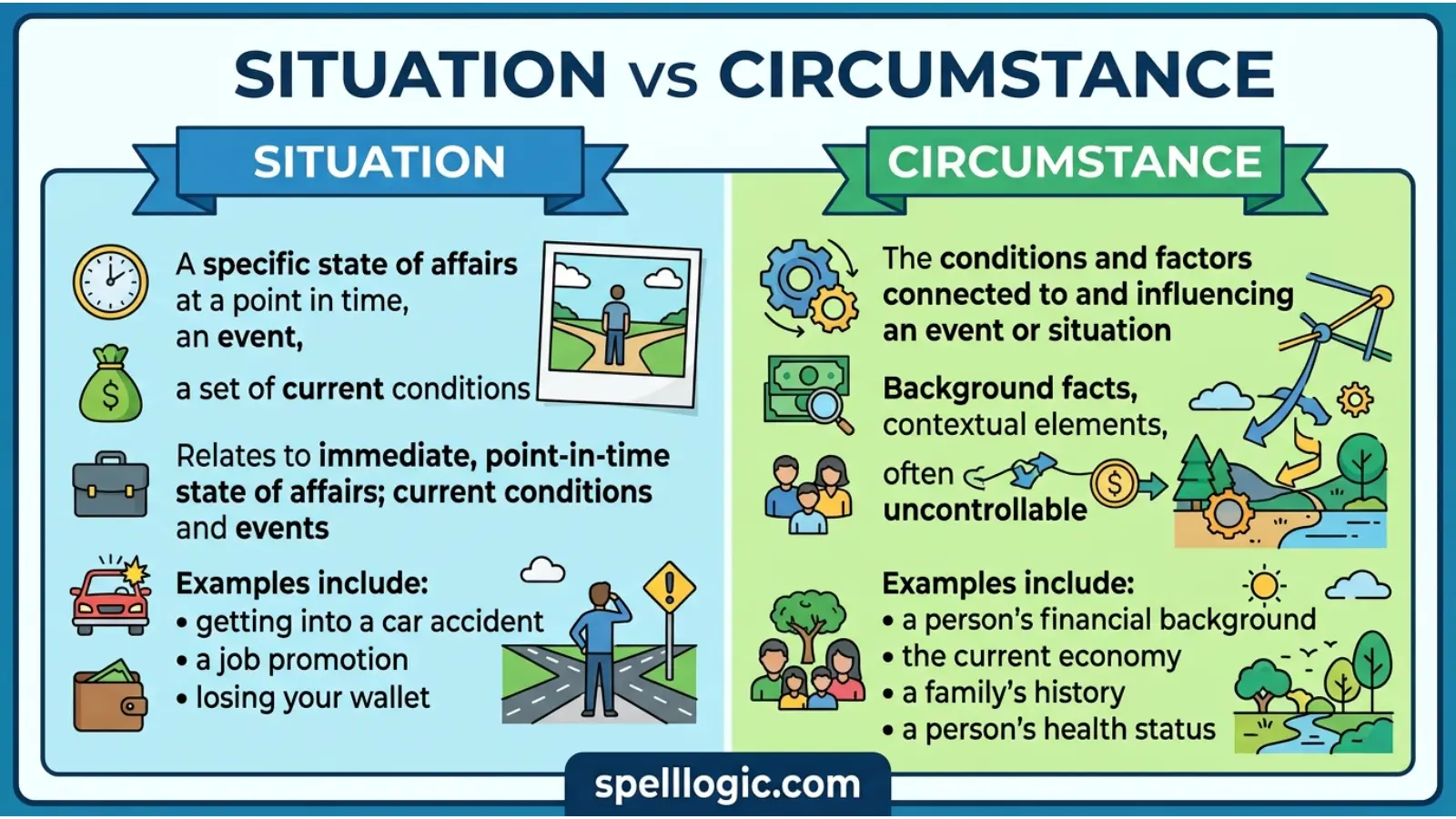
Situation means the overall condition, position, or state someone is in, while circumstance means the facts or conditions that surround or influence that situation.
One-Line Distinction
A situation is the overall condition, while circumstances are the details that create or affect that condition.
Example Sentences
- The company is facing a difficult situation.
- Financial circumstances forced him to move to another city.
Another pair:
- Her current situation is improving every day.
- Unexpected circumstances delayed our flight.
Understanding Homophones in English
Although situation and circumstance are not homophones, learners often confuse them because they have related meanings.
What Are Homophones?
Homophones are words that sound the same but have different meanings and spellings.
Example:
- Sea
- See
These two words sound identical but have different meanings.
Why Homophones Cause Confusion
When two words sound alike, learners may choose the wrong spelling or meaning.
Example:
- I can see the ocean.
- The sea is calm today.
In contrast, situation and circumstance are confusing because of their similar meanings—not because they sound alike.
What Does “Situation” Mean?
Definition and Core Meaning
A situation is the general condition, state, or position in which someone or something exists.
It often describes the bigger picture.
Origin and Historical Use
The word situation comes from the Latin word situatio, meaning position or location. Over time, its meaning expanded to include social, personal, and professional conditions.
Modern Usage and Synonyms
Common synonyms include:
- Condition
- Position
- State
- Scenario
- Case
- Status
Key Points
- Refers to an overall condition.
- Can be temporary or permanent.
- Common in everyday and formal English.
- Often describes problems or opportunities.
Example Sentences
- We discussed the financial situation.
- The political situation has improved.
- She understands the situation very well.
- The emergency situation required quick action.
What Does “Circumstance” Mean?
Definition and Core Meaning
A circumstance is a particular fact, event, or condition that affects a situation.
It focuses on the surrounding details rather than the whole picture.
Origin and Historical Context
The word comes from the Latin circumstantia, meaning standing around. Originally, it referred to surrounding facts or conditions.
Modern Usage and Synonyms
Common synonyms include:
- Condition
- Factor
- Event
- Detail
- Context
- Surrounding condition
Key Points
- Refers to individual factors.
- Usually used in the plural form: circumstances.
- Explains why something happened.
- Often appears in formal writing.
Example Sentences
- Under the circumstances, we decided to stay home.
- Personal circumstances prevented her from attending.
- The accident happened because of unusual circumstances.
- Every circumstance should be considered carefully.
Situation vs Circumstance: Key Differences at a Glance
| Word | Part of Speech | Meaning | Example Context |
|---|---|---|---|
| Situation | Noun | Overall condition or state | The economic situation is improving. |
| Circumstance | Noun | A fact or condition affecting a situation | Financial circumstances changed his plans. |
How to Remember the Difference Between Situation and Circumstance
Here are some simple memory tricks.
Easy Memory Tricks
- Situation = State
- Circumstance = Conditions
Notice that both Situation and State begin with S.
Think of Circumstances as the conditions surrounding something.
Association Technique
Imagine a tree.
- The tree is the situation.
- The weather, soil, sunlight, and water are the circumstances affecting the tree.
Memorable Example
The situation was stressful because the circumstances were difficult.
The stressful condition is the situation.
The difficult reasons are the circumstances.
Common Mistakes and Confusions
Wrong
His financial situation forced him to leave.
Better
His financial circumstances forced him to leave.
Explanation: Specific financial factors are circumstances.
Wrong
The emergency circumstances at the hospital were under control.
Better
The emergency situation at the hospital was under control.
Explanation: The sentence refers to the overall condition.
Wrong
I understand your circumstances.
Better
I understand your situation.
Explanation: If referring to someone’s overall condition, use situation.
Wrong
The situation surrounding the accident.
Better
The circumstances surrounding the accident.
Explanation: The sentence refers to surrounding factors.
Examples Section: Correct and Incorrect Usage
Example 1
✔ Correct: The rescue team quickly assessed the situation.
✘ Incorrect: The rescue team quickly assessed the circumstance.
Example 2
✔ Correct: Family circumstances prevented him from traveling.
✘ Incorrect: Family situation prevented him from traveling.
Example 3
✔ Correct: The company’s financial situation has improved.
✘ Incorrect: The company’s financial circumstance has improved.
Example 4
✔ Correct: Under these circumstances, we should postpone the meeting.
✘ Incorrect: Under this situation, we should postpone the meeting.
Example 5
✔ Correct: She explained her situation honestly.
✘ Incorrect: She explained her circumstance honestly.
Example 6
✔ Correct: Unexpected circumstances changed our schedule.
✘ Incorrect: Unexpected situations changed our schedule.
Self Assessment: Test Your Knowledge
Fill in the blanks.
- We must understand the entire ________ before making a decision.
- Financial ________ made it impossible for them to buy a house.
- Under these ________, canceling the event was the best choice.
- The manager handled the difficult ________ calmly.
Self Assessment Answers
- situation
- circumstances
- circumstances
- situation
FAQs
1. Are situation and circumstance the same?
No. A situation is the overall condition, while circumstances are the individual factors affecting it.
2. Which word is more common in everyday English?
Situation is generally more common in everyday conversations.
3. Why is “circumstances” often plural?
Many events are influenced by several conditions, so English speakers usually say circumstances instead of circumstance.
4. Can I use situation and circumstance interchangeably?
Sometimes, but not always. Choosing the correct word makes your English more precise.
5. Which word is better in formal writing?
Both are appropriate. Circumstance often appears in legal, academic, and business writing when discussing specific factors.
6. How can I remember the difference?
Remember:
- Situation = Overall state
- Circumstances = Surrounding conditions
7. Is “under the circumstances” a common English expression?
Yes. It is a very common phrase meaning considering the current conditions or facts.
Final Conclusion: Using “Situation” and “Circumstance” Correctly
Understanding the difference between situation and circumstance is an important step toward speaking and writing English more naturally. Although these words are closely related and sometimes appear in similar contexts, they highlight different ideas. A situation describes the overall condition or state of a person, place, or event. Circumstances, on the other hand, refer to the specific facts, conditions, or events that influence or explain that situation. Keeping this distinction in mind will help you choose the most accurate word in conversations, essays, emails, and professional communication.
A simple way to remember the difference is this: the situation is the big picture, while the circumstances are the details surrounding it. If you are talking about someone’s general condition, use situation. If you are explaining the reasons or factors behind that condition, use circumstances. Reading authentic English content, paying attention to how native speakers use these words, and practicing with your own examples will strengthen your understanding over time.
Every new word you master makes your English clearer and more confident. Continue practicing, review the examples in this guide, and soon choosing between situation and circumstance will become second nature. With regular practice and careful observation, you’ll communicate more accurately and sound more natural in both everyday and professional English.