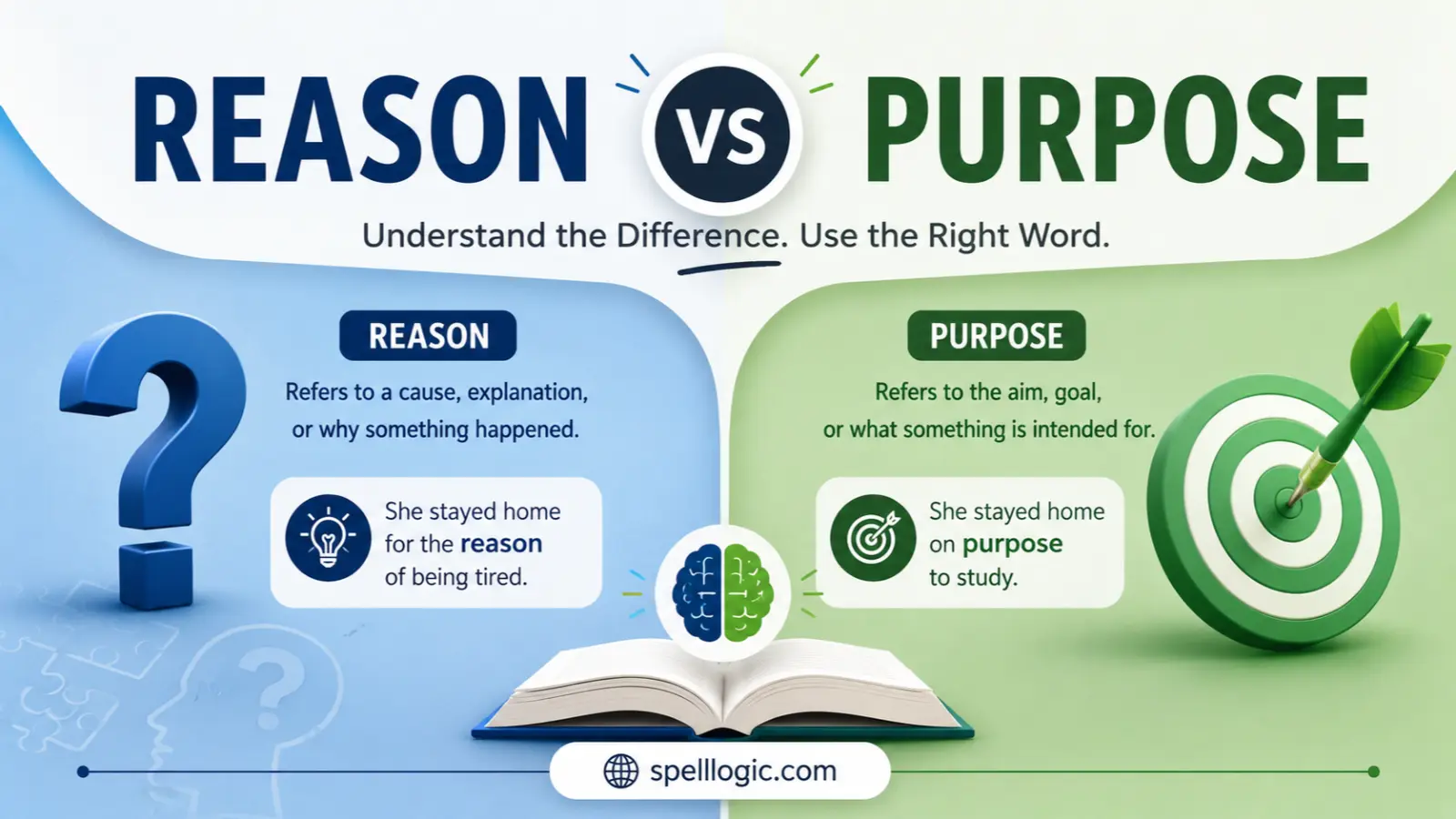
Many English learners confuse reason and purpose because both words explain why something happens or why someone does something. However, they are not interchangeable in every situation. A reason explains the cause behind an action, while a purpose explains the intended goal or aim.
Knowing the difference helps you speak and write more naturally in English. Whether you’re writing an essay, having a conversation, or improving your grammar, understanding these two words will make your communication clearer and more accurate. In this guide, you’ll learn their meanings, differences, usage, and simple ways to remember them.
Why “Reason” and “Purpose” Are Confusing
Many learners mix up reason and purpose because they both answer questions about why something happens. Even though they have different meanings, they often appear in similar situations.
Here are the main reasons for the confusion:
- Similar pronunciation: Both words are easy to pronounce and commonly appear together in conversations.
- Similar spelling: They are not spelled alike, but both are common nouns used in similar sentence structures.
- Context confusion: Both can answer the question “Why?” but from different perspectives.
- Common learner mistakes: People often use reason when talking about a goal, or purpose when explaining a cause.
For example:
- The reason I left early was the rain. ✅
- The purpose of leaving early was to avoid traffic. ✅
Although both sentences discuss the same event, they focus on different ideas.
Reason vs Purpose Explained Simply
Reason means the cause of something, while purpose means the intended goal or objective.
One-line distinction
Reason explains why something happened, while purpose explains what someone hopes to achieve.
Examples
Reason
- The reason she smiled was the good news.
- His reason for studying late was tomorrow’s exam.
Purpose
- The purpose of the meeting is to discuss the project.
- She exercises with the purpose of staying healthy.
Understanding Homophones in English
What Are Homophones?
Homophones are words that sound the same but have different meanings and often different spellings.
Example:
- Sea and see
These words sound alike but have completely different meanings.
Why Homophones Cause Confusion
Homophones can confuse learners because the pronunciation is identical even though the meanings differ.
Example:
- I can see the ocean.
- The sea is calm today.
Although reason and purpose are not homophones, learners still confuse them because they often answer similar questions.
What Does “Reason” Mean?
Definition and Core Meaning
A reason is the cause, explanation, or justification for something that happens or someone does.
It answers the question:
Why did it happen?
Origin and Historical Use
The word reason comes from the Latin word ratio, meaning calculation, judgment, or explanation. It entered English through Old French and has been used for centuries to describe logical thinking and causes.
Modern Usage and Synonyms
Today, reason is commonly used in everyday conversations, education, business, and writing.
Synonyms
- Cause
- Explanation
- Motive
- Justification
- Ground
Key Points
- Explains a cause.
- Often follows the reason is…
- Can describe facts or personal motivations.
- Common in both formal and informal English.
Example Sentences
- The reason for the delay was heavy traffic.
- There’s no reason to worry.
- She explained the reason behind her decision.
- What is the reason for your visit?
What Does “Purpose” Mean?
Definition and Core Meaning
A purpose is the intended aim, goal, or objective behind an action.
It answers the question:
What is it meant to achieve?
Origin and Historical Context
The word purpose comes from Old French and ultimately from Latin, meaning intention or proposed action. It has long been used to describe goals and intentions.
Modern Usage and Synonyms
Today, purpose is widely used in education, business, psychology, and everyday conversations.
Synonyms
- Goal
- Aim
- Objective
- Intention
- Mission
Key Points
- Describes an intended result.
- Focuses on future outcomes.
- Often used when discussing plans or functions.
- Can describe the function of an object.
Example Sentences
- The purpose of this lesson is to improve your grammar.
- She has a clear purpose in life.
- The purpose of the lock is to keep the door secure.
- His purpose was to help others.
Reason vs Purpose: Key Differences at a Glance
| Word | Part of Speech | Meaning | Example Context |
|---|---|---|---|
| Reason | Noun | The cause or explanation for something | The reason for the accident was icy roads. |
| Purpose | Noun | The intended goal or objective | The purpose of the training is to improve skills. |
How to Remember the Difference Between Reason and Purpose
Learning a simple memory trick can help.
Memory Trick 1
Reason = Cause
Think:
Reason = Why it happened.
Memory Trick 2
Purpose = Plan
Think:
Purpose = What you want to accomplish.
Association Technique
Imagine planting a tree.
- The reason you planted it was because your yard lacked shade.
- The purpose of planting it was to provide shade in the future.
Memorable Example
Reason looks backward. Purpose looks forward.
That simple sentence helps many learners remember the difference.
Common Mistakes and Confusions
Mistake 1
❌ The reason of this meeting is to discuss sales.
✅ The purpose of this meeting is to discuss sales.
Explanation:
The meeting has a goal, not a cause.
Mistake 2
❌ The purpose I was late was traffic.
✅ The reason I was late was traffic.
Explanation:
Traffic caused the delay.
Mistake 3
❌ My reason in life is helping people.
✅ My purpose in life is helping people.
Explanation:
This refers to a life goal.
Mistake 4
❌ What was your purpose for missing class?
✅ What was your reason for missing class?
Explanation:
Missing class has a cause.
Examples Section: Correct and Incorrect Usage
Example 1
✔ Correct: The reason she cried was sadness.
✘ Incorrect: The purpose she cried was sadness.
Example 2
✔ Correct: The purpose of this app is to teach English.
✘ Incorrect: The reason of this app is to teach English.
Example 3
✔ Correct: His reason for quitting was stress.
✘ Incorrect: His purpose for quitting was stress.
Example 4
✔ Correct: The purpose of exercise is to improve health.
✘ Incorrect: The reason of exercise is to improve health.
Self Assessment: Test Your Knowledge
Fill in the blanks with reason or purpose.
- The ________ of the bridge is to connect the two towns.
- What was the ________ you missed the meeting?
- She explained the ________ behind her decision.
- The ________ of this course is to improve your speaking skills.
Self Assessment Answers
- purpose
- reason
- reason
- purpose
FAQs
1. What is the main difference between reason and purpose?
A reason explains the cause of something, while a purpose explains the intended goal or objective.
2. Can reason and purpose be used interchangeably?
Not always. They answer different questions, so using the wrong word may change the meaning of a sentence.
3. Is purpose always about the future?
Generally, yes. A purpose usually describes an intended result or goal.
4. Does reason always describe a cause?
Yes. A reason explains why something happened or why someone acted.
5. Which word is more common in everyday English?
Both are common. Reason is often used when giving explanations, while purpose is common when discussing goals, functions, or intentions.
6. How can I remember the difference easily?
Remember:
- Reason = Cause
- Purpose = Goal
This simple rule works in most situations.
7. Can an object have a purpose?
Yes. Objects often have a purpose or function.
Example:
The purpose of a flashlight is to help you see in the dark.
Final Conclusion: Using “Reason” and “Purpose” Correctly
Understanding the difference between reason and purpose is an important step toward speaking and writing English more naturally. Although both words answer questions about why, they focus on different ideas. A reason explains the cause behind an action, event, or decision. It looks back at what made something happen. A purpose, on the other hand, describes the intended goal or objective. It looks ahead to what someone hopes to achieve. Keeping this simple distinction in mind will help you choose the right word in conversations, school assignments, emails, and professional writing.
A helpful way to remember the difference is this: reason explains the past, while purpose points to the future. If you’re talking about why something happened, use reason. If you’re talking about an aim, function, or intention, use purpose. Reading authentic English, paying attention to examples, and practicing with your own sentences will reinforce this habit over time.
Don’t worry if you occasionally mix them up—many English learners do. The more you notice how native speakers use these words, the more natural your own English will become. Keep practicing, review the examples in this guide, and challenge yourself to use reason and purpose correctly in your daily conversations. Every small improvement brings you one step closer to confident and fluent English.