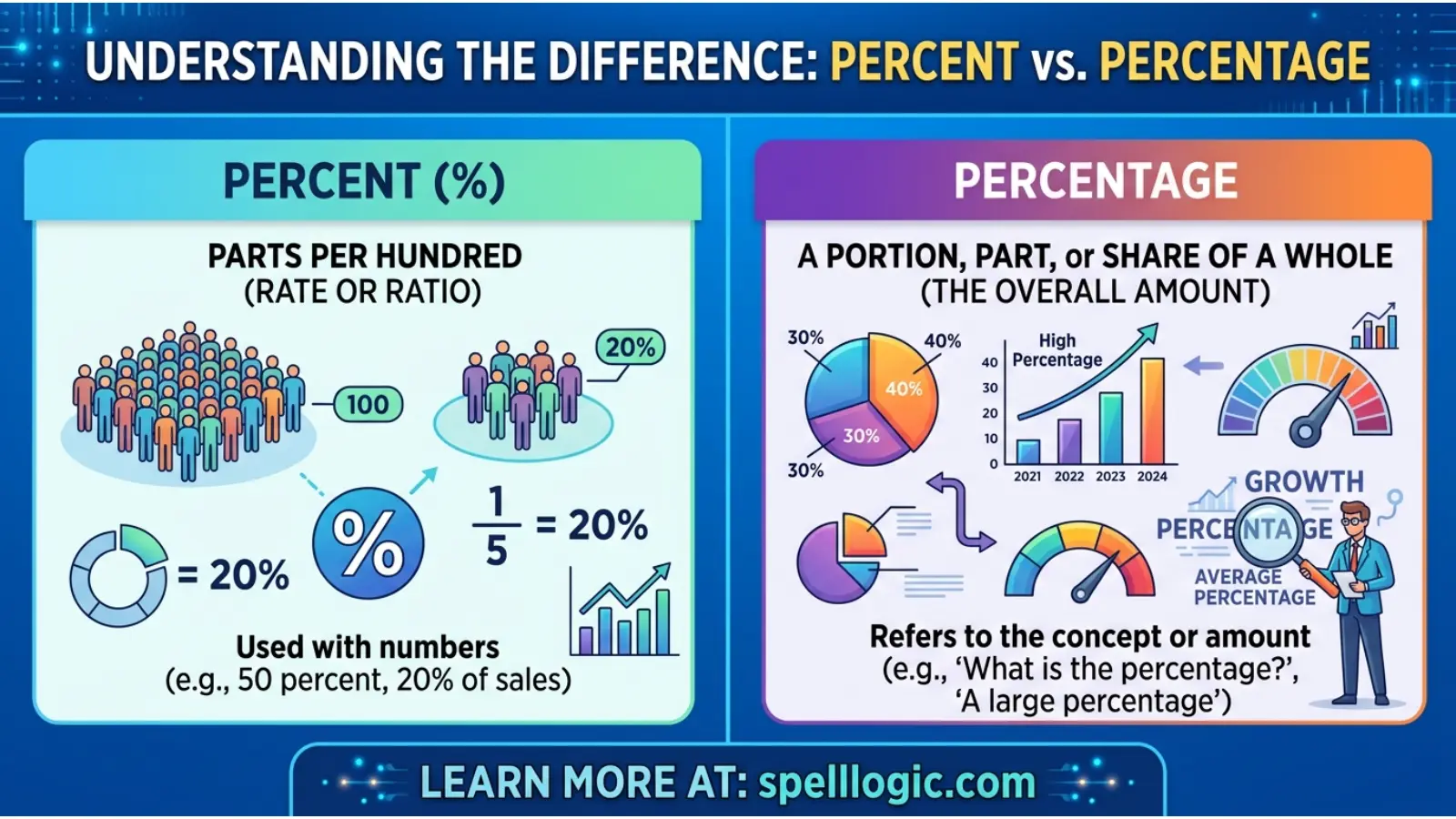
Many English learners get confused by percent and percentage because both words relate to numbers and proportions. Although they look and sound similar, they are not always interchangeable. Using the wrong one can make your writing sound unnatural or even grammatically incorrect.
The good news is that the difference is simple once you understand how each word works. In this guide, you’ll learn the meanings of percent and percentage, when to use each one, common mistakes to avoid, and easy memory tricks that will help you remember the difference forever.
Table of Contents
- Introduction
- Why “Percent” and “Percentage” Are Confusing
- Percent vs Percentage Explained Simply
- Understanding Homophones in English
- What Does “Percent” Mean?
- What Does “Percentage” Mean?
- Percent vs Percentage: Key Differences at a Glance
- How to Remember the Difference Between Percent and Percentage
- Common Mistakes and Confusions
- Examples Section: Correct and Incorrect Usage
- Self Assessment: Test Your Knowledge
- Self Assessment Answers
- FAQs About “Percent” and “Percentage”
- Final Conclusion: Using “Percent” and “Percentage” Correctly
Why “Percent” and “Percentage” Are Confusing
Many learners mix up percent and percentage because they both describe parts of a whole. However, they serve different grammatical purposes.
Similar Pronunciation
The words sound very similar. Both begin with “percent,” making them easy to confuse in conversation.
Similar Spelling
The word percentage is simply percent with the suffix -age, so many learners assume they have the same meaning.
Context Confusion
People often see both words in math, statistics, school lessons, business reports, and everyday conversations. Without understanding the grammar, they may use one when the other is needed.
Common Learner Mistakes
Some frequent errors include:
- Saying 20 percentage instead of 20 percent
- Writing a percent of people instead of a percentage of people
- Believing both words can always replace each other
Understanding their different roles makes English much more natural.
Percent vs Percentage Explained Simply
The simplest difference is this:
Percent is used with a specific number.
Percentage refers to a proportion or rate without stating the exact number.
One-Line Distinction
Percent means an exact numerical proportion, while percentage means a general proportion or rate.
Simple Explanation
Whenever you mention an exact figure like 10, 25, or 75, use percent.
When talking about a proportion without giving the exact figure, use percentage.
Example Sentences
- Percent means an exact amount out of 100, while percentage means a proportion or share.
- The test score increased by 15 percent.
- A large percentage of students passed the exam.
Understanding Homophones in English
What Are Homophones?
Homophones are words that sound the same but have different meanings and often different spellings.
Example:
- Sea
- See
Although they sound alike, their meanings are different.
Note: Percent and percentage are not true homophones. They simply sound similar and belong to the same word family, which is why learners confuse them.
Why Homophones Cause Confusion
When words sound alike, learners often rely on pronunciation instead of grammar.
For example:
- I can see the ocean.
- The sea is calm today.
The pronunciation is identical, but the meanings are different.
Similarly, percent and percentage sound alike, yet they are used differently in sentences.
What Does “Percent” Mean?
Definition and Core Meaning
Percent means per hundred or out of every one hundred.
It is always used with a specific number.
Origin and Historical Use
The word comes from the Latin phrase per centum, meaning by the hundred. Over time, it became the English word percent, commonly used in mathematics, finance, economics, and everyday language.
Modern Usage and Synonyms
Modern uses include:
- Mathematics
- Statistics
- Discounts
- Taxes
- Test scores
- Business reports
Similar expressions include:
- Per hundred
- Rate
- Ratio (in some contexts)
Key Points
- Used with numbers
- Expresses an exact value
- Often written with the % symbol
- Common in formal and informal English
Example Sentences
- Only 5 percent of the tickets remain.
- The company grew by 12 percent this year.
- She scored 98 percent on the test.
- Water covers about 71 percent of Earth’s surface.
What Does “Percentage” Mean?
Definition and Core Meaning
Percentage refers to a proportion, share, or rate without necessarily giving the exact number.
It emphasizes the idea rather than the exact value.
Origin and Historical Context
The word developed from percent with the addition of -age, a suffix often used to describe a state, amount, or collection.
Today, it appears frequently in education, business, healthcare, surveys, and research.
Modern Usage and Synonyms
Common synonyms include:
- Proportion
- Share
- Fraction
- Portion
- Rate
Key Points
- Usually used without an exact number
- Refers to a general proportion
- Common in reports and discussions
- Functions as a noun
Example Sentences
- A high percentage of customers returned.
- Only a small percentage of employees work remotely.
- The survey showed a significant percentage of positive responses.
- What percentage of people voted?
Percent vs Percentage: Key Differences at a Glance
| Word | Part of Speech | Meaning | Example Context |
|---|---|---|---|
| Percent | Noun (used with a number) | An exact amount out of 100 | The price dropped by 20 percent. |
| Percentage | Noun | A proportion or rate, often without an exact number | A high percentage of students graduated. |
How to Remember the Difference Between Percent and Percentage
Here are some easy memory tricks.
Easy Memory Tricks
- If you see a number, use percent.
- If there is no exact number, use percentage.
Association Technique
Think of this simple formula:
Number + Percent
Examples:
- 30 percent
- 45 percent
- 99 percent
If you are simply discussing a share or portion, think:
General Idea = Percentage
Examples:
- a high percentage
- a low percentage
- a small percentage
Memorable Example
Imagine a teacher saying:
“I know the exact score.”
Use:
85 percent
If the teacher says:
“Most students passed.”
Use:
A high percentage of students passed.
Common Mistakes and Confusions
Wrong
Twenty percentage of people agreed.
Correct
Twenty percent of people agreed.
Explanation: Exact numbers require percent.
Wrong
A large percent of customers returned.
Correct
A large percentage of customers returned.
Explanation: No exact number is given.
Wrong
The percentage was 40 percentage.
Correct
The percentage was 40 percent.
Explanation: The measurement itself is a percentage, but the value uses percent.
Wrong
Ten percentages attended.
Correct
Ten percent attended.
Explanation: Percent does not become plural in this way.
Examples Section: Correct and Incorrect Usage
Example 1
✔ Correct: The store offered a 30 percent discount.
✘ Incorrect: The store offered a 30 percentage discount.
Example 2
✔ Correct: A high percentage of voters participated.
✘ Incorrect: A high percent of voters participated.
Example 3
✔ Correct: She improved by 12 percent.
✘ Incorrect: She improved by 12 percentage.
Example 4
✔ Correct: Only a small percentage of visitors stayed overnight.
✘ Incorrect: Only a small percent of visitors stayed overnight.
Self Assessment: Test Your Knowledge
Fill in the blanks.
- The company’s profits increased by 20 ________.
- A large ________ of children enjoy reading.
- The survey showed that 75 ________ of participants agreed.
- Only a small ________ of applicants met the requirements.
Self Assessment Answers
- percent
- percentage
- percent
- percentage
FAQs About “Percent” and “Percentage”
1. What is the difference between percent and percentage?
Percent is used with an exact number, while percentage refers to a general proportion or share.
2. Can I use percent and percentage interchangeably?
No. They have related meanings but different grammatical uses.
3. Why do we say “20 percent” instead of “20 percentage”?
Because percent always follows an exact numerical value.
4. When should I use percentage?
Use percentage when discussing a proportion without mentioning the exact number.
5. Is “percentage” always a noun?
Yes. It functions as a noun that refers to a proportion or rate.
6. Can I write “percent” with the % symbol?
Yes. For example:
- 25 percent
- 25%
Both are acceptable in many contexts.
7. Which word is more common in academic writing?
Both are common. Percent is used with exact statistics, while percentage is used when discussing proportions or trends.
Final Conclusion: Using “Percent” and “Percentage” Correctly
Understanding the difference between percent and percentage is easier than it first appears. Although these words are closely related and often appear in the same types of writing, they have different jobs. Percent is used when you mention an exact number out of one hundred, such as 15 percent, 50 percent, or 100 percent. Percentage, on the other hand, refers to a general proportion or share without focusing on a specific numerical value. This distinction helps your English sound more natural and accurate in school assignments, business reports, news articles, and everyday conversations.
A useful memory tip is simple: If there is a number, use percent. If there is no exact number, use percentage. Keeping this rule in mind will prevent many common grammar mistakes. As you read books, newspapers, or online articles, pay attention to how native English speakers use these words. You’ll quickly notice the pattern and begin using it confidently yourself.
Learning small differences like this is an important step toward mastering English. With regular practice, careful reading, and plenty of real-life examples, you’ll soon know exactly when to use percent and when percentage is the better choice. Every new grammar rule you learn strengthens your communication skills and brings you closer to fluent, confident English.