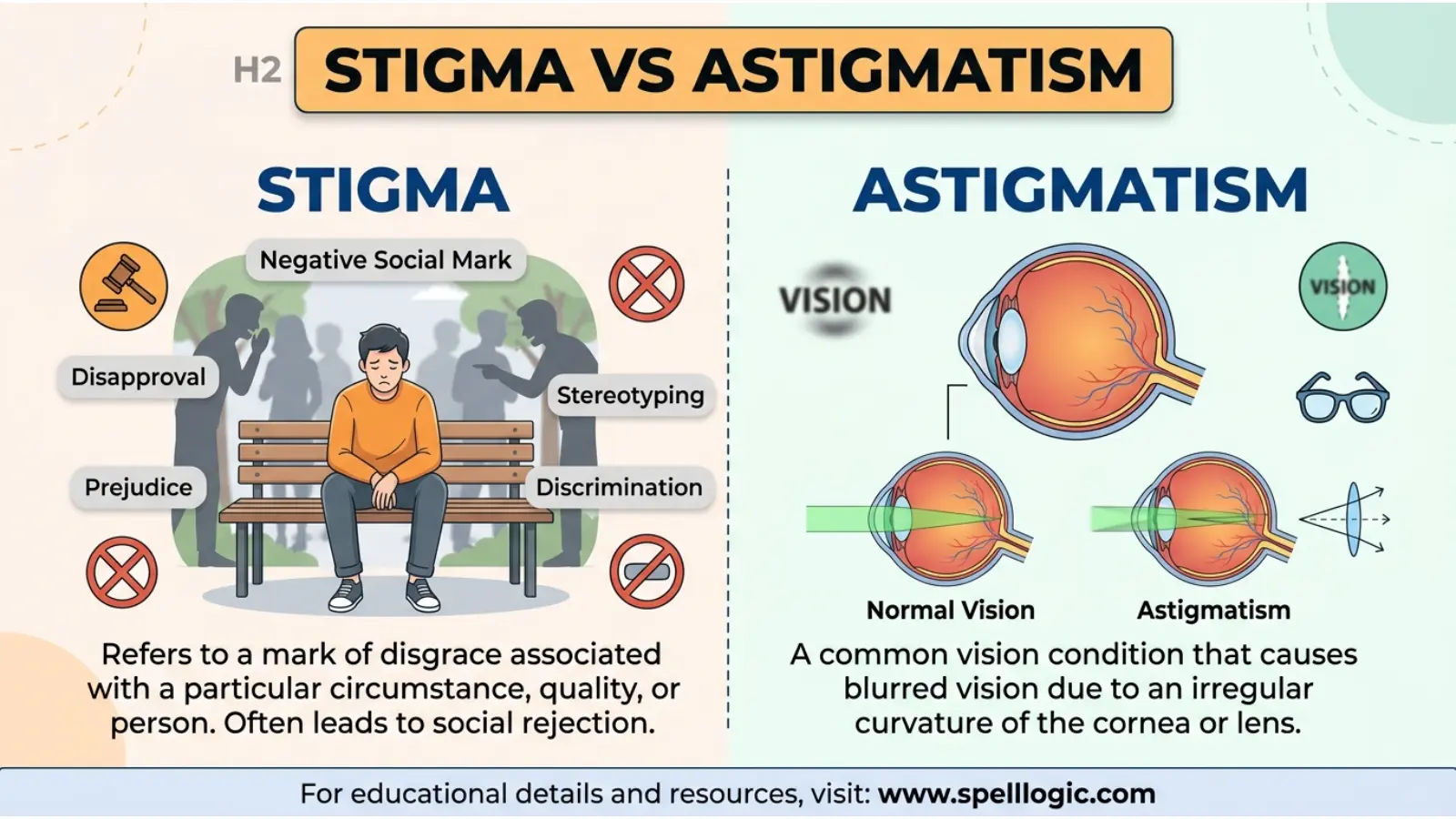
Many English learners become confused by stigma and stigmatism because the two words look and sound somewhat similar. However, they have completely different meanings and are used in different fields. Stigma is a common English word that refers to shame, disgrace, or a mark of disapproval.
Stigmatism, on the other hand, is a rare and specialized term, mainly used in biology and botany—not as a replacement for stigma. Understanding the difference helps you communicate more accurately, avoid common vocabulary mistakes, and improve both your writing and speaking skills. This guide explains each word in simple language with examples, tips, and comparisons.
Table of Contents
- Introduction
- Why “Stigma” and “Stigmatism” Are Confusing
- Stigma vs Stigmatism Explained Simply
- Understanding Homophones in English
- What Does “Stigma” Mean?
- What Does “Stigmatism” Mean?
- Stigma vs Stigmatism: Key Differences at a Glance
- How to Remember the Difference Between Stigma and Stigmatism
- Common Mistakes and Confusions
- Examples Section: Correct and Incorrect Usage
- Self Assessment: Test Your Knowledge
- Self Assessment Answers
- FAQs About “Stigma” and “Stigmatism”
- Final Conclusion: Using “Stigma” and “Stigmatism” Correctly
Why “Stigma” and “Stigmatism” Are Confusing
Many learners mix up these two words for several reasons.
Similar Pronunciation
Both words begin with stigma-, making them sound alike, especially when spoken quickly.
Similar Spelling
The words share the same root, but stigmatism simply adds the ending -tism. This similarity often leads people to believe they have related meanings.
Context Confusion
Stigma appears frequently in conversations about society, health, education, and psychology.
Stigmatism is rarely used in everyday English and belongs mainly to technical discussions in biology and botany.
Common Learner Mistakes
- Using stigmatism when talking about social discrimination.
- Assuming stigmatism is a stronger form of stigma.
- Confusing stigmatism with astigmatism, the common eye condition.
Stigma vs Stigmatism Explained Simply
Stigma means a mark of shame, disgrace, or social disapproval, while stigmatism refers to the condition of having a stigma or stigmas in biological or botanical contexts.
One-Line Distinction
Stigma is a common English word about social judgment, while stigmatism is a rare technical term.
Example Sentences
Stigma means social shame or disapproval.
- There is still a stigma surrounding mental illness.
- She worked to reduce the stigma associated with seeking therapy.
Stigmatism means the condition of possessing a stigma in biology or botany.
- The scientist studied stigmatism in flowering plants.
- The research paper discussed floral stigmatism.
Understanding Homophones in English
What Are Homophones?
Homophones are words that sound the same or nearly the same but have different meanings and spellings.
Example:
- Sea and see
Although stigma and stigmatism are not true homophones, they are often confused because of their similar pronunciation and spelling.
Why Homophones Cause Confusion
Words that sound alike can easily be mixed up in speech and writing.
For example:
- “They’re going to their house.”
The words they’re, there, and their sound alike but have different meanings.
Similarly, learners sometimes replace stigma with stigmatism simply because the words appear closely related.
What Does “Stigma” Mean?
Definition and Core Meaning
A stigma is a mark of disgrace, shame, or social disapproval connected with a person, group, condition, or behavior.
It can also refer to a physical mark or, in botany, the part of a flower that receives pollen.
Origin and Historical Use
The word stigma comes from the Greek word stigma, meaning a mark or tattoo. In ancient times, it referred to marks placed on people to identify them. Over time, its meaning expanded to include social shame or disgrace.
Modern Usage and Synonyms
Today, stigma is widely used in:
- Psychology
- Healthcare
- Education
- Sociology
- News articles
Synonyms include:
- Shame
- Disgrace
- Disapproval
- Prejudice
- Social mark
- Negative reputation
Example Sentences
- People are working to end the stigma around depression.
- Addiction should be treated without stigma.
- The campaign challenged the stigma associated with disabilities.
- Speaking openly can reduce social stigma.
What Does “Stigmatism” Mean?
Definition and Core Meaning
Stigmatism is a rare noun used mainly in biology and botany. It describes the condition of having one or more stigmas or relating to stigmas.
It is not the correct word when discussing shame, prejudice, or discrimination.
Origin and Historical Context
The word developed from stigma with the suffix -ism, but its use remained limited to scientific contexts rather than everyday English.
Today, most English speakers rarely encounter the term outside academic literature.
Modern Usage and Synonyms
Common contexts include:
- Botany
- Plant biology
- Scientific research
Possible related terms include:
- Floral structure
- Stigma formation
- Botanical characteristics
Example Sentences
- The paper examined stigmatism in several flowering species.
- Researchers compared stigmatism across plant families.
- The study focused on floral stigmatism.
- Stigmatism remains a specialized scientific term.
Stigma vs Stigmatism: Key Differences at a Glance
| Word | Part of Speech | Meaning | Example Context |
|---|---|---|---|
| Stigma | Noun | Shame, disgrace, social disapproval, or a botanical flower part | There is still a stigma around mental health. |
| Stigmatism | Noun | A rare biological or botanical condition involving stigmas | The scientist researched floral stigmatism. |
How to Remember the Difference Between Stigma and Stigmatism
Here are some simple memory tricks.
Easy Memory Tricks
- Stigma = Society
- Both begin with S.
- Think of social stigma.
- Stigmatism = Science
- Think of scientific research.
- It appears mostly in biology.
Association Techniques
Imagine reading a newspaper.
If the article discusses discrimination, prejudice, or mental health, the correct word is stigma.
If the article appears in a scientific journal about flowers, stigmatism may be appropriate.
One Memorable Example
Society has stigma. Scientists study stigmatism.
Common Mistakes and Confusions
Wrong
There is a stigmatism against mental illness.
Correct
There is a stigma against mental illness.
Explanation: Social shame is called stigma, not stigmatism.
Wrong
She wants to reduce stigmatism in schools.
Correct
She wants to reduce stigma in schools.
Explanation: Schools deal with social issues, so stigma is correct.
Wrong
The doctor discussed social stigmatism.
Correct
The doctor discussed social stigma.
Explanation: Medical professionals commonly discuss stigma, especially regarding diseases and mental health.
Examples Section: Correct and Incorrect Usage
Example 1
✔ Correct: Mental health stigma prevents some people from asking for help.
✘ Incorrect: Mental health stigmatism prevents some people from asking for help.
Example 2
✔ Correct: The organization fights against the stigma of addiction.
✘ Incorrect: The organization fights against the stigmatism of addiction.
Example 3
✔ Correct: The scientist analyzed stigmatism in flowering plants.
✘ Incorrect: The scientist analyzed stigma in flowering plants. (Possible in botany when referring to the flower part itself, but not if discussing the biological condition called stigmatism.)
Example 4
✔ Correct: Public education can reduce stigma.
✘ Incorrect: Public education can reduce stigmatism.
Self Assessment: Test Your Knowledge
Fill in the blanks with stigma or stigmatism.
- There is still a ______ surrounding mental illness.
- The botanist researched floral ______.
- Public awareness helps reduce social ______.
- The journal described ______ in several plant species.
Self Assessment Answers
- stigma
- stigmatism
- stigma
- stigmatism
FAQs
1. Is stigma the same as stigmatism?
No. Stigma refers to social shame or disapproval, while stigmatism is a rare scientific term used mainly in biology and botany.
2. Which word is more common?
Stigma is far more common and appears in everyday English.
3. Can I use stigmatism instead of stigma?
No. In ordinary conversation and writing, stigma is the correct word.
4. Is stigmatism related to astigmatism?
No. Although the words look similar, astigmatism is an eye condition, while stigmatism is a botanical or biological term.
5. Where is stigma commonly used?
It is frequently used in discussions about mental health, disability, addiction, disease, and social issues.
6. Is stigma ever used in botany?
Yes. In botany, stigma is the part of a flower that receives pollen.
7. How can I remember the correct word?
Remember: Social problems involve stigma. Scientific plant studies may involve stigmatism.
Final Conclusion: Using “Stigma” and “Stigmatism” Correctly
Understanding the difference between stigma and stigmatism can make your English more accurate and confident. Although these words share similar spelling and pronunciation, they belong to very different contexts. Stigma is the word you will encounter most often. It refers to social shame, negative stereotypes, prejudice, or disapproval and is commonly used when discussing topics such as mental health, disabilities, addiction, poverty, and other social issues. It also has a botanical meaning as the pollen-receiving part of a flower.
Stigmatism, however, is a rare technical term used mainly in biology and botany to describe the condition of possessing stigmas or relating to them. It is not an appropriate substitute for stigma in everyday conversation or writing. A helpful way to remember the distinction is this: stigma belongs to society, while stigmatism belongs to science.
Whenever you are talking about discrimination, shame, or public attitudes, choose stigma. Reserve stigmatism for specialized scientific discussions. Reading authentic English texts, paying attention to context, and practicing with example sentences will reinforce the difference over time. Every new word you master strengthens your vocabulary, so keep learning, keep practicing, and enjoy building your confidence in English one word at a time.