Many English learners confuse thereby and therefore because both words connect ideas and often appear in formal writing. Although they look similar and are sometimes used in the same sentence, they have different meanings and functions. Using the wrong one can make your writing unclear or grammatically incorrect.
Learning the difference between thereby and therefore will help you write more confidently in academic, professional, and everyday English. In this guide, you’ll discover what each word means, when to use it, and easy tricks to remember the difference so you can avoid common mistakes.
Why “Thereby” and “Therefore” Are Confusing
Many English learners mix up thereby and therefore because both words connect ideas and are common in formal English. However, they perform different jobs in a sentence.
Here are the main reasons for the confusion:
Similar Pronunciation
Both words begin with there-, making them sound alike when spoken quickly.
Similar Spelling
The words differ only in their endings:
- Thereby
- Therefore
Because they share the same first five letters, learners often assume they have the same meaning.
Context Confusion
Both words are transitional expressions that connect clauses. However:
- Thereby explains how something happens or by what means.
- Therefore explains the result or conclusion of something.
Common Learner Mistakes
Many people write:
He studied hard, thereby he passed the exam.
This is incorrect because therefore should introduce the result.
Correct:
He studied hard; therefore, he passed the exam.
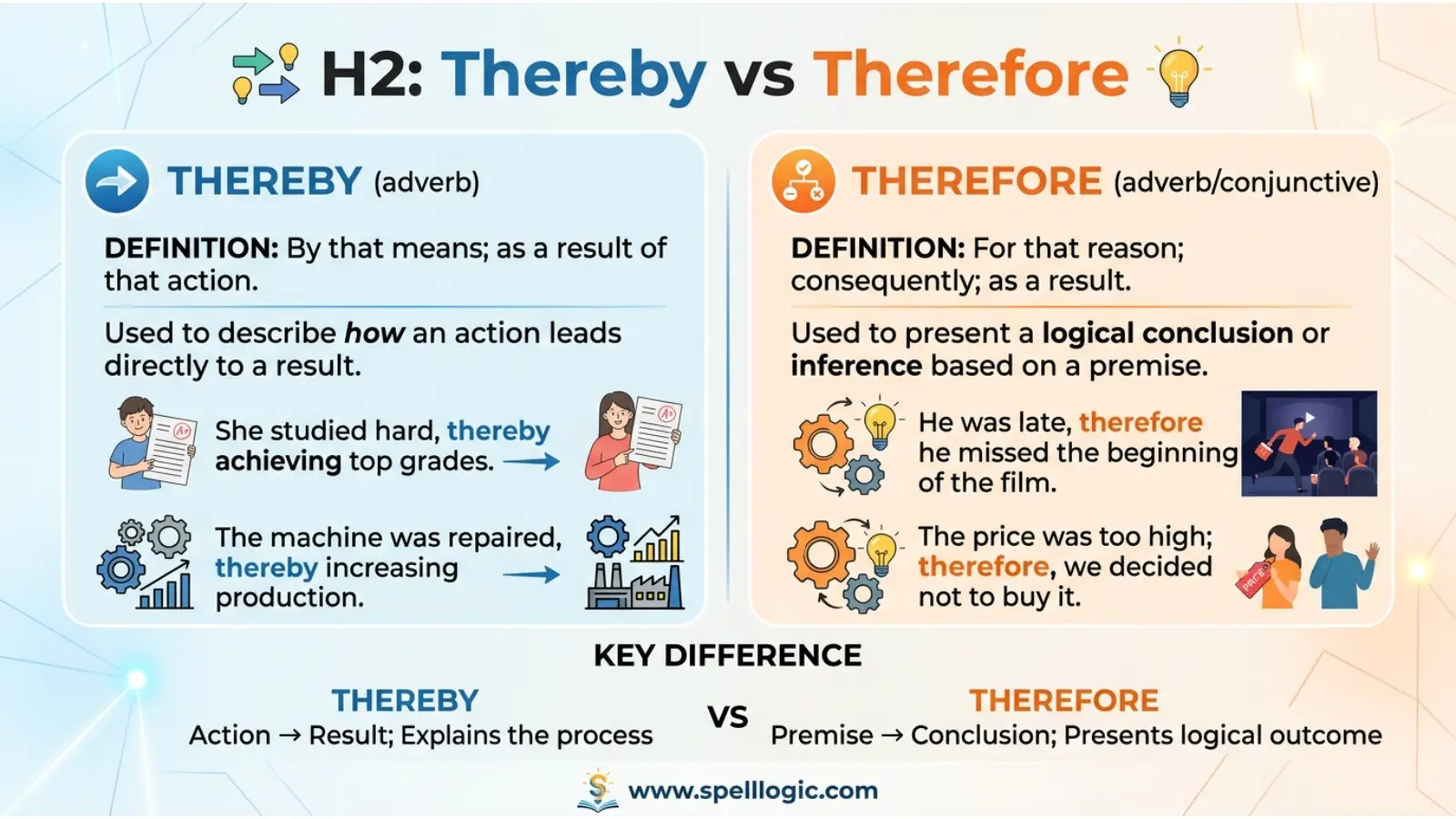
Thereby vs Therefore Explained Simply
Thereby means “by doing that,” while therefore means “for that reason.”
One-Line Distinction
Thereby shows the method, while therefore shows the result.
Examples
Thereby
She reduced unnecessary expenses, thereby saving thousands of dollars each year.
The company improved its website, thereby increasing customer satisfaction.
Therefore
It rained all night; therefore, the match was canceled.
The evidence was incomplete; therefore, the case remained unsolved.
Understanding Homophones in English
Although thereby and therefore are not true homophones, they are often confused because they look and sound similar.
What Are Homophones?
Homophones are words that sound the same but have different meanings and spellings.
Example:
- Sea
- See
Both sound alike but have different meanings.
Why Homophones Cause Confusion
When words sound similar, learners often choose the wrong one while speaking or writing.
For example:
- Their
- There
- They’re
These words are pronounced almost the same but have completely different meanings.
Similarly, although thereby and therefore are not homophones, their similar appearance causes many learners to confuse them.
What Does “Thereby” Mean?
Definition and Core Meaning
Thereby means:
- By that means
- As a result of that action
- Through doing that
It explains how one action produces another.
In other words, it describes the method or process.
Simple Definition
Thereby = by doing that
Origin and Historical Use
The word thereby comes from Middle English and combines:
- there
- by
Originally, it literally meant “by that.”
Over time, it became a formal linking word commonly used in legal, academic, and professional writing.
Modern Usage and Synonyms
Today, thereby appears mostly in formal English.
Common synonyms
- By doing so
- Thus
- Through that
- By means of that
- As a consequence of that action
Key Points
- Explains how something happens.
- Connects an action with its effect.
- Usually follows the action it describes.
- Common in reports, contracts, and research papers.
Example Sentences
The scientist improved the formula, thereby increasing its accuracy.
She apologized immediately, thereby avoiding further conflict.
The company invested in automation, thereby reducing production costs.
The coach adjusted the strategy, thereby helping the team win.
What Does “Therefore” Mean?
Definition and Core Meaning
Therefore means:
- For that reason
- As a result
- Consequently
- Because of that
It introduces a logical result or conclusion based on what was said before.
Simple Definition
Therefore = for that reason
Unlike thereby, which explains how something happened, therefore explains why a result follows.
Origin and Historical Context
The word therefore comes from Middle English and combines:
- there
- fore (meaning “for that”)
For centuries, writers have used therefore to show conclusions in arguments, essays, legal documents, and academic writing. Today, it remains one of the most common transition words for expressing logical results.
Modern Usage and Synonyms
In modern English, therefore is widely used in both formal and semi-formal writing.
Common Synonyms
- Consequently
- Thus
- Hence
- As a result
- For that reason
- Accordingly
Key Points
- Shows a result or conclusion.
- Connects one idea to its logical outcome.
- Frequently appears after a semicolon or at the beginning of a sentence followed by a comma.
- Common in essays, reports, presentations, and professional communication.
Example Sentences
The road was flooded; therefore, we took another route.
She completed all the required training; therefore, she qualified for the position.
The package arrived late. Therefore, the meeting was postponed.
The evidence proved his innocence; therefore, the court dismissed the case.
Thereby vs Therefore: Key Differences at a Glance
| Word | Part of Speech | Meaning | Example Context |
|---|---|---|---|
| Thereby | Adverb | By doing that; by that means | He exercised daily, thereby improving his health. |
| Therefore | Conjunctive adverb | For that reason; as a result | He exercised daily; therefore, he became healthier. |
Quick Summary
| Thereby | Therefore |
|---|---|
| Shows how something happens | Shows why something happens |
| Means by doing that | Means for that reason |
| Explains the method | Explains the conclusion |
| Focuses on the action | Focuses on the result |
How to Remember the Difference Between Thereby and Therefore
Learning a simple memory trick can help you choose the correct word every time.
Easy Memory Tricks
Remember “By”
The word thereby ends with by.
Think:
By doing that
If you’re describing how one action leads to another, choose thereby.
Example:
She practiced every day, thereby improving her pronunciation.
Remember “For”
The word therefore ends with fore, reminding you of for.
Think:
For that reason
If you’re explaining the reason or conclusion, use therefore.
Example:
She practiced every day; therefore, she spoke more confidently.
Association Technique
Ask yourself one question:
Am I explaining HOW or WHY?
- HOW? → Thereby
- WHY? → Therefore
One Memorable Example
He turned off unnecessary lights, thereby saving electricity.
Electricity costs became lower; therefore, he spent less money.
Notice that:
- Thereby explains how he saved electricity.
- Therefore explains why he spent less money.
Common Mistakes and Confusions
Below are mistakes many English learners make when using these words.
Mistake 1
❌ He studied hard, thereby he passed the exam.
✔ He studied hard; therefore, he passed the exam.
Explanation:
Passing the exam is the result, not the method.
Mistake 2
❌ The company hired more employees; therefore increasing production.
✔ The company hired more employees, thereby increasing production.
Explanation:
Increasing production describes how the hiring affected the company.
Mistake 3
❌ She followed the instructions; thereby, the machine worked correctly.
✔ She followed the instructions; therefore, the machine worked correctly.
Explanation:
The second clause expresses the outcome, so therefore is correct.
Mistake 4
❌ The software was updated; therefore improving security.
✔ The software was updated, thereby improving security.
Explanation:
Improving security is the direct effect of updating the software, so thereby is appropriate.
Examples Section: Correct and Incorrect Usage
Example 1
✔ Correct: The teacher explained the lesson clearly, thereby helping every student understand it.
✘ Incorrect: The teacher explained the lesson clearly, therefore helping every student understand it.
Example 2
✔ Correct: The weather became worse; therefore, the flight was delayed.
✘ Incorrect: The weather became worse, thereby the flight was delayed.
Example 3
✔ Correct: She organized her schedule, thereby reducing stress.
✘ Incorrect: She organized her schedule; therefore reducing stress.
Example 4
✔ Correct: The project exceeded its budget; therefore, management reviewed the spending.
✘ Incorrect: The project exceeded its budget, thereby management reviewed the spending.
Example 5
✔ Correct: He installed better insulation, thereby lowering energy costs.
✘ Incorrect: He installed better insulation; therefore lowering energy costs.
Example 6
✔ Correct: All safety checks were completed; therefore, the factory reopened.
✘ Incorrect: All safety checks were completed, thereby the factory reopened.
Self Assessment: Test Your Knowledge
Fill in each blank with thereby or therefore.
1.
She revised every chapter carefully; __________, she passed the final exam with excellent marks.
2.
The company introduced automated systems, __________ reducing production time by nearly 30%.
3.
The bridge was declared unsafe; __________, traffic was redirected to another route.
4.
He followed the doctor’s advice, __________ improving his overall health.
Self Assessment Answers
- therefore
- thereby
- therefore
- thereby
FAQs
1. What is the main difference between thereby and therefore?
Thereby explains how an action produces another result, while therefore introduces a logical conclusion or result. In simple terms, thereby means “by doing that,” whereas therefore means “for that reason.”
2. Can thereby and therefore be used interchangeably?
No. Although both words connect ideas, they have different meanings and grammatical roles. Replacing one with the other usually changes the meaning of the sentence or makes it incorrect.
3. Is therefore more common than thereby?
Yes. Therefore appears more frequently in everyday writing, academic essays, business reports, and formal communication. Thereby is less common and is mainly used when explaining how one action directly causes another.
4. Is thereby formal English?
Yes. Thereby is considered a formal adverb and is commonly found in legal documents, academic papers, research articles, contracts, and professional writing. In casual conversation, people often replace it with by doing so or by that.
5. Where should I place therefore in a sentence?
Therefore often appears:
- After a semicolon: The experiment failed; therefore, we repeated it.
- At the beginning of a sentence: Therefore, we changed our approach.
- Occasionally in the middle of a sentence when punctuation supports it.
6. Where should I place thereby in a sentence?
Thereby usually comes immediately before the result of an action.
Example:
She negotiated a better contract, thereby saving the company thousands of dollars.
7. How can I remember the difference easily?
Ask yourself a simple question:
- Am I explaining how something happened? → Use thereby.
- Am I explaining why or giving a conclusion? → Use therefore.
This quick test works in most situations and helps you choose the correct word with confidence.
Final Conclusion: Using “Thereby” and “Therefore” Correctly
Understanding the difference between thereby and therefore is an important step toward improving your English writing and speaking skills. Although these words look similar and often appear in formal contexts, they perform different functions. Thereby explains how one action leads to another, making it useful for describing the method or means by which something happens. Therefore, on the other hand, introduces a logical conclusion or result, showing what follows because of a previous statement.
A simple way to remember them is to think of thereby as meaning “by doing that” and therefore as meaning “for that reason.” Whenever you write, ask yourself whether you are explaining the method or the conclusion. If you’re describing how an action produces an effect, choose thereby. If you’re showing the outcome or logical consequence of an earlier idea, use therefore.
Reading books, articles, and professional documents will help you notice these words in real contexts. The more examples you see and practice using them in your own sentences, the more natural they will become. Don’t worry if you confuse them at first—many English learners do. With regular practice and the memory tips in this guide, you’ll soon use thereby and therefore accurately and confidently in both academic and everyday English.