
Many English learners wonder whether they should write timepoint or time point. At first glance, both forms seem to mean the same thing, and you may even see both used in books, research papers, and online articles. This can make it difficult to know which version is correct.
The truth is that the preferred spelling often depends on the writing style, industry, and context. Understanding the difference will help you write more naturally and professionally, especially in academic, scientific, and technical English. In this guide, you’ll learn when to use timepoint, when to use time point, and how to remember the difference with simple explanations and practical examples.
Table of Contents
- Introduction
- Why “Timepoint” and “Time Point” Are Confusing
- Timepoint vs Time Point Explained Simply
- Understanding Homophones in English
- What Are Homophones?
- Why Homophones Cause Confusion
- What Does “Timepoint” Mean?
- What Does “Time Point” Mean?
- Timepoint vs Time Point: Key Differences at a Glance
- How to Remember the Difference Between Timepoint and Time Point
- Common Mistakes and Confusions
- Examples Section: Correct and Incorrect Usage
- Self Assessment: Test Your Knowledge
- Self Assessment Answers
- FAQs About “Timepoint” and “Time Point”
- Final Conclusion: Using “Timepoint” and “Time Point” Correctly
Why “Timepoint” and “Time Point” Are Confusing
Many people mix up timepoint and time point because they refer to the same basic idea—a specific moment in time. However, the way they are written varies across different types of English.
Here are the main reasons for the confusion:
Similar pronunciation
Both timepoint and time point are pronounced exactly the same. When spoken, there is no audible difference between them.
Similar spelling
The only difference is the space between the words. Since English contains many compound words that may appear as one word or two, learners often wonder which version is standard.
Context confusion
In scientific and medical writing, timepoint is increasingly accepted as a single compound word. In general English and many style guides, time point is still preferred.
Common learner mistakes
Learners often:
- Assume both forms are interchangeable in every situation.
- Use one style inconsistently within the same document.
- Think one form is always incorrect.
- Forget that publishers or organizations may have their own style preferences.
Timepoint vs Time Point Explained Simply
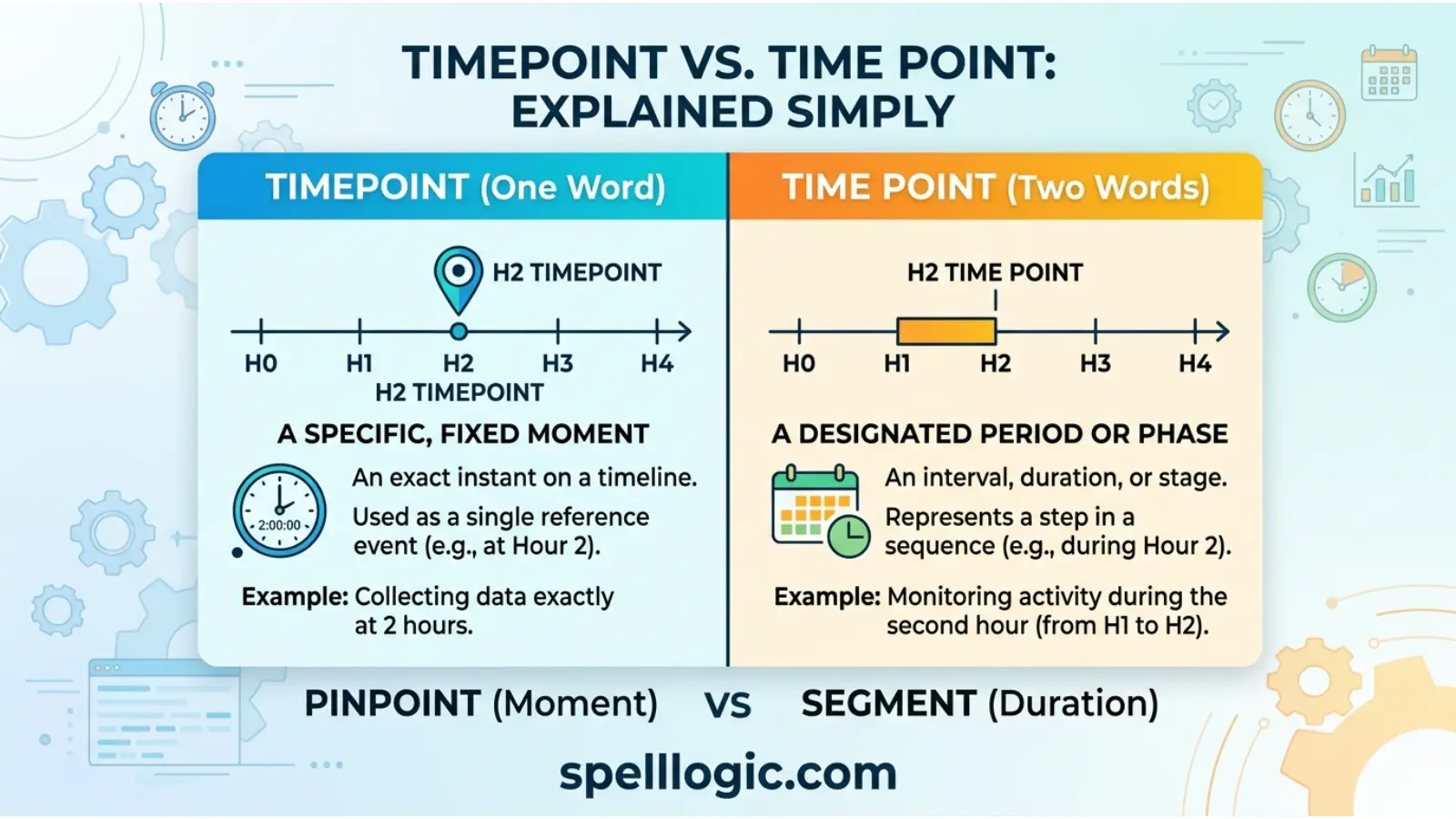
Timepoint means a specific moment in time, usually in scientific, medical, or technical writing, while time point is the traditional two-word form used in general English and many formal publications.
One-line distinction
Timepoint is the newer compound spelling, while time point is the more traditional and widely accepted two-word form.
Examples
- Researchers collected blood samples at each timepoint.
- The project reached an important time point after six months.
Understanding Homophones in English
What Are Homophones?
Homophones are words that sound the same but have different meanings or spellings.
Example:
- Sea
- See
These words sound identical but have different meanings.
Note: Timepoint and time point are not true homophones because they share the same meaning. They are simply different written forms of the same expression.
Why Homophones Cause Confusion
English learners often rely on pronunciation. Since many words sound alike, they may choose the wrong spelling when writing.
For example:
- Their
- There
- They’re
Although these words sound the same, each has a different meaning and usage.
What Does “Timepoint” Mean?
Definition and Core Meaning
Timepoint is a compound noun that refers to a specific moment at which something is measured, observed, or recorded.
It is especially common in:
- Medical research
- Clinical trials
- Biology
- Data analysis
- Psychology
- Scientific reports
Origin and Historical Use
The compound spelling timepoint became popular as scientific writing evolved. Researchers wanted a concise term to describe scheduled moments of observation during experiments.
Although relatively modern, it is now frequently seen in journals and technical documents.
Modern Usage and Synonyms
Modern writers often use timepoint in technical contexts.
Similar words include:
- Measurement point
- Observation point
- Reference point
- Stage
- Interval (depending on context)
- Checkpoint
Example sentences
- Data were collected at every timepoint during the study.
- Each timepoint showed consistent improvement.
- Scientists compared the results across several timepoints.
- Patient responses differed at each timepoint.
What Does “Time Point” Mean?
Definition and Core Meaning
Time point also means a particular moment in time.
Unlike the compound version, this spelling remains common in:
- General English
- Academic writing
- Business documents
- Educational materials
- Formal reports
Origin and Historical Context
The phrase time point developed naturally as a noun phrase consisting of two separate words. It has appeared in English writing for many decades and remains the preferred form in many dictionaries and editorial style guides.
Modern Usage and Synonyms
Common alternatives include:
- Moment
- Point in time
- Specific time
- Stage
- Milestone
- Instant
Example sentences
- This time point marks the beginning of the experiment.
- We analyzed the data at each time point.
- Every time point produced similar results.
- The survey included three different time points.
Timepoint vs Time Point: Key Differences at a Glance
| Word | Part of Speech | Meaning | Example Context |
|---|---|---|---|
| Timepoint | Noun | A specific moment, especially in scientific or technical writing | Researchers compared results at each timepoint. |
| Time point | Noun phrase | A particular moment in time; preferred in general and formal English | Data were recorded at every time point. |
How to Remember the Difference Between Timepoint and Time Point
Fortunately, remembering the difference is easy.
Easy memory tricks
- Think of timepoint as the compact scientific version.
- Think of time point as the standard phrase used in everyday writing.
Association techniques
Imagine a laboratory.
Scientists often combine technical terms into single words.
Outside the lab, people usually write the phrase as time point.
Memorable example
Science loves compounds, so remember: “The lab writes timepoint.”
For school essays or everyday English, time point is usually the safer choice unless your style guide says otherwise.
Common Mistakes and Confusions
Wrong
The experiment included five time points.
Correct
The experiment included five time points.
Explanation: The plural should be time points when using the two-word form.
Wrong
Every timepoint was analyzed carefully. (In a publication that requires the two-word style.)
Correct
Every time point was analyzed carefully.
Explanation: Follow the preferred style guide for consistency.
Wrong
Each time point was compared with the next timepoint.
Correct
Choose one spelling and use it consistently throughout your document.
Examples Section: Correct and Incorrect Usage
Example 1
✔ Correct: The researchers recorded observations at every timepoint.
✘ Incorrect: The researchers recorded observations at every time point. (Incorrect only if your publication requires the compound form.)
Example 2
✔ Correct: We reviewed the data at each time point.
✘ Incorrect: We reviewed the data at each timepoint. (Incorrect only if following a style guide that prefers two words.)
Example 3
✔ Correct: Patient progress improved at every timepoint.
✘ Incorrect: Patient progress improved at every time point. (In journals using the compound spelling.)
Example 4
✔ Correct: Be consistent throughout your report.
✘ Incorrect: Use timepoint in one paragraph and time point in the next without a reason.
Self Assessment: Test Your Knowledge
Fill in the blanks.
1. The researchers collected samples at each __________ during the trial.
2. Many editors still prefer the two-word form __________ in general writing.
3. Scientific journals often use the compound form __________.
4. The most important rule is to remain __________ throughout your document.
Self Assessment Answers
- timepoint or time point (depending on the chosen style)
- time point
- timepoint
- consistent
FAQs
Is timepoint a real word?
Yes. It is widely accepted in scientific, medical, and technical writing.
Is time point more correct?
Neither is universally more correct. Time point is generally preferred in standard English, while timepoint is common in technical fields.
Which spelling should I use?
Follow your organization’s style guide or remain consistent throughout your document.
Why do researchers often write timepoint?
Many scientific disciplines prefer concise compound nouns for technical terms.
Can I use both spellings in one article?
It is better not to. Choose one version and use it consistently.
Do dictionaries recognize timepoint?
Some modern dictionaries include it, while others still list time point as the preferred form.
Is timepoint informal?
No. It is actually most common in formal scientific and technical writing.
Final Conclusion: Using “Timepoint” and “Time Point” Correctly
Choosing between timepoint and time point is easier once you understand the context in which each form is used. Both expressions refer to a specific moment in time, especially one used for observation, measurement, or analysis. The main difference is not in meaning but in writing style. Timepoint has become increasingly common in scientific, medical, and technical publications because many fields prefer concise compound nouns. Meanwhile, time point remains the traditional two-word spelling and is still widely used in general English, academic writing, and many editorial style guides. Neither form is inherently wrong, but consistency is essential.
If your school, employer, journal, or publisher recommends one spelling, use that version throughout your document. A simple way to remember the distinction is this: science often prefers “timepoint,” while general English usually favors “time point.” By keeping your audience and style guide in mind, you’ll make better writing choices and avoid unnecessary confusion. As you continue learning English, pay attention to how compound words evolve over time. The more examples you read and practice, the more natural these distinctions will become. With a little consistency and awareness, you’ll be able to use timepoint and time point confidently in any writing situation.