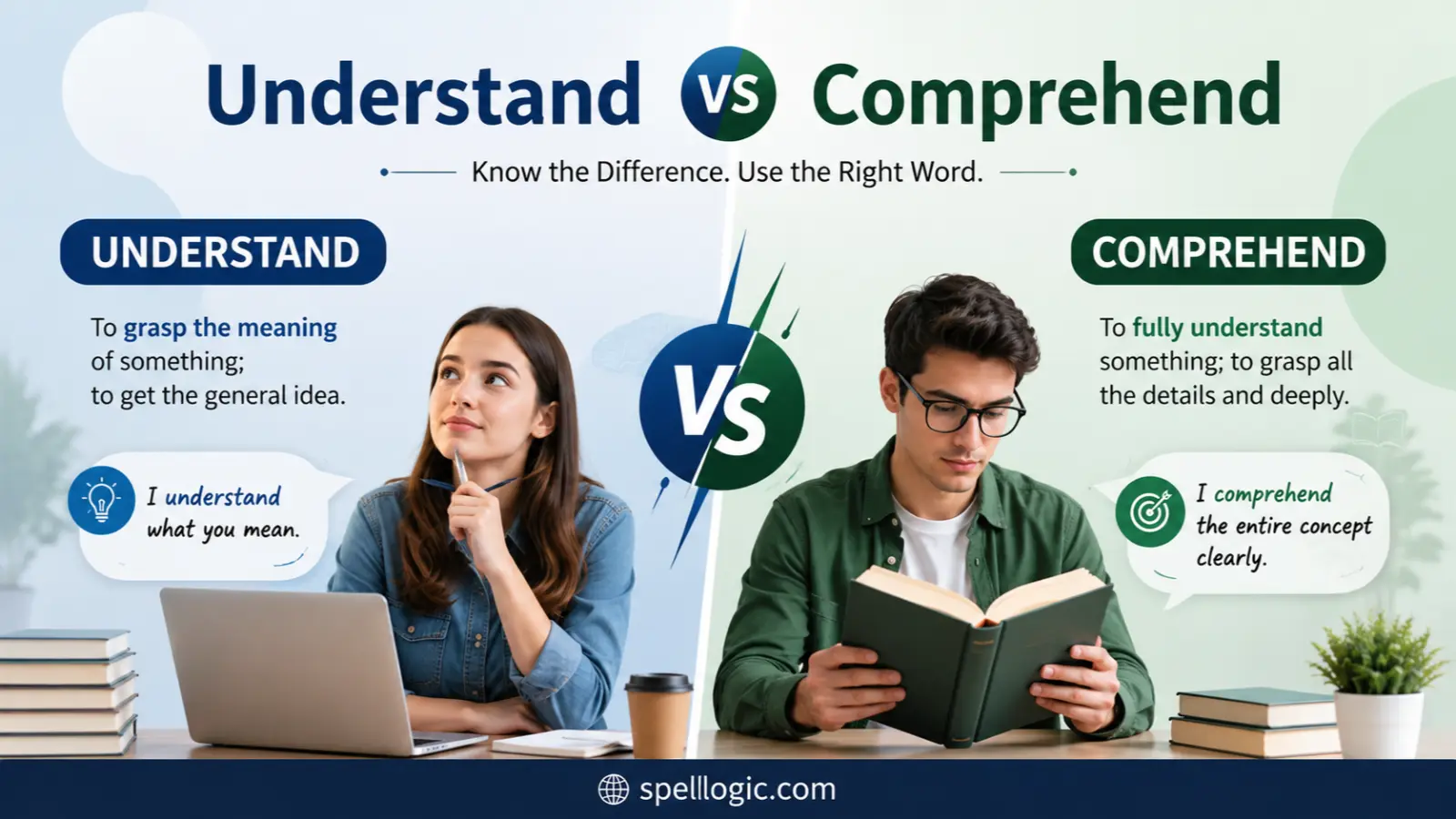
Many English learners use understand and comprehend as if they mean exactly the same thing. While they are very similar, they are not always used in the same situations. In everyday conversations, people usually say they understand something, but in formal writing or academic settings, you may also see comprehend.
Knowing when to choose each word helps you sound more natural and communicate more clearly. This guide explains the difference in simple English, provides practical examples, and gives you easy memory tricks so you can confidently use both words in speaking and writing.
Table of Contents
- Introduction
- Why “Understand” and “Comprehend” Are Confusing
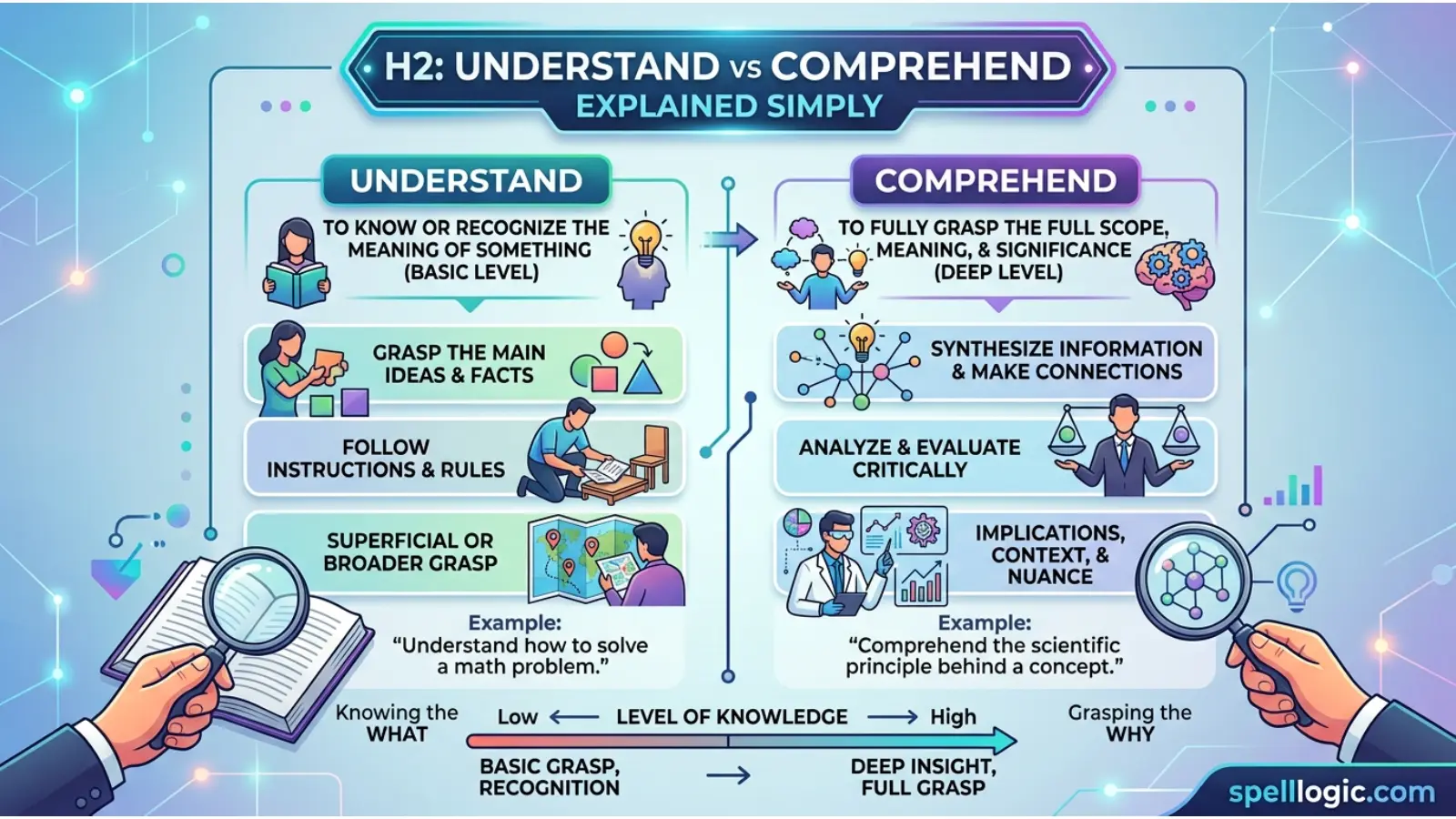
- Understand vs Comprehend Explained Simply
- Understanding Homophones in English
- What Are Homophones?
- Why Homophones Cause Confusion
- What Does “Understand” Mean?
- What Does “Comprehend” Mean?
- Understand vs Comprehend: Key Differences at a Glance
- How to Remember the Difference Between Understand and Comprehend
- Common Mistakes and Confusions
- Examples Section: Correct and Incorrect Usage
- Self Assessment: Test Your Knowledge
- Self Assessment Answers
- FAQs About “Understand and Comprehend”
- Final Conclusion: Using “Understand” and “Comprehend” Correctly
Why “Understand” and “Comprehend” Are Confusing
Many learners struggle with these two words because they both relate to knowing or grasping the meaning of something.
Here are the main reasons people confuse them:
- Similar pronunciation: Although they do not sound exactly alike, both have a similar rhythm and are often used in similar conversations.
- Similar spelling: They do not share the same spelling, but both are verbs with similar meanings.
- Context confusion: In many situations, either word can be used without changing the basic meaning.
- Common learner mistakes: Students often think comprehend is simply a more difficult word for understand, but there are slight differences in tone and usage.
In general, understand is more common in everyday English, while comprehend often appears in formal, educational, or scientific contexts.
Understand vs Comprehend Explained Simply
Understand means to know the meaning of something, while comprehend means to fully understand something, often after careful thought or explanation.
One-line distinction
Understand is the everyday word, while comprehend often emphasizes complete or deeper understanding.
Examples
- I understand your question.
- She understands how the machine works.
- It took him several hours to comprehend the complex theory.
- Young children may not comprehend the importance of saving money.
Understanding Homophones in English
What Are Homophones?
Homophones are words that sound the same but have different meanings and spellings.
Example:
- Flower – a blooming plant
- Flour – powder used for baking
Why Homophones Cause Confusion
Homophones often confuse learners because the pronunciation is identical while the meanings are completely different.
For example:
- “I bought flour.”
- “The flower smells wonderful.”
Understand and comprehend are not homophones. They simply have similar meanings, which is why learners confuse them.
What Does “Understand” Mean?
Definition and Core Meaning
Understand means to know the meaning, idea, reason, or explanation of something.
It is one of the most common English verbs and is suitable for almost every situation.
Origin and Historical Use
The word understand comes from Old English understandan, meaning “to grasp the meaning of” or “to perceive.” It has been part of the English language for over a thousand years.
Modern Usage and Synonyms
Today, understand is used in everyday conversation, education, work, and writing.
Synonyms
- Know
- Grasp
- Realize
- Follow
- Recognize
- Appreciate
Common Uses
- Understanding instructions
- Understanding feelings
- Understanding languages
- Understanding ideas
- Understanding directions
Example Sentences
- I understand what you mean.
- Do you understand these instructions?
- She understands English very well.
- We finally understood the problem.
What Does “Comprehend” Mean?
Definition and Core Meaning
Comprehend means to fully understand something, especially something difficult, detailed, or complex.
It often suggests deeper mental understanding.
Origin and Historical Context
The word comes from the Latin comprehendere, meaning “to seize” or “to grasp completely.”
English adopted it during the Middle Ages, and it has long been associated with formal and academic language.
Modern Usage and Synonyms
Today, comprehend appears more often in books, schools, psychology, research, and professional writing.
Synonyms
- Fully understand
- Grasp
- Interpret
- Perceive
- Appreciate
- Absorb
Common Uses
- Comprehending scientific concepts
- Reading comprehension
- Understanding legal documents
- Interpreting difficult ideas
- Learning complex subjects
Example Sentences
- I cannot comprehend how the accident happened.
- Students must comprehend the passage before answering the questions.
- She quickly comprehended the new theory.
- It is difficult to comprehend the size of the universe.
Understand vs Comprehend: Key Differences at a Glance
| Word | Part of Speech | Meaning | Example Context |
|---|---|---|---|
| Understand | Verb | To know or grasp the meaning of something | I understand your message. |
| Comprehend | Verb | To fully or deeply understand something | She comprehended the scientific explanation. |
How to Remember the Difference Between Understand and Comprehend
Here are some simple tricks to help you remember.
Memory Trick 1
Think of understand as the everyday word.
You use it in daily conversations.
“I understand.”
Memory Trick 2
Think of comprehend as complete understanding.
If something is difficult or requires careful thinking, comprehend is often the better choice.
Association Technique
- Understand = Everyday understanding
- Comprehend = Complete understanding
Memorable Example
“I understand the question, but I need more time to comprehend the entire chapter.”
Common Mistakes and Confusions
Mistake 1
❌ I comprehend what time it is.
✔ I understand what time it is.
Explanation: Everyday information usually takes understand.
Mistake 2
❌ The students understood every detail of the advanced research paper.
✔ The students comprehended every detail of the advanced research paper.
Explanation: A detailed academic topic often fits comprehended better.
Mistake 3
❌ I cannot comprehend your simple question.
✔ I don’t understand your simple question.
Explanation: For ordinary conversation, understand sounds more natural.
Mistake 4
❌ Reading comprehension helps students understand difficult texts completely.
✔ Reading comprehension helps students comprehend difficult texts.
Explanation: The educational context naturally uses comprehend.
Examples Section: Correct and Incorrect Usage
Example 1
✔ Correct: I understand your explanation.
✘ Incorrect: I comprehend your explanation. (Possible but less natural in everyday conversation.)
Example 2
✔ Correct: She comprehended the complex mathematical proof.
✘ Incorrect: She understood the complex mathematical proof immediately. (Not wrong, but comprehended emphasizes deeper understanding.)
Example 3
✔ Correct: Do you understand the teacher?
✘ Incorrect: Do you comprehend the teacher?
Example 4
✔ Correct: Few people can comprehend the vastness of space.
✘ Incorrect: Few people can understandly the vastness of space.
Self Assessment: Test Your Knowledge
Fill in the blanks with understand or comprehend.
1.
I don’t ________ why he left so early.
2.
Scientists continue to ________ the mysteries of the human brain.
3.
Do you ________ these directions?
4.
It took me several days to ________ the legal document.
Self Assessment Answers
- understand
- comprehend
- understand
- comprehend
FAQs
1. Are understand and comprehend synonyms?
Yes. They are close synonyms, but comprehend usually suggests a deeper or more complete understanding.
2. Which word is more common in everyday English?
Understand is much more common in daily conversation.
3. Is comprehend more formal?
Yes. Comprehend is generally considered more formal and is often used in academic or professional writing.
4. Can I use them interchangeably?
Sometimes. However, understand sounds more natural in casual speech, while comprehend is better for emphasizing complete understanding.
5. Which word should English learners use more often?
Start with understand, since native speakers use it frequently. Learn comprehend for formal and academic situations.
6. Is “reading comprehension” related to comprehend?
Yes. The word comprehension comes from comprehend and refers to the ability to fully understand written or spoken language.
7. Can someone understand something without comprehending it?
Yes. You might understand the basic idea of a topic but not fully comprehend all of its details or implications.
Final Conclusion: Using “Understand” and “Comprehend” Correctly
Learning the difference between understand and comprehend can make your English sound more natural and precise. Both words describe the ability to grasp meaning, but they are not always used in the same way. Understand is the everyday choice that fits most conversations, whether you are talking about instructions, opinions, feelings, or simple facts. Comprehend, on the other hand, often emphasizes a deeper, more complete understanding and is commonly used in academic, scientific, legal, or professional contexts. While native speakers may sometimes use the two words interchangeably, choosing the one that best matches the situation improves both your writing and speaking.
A helpful way to remember the difference is this: understand is for ordinary communication, while comprehend suggests fully grasping something that may be difficult or detailed. Practice by reading English articles, listening to conversations, and creating your own example sentences. The more you see these words in context, the easier it becomes to recognize when each one sounds most natural. Don’t worry if you make mistakes at first—every learner does. With regular practice and attention to context, you’ll soon use understand and comprehend with confidence, making your English clearer, more accurate, and more effective in both everyday and formal communication.