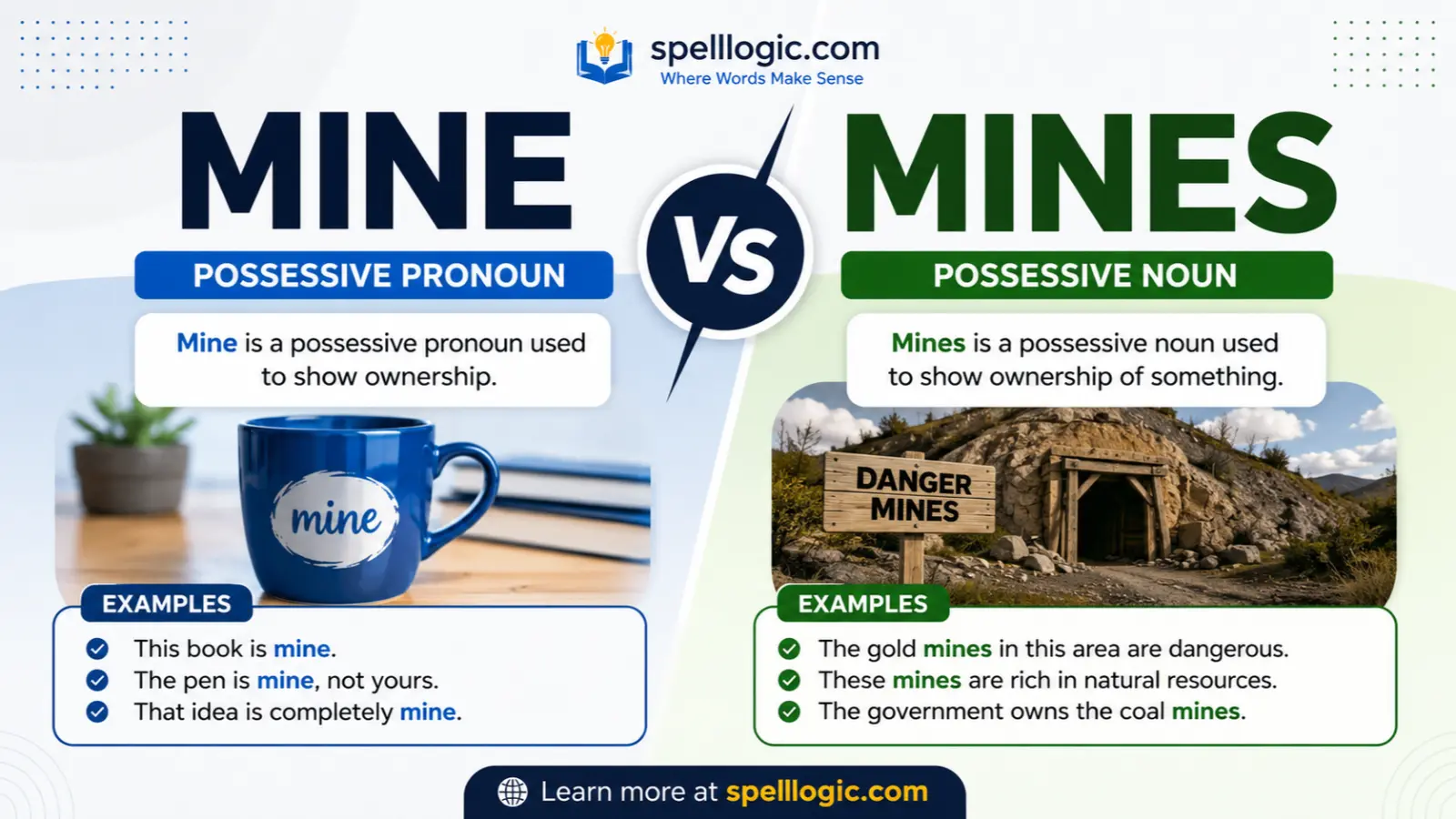
Many English learners get confused by mine and mines because the two words look almost the same and are closely related. However, they do not always have the same meaning or function in a sentence. Sometimes mine shows ownership, while mines can refer to more than one place where minerals are dug from the ground or the plural form of a military explosive.
Understanding the difference helps you avoid common grammar mistakes and communicate more clearly in both speaking and writing. This guide explains everything you need to know about mine vs mines using simple definitions, practical examples, and easy memory tips.
Table of Contents
- Introduction
- Why “Mine” and “Mines” Are Confusing
- Mine vs Mines Explained Simply
- Understanding Homophones in English
- What Are Homophones?
- Why Homophones Cause Confusion
- What Does “Mine” Mean?
- What Does “Mines” Mean?
- Mine vs Mines: Key Differences at a Glance
- How to Remember the Difference Between Mine and Mines
- Common Mistakes and Confusions
- Examples Section: Correct and Incorrect Usage
- Self Assessment: Test Your Knowledge
- Self Assessment Answers
- FAQs About “Mine and Mines”
- Final Conclusion: Using “Mine” and “Mines” Correctly
Why “Mine” and “Mines” Are Confusing
Many learners mistakenly believe that mine and mines are interchangeable. Although they are related, they have different meanings depending on how they are used.
Here are the main reasons people confuse them.
Similar Pronunciation
Both words are pronounced almost the same. The only difference is that mines ends with an extra /z/ sound.
- Mine → /maɪn/
- Mines → /maɪnz/
Because the pronunciation is so similar, learners often write the wrong form.
Similar Spelling
The only spelling difference is the letter s at the end. This small change gives the word a different grammatical function.
Context Confusion
The word mine can be:
- A possessive pronoun
- A noun meaning a place where minerals are extracted
- A noun referring to an explosive device
The word mines is simply the plural form of the noun mine.
Common Learner Mistakes
Learners often write sentences like:
- ✘ Those books are mines.
- ✔ Those books are mine.
Or:
- ✘ There is many mine in this country.
- ✔ There are many mines in this country.
Understanding the context is the key to choosing the correct word.
Mine vs Mines Explained Simply
The easiest way to remember the difference is this:
Mine means “belongs to me,” while mines means more than one mine (such as coal mines, gold mines, or land mines).
One-line distinction
Mine usually shows ownership or refers to one mine, whereas mines refers to two or more mines.
Examples
Mine means something belongs to the speaker.
- This notebook is mine.
- The blue jacket is mine, not yours.
Mines refers to multiple mines.
- The country has many coal mines.
- Soldiers carefully removed the land mines.
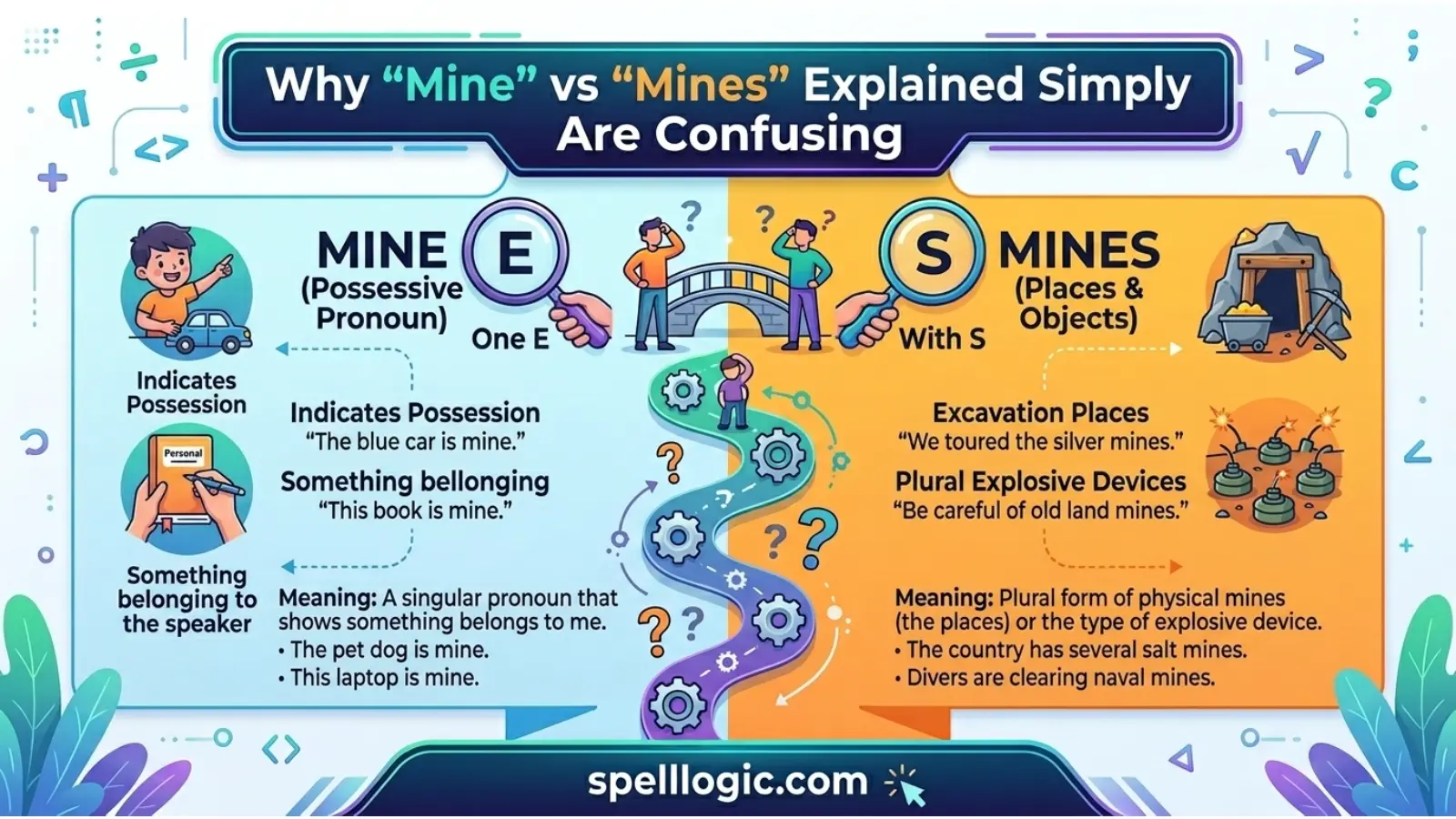
Understanding Homophones in English
Although mine and mines are not true homophones, they sound very similar, which often causes confusion.
What Are Homophones?
Homophones are words that have the same pronunciation but different meanings and spellings.
Example:
- Sea
- See
These words sound identical but have different meanings.
Why Homophones Cause Confusion
When people hear words that sound alike, they may spell them incorrectly while writing.
For example:
- Their
- There
- They’re
These words sound the same but serve different grammatical purposes.
Likewise, mine and mines sound very similar, so learners sometimes choose the wrong one even though they are not perfect homophones.
What Does “Mine” Mean?
Definition and Core Meaning
The word mine has several meanings in English depending on the context.
The most common meaning is a possessive pronoun showing ownership.
Example:
- This phone is mine.
It can also mean:
- A place where minerals are extracted.
- An explosive device buried underground or underwater.
Origin and Historical Use
The possessive pronoun mine comes from Old English mīn, meaning belonging to me.
Historically, mine was also used before nouns beginning with vowels.
Examples from older English include:
- Mine eyes
- Mine honor
Today, this usage mostly appears in classic literature and historical writing.
The noun mine, meaning a place where valuable minerals are dug from the earth, comes from medieval European languages and has been used for centuries.
Modern Usage and Synonyms
As a possessive pronoun:
Synonyms include:
- Belonging to me
- My own
As a noun:
It may refer to:
- Coal mine
- Gold mine
- Diamond mine
- Salt mine
- Land mine
- Naval mine
Key Points
- Shows ownership.
- Functions as a possessive pronoun.
- Can also mean one excavation site.
- Can refer to one explosive device.
Example Sentences
Ownership:
- The backpack is mine.
- That decision is mine to make.
- This seat is mine.
Mining:
- The gold mine employs hundreds of workers.
- The old coal mine closed years ago.
Military:
- The soldier discovered a hidden mine.
What Does “Mines” Mean?
Definition and Core Meaning
Mines is the plural form of the noun mine.
It never functions as a possessive pronoun.
Instead, it refers to:
- More than one mineral mine.
- More than one explosive device.
Origin and Historical Context
As industries expanded around the world, the plural mines became common when discussing multiple mining locations.
Likewise, military writing frequently uses mines when referring to explosive weapons placed in groups.
Modern Usage and Synonyms
Depending on the context, mines may refer to:
Mining:
- Quarries
- Excavation sites
- Mineral deposits
Military:
- Explosive devices
- Land mines
- Naval mines
Key Points
- Always plural.
- Refers to two or more mines.
- Never replaces the possessive pronoun mine.
- Common in geography, history, engineering, and military discussions.
Example Sentences
Mining:
- Australia has many iron ore mines.
- The company operates several copper mines.
- Workers visited different coal mines during the project.
Military:
- The road was cleared of land mines.
- Engineers safely removed underwater mines.
Continue with Part 2, which includes the comparison table, memory tricks, common mistakes, practice examples, self-assessment, FAQs, and a comprehensive conclusion.
Mine vs Mines: Key Differences at a Glance
The table below summarizes the main differences between mine and mines.
| Word | Part of Speech | Meaning | Example Context |
|---|---|---|---|
| Mine | Possessive pronoun / Noun | Belonging to me; one place where minerals are extracted; one explosive device | This notebook is mine. / The gold mine is nearby. |
| Mines | Plural noun | More than one mine or explosive device | The region has many coal mines. |
Quick Summary
- Mine = belongs to me or one mine.
- Mines = two or more mines.
- Never use mines instead of the possessive pronoun mine.
How to Remember the Difference Between Mine and Mines
Learning grammar becomes much easier when you use simple memory tricks.
Easy Memory Tricks
Trick 1: Think About the Letter “S”
The letter S usually means more than one.
- Mine = one
- Mines = many
Trick 2: Ownership Has No “S”
When something belongs to you, simply say:
- It’s mine.
Never say:
- It’s mines.
Trick 3: Ask Yourself a Question
Before choosing the word, ask:
Am I talking about ownership?
- Yes → mine
Am I talking about several mining locations or explosives?
- Yes → mines
Association Technique
Imagine holding your own backpack and saying:
“This is mine.”
Now imagine looking at several coal excavation sites on a map.
You would say:
“These are coal mines.”
Memorable Example
- This bicycle is mine.
- These diamond mines produce valuable gems.
Just remember:
No S = ownership.
S = more than one mine.
Common Mistakes and Confusions
Many English learners make predictable mistakes with these words.
Mistake 1
✘ Those books are mines.
✔ Those books are mine.
Explanation:
The sentence talks about ownership, not multiple mines.
Mistake 2
✘ The country has many coal mine.
✔ The country has many coal mines.
Explanation:
Because there are several coal mines, the plural form is required.
Mistake 3
✘ These keys are mines.
✔ These keys are mine.
Explanation:
The keys belong to the speaker.
Mistake 4
✘ The soldiers removed several mine.
✔ The soldiers removed several mines.
Explanation:
Several means more than one, so the plural noun is necessary.
Examples Section: Correct and Incorrect Usage
Here are more examples to help reinforce the difference.
Example 1
✔ Correct:
This wallet is mine.
✘ Incorrect:
This wallet is mines.
Example 2
✔ Correct:
Canada has many gold mines.
✘ Incorrect:
Canada has many gold mine.
Example 3
✔ Correct:
The blue umbrella is mine.
✘ Incorrect:
The blue umbrella is mines.
Example 4
✔ Correct:
Workers inspected several copper mines.
✘ Incorrect:
Workers inspected several copper mine.
Example 5
✔ Correct:
The old mine is now a tourist attraction.
✘ Incorrect:
The old mines is now a tourist attraction.
Example 6
✔ Correct:
The engineer located hidden land mines.
✘ Incorrect:
The engineer located hidden land mine.
Self Assessment: Test Your Knowledge
Choose the correct word to complete each sentence.
1.
This notebook is ________.
a) mine
b) mines
2.
The workers visited three coal ________.
a) mine
b) mines
3.
That red jacket is ________.
a) mine
b) mines
4.
The soldiers safely removed several land ________.
a) mine
b) mines
Self Assessment Answers
- mine
- mines
- mine
- mines
If you answered all four correctly, you’ve mastered the basic difference between mine and mines.
FAQs
1. What is the difference between mine and mines?
Mine usually shows ownership or refers to one mine. Mines is the plural form of the noun mine.
2. Is “This is mines” grammatically correct?
No. The correct sentence is:
This is mine.
3. Can mine be both a pronoun and a noun?
Yes. It can show ownership or refer to a mining site or an explosive device.
4. When should I use mines?
Use mines whenever you’re talking about two or more mines, such as coal mines, gold mines, or land mines.
5. Is mine singular or plural?
As a possessive pronoun, mine has no plural form. As a noun, it is singular.
6. Are mine and mines homophones?
Not exactly. They sound very similar, but mines has an extra /z/ sound at the end.
7. Why do English learners confuse these words?
Because they have nearly identical spelling, similar pronunciation, and different meanings depending on context.
Final Conclusion: Using “Mine” and “Mines” Correctly
Understanding the difference between mine and mines is easier once you know the role each word plays in a sentence. In most everyday conversations, mine is a possessive pronoun that shows ownership. Whenever you want to say that something belongs to you, mine is the correct choice. It can also be used as a singular noun to describe a place where minerals are extracted or a single explosive device. On the other hand, mines is simply the plural form of the noun mine. It refers to two or more mining sites or explosive devices and should never be used to express ownership.
A useful memory tip is to focus on the final S. If you’re talking about more than one mine, add S and write mines. If you’re talking about something that belongs to you, leave off the S and use mine. Reading example sentences, practicing short exercises, and paying attention to context will help make the correct choice feel natural.