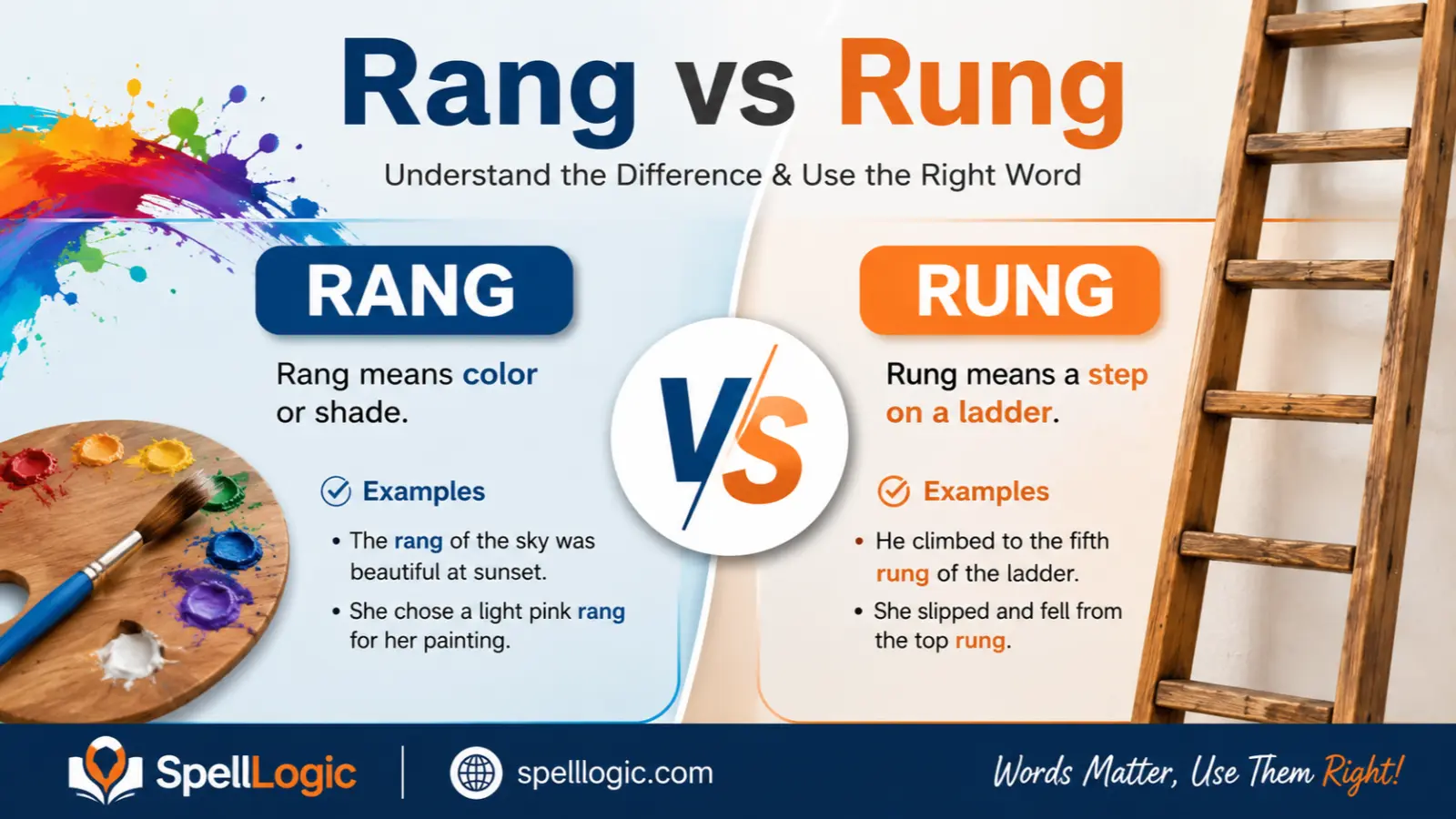
Many English learners struggle with rang vs rung because both words come from the same verb, ring, and both describe actions that happened in the past. However, they are not interchangeable. Using the wrong form can make your sentences sound unnatural or grammatically incorrect.
The good news is that once you understand when to use each word, the difference becomes easy to remember. In this guide, you’ll learn the meanings of rang and rung, see practical examples, discover common mistakes, and pick up simple memory tricks to help you use these words correctly in everyday English.
Table of Contents
- Introduction
- Why “Rang” and “Rung” Are Confusing
- Rang vs Rung Explained Simply
- Understanding Irregular Verbs in English
- What Does “Rang” Mean?
- What Does “Rung” Mean?
- Rang vs Rung: Key Differences at a Glance
- How to Remember the Difference Between Rang and Rung
- Common Mistakes and Confusions
- Examples Section: Correct and Incorrect Usage
- Self-Assessment: Test Your Knowledge
- Self-Assessment Answers
- FAQs About Rang and Rung
- Final Conclusion: Using Rang and Rung Correctly
Why “Rang” and “Rung” Are Confusing
Many learners confuse rang and rung because they are closely related forms of the same verb.
Here are the main reasons:
- Both come from the irregular verb ring.
- They sound similar when spoken quickly.
- Both refer to actions that happened in the past.
- Many learners assume either form works in every sentence.
- Some native speakers also make mistakes in casual speech.
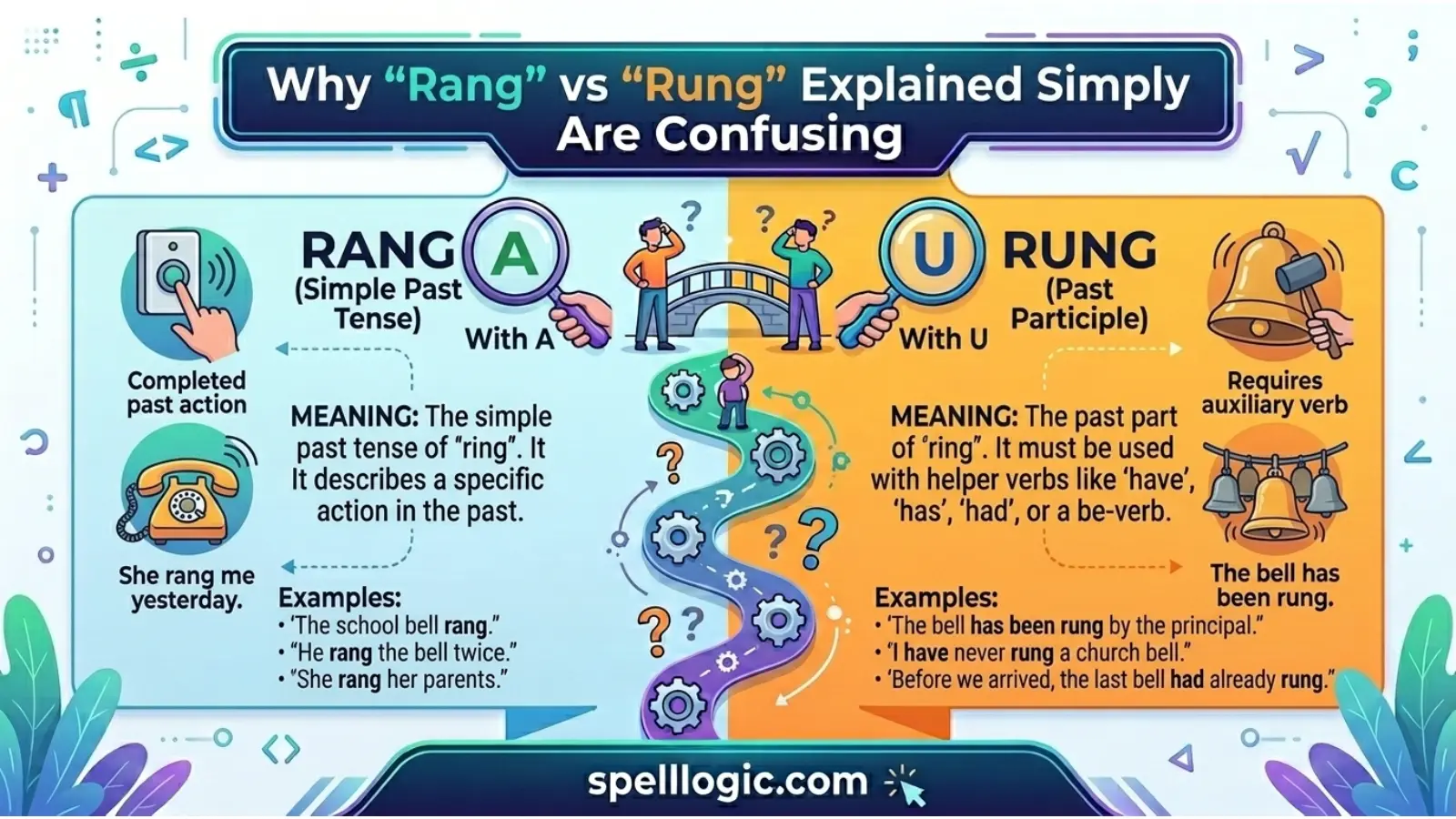
The biggest source of confusion is grammar rather than pronunciation. Remember that rang is the simple past tense, while rung is the past participle that requires a helping verb such as has, have, or had.
Rang vs Rung Explained Simply
Rang means the action happened in the past, while rung is used with a helping verb to describe a completed action.
One-line distinction
Rang is the simple past tense, while rung is the past participle.
Examples
Rang
- She rang the school yesterday.
- The church bells rang at noon.
Rung
- She has rung the school twice today.
- The bell had rung before we arrived.
Understanding Irregular Verbs in English
What Are Irregular Verbs?
Irregular verbs do not form their past tense by simply adding -ed. Instead, they change in different ways.
Examples:
- Go → Went → Gone
- Sing → Sang → Sung
- Ring → Rang → Rung
These verbs must be memorized because they do not follow regular grammar patterns.
Example
- I went to the store yesterday.
- I have gone to the store before.
Why Irregular Verbs Cause Confusion
Irregular verbs often have two different past forms:
- Simple past
- Past participle
For example:
- She sang beautifully yesterday.
- She has sung many songs.
Similarly:
- He rang the bell.
- He has rung the bell.
Knowing which form belongs in each sentence is essential for speaking and writing correctly.
What Does “Rang” Mean?
Definition and Core Meaning
Rang is the simple past tense of the verb ring.
It describes an action that happened and finished in the past.
Origin and Historical Use
The verb ring comes from Old English and has been used for centuries to describe the sound of bells, telephones, alarms, and similar objects. Over time, English kept the irregular past form rang.
Modern Usage and Synonyms
You may use rang when talking about:
- Telephone calls
- Doorbells
- Church bells
- Alarms
- Sounds that occurred in the past
Synonyms include:
- Called
- Sounded
- Chimed
- Tolled
Example Sentences
- The phone rang during dinner.
- Someone rang the front doorbell.
- The alarm rang at six o’clock.
- The church bells rang for the ceremony.
What Does “Rung” Mean?
Definition and Core Meaning
Rung is the past participle of ring.
It must be used with helping verbs such as:
- Has
- Have
- Had
Origin and Historical Context
Like rang, rung comes from the historical development of the irregular verb ring. English has preserved this pattern for hundreds of years.
Modern Usage and Synonyms
Use rung after an auxiliary verb.
Examples include:
- Has rung
- Have rung
- Had rung
Synonyms depend on context:
- Called
- Sounded
- Chimed
- Tolled
Example Sentences
- The phone has rung several times.
- They have rung every customer.
- The bell had rung before class began.
- The alarm has rung twice already.
Rang vs Rung: Key Differences at a Glance
| Word | Part of Speech | Meaning | Example Context |
|---|---|---|---|
| Rang | Simple past verb | Action happened in the past | She rang the bell yesterday. |
| Rung | Past participle | Used with has, have, or had | She has rung the bell twice. |
How to Remember the Difference Between Rang and Rung
Here are a few easy tricks:
Memory Trick 1
If there is has, have, or had, choose rung.
- Has rung
- Have rung
- Had rung
Memory Trick 2
If the sentence simply talks about yesterday or another completed past event without a helping verb, use rang.
Association Technique
Think of this pattern:
- Ring
- Rang
- Rung
It matches another common verb:
- Sing
- Sang
- Sung
Memorable Example
- Yesterday the bell rang.
- Today it has rung three times.
Common Mistakes and Confusions
Mistake 1
❌ She rung me yesterday.
✔ She rang me yesterday.
Explanation: No helping verb is used.
Mistake 2
❌ The phone has rang.
✔ The phone has rung.
Explanation: After has, use the past participle.
Mistake 3
❌ We had rang the bell.
✔ We had rung the bell.
Explanation: Past perfect requires the past participle.
Mistake 4
❌ They have rang twice.
✔ They have rung twice.
Explanation: Use rung after have.
Examples Section: Correct and Incorrect Usage
Example 1
✔ Correct: The bell rang loudly this morning.
✘ Incorrect: The bell rung loudly this morning.
Example 2
✔ Correct: She has rung her parents already.
✘ Incorrect: She has rang her parents already.
Example 3
✔ Correct: The alarm rang at 7 a.m.
✘ Incorrect: The alarm rung at 7 a.m.
Example 4
✔ Correct: The phone had rung before I answered it.
✘ Incorrect: The phone had rang before I answered it.
Self-Assessment: Test Your Knowledge
Fill in the blanks.
- The church bell ______ loudly yesterday.
- The phone has ______ three times today.
- She ______ me after work.
- They had ______ the alarm before leaving.
Self-Assessment Answers
- rang
- rung
- rang
- rung
FAQs
Both are correct. The right choice depends on the sentence structure. Rang is the simple past tense, while rung is the past participle.
Can I say “has rang”?
No. The correct phrase is has rung.
Is “she rung me yesterday” grammatically correct?
No. The correct sentence is She rang me yesterday.
Why is “rung” used with “has” and “have”?
Because rung is the past participle, and perfect tenses require a helping verb.
Is “rang” a past tense verb?
Yes. Rang is the simple past tense of ring.
What is the verb pattern for “ring”?
The complete pattern is:
- Ring
- Rang
- Rung
How can I remember the difference?
Remember this rule:
No helping verb = rang.
Has, have, or had = rung.
Final Conclusion: Using Rang and Rung Correctly
Understanding the difference between rang and rung is an important step toward mastering English grammar. Although these words come from the same verb, they have different grammatical roles and cannot be used interchangeably. Rang is the simple past tense and describes an action that happened and finished in the past, such as The phone rang this morning. Rung, on the other hand, is the past participle and must be used with helping verbs like has, have, or had, as in The phone has rung several times today.
A simple rule can help you avoid most mistakes. If your sentence contains has, have, or had, choose rung. If you are talking about a completed past action without a helping verb, choose rang. You can also remember the pattern ring–rang–rung, just like sing–sang–sung, since both follow the same irregular verb structure.
The more you read, write, and speak English, the more natural these forms will become. Practice using rang and rung in everyday conversations, pay attention to them while reading books or listening to native speakers, and review the examples in this guide whenever you need a quick reminder. With consistent practice, choosing the correct word will soon become second nature, helping you communicate more confidently and accurately in English.