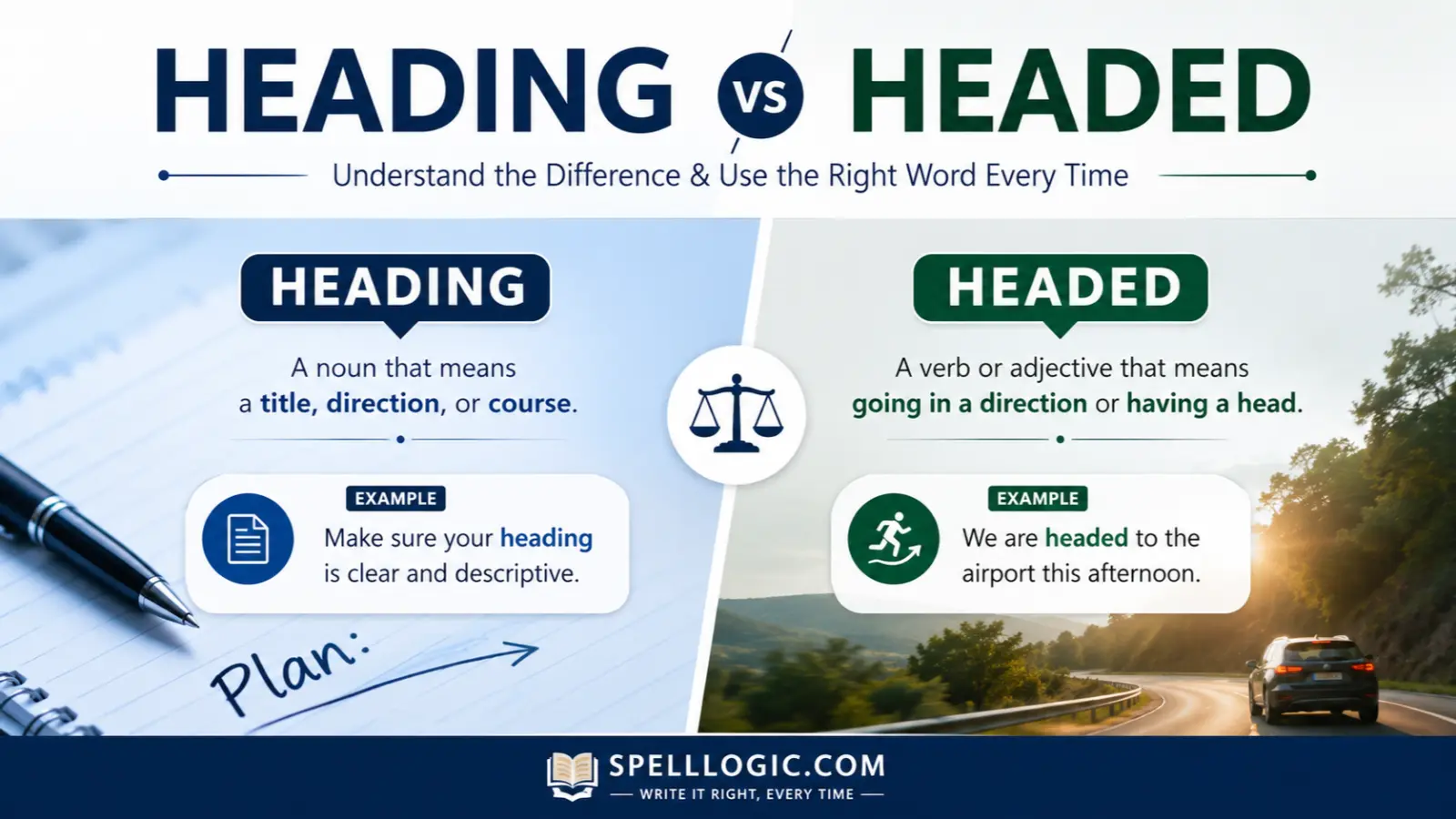
Many English learners get confused by heading and headed because both words come from the verb head and often appear in conversations about movement, direction, or titles. At first glance, they seem interchangeable, but they serve different grammatical purposes and meanings.
Using the wrong one can make your sentence sound unnatural or even incorrect. Fortunately, the difference is easy to understand once you know how each word is used. In this guide, you’ll learn the meanings of heading and headed, discover their key differences, see practical examples, and pick up simple memory tricks to help you use both words correctly in everyday English.
Table of Contents
- Introduction
- Why “Heading” and “Headed” Are Confusing
- Heading vs Headed Explained Simply
- Understanding Homophones in English
- What Does “Heading” Mean?
- What Does “Headed” Mean?
- Heading vs Headed: Key Differences at a Glance
- How to Remember the Difference Between Heading and Headed
- Common Mistakes and Confusions
- Examples Section: Correct and Incorrect Usage
- Self Assessment: Test Your Knowledge
- Self Assessment Answers
- FAQs About “Heading and Headed”
- Final Conclusion: Using “Heading” and “Headed” Correctly
Why “Heading” and “Headed” Are Confusing
English learners often mix up heading and headed because they share the same root word and are commonly used in similar situations.
Here are the main reasons for the confusion:
- Similar pronunciation: Both words sound alike, especially in fast speech.
- Similar spelling: They differ by only a few letters.
- Context confusion: Both can describe movement or direction.
- Common learner mistakes: Many learners think the words are interchangeable because they relate to the verb head.
For example:
- We are heading home.
- We are headed home.
Both sentences are correct, but they use different grammatical forms.
Heading vs Headed Explained Simply
Heading is the present participle or gerund of the verb head, while headed is the past participle or an adjective describing direction.
One-line distinction:
Heading means moving toward a place or serving as a title, while headed describes someone or something that is directed toward a destination.
Examples
- We are heading to the airport now.
- The report has a clear heading at the top.
- They are headed for the mountains.
- The train is headed north.
Understanding Homophones in English
What Are Homophones?
Homophones are words that sound the same but have different meanings and sometimes different spellings.
Example:
- Sea
- See
Although heading and headed are not true homophones, learners often confuse them because they sound very similar and share the same root.
Why Homophones Cause Confusion
Words with similar sounds can easily be mistaken during speaking or listening.
For example:
- Their
- There
These words sound identical but have different meanings. Similarly, heading and headed can be confused because they often appear in similar contexts involving movement.
What Does “Heading” Mean?
Definition and Core Meaning
Heading has two common meanings:
- The act of moving toward a place.
- A title placed at the top of a section, page, or document.
Origin and Historical Use
The word heading comes from the Old English word head, meaning the top or front of something. Over time, it developed into forms that describe direction and document organization.
Modern Usage and Synonyms
When referring to movement:
- Going
- Traveling
- Moving toward
- Proceeding
When referring to titles:
- Title
- Caption
- Section title
- Label
Example Sentences
- We are heading to school.
- She is heading home after work.
- Please read the heading before the paragraph.
- The article uses clear headings to organize information.
What Does “Headed” Mean?
Definition and Core Meaning
Headed usually means going toward a destination or having a particular direction. It can also describe someone’s characteristics when combined with another word, such as level-headed.
Origin and Historical Context
Headed developed as the past participle of head. It later became widely used as an adjective to describe direction or destination.
Modern Usage and Synonyms
- Bound
- Directed
- Going toward
- On the way to
Example Sentences
- We are headed for London.
- The storm is headed east.
- She is headed in the right direction.
- They are headed home after dinner.
Heading vs Headed: Key Differences at a Glance
| Word | Part of Speech | Meaning | Example Context |
|---|---|---|---|
| Heading | Present participle, gerund, noun | Moving toward somewhere or a document title | We are heading to the park. |
| Headed | Past participle, adjective | Directed toward a destination | They are headed south. |
How to Remember the Difference Between Heading and Headed
Here are some easy memory tricks:
- Heading = Going now.
- Headed = Already directed or bound for somewhere.
- Think of -ing as showing an action in progress.
- Think of -ed as describing a state or direction.
Association Technique
- Heading → “I’m currently moving.”
- Headed → “I’m bound for a place.”
Memorable Example
- We are heading to the beach right now.
- We are headed to the beach for the weekend.
Both are correct, but heading emphasizes the ongoing action, while headed emphasizes the destination.
Common Mistakes and Confusions
Wrong
❌ We are headed a new chapter in the book.
Correct
✔ We are reading the heading of the new chapter.
Explanation: A chapter title is a heading, not headed.
Wrong
❌ The bus is heading for New York.
Correct
✔ The bus is headed for New York.
Explanation: Although heading can be used here, headed for is the more common expression describing direction.
Wrong
❌ Please read the headed before the article.
Correct
✔ Please read the heading before the article.
Wrong
❌ She wrote a beautiful headed.
Correct
✔ She wrote a beautiful heading.
Examples Section: Correct and Incorrect Usage
Example 1
✔ Correct: We are heading to the museum.
✘ Incorrect: We are headed to the museum now. (This sentence is actually grammatically correct, but if emphasizing the ongoing action, “heading” is more natural.)
Example 2
✔ Correct: The airplane is headed west.
✘ Incorrect: The airplane has a west heading. (Only correct in specific aviation contexts.)
Example 3
✔ Correct: The document has a clear heading.
✘ Incorrect: The document has a clear headed.
Example 4
✔ Correct: They are headed home after work.
✘ Incorrect: They are heading home yesterday.
Self Assessment: Test Your Knowledge
Fill in the blanks with heading or headed.
- We are ________ to the airport.
- The report needs a clear ________.
- The ship is ________ toward the island.
- Read the main ________ before the first paragraph.
Self Assessment Answers
- heading
- heading
- headed
- heading
FAQs
1. Is heading the same as headed?
No. Heading usually refers to an action in progress or a document title, while headed describes direction or destination.
2. Can I say “I’m heading home”?
Yes. It is one of the most common and natural expressions in English.
3. Can I say “I’m headed home”?
Yes. It is also correct and commonly used, especially in American English.
4. Is heading a noun?
Yes. It is a noun when it refers to the title of a section or document.
5. Is headed an adjective?
Yes. It often functions as an adjective describing direction, such as headed north.
6. Which is more common: “heading to” or “headed to”?
Both are common. Heading to emphasizes the ongoing action, while headed to emphasizes the destination or direction.
7. Can headed be used in compound adjectives?
Yes. Examples include level-headed, strong-headed, and clear-headed.
Final Conclusion: Using “Heading” and “Headed” Correctly
Understanding the difference between heading and headed is an important step toward speaking and writing English more naturally. Although these words come from the same root verb, they are used in different ways. Heading usually describes an action that is happening now, such as moving toward a place, and it also refers to the title of a section in a document. Headed, on the other hand, commonly describes direction or destination and often works as an adjective or past participle. Recognizing this distinction will help you choose the right word with confidence.
A simple way to remember the difference is to connect heading with ongoing movement and headed with being bound for a destination. If you’re talking about a document title, always use heading. If you’re describing where someone or something is going, headed is often the better choice, although heading also works when emphasizing the action of traveling.
The best way to master these words is through regular practice. Read English articles, listen to native speakers, and write your own sentences using both heading and headed. Over time, the difference will become natural, and you’ll be able to use each word accurately in conversations, emails, school assignments, and professional writing. Every small grammar improvement strengthens your overall English skills, so keep practicing and enjoy the learning process.