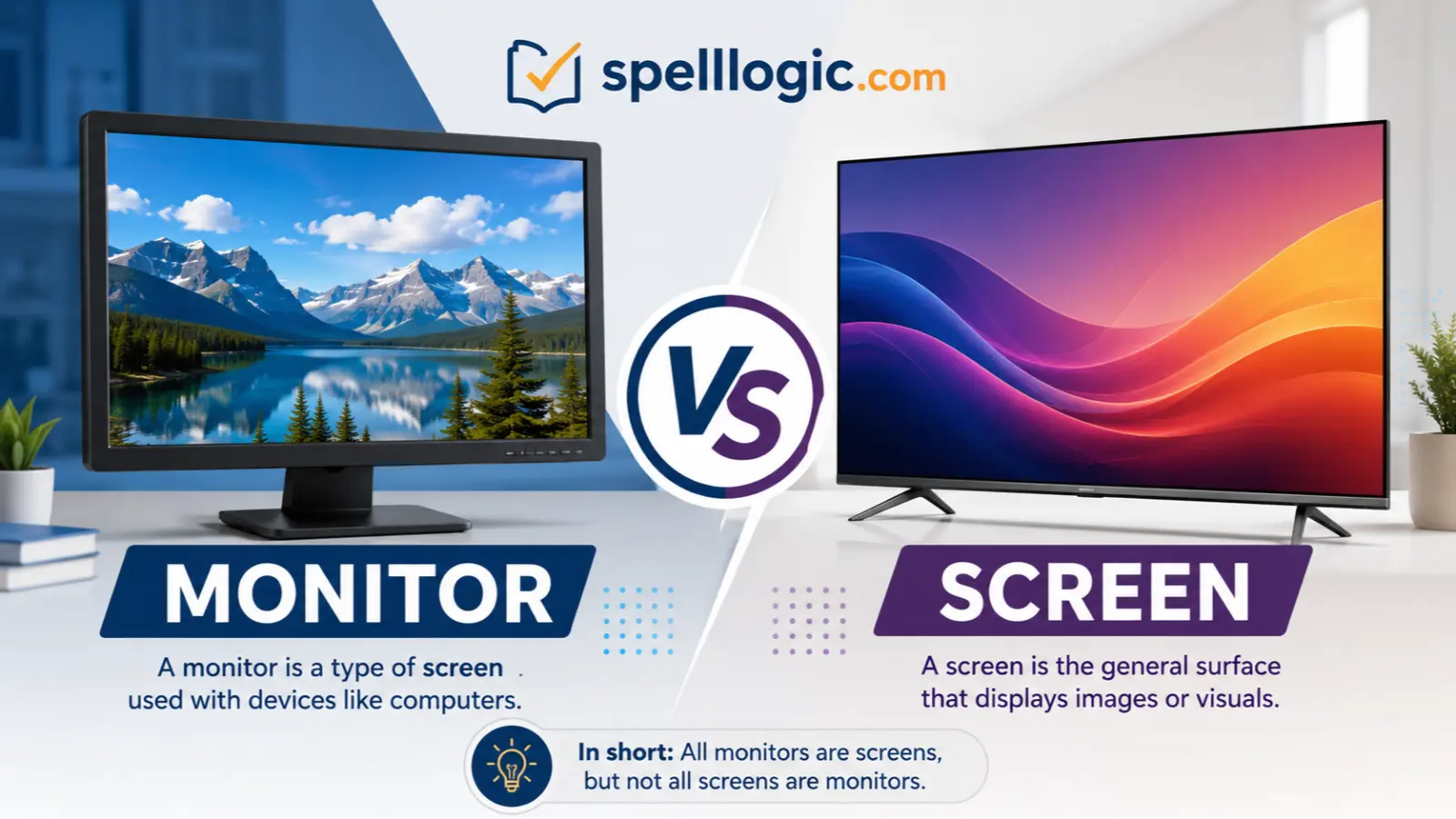
Many English learners use monitor and screen as if they mean exactly the same thing. While these words are closely related, they are not always interchangeable. In everyday conversations, people often say, “Look at the screen,” even when talking about a computer monitor. On the other hand, someone buying computer equipment may ask for a “new monitor” instead of a “new screen.
“Understanding the difference helps you choose the right word in different situations, whether you’re talking about computers, TVs, smartphones, or other electronic devices. This guide explains the meanings of monitor and screen in simple English with plenty of examples.
Table of Contents
- Introduction
- Why “Monitor” and “Screen” Are Confusing
- Monitor vs Screen Explained Simply
- Understanding Homophones in English
- What Are Homophones?
- Why Homophones Cause Confusion
- What Does “Monitor” Mean?
- What Does “Screen” Mean?
- Monitor vs Screen: Key Differences at a Glance
- How to Remember the Difference Between Monitor and Screen
- Common Mistakes and Confusions
- Examples Section: Correct and Incorrect Usage
- Self Assessment: Test Your Knowledge
- Self Assessment Answers
- FAQs About “Monitor” and “Screen”
- Final Conclusion: Using “Monitor” and “Screen” Correctly
Why “Monitor” and “Screen” Are Confusing
Many people confuse monitor and screen because they often refer to the same device in everyday conversations. However, they have different meanings.
Similar Pronunciation
Both words are easy to pronounce and are commonly heard when talking about computers and technology. Since they appear in similar conversations, learners often think they are identical.
Similar Spelling
The words do not have similar spelling. However, because they frequently appear together in technology-related writing, people may assume they have the same meaning.
Context Confusion
The confusion happens because:
- A computer monitor has a screen.
- People often call the whole monitor a “screen.”
- A screen can also refer to the display on a phone, tablet, TV, or even a movie theater.
Common Learner Mistakes
Some common mistakes include:
- Calling every display device a monitor.
- Referring to a smartphone display as a monitor.
- Using screen when talking about the entire computer display unit in technical writing.
Monitor vs Screen Explained Simply
A monitor is the complete display device connected to a computer, while a screen is the surface that displays images, videos, or text.
One-line distinction:
A monitor is the whole device, while a screen is the part you look at.
Examples
- The monitor on my desk has a 27-inch display.
- I accidentally scratched my laptop screen.
Another pair of examples:
- She bought a new computer monitor for work.
- The phone screen cracked after it fell.
Understanding Homophones in English
Although monitor and screen are not homophones, understanding homophones helps learners avoid confusing English words.
What Are Homophones?
Homophones are words that sound the same but have different meanings and spellings.
Example:
- Sea and see
Why Homophones Cause Confusion
English contains many words that sound alike. Learners may hear one word but write another.
For example:
- “I can see the ocean.”
- “The sea is calm today.”
Even though monitor and screen are not homophones, they are often confused because they are closely related in meaning.
What Does “Monitor” Mean?
Definition and Core Meaning
A monitor is an electronic display device used with a computer. It includes the screen and the hardware that makes the display work.
In another meaning, monitor can also be a verb that means to observe or check something regularly.
Origin and Historical Use
The word monitor comes from the Latin word monere, meaning to warn or advise. It entered English centuries ago. As technology developed, the word became the standard name for computer display devices.
Modern Usage and Synonyms
Today, monitor commonly refers to:
- A computer display
- A professional display device
- Medical monitoring equipment (in some contexts)
Synonyms
- Display
- Computer display
- Visual display unit (VDU)
- Display monitor
Example Sentences
- I bought a new monitor for graphic design.
- His computer monitor supports 4K resolution.
- The nurse will monitor the patient’s heartbeat.
- We use dual monitors in our office.
What Does “Screen” Mean?
Definition and Core Meaning
A screen is the flat surface where images, text, or videos appear. It is only one part of a device.
A screen can belong to:
- Computers
- Smartphones
- Tablets
- Televisions
- Movie theaters
- Digital kiosks
Origin and Historical Context
The word screen originally referred to something that provided protection or separation, such as a folding room divider. Later, it came to describe the surface used for projecting pictures and eventually digital displays.
Modern Usage and Synonyms
Today, screen is widely used for many kinds of displays.
Synonyms
- Display
- Display panel
- Touchscreen
- Display surface
Example Sentences
- The phone screen is very bright.
- I cleaned my laptop screen with a soft cloth.
- The movie appeared on a giant screen.
- My tablet screen stopped responding.
Monitor vs Screen: Key Differences at a Glance
| Word | Part of Speech | Meaning | Example Context |
|---|---|---|---|
| Monitor | Noun (also verb) | A complete computer display device | I connected a second monitor to my PC. |
| Screen | Noun (also verb in other contexts) | The surface that displays images or information | The laptop screen is cracked. |
How to Remember the Difference Between Monitor and Screen
Here are a few easy tricks.
Easy Memory Tricks
- Monitor = the whole machine you look at.
- Screen = only the display surface.
Association Techniques
Imagine buying a computer.
You purchase a monitor, but you clean its screen.
Memorable Example
The monitor sits on your desk, but the screen shows the picture.
This simple sentence makes the difference easy to remember.
Common Mistakes and Confusions
Wrong
“My phone monitor is broken.”
Correct
“My phone screen is broken.”
Explanation: Phones have screens, not monitors.
Wrong
“The monitor of my television has fingerprints.”
Correct
“The screen of my television has fingerprints.”
Explanation: You’re talking about the display surface.
Wrong
“I need a bigger screen for my desktop computer.”
Correct
“I need a bigger monitor for my desktop computer.”
Explanation: When buying the entire display unit, monitor is more accurate.
Wrong
“I cleaned my monitor with a microfiber cloth.”
Correct
“I cleaned my monitor’s screen with a microfiber cloth.”
Explanation: Usually, you’re cleaning the screen, not the entire monitor.
Examples Section: Correct and Incorrect Usage
Example 1
✔ Correct: I connected two monitors to my desktop computer.
✘ Incorrect: I connected two screens to my desktop computer.
Example 2
✔ Correct: The laptop screen is cracked.
✘ Incorrect: The laptop monitor is cracked.
Example 3
✔ Correct: Please wipe the screen before using the tablet.
✘ Incorrect: Please wipe the monitor before using the tablet.
Example 4
✔ Correct: She purchased a curved monitor for gaming.
✘ Incorrect: She purchased a curved screen for gaming.
Self Assessment: Test Your Knowledge
Fill in the blanks with monitor or screen.
- My computer _______ has a 32-inch display.
- The phone _______ stopped working after it fell.
- Please clean the laptop _______ carefully.
- I added another _______ to improve my workspace.
Self Assessment Answers
- monitor
- screen
- screen
- monitor
FAQs
Is a monitor the same as a screen?
No. A monitor is the complete display device, while a screen is only the part that shows images.
Can I call a monitor a screen?
Yes. In casual conversation, many people do. However, monitor is more precise when referring to the entire computer display.
Does every monitor have a screen?
Yes. Every monitor includes a screen, but not every screen belongs to a monitor.
Why do people use these words interchangeably?
Because the screen is the most visible part of a monitor, many people use screen to refer to the entire device.
Is a TV display called a monitor?
Usually no. It is commonly called a television or TV, although some displays can function as both TVs and monitors.
What is the screen on a phone called?
It is called a phone screen or touchscreen, not a monitor.
Which word should I use in technical writing?
Use monitor when referring to the complete computer display device and screen when referring only to the display surface.
Final Conclusion: Using “Monitor” and “Screen” Correctly
Understanding the difference between monitor and screen is easier once you know what each word refers to. A monitor is the complete electronic display device used with a computer, including its casing, electronics, and display panel. A screen, on the other hand, is the surface that actually shows text, images, videos, and other visual content. Because every monitor has a screen, many people casually use the two words as if they mean the same thing. However, choosing the correct term makes your English clearer and more accurate, especially in technical, educational, and professional settings.
A simple way to remember the difference is this: you buy a monitor, but you look at the screen. Likewise, you might replace a monitor if it stops working, but you clean the screen when it gets dirty. This small distinction can greatly improve your vocabulary and help you communicate more naturally about computers and electronic devices.
As you continue learning English, pay attention to how native speakers use these words in different situations. Reading technology articles, watching tutorials, and practicing with real-life examples will strengthen your understanding. With regular practice, you’ll know exactly when to say monitor and when screen is the better choice. Every new word you master brings you one step closer to confident, accurate English communication.