Many English learners struggle with best and better because both words compare people, things, or ideas. Since they come from the same base word, good, it is easy to wonder which one fits a sentence. However, they are not interchangeable. Choosing the wrong word can make your writing or speech sound unnatural or grammatically incorrect.
The good news is that the difference is simple once you understand how comparison works. In this guide, you’ll learn the meanings of best and better, see practical examples, discover common mistakes, and pick up easy memory tricks that will help you use both words correctly in everyday English.
Table of Contents
- Introduction
- Why “Best” and “Better” Are Confusing
- Best vs Better Explained Simply
- Understanding Homophones in English
- What Are Homophones?
- Why Homophones Cause Confusion
- What Does “Best” Mean?
- What Does “Better” Mean?
- Best vs Better: Key Differences at a Glance
- How to Remember the Difference Between Best and Better
- Common Mistakes and Confusions
- Examples Section: Correct and Incorrect Usage
- Self Assessment: Test Your Knowledge
- Self Assessment Answers
- FAQs About “Best and Better”
- Final Conclusion: Using “Best” and “Better” Correctly
Why “Best” and “Better” Are Confusing
English learners often mix up best and better because both describe quality and both come from the adjective good.
Here are the main reasons for the confusion:
- They have similar pronunciation.
- They come from the same word (good).
- Both compare people, objects, or situations.
- Learners often forget whether they are comparing two things or three or more.
- Both are commonly used in speaking and writing.
For example:
- This phone is better than mine. ✅
- This phone is the best in the store. ✅
Many learners incorrectly say:
- This phone is the best than mine. ❌
The mistake happens because better is used when comparing two, while best is used for three or more or to show the highest quality.
Best vs Better Explained Simply
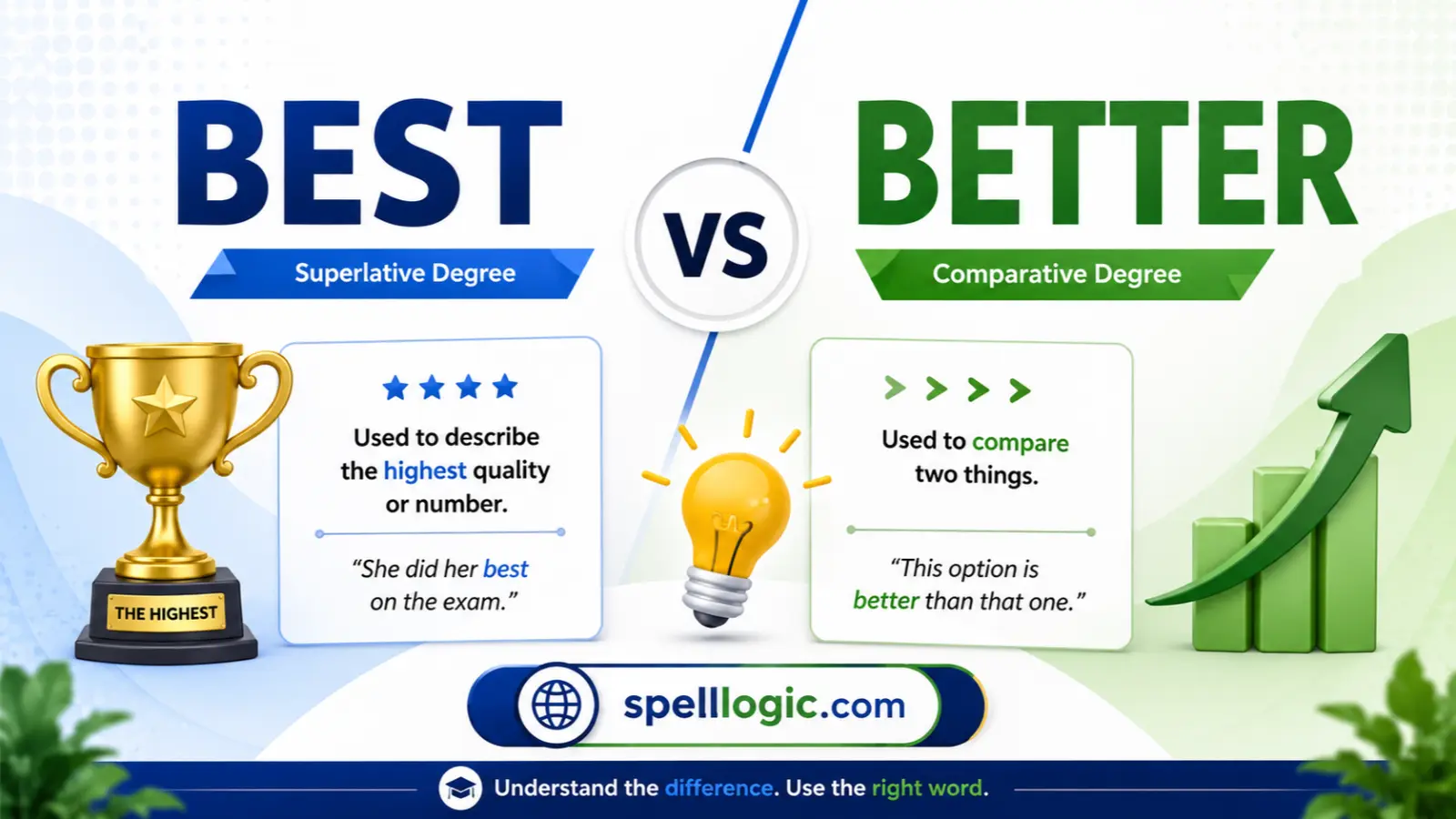
Better means something is of higher quality than another thing, while best means something is the highest quality of all.
One-line distinction
Better compares two things, while best shows the number one among three or more.
Example Sentences
Better
- This book is better than the previous one.
- She feels better today.
Best
- This is the best movie I have ever watched.
- He is the best player on the team.
Understanding Homophones in English
What Are Homophones?
Homophones are words that sound the same but have different meanings and often different spellings.
Example:
- Sea
- See
Although they sound alike, they mean different things.
Why Homophones Cause Confusion
Homophones can confuse learners because pronunciation does not reveal spelling or meaning.
Example:
- I can see the ocean.
- The sea is calm today.
Best and better are not homophones. They sound similar because they belong to the same word family, but they have different grammatical functions.
What Does “Best” Mean?
Definition and Core Meaning
Best is the superlative form of good. It means better than all others.
It describes the highest quality, greatest skill, or strongest performance.
Origin and Historical Use
The word best comes from Old English betst, the superlative form of good. It has been used for centuries to describe the highest level of excellence.
Modern Usage and Synonyms
Today, best appears in everyday conversation, business, education, sports, and writing.
Synonyms
- Finest
- Greatest
- Top
- Leading
- Excellent
- Outstanding
Key Points
- Superlative adjective
- Compares three or more things
- Shows the highest rank
- Can also function as an adverb
Example Sentences
- She is the best singer in the class.
- This restaurant serves the best pizza in town.
- I always try my best.
- Sunday is the best day to relax.
What Does “Better” Mean?
Definition and Core Meaning
Better is the comparative form of good.
It means more good, more suitable, or higher in quality than another person or thing.
Origin and Historical Context
The word comes from Old English betera and has been used for hundreds of years to compare two things.
Modern Usage and Synonyms
Today, better is widely used in conversations, schools, workplaces, and literature.
Synonyms
- Improved
- Superior
- Stronger
- More effective
- More suitable
- Higher quality
Key Points
- Comparative adjective
- Compares two things
- Shows improvement
- Can also function as an adverb
Example Sentences
- This solution is better than the first one.
- I feel better after resting.
- Her writing is getting better every week.
- Walking is better than driving for short distances.
Best vs Better: Key Differences at a Glance
| Word | Part of Speech | Meaning | Example Context |
|---|---|---|---|
| Better | Comparative adjective/adverb | Higher quality than another | This laptop is better than mine. |
| Best | Superlative adjective/adverb | Highest quality of all | This is the best laptop in the store. |
How to Remember the Difference Between Best and Better
Learning this difference is easier with simple memory tricks.
Easy Memory Tricks
- Better = Between Two
- Best = Beats the Rest
Association Techniques
Imagine a race.
- Two runners compete.
- One is better than the other.
Now imagine ten runners.
- The winner is the best.
Memorable Example
- Comparing two cakes:
- Chocolate cake is better than vanilla cake.
- Comparing five cakes:
- Chocolate cake is the best.
Remember:
Better compares. Best wins.
Common Mistakes and Confusions
Wrong
This is the best than my old phone.
Correct
This is better than my old phone.
Explanation: Use better when comparing two things.
Wrong
She is better student in the class.
Correct
She is the best student in the class.
Explanation: She ranks highest among the entire class.
Wrong
This is the better movie I have ever seen.
Correct
This is the best movie I have ever seen.
Explanation: You’re talking about all the movies you’ve watched.
Wrong
Today is the better day of the week.
Correct
Today is the best day of the week.
Explanation: The sentence compares all seven days.
Examples Section: Correct and Incorrect Usage
Example 1
✔ Correct: This chair is better than the old one.
✘ Incorrect: This chair is the best than the old one.
Example 2
✔ Correct: She is the best dancer in the school.
✘ Incorrect: She is the better dancer in the school.
Example 3
✔ Correct: My health is getting better every day.
✘ Incorrect: My health is getting best every day.
Example 4
✔ Correct: This is the best solution for the problem.
✘ Incorrect: This is the better solution of all.
Self Assessment: Test Your Knowledge
Fill in the blanks with best or better.
- This coffee tastes ______ than yesterday’s.
- She is the ______ student in our class.
- Exercise is ______ than sitting all day.
- This was the ______ vacation we have ever had.
Self Assessment Answers
- better
- best
- better
- best
FAQs
1. What is the difference between best and better?
Better compares two things, while best refers to the highest quality among three or more.
2. Is “best” the comparative form of good?
No. Better is the comparative form, while best is the superlative form.
3. Can I say “best than”?
No. The phrase best than is grammatically incorrect. Use better than instead.
4. Is “better” always used with “than”?
Usually, yes, when making a comparison. However, it can also describe improvement, as in I feel better today.
5. Which is correct: “the better” or “the best”?
Use the better when comparing two options. Use the best when referring to the highest among three or more.
6. Can “best” and “better” be adverbs?
Yes. For example:
- She sings better now.
- He performed best in the final round.
7. How can I remember when to use each word?
Think of this simple rule:
- Better = two choices
- Best = all choices
Final Conclusion: Using “Best” and “Better” Correctly
Understanding the difference between best and better is an important step toward speaking and writing English more naturally. Although both words come from the adjective good, they serve different purposes. Better is the comparative form and is used when comparing two people, things, or ideas. It tells us that one option has a higher quality than another. Best, on the other hand, is the superlative form. It describes the highest quality among three or more people, objects, or choices. Remembering this simple comparison rule will help you avoid one of the most common grammar mistakes made by English learners.
A helpful way to keep them straight is to use the memory trick: “Better compares two. Best beats the rest.” Whenever you are deciding which word to use, ask yourself how many things you are comparing. If there are only two, choose better. If you’re talking about the top choice in a larger group, choose best. Reading books, listening to native speakers, and practicing with your own sentences will make these forms feel natural over time. With regular practice, you’ll become more confident using both words correctly in conversations, school assignments, professional writing, and everyday communication. Keep learning, keep practicing, and remember that every small improvement makes your English even better—and one day, it may become your best skill.