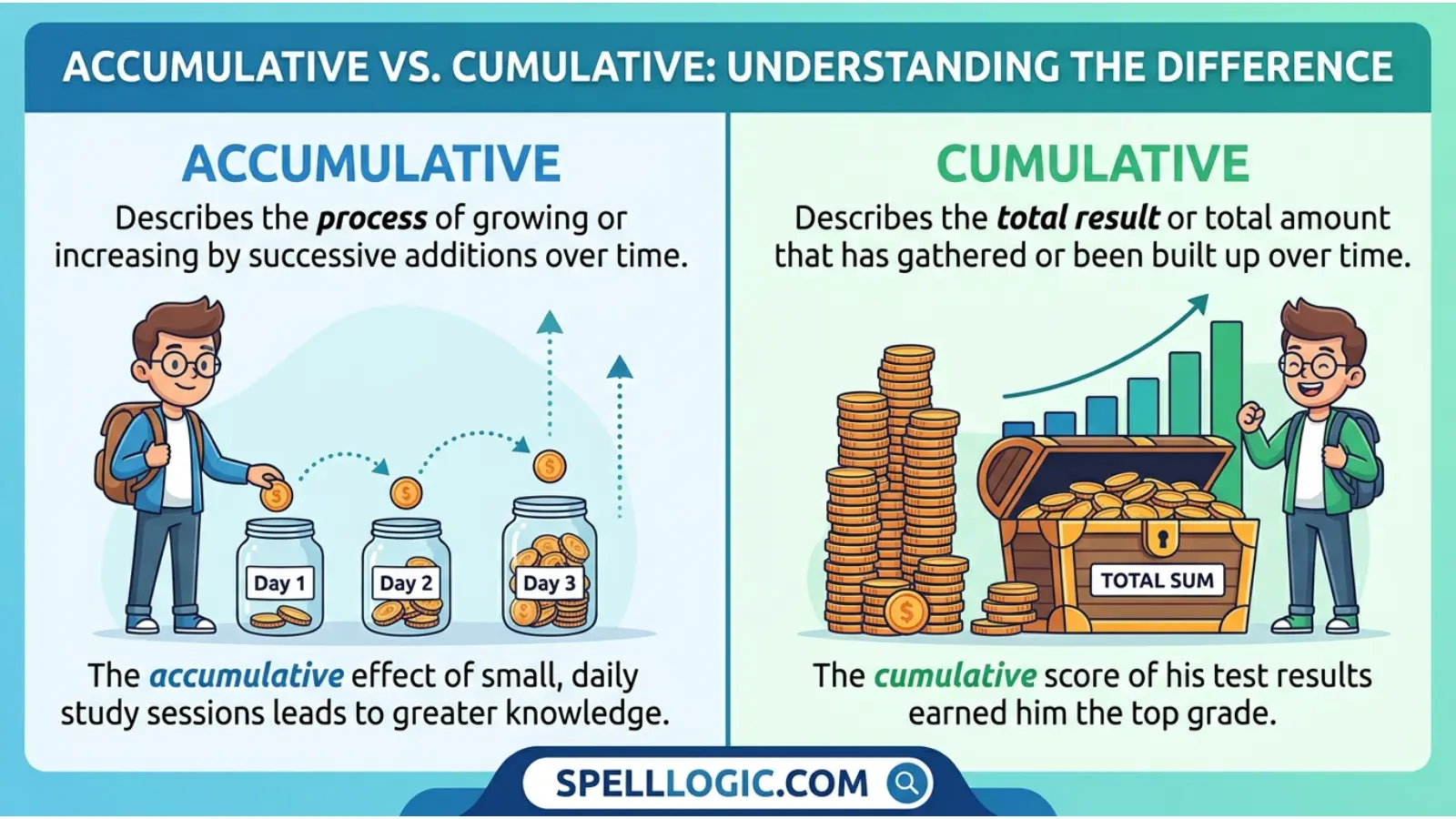
Many English learners struggle with accumulative vs cumulative because both words relate to the idea of increasing over time. They also look and sound very similar, making it easy to assume they mean exactly the same thing. However, these words are not always interchangeable.
While cumulative is widely accepted and commonly used in modern English, accumulative is much less common and often appears in specialized or historical contexts. Understanding the difference will help you choose the correct word in writing, exams, business communication, and everyday conversations. This guide explains both words in simple language with examples and practical tips.
Table of Contents
- Introduction
- Why “Accumulative” and “Cumulative” Are Confusing
- Accumulative vs Cumulative Explained Simply
- Understanding Homophones in English
- What Does “Accumulative” Mean?
- What Does “Cumulative” Mean?
- Accumulative vs Cumulative: Key Differences at a Glance
- How to Remember the Difference Between Accumulative and Cumulative
- Common Mistakes and Confusions
- Examples Section: Correct and Incorrect Usage
- Self Assessment: Test Your Knowledge
- Self Assessment Answers
- FAQs About “Accumulative” and “Cumulative”
- Final Conclusion: Using “Accumulative” and “Cumulative” Correctly
Why “Accumulative” and “Cumulative” Are Confusing
Many people confuse accumulative and cumulative because they both describe something that grows over time.
Similar Pronunciation
The two words sound almost alike when spoken. The only noticeable difference is the extra syllable in accumulative, which many speakers barely emphasize.
Similar Spelling
Both words share the root related to gathering or increasing. Their similar spelling makes them easy to mix up while reading or writing.
Context Confusion
Both words are used when discussing growth, totals, progress, or collected amounts. However, cumulative is the preferred choice in modern English, while accumulative is relatively uncommon.
Common Learner Mistakes
- Assuming both words are equally common.
- Using accumulative in formal writing when cumulative is expected.
- Thinking accumulative is the only adjective formed from accumulate.
- Replacing cumulative with accumulative in academic or business documents.
Accumulative vs Cumulative Explained Simply
The simplest way to understand these words is this:
Accumulative describes something that has the ability to accumulate or continues to accumulate.
Cumulative describes something that increases by adding together previous amounts or effects.
One-Line Distinction
Accumulative means capable of accumulating, while cumulative means increasing through successive additions.
Example Sentences
- The report described the accumulative effects of pollution over many decades.
- The student’s cumulative GPA improved after another successful semester.
Another way to remember it is:
Accumulative means something accumulates, while cumulative means the total grows over time.
Understanding Homophones in English
What Are Homophones?
Homophones are words that sound the same or nearly the same but have different meanings and often different spellings.
Example:
- Flour
- Flower
Although they sound alike, they refer to completely different things.
Note: Accumulative and cumulative are not true homophones. They are simply very similar in pronunciation and spelling, which often causes confusion.
Why Homophones Cause Confusion
English learners often rely on pronunciation. When two words sound almost identical, it’s easy to select the wrong spelling.
For example:
- Their house
- There is a house.
These words sound alike but have different meanings.
Similarly, many learners mistakenly choose accumulative when cumulative is the standard word.
What Does “Accumulative” Mean?
Definition and Core Meaning
Accumulative is an adjective that means tending to accumulate or capable of increasing through accumulation.
Although it is a correct English word, it is much less common than cumulative.
Origin and Historical Use
The word developed from the verb accumulate, which comes from the Latin word accumulare, meaning “to heap up.”
Historically, accumulative appeared more frequently in older writings and technical discussions. Today, it is considered uncommon in everyday English.
Modern Usage and Synonyms
Modern writers usually prefer cumulative instead.
Synonyms
- Increasing
- Growing
- Building
- Gathering
- Collecting
Key Points
- Less common in modern English
- Often replaced by cumulative
- Found mainly in technical or historical writing
- Refers to something that continues accumulating
Example Sentences
- Scientists studied the accumulative impact of chemical exposure.
- The policy had an accumulative effect over many years.
- Dust created an accumulative layer on unused furniture.
What Does “Cumulative” Mean?
Definition and Core Meaning
Cumulative means increasing by successive additions so that each new amount is added to previous ones.
This is the standard and preferred adjective in modern English.
Origin and Historical Context
Like accumulative, cumulative comes from the Latin root related to gathering or heaping up.
Over time, cumulative became the dominant form in education, science, business, law, medicine, and everyday communication.
Modern Usage and Synonyms
You’ll frequently hear or read cumulative in these expressions:
- Cumulative score
- Cumulative effect
- Cumulative total
- Cumulative GPA
- Cumulative damage
- Cumulative experience
Synonyms
- Total
- Combined
- Overall
- Progressive
- Increasing
Key Points
- Common in modern English
- Accepted worldwide
- Used in formal and informal writing
- Preferred by style guides and dictionaries
Example Sentences
- Her cumulative score earned first place.
- Years of practice produced cumulative improvements.
- The cumulative cost exceeded the original budget.
Accumulative vs Cumulative: Key Differences at a Glance
| Word | Part of Speech | Meaning | Example Context |
|---|---|---|---|
| Accumulative | Adjective | Able to accumulate; increasing gradually | Accumulative effects of pollution |
| Cumulative | Adjective | Growing through successive additions | Cumulative GPA, cumulative total |
How to Remember the Difference Between Accumulative and Cumulative
Here are some simple tricks to remember which word to use.
Easy Memory Tricks
- Cumulative is the common everyday word.
- If you’re talking about totals, grades, scores, costs, or effects, choose cumulative.
- Think of cumulative total—a phrase you’ll see everywhere.
Association Techniques
Associate cumulative with calculator totals.
Every number adds to the previous one.
That is exactly what cumulative means.
Think of accumulative as a rare cousin of cumulative.
One Memorable Example
Imagine saving money every week.
Your savings become cumulative because every week’s amount is added to the previous total.
Common Mistakes and Confusions
Wrong
The cumulative pollution slowly accumulated over time.
Better
The cumulative effects of pollution increased over time.
Explanation: Here, cumulative is the accepted adjective.
Wrong
My accumulative GPA is 3.8.
Correct
My cumulative GPA is 3.8.
Explanation: Universities almost always use cumulative GPA.
Wrong
The accumulative score determined the winner.
Correct
The cumulative score determined the winner.
Explanation: Cumulative score is the standard expression.
Wrong
The company calculated the accumulative cost.
Correct
The company calculated the cumulative cost.
Explanation: Business English strongly prefers cumulative cost.
Examples Section: Correct and Incorrect Usage
Example 1
✔ Correct: The cumulative rainfall caused flooding.
✘ Incorrect: The accumulative rainfall caused flooding.
Example 2
✔ Correct: Her cumulative GPA qualified her for the scholarship.
✘ Incorrect: Her accumulative GPA qualified her for the scholarship.
Example 3
✔ Correct: Researchers examined the accumulative effects of repeated exposure.
✘ Incorrect: Researchers examined the cumulatively effects of repeated exposure.
Example 4
✔ Correct: The cumulative total reached one million dollars.
✘ Incorrect: The accumulative total reached one million dollars.
Example 5
✔ Correct: Small daily improvements create cumulative success.
✘ Incorrect: Small daily improvements create accumulative success.
Self Assessment: Test Your Knowledge
Fill in the blanks with accumulative or cumulative.
- Her __________ GPA improved every semester.
- Scientists studied the __________ effects of repeated exposure.
- The __________ total exceeded expectations.
- Small efforts produce __________ progress over time.
Self Assessment Answers
- Cumulative
- Accumulative (or cumulative, depending on the context; cumulative is more common in modern English.)
- Cumulative
- Cumulative
FAQs
Is accumulative a real English word?
Yes. It is a legitimate English adjective, although it is much less common than cumulative.
Which word is more common?
Cumulative is far more common in modern English.
Should I write cumulative GPA or accumulative GPA?
Always use cumulative GPA.
Can accumulative and cumulative mean the same thing?
In many contexts, yes. However, cumulative is generally preferred because it is more natural and widely accepted.
Which word should I use in academic writing?
Use cumulative unless a specific technical source requires accumulative.
Is accumulative old-fashioned?
It can sound somewhat dated because modern English strongly favors cumulative.
Are accumulative and cumulative interchangeable?
Sometimes, but replacing cumulative with accumulative may sound unusual to native speakers.
Final Conclusion: Using “Accumulative” and “Cumulative” Correctly
Choosing between accumulative and cumulative becomes much easier once you understand how each word is used. Both describe growth through addition, but they differ in frequency and style. Accumulative is a valid English word that refers to something capable of accumulating or increasing gradually. However, it appears relatively rarely in modern writing and is most often found in specialized, technical, or older texts. In contrast, cumulative is the standard adjective used in everyday English, academic writing, business reports, education, science, and many other fields. You will regularly encounter phrases such as cumulative GPA, cumulative effect, cumulative score, and cumulative total, making it the safer and more natural choice in most situations.
A simple memory trick is to remember that whenever you’re talking about a running total, combined results, or effects that build over time, cumulative is almost always the correct word. Think of adding one block on top of another until they form a larger whole—that is exactly how something becomes cumulative. While accumulative is not incorrect, using it where cumulative is expected may sound unusual to many native English speakers. By practicing the examples, reviewing the comparison table, and testing yourself regularly, you’ll gain confidence in choosing the right word. Keep learning, pay attention to real-world usage, and you’ll continue improving your English vocabulary one word at a time.