Many English learners wonder whether they should use inspiring or inspirational when describing a person, story, speech, or event. At first glance, these two words seem almost identical because they share the same root word, inspire, and are often used in similar situations.
If, they are not always interchangeable in every sentence or writing style. Understanding the subtle difference between inspiring and inspirational will help you speak and write more naturally and confidently. In this guide, you’ll learn the meanings, uses, examples, and simple memory tricks that make choosing the correct word much easier.
Table of Contents
- Introduction
- Why “Inspiring” and “Inspirational” Are Confusing
- Inspiring vs Inspirational Explained Simply
- Understanding Homophones in English
- What Are Homophones?
- Why Homophones Cause Confusion
- What Does “Inspiring” Mean?
- What Does “Inspirational” Mean?
- Inspiring vs Inspirational: Key Differences at a Glance
- How to Remember the Difference Between Inspiring and Inspirational
- Common Mistakes and Confusions
- Examples Section: Correct and Incorrect Usage
- Self Assessment: Test Your Knowledge
- Self Assessment Answers
- FAQs About “Inspiring” and “Inspirational”
- Final Conclusion: Using “Inspiring” and “Inspirational” Correctly
Why “Inspiring” and “Inspirational” Are Confusing
Many learners use inspiring and inspirational as if they mean exactly the same thing. While they are closely related, there are small differences in tone and usage that can affect how natural your English sounds.
Here are the main reasons people confuse these words.
Similar Pronunciation
Both words begin with inspir- and sound very similar when spoken. The extra syllables in inspirational are easy to overlook during conversations.
Similar Spelling
The two words share the same root, inspire, making them look almost identical. The only noticeable difference is the ending:
- Inspiring
- Inspirational
Because of this, many learners assume they have exactly the same meaning.
Context Confusion
Both words describe something that motivates or encourages people. For example:
- an inspiring teacher
- an inspirational teacher
Both sound correct, but one may sound more natural depending on the context and writing style.
Common Learner Mistakes
Some common mistakes include:
- Thinking one word is always more correct than the other.
- Using inspirational when inspiring sounds smoother.
- Believing the two words have completely different meanings.
The good news is that both words are correct. The key is knowing when each one sounds more natural.
Inspiring vs Inspirational Explained Simply
The easiest way to understand these words is to focus on how they describe something that creates inspiration.
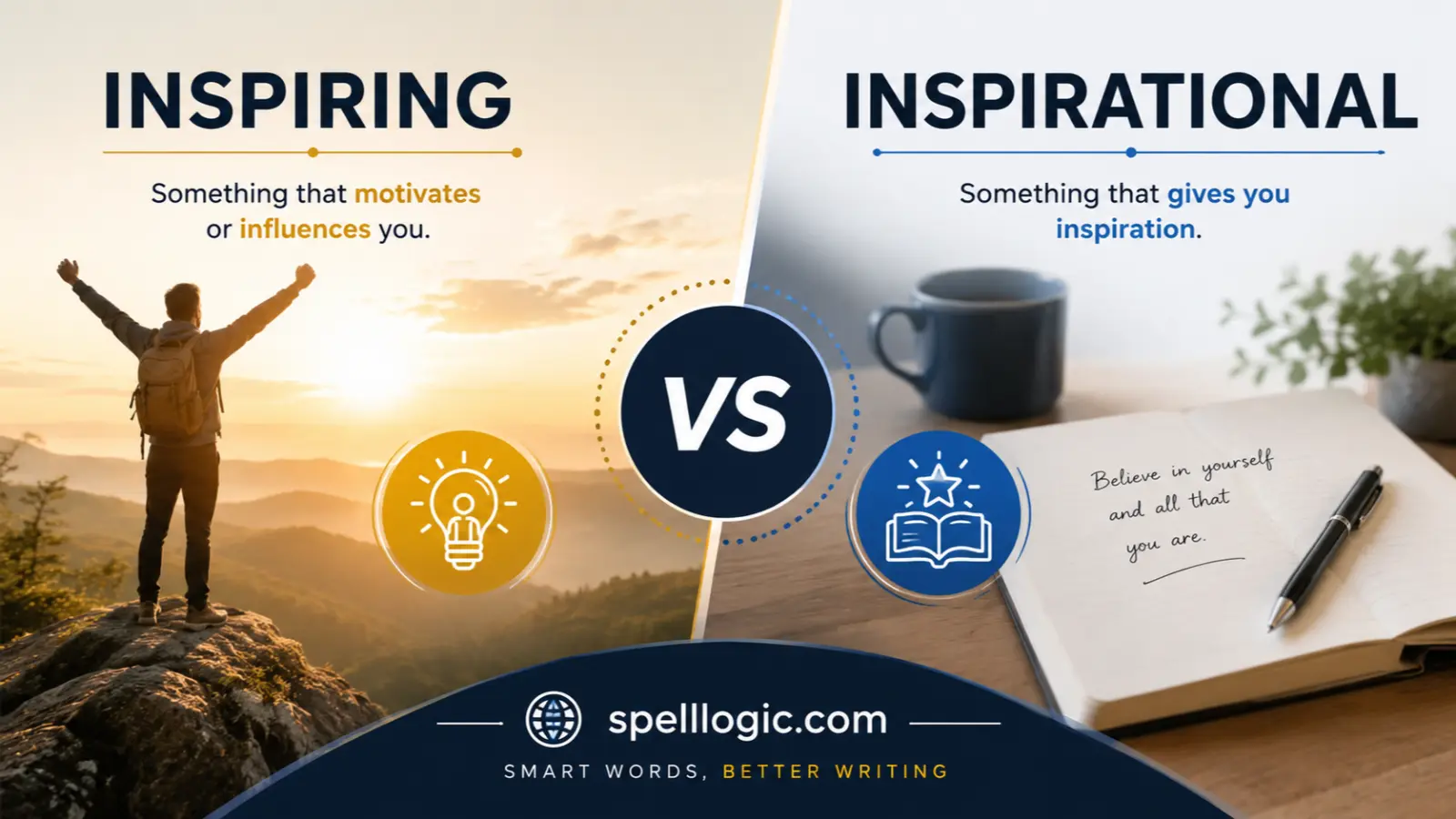
Inspiring means something actively gives people motivation, admiration, or encouragement.
Inspirational means something is full of inspiration or has the quality of inspiring people.
One-Line Distinction
Inspiring describes something that inspires people directly, while inspirational emphasizes that something is characterized by inspiration.
Although there is a slight difference in nuance, modern English speakers often use them interchangeably.
Examples
Inspiring means…, while Inspirational means…
- Inspiring means causing someone to feel motivated or encouraged, while inspirational means having the quality of inspiring others.
Examples:
- Her speech was inspiring and gave everyone hope.
- She shared an inspirational message with the students.
Another pair:
- His life story is truly inspiring.
- He wrote an inspirational book about overcoming challenges.
Understanding Homophones in English
Before going further, it’s useful to understand a common source of confusion in English.
What Are Homophones?
Homophones are words that sound the same but have different meanings and spellings.
For example:
- their
- there
Although they sound alike, they have different meanings and uses.
Why Homophones Cause Confusion
English learners often rely on pronunciation when learning vocabulary. When words sound alike—or nearly alike—they can easily be mixed up.
For example:
- your
- you’re
Many learners accidentally use one instead of the other because they sound the same in everyday speech.
It’s important to note that inspiring and inspirational are not true homophones. They simply sound similar and share the same root word, which is why learners often confuse them.
What Does “Inspiring” Mean?
Definition and Core Meaning
Inspiring is an adjective that describes someone or something that fills others with motivation, hope, confidence, admiration, or enthusiasm.
When something is inspiring, it creates a positive emotional response and encourages people to take action or believe in themselves.
Core idea
Something that inspires people right now.
Origin and Historical Use
The word inspiring comes from the verb inspire, which entered English from Latin through French.
Originally, inspire meant to breathe into or to fill someone with a feeling or idea.
Over time, English speakers began using inspiring to describe people, speeches, achievements, books, and experiences that motivate others.
Modern Usage and Synonyms
Today, inspiring is extremely common in both spoken and written English.
It often describes:
- people
- speeches
- teachers
- leaders
- athletes
- books
- films
- achievements
- acts of kindness
Synonyms
- motivating
- encouraging
- uplifting
- moving
- influential
- heartening
- empowering
- stirring
Example Sentences
- Her determination was truly inspiring.
- The documentary tells an inspiring story of courage.
- Our coach gave an inspiring speech before the final match.
- Watching volunteers help others is inspiring.
What Does “Inspirational” Mean?
Definition and Core Meaning
Inspirational is an adjective that means providing inspiration or containing qualities that encourage people to improve, achieve goals, or stay positive.
It focuses more on the overall quality or nature of something rather than the immediate effect.
Origin and Historical Context
The word inspirational developed from the noun inspiration by adding the suffix -al, meaning “related to.”
As English evolved, it became a common adjective for describing messages, books, quotes, music, seminars, and speeches designed to inspire others.
Modern Usage and Synonyms
Today, inspirational is especially common when describing content intended to motivate people.
You’ll often hear it with:
- books
- podcasts
- videos
- quotes
- seminars
- conferences
- speeches
- social media posts
Synonyms
- motivational
- encouraging
- uplifting
- empowering
- positive
- influential
- heartening
Example Sentences
- She gave an inspirational presentation.
- The movie delivers an inspirational message.
- I enjoy reading inspirational biographies.
- His podcast features inspirational interviews with successful people.
Inspiring vs Inspirational: Key Differences at a Glance
| Word | Part of Speech | Meaning | Example Context |
|---|---|---|---|
| Inspiring | Adjective | Actively causing someone to feel inspired | The teacher gave an inspiring lesson. |
| Inspirational | Adjective | Having the quality of inspiring people | She enjoys inspirational books. |
Quick Summary
| Inspiring | Inspirational |
|---|---|
| Often emphasizes the effect on people | Often emphasizes the overall quality |
| Very common in everyday conversation | Common in books, speeches, media, and formal writing |
| Sounds slightly more direct | Sounds slightly more descriptive |
How to Remember the Difference Between Inspiring and Inspirational
Fortunately, remembering these words is easier than it seems.
Easy Memory Tricks
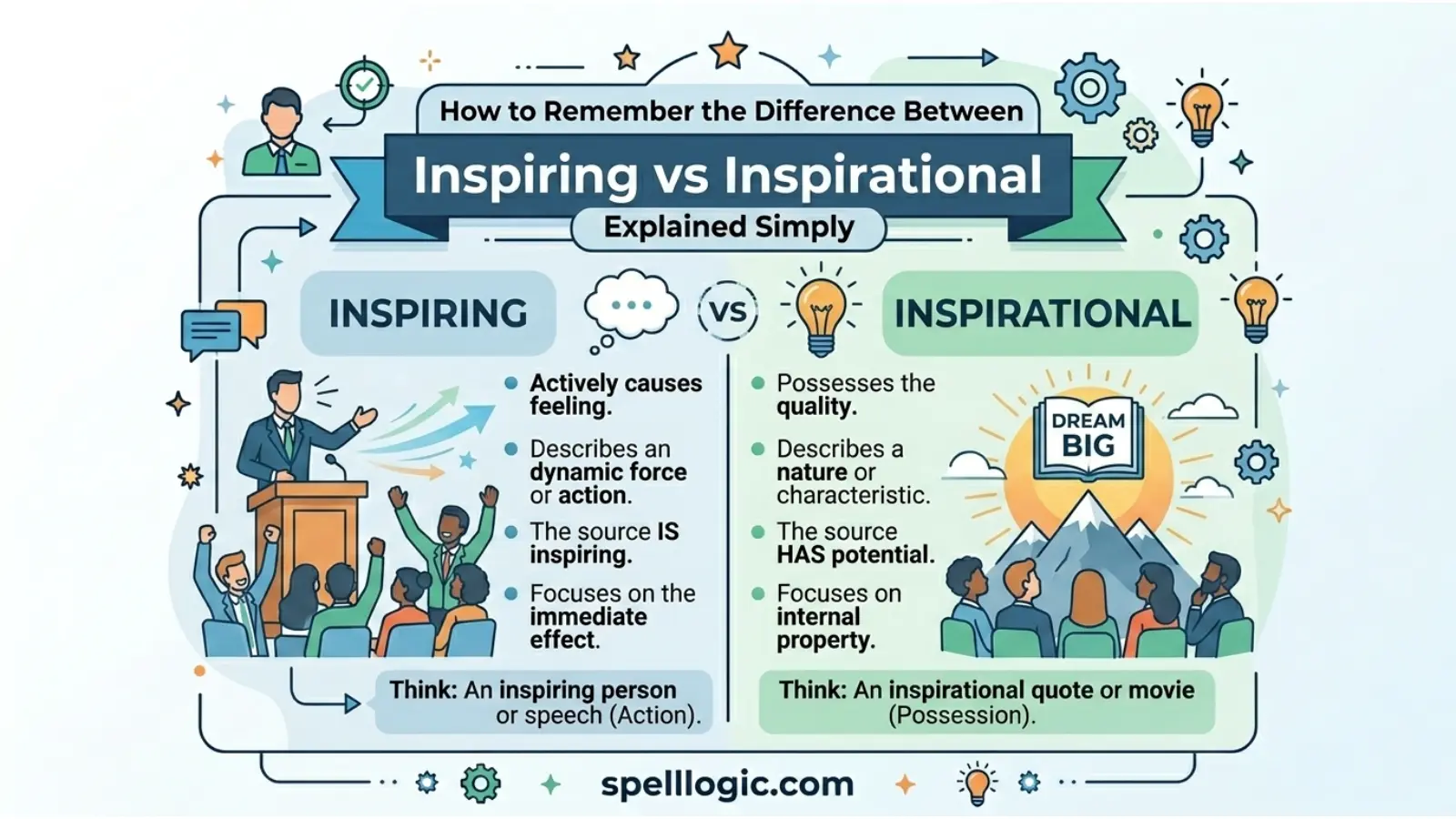
Think of inspiring as something that is actively inspiring you at the moment.
Think of inspirational as describing something that belongs to the category of inspiring things.
Association Technique
Imagine attending a speech.
- While listening, you think:
- “This speech is inspiring.”
Later, when recommending it, you might say:
- “It was an inspirational speech.”
Both are correct, but each highlights the idea slightly differently.
One Memorable Example
Imagine climbing a mountain.
The beautiful sunrise feels inspiring because it immediately fills you with hope.
Later, you describe the experience as an inspirational journey because the entire experience represents inspiration.
This simple picture can help you remember which word feels more natural in different situations.
Common Mistakes and Confusions
Although inspiring and inspirational have very similar meanings, learners sometimes use them in unnatural ways. The good news is that most mistakes are easy to fix once you understand the slight difference in emphasis.
Here are some common errors.
Mistake 1
❌ She is an inspirationally teacher.
✔ She is an inspiring teacher.
Explanation: The adjective inspiring naturally describes a person who motivates others. Inspirationally is an adverb and does not fit here.
Mistake 2
❌ His story inspired.
✔ His story is inspiring.
Explanation: The sentence needs an adjective after is to describe the story.
Mistake 3
❌ That was a very inspire speech.
✔ That was a very inspiring speech.
Explanation: The adjective form is inspiring, not inspire.
Mistake 4
❌ This quote is full of inspire.
✔ This quote is inspirational.
or
✔ This quote is inspiring.
Explanation: Use an adjective to describe the quote.
Examples Section: Correct and Incorrect Usage
Below are examples that show the correct and incorrect use of these words.
Example 1
✔ Correct: The coach gave an inspiring speech before the championship.
✘ Incorrect: The coach gave an inspire speech before the championship.
Example 2
✔ Correct: I enjoy reading inspirational books about successful entrepreneurs.
✘ Incorrect: I enjoy reading inspiration books about successful entrepreneurs.
Example 3
✔ Correct: Her kindness is inspiring.
✘ Incorrect: Her kindness is inspirationally.
Example 4
✔ Correct: The documentary tells an inspirational story of hope.
✔ Correct: The documentary is inspiring from beginning to end.
Explanation: Both are correct because each adjective highlights a slightly different aspect of the documentary.
Example 5
✔ Correct: His determination is inspiring to everyone around him.
✘ Incorrect: His determination is inspire to everyone around him.
Example 6
✔ Correct: We watched an inspirational film last night.
✔ Correct: The film was inspiring and unforgettable.
Self Assessment: Test Your Knowledge
Choose the correct word to complete each sentence.
1.
The teacher gave an __________ speech that motivated every student.
a) inspiring
b) inspirational
2.
Her life story is truly __________.
a) inspiring
b) inspiration
3.
I like reading __________ biographies before starting a new project.
a) inspirational
b) inspire
4.
The volunteer work was so __________ that many people decided to join.
a) inspiring
b) inspiration
Self Assessment Answers
- a) inspiring (Although “inspirational” can also work, “inspiring” is the more natural choice when emphasizing the speech’s immediate effect.)
- a) inspiring
- a) inspirational
- a) inspiring
FAQs
Is there a difference between inspiring and inspirational?
Yes. Inspiring usually emphasizes the immediate effect of motivating someone, while inspirational highlights the overall quality of providing inspiration. In everyday English, they are often interchangeable.
Which word is more common in everyday conversation?
Inspiring is slightly more common in casual conversation because it sounds more direct and natural.
Can I use inspiring and inspirational interchangeably?
In many situations, yes. For example:
- an inspiring speech
- an inspirational speech
Both are grammatically correct and widely accepted.
Is “inspirational” more formal?
Generally, yes. Inspirational often appears in books, articles, presentations, advertisements, and motivational content, giving it a slightly more formal tone.
Which word should I use for a person?
Both are correct.
Examples:
- She is an inspiring leader.
- She is an inspirational leader.
However, inspiring is often the more natural choice when talking about someone’s direct influence.
Are inspiring and inspirational synonyms?
Yes. They are near-synonyms with a slight difference in emphasis rather than meaning. Most native speakers understand both words in the same general way.
Are these words homophones?
No. They are not homophones. They share the same root word (inspire) and have similar pronunciation, but they are different adjectives with closely related meanings.
Final Conclusion: Using “Inspiring” and “Inspirational” Correctly
Understanding the difference between inspiring and inspirational can make your English sound more natural and precise. Both words describe people, experiences, stories, speeches, books, and ideas that encourage or motivate others. The main difference is one of emphasis. Inspiring often focuses on the immediate effect something has on people, while inspirational highlights the overall quality of being a source of inspiration. In everyday conversation, the two words are frequently interchangeable, and native speakers regularly use both without causing confusion.
A simple way to remember the difference is this: if something makes you feel motivated at that moment, inspiring is usually the best choice. If you are describing something as a source of motivation in general, inspirational often fits naturally. Reading, listening, and speaking regularly will help you recognize which word sounds best in different situations.
As you continue learning English, don’t worry about making small vocabulary mistakes. Every new word you master builds your confidence and improves your communication skills. Practice using inspiring and inspirational in your own sentences, notice how native speakers use them, and revisit these examples whenever you need a quick reminder. With a little practice, choosing the correct word will soon become second nature.