Less Then vs Less Than Many English learners get confused by less then and less than because the two phrases look and sound very similar. However, only one of them is usually correct in standard English. Understanding the difference is important because using the wrong phrase can make your writing appear less accurate and professional.
If you are writing an essay, sending an email, or speaking in everyday conversations, knowing when to use less than will help you communicate more clearly. In this guide, we’ll explain the difference in simple language, provide examples, highlight common mistakes, and share easy memory tricks to help you remember the correct form.
Table of Contents
- Introduction
- Why “Less Then” and “Less Than” Are Confusing
- Less Then vs Less Than Explained Simply
- Understanding Homophones in English
- What Are Homophones?
- Why Homophones Cause Confusion
- What Does “Less Then” Mean?
- What Does “Less Than” Mean?
- Less Then vs Less Than: Key Differences at a Glance
- How to Remember the Difference Between Less Then and Less Than
- Common Mistakes and Confusions
- Examples Section: Correct and Incorrect Usage
- Self Assessment: Test Your Knowledge
- Self Assessment Answers
- FAQs About “Less Then and Less Than”
- Final Conclusion: Using “Less Then” and “Less Than” Correctly
Why “Less Then” and “Less Than” Are Confusing
Many people accidentally write less then when they actually mean less than. This mistake is especially common among English learners and native speakers typing quickly.
Similar Pronunciation
The words then and than sound very similar in many English accents. Because of this, people often confuse them when writing.
Similar Spelling
Both words contain the same letters except for the vowel in the middle. This small difference can be easy to overlook.
Context Confusion
Both words are common in English and often appear in short phrases. Learners may know the individual meanings of then and than, but struggle to choose the correct one in a sentence.
Common Learner Mistakes
Some common errors include:
- He has less then ten dollars.
- The meeting took less then an hour.
- She is less then excited about the news.
In all these examples, than should replace then.
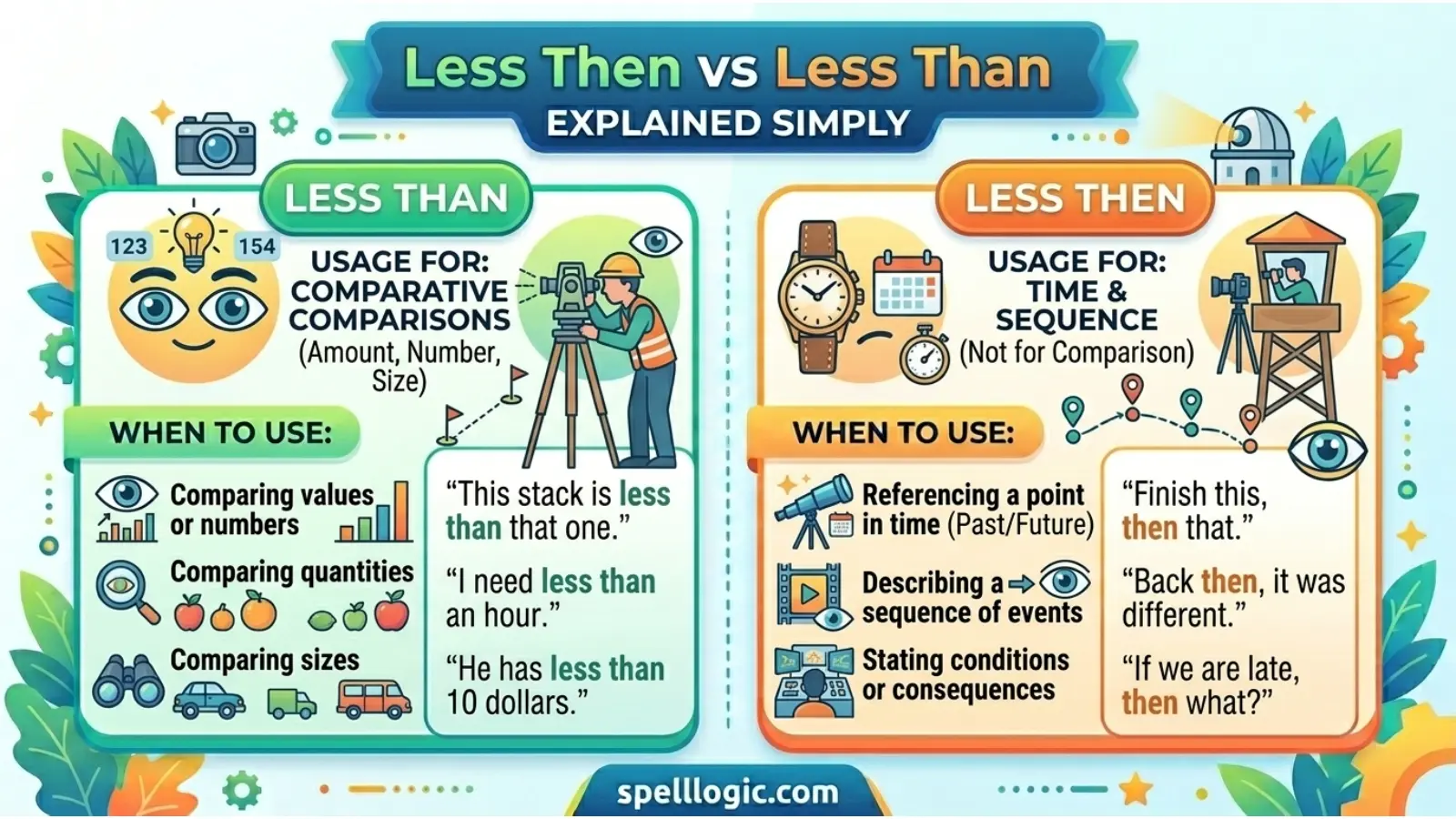
Less Then vs Less Than Explained Simply
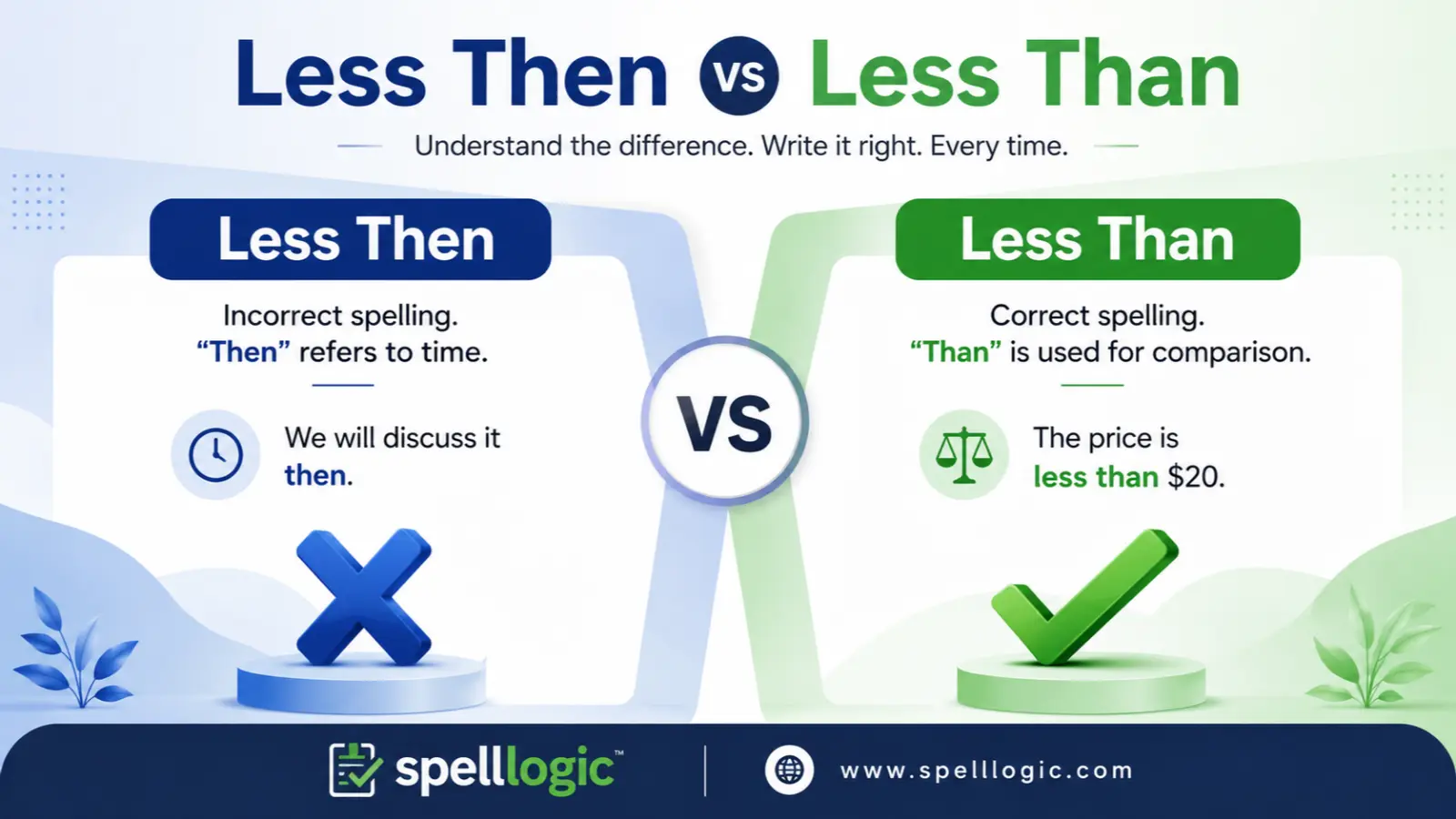
Less than is the correct phrase used to compare quantities, numbers, amounts, or degrees.
Less then is usually a spelling mistake because then relates to time or sequence, not comparison.
One-Line Distinction
Less than compares things, while then refers to what happens next in time.
Simple Explanation
“Less than means a smaller amount, number, or degree, while less then is generally an incorrect phrase in standard English.”
Example Sentences
- The project took less than two weeks to complete.
- There were less than twenty students in the classroom.
Understanding Homophones in English
What Are Homophones?
Homophones are words that sound the same or nearly the same but have different meanings and spellings.
Example:
- Their
- There
These words sound alike but mean different things.
Why Homophones Cause Confusion
When people hear words rather than see them written, they may choose the wrong spelling.
For example:
- I would rather stay here than leave.
- We finished dinner, and then we watched a movie.
Because than and then sound similar, many writers accidentally switch them.
What Does “Less Then” Mean?
Definition and Core Meaning
In standard English, less then generally has no accepted meaning as a fixed phrase. It is usually considered a grammatical or spelling mistake.
The confusion occurs because people mistakenly use then instead of than after the word less.
Origin and Historical Use
The word then comes from Old English and traditionally refers to:
- Time
- Sequence
- Next events
- Consequences
Examples include:
- First we ate, then we left.
- If you’re ready, then let’s begin.
However, then does not normally follow less when making comparisons.
Modern Usage and Synonyms
Since less then is typically incorrect, it has no recognized synonyms as a comparative phrase.
The word then alone can mean:
- Next
- Afterward
- At that time
- Subsequently
Example Sentences
Incorrect examples:
- We spent less then fifty dollars.
- The journey took less then three hours.
Corrected versions:
- We spent less than fifty dollars.
- The journey took less than three hours.
What Does “Less Than” Mean?
Definition and Core Meaning
Less than is a common English phrase used to show that one amount, number, quantity, or degree is smaller than another.
It is widely used in:
- Mathematics
- Everyday conversation
- Academic writing
- Business communication
Origin and Historical Context
The word than comes from Old English comparative structures and has been used for centuries to compare people, objects, quantities, and ideas.
As English evolved, less than became the standard phrase for expressing smaller amounts or lower values.
Modern Usage and Synonyms
Common synonyms and alternatives include:
- Fewer than (for countable items)
- Under
- Below
- Not as much as
- Smaller than
Example Sentences
- The package weighs less than five kilograms.
- She earns less than her older sister.
- The event attracted less than one hundred visitors.
- We finished the task in less than an hour.
Less Then vs Less Than: Key Differences at a Glance
| Word | Part of Speech | Meaning | Example Context |
|---|---|---|---|
| Less Then | Phrase (usually incorrect) | Common spelling mistake | He has less then ten dollars. |
| Less Than | Comparative phrase | Smaller amount, quantity, or degree | He has less than ten dollars. |
| Then | Adverb | Refers to time or sequence | We ate dinner, then watched TV. |
| Than | Conjunction/Preposition | Used for comparison | She is taller than her brother. |
How to Remember the Difference Between Less Then and Less Than
Learning a simple memory trick can prevent this mistake.
Easy Memory Tricks
- Than = Comparison
- Then = Time
Whenever you compare amounts, use than.
Association Techniques
Think of the letter A in than as standing for amount.
- Less than ten
- More than twenty
- Better than before
Think of the letter E in then as standing for events.
- First this, then that.
- Finish work, then relax.
One Memorable Example
Less than five minutes later, then we left the building.
Notice that:
- Less than compares time.
- Then shows what happened next.
Common Mistakes and Confusions
Here are some frequently seen mistakes.
Wrong Example
✘ She has less then twenty books.
Correct Version
✔ She has less than twenty books.
Explanation: The sentence compares a quantity.
Wrong Example
✘ The repair took less then an hour.
Correct Version
✔ The repair took less than an hour.
Explanation: The phrase compares a period of time.
Wrong Example
✘ There were less then fifty guests.
Correct Version
✔ There were less than fifty guests.
Explanation: A comparison requires than.
Wrong Example
✘ Less then a week passed.
Correct Version
✔ Less than a week passed.
Explanation: The phrase refers to a smaller amount of time.
Examples Section: Correct and Incorrect Usage
Example 1
✔ Correct: The flight lasted less than two hours.
✘ Incorrect: The flight lasted less then two hours.
Example 2
✔ Correct: There were less than thirty applicants.
✘ Incorrect: There were less then thirty applicants.
Example 3
✔ Correct: We finished the project in less than a month.
✘ Incorrect: We finished the project in less then a month.
Example 4
✔ Correct: The item costs less than twenty dollars.
✘ Incorrect: The item costs less then twenty dollars.
Example 5
✔ Correct: Finish your homework, then watch television.
✘ Incorrect: Finish your homework, than watch television.
Example 6
✔ Correct: She is younger than her brother.
✘ Incorrect: She is younger then her brother.
Self Assessment: Test Your Knowledge
Fill in the blanks with than or then.
- The race lasted less _____ an hour.
- Finish your meal, _____ you can have dessert.
- There were less _____ fifty people at the meeting.
- My car is older _____ yours.
Self Assessment Answers
- than
- then
- than
- than
FAQs
1. Is “less then” ever correct?
In most situations, no. It is usually a spelling mistake for less than.
2. Which phrase should I use when comparing numbers?
Use less than.
Example: Less than 100 people attended.
3. What is the difference between “then” and “than”?
Then relates to time or sequence, while than is used for comparisons.
4. Why do people confuse than and then?
They look similar and often sound alike in spoken English.
5. Can I use “less than” with time?
Yes.
Example: The movie lasted less than two hours.
6. Is “less than” grammatically correct?
Yes. It is the standard and correct phrase for comparisons involving smaller amounts or quantities.
7. How can I remember the correct word?
Remember:
- Than = Comparison
- Then = Time
This simple rule works in most situations.
Final Conclusion: Using “Less Then” and “Less Than” Correctly
Understanding the difference between less then and less than is easier than it first appears. The key point is that less than is the correct phrase when comparing numbers, amounts, quantities, distances, or periods of time. In contrast, less then is usually a spelling mistake caused by confusion between the words then and than. While these words sound similar in many accents, they serve completely different purposes in English grammar.
A useful rule to remember is that than is used for comparisons, while then relates to time, sequence, or what happens next. Whenever you see the word less, you will almost always need than afterward. For example, “less than ten minutes,” “less than fifty dollars,” and “less than one hundred people” are all correct expressions.
Regular practice can help make the distinction automatic. Reading English articles, noticing comparison phrases, and checking your writing for common errors will strengthen your understanding. You can also use the memory trick that A in than stands for amount, while E in then stands for events. With a little attention and practice, you’ll avoid this common mistake and write with greater confidence. Keep learning, keep practicing, and remember that every grammar rule you master brings you one step closer to fluent and accurate English.