Patronizing vs Condescending Many English learners struggle with patronizing and condescending because both words describe attitudes that can make other people feel inferior. In everyday conversations, books, and workplace discussions, these terms are often used in similar situations. As a result, many people think they mean exactly the same thing.
if, there is a subtle difference between them. Understanding this difference can help you communicate more accurately and avoid misunderstandings. In this guide, you’ll learn the meanings of patronizing and condescending, how they are used, their key differences, and easy ways to remember when to use each word correctly.
Table of Contents
- Introduction
- Why “Patronizing” and “Condescending” Are Confusing
- Patronizing vs Condescending Explained Simply
- Understanding Homophones in English
- What Are Homophones?
- Why Homophones Cause Confusion
- What Does “Patronizing” Mean?
- What Does “Condescending” Mean?
- Patronizing vs Condescending: Key Differences at a Glance
- How to Remember the Difference Between Patronizing and Condescending
- Common Mistakes and Confusions
- Examples Section: Correct and Incorrect Usage
- Self Assessment: Test Your Knowledge
- Self Assessment Answers
- FAQs About “Patronizing and Condescending”
- Final Conclusion: Using “Patronizing” and “Condescending” Correctly
Why “Patronizing” and “Condescending” Are Confusing
Many learners mix up patronizing and condescending because they are closely related in meaning.
Similar Pronunciation
Although the words do not sound exactly alike, they have a similar rhythm and are often used in comparable situations.
Similar Spelling
Both words are long adjectives that describe a person’s attitude or behavior. Their similar structure can make them difficult to distinguish.
Context Confusion
People often use both words when talking about someone who treats others as less intelligent, less capable, or less important.
Common Learner Mistakes
Learners frequently assume that the two words are perfect synonyms. While they overlap in meaning, patronizing often focuses on behavior that appears overly helpful or protective, whereas condescending focuses more on an attitude of superiority.
Patronizing vs Condescending Explained Simply
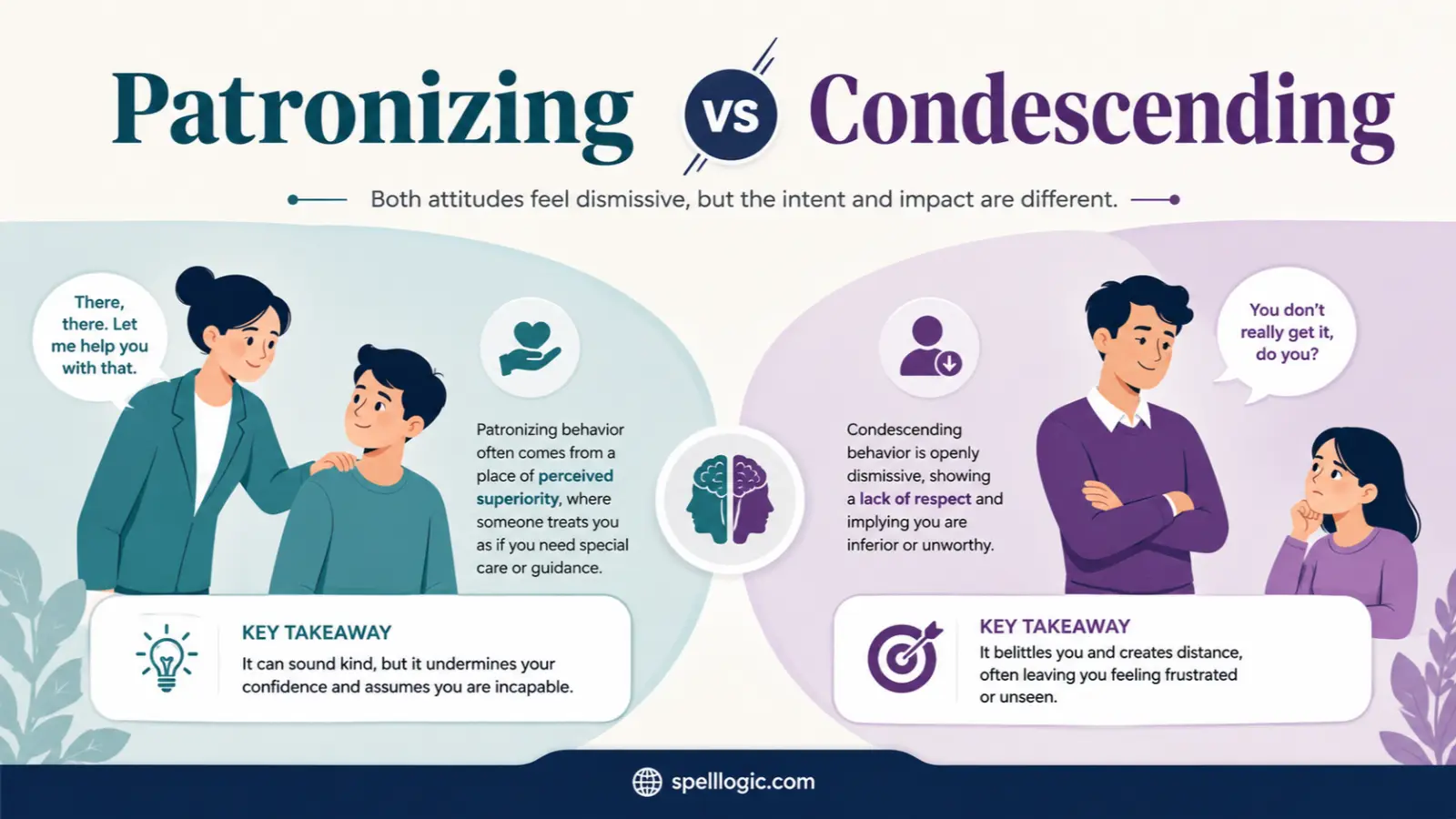
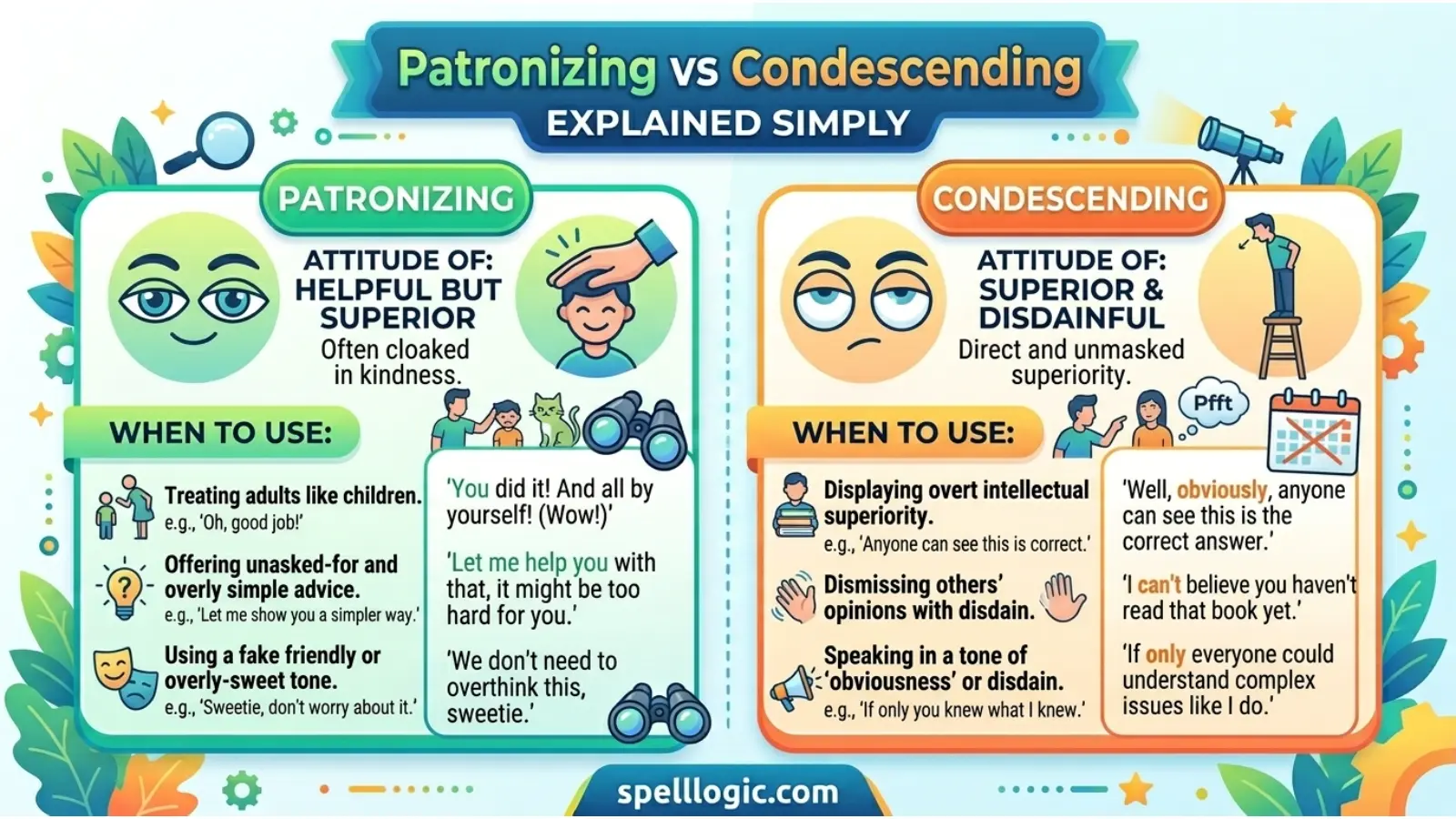
Patronizing means treating someone with apparent kindness while implying they are less capable or less intelligent.
Condescending means talking or behaving toward someone as if you are superior to them.
One-Line Distinction
Patronizing is often disguised as helpfulness, while condescending openly shows superiority.
Examples
- Her patronizing tone made the new employee feel inexperienced.
- The teacher’s patronizing comments sounded supportive but felt insulting.
- His condescending attitude annoyed everyone in the meeting.
- She gave a condescending smile as if she knew better than everyone else.
Patronizing means acting overly helpful in a way that suggests someone is inferior, while condescending means directly showing a sense of superiority.
Understanding Homophones in English
What Are Homophones?
Homophones are words that sound the same but have different meanings and spellings.
Example:
- Sea = a large body of salt water
- See = to look at something
These words sound alike but have different meanings.
Why Homophones Cause Confusion
English learners often rely on pronunciation when learning new vocabulary. When words sound similar, it becomes easy to confuse their meanings.
For example:
- Their
- There
- They’re
These words sound nearly identical but are used differently.
Note: Patronizing and condescending are not homophones, but they create confusion because their meanings overlap.
What Does “Patronizing” Mean?
Definition and Core Meaning
Patronizing describes behavior that seems kind, encouraging, or helpful but actually suggests that the other person is less capable, less knowledgeable, or inferior.
The speaker may not always intend to be rude, but the effect can still feel insulting.
Origin and Historical Use
The word comes from the verb patronize, which originally meant to act as a patron or supporter. Over time, the meaning evolved to describe behavior that offers support in a way that appears superior or dismissive.
Modern Usage and Synonyms
Today, patronizing is commonly used in workplaces, schools, families, and social situations.
Synonyms:
- Belittling
- Overprotective
- Dismissive
- Infantilizing
- Overly helpful
Key Points
- Often sounds friendly on the surface.
- May involve excessive praise.
- Suggests the other person needs guidance.
- Can make someone feel underestimated.
Example Sentences
- She gave a patronizing explanation of a simple task.
- His patronizing praise made the experienced worker uncomfortable.
- The customer disliked the patronizing tone of the salesperson.
- Stop using that patronizing voice when speaking to adults.
What Does “Condescending” Mean?
Definition and Core Meaning
Condescending describes behavior that shows an obvious belief that one person is better, smarter, or more important than another.
Unlike patronizing behavior, condescension is usually more direct and easier to recognize.
Origin and Historical Context
The word comes from the Latin root meaning “to descend.” Historically, it referred to a person lowering themselves to interact with those considered below them in status.
Over time, the word developed a negative meaning associated with arrogance and superiority.
Modern Usage and Synonyms
Condescending is commonly used to describe attitudes in conversations, professional environments, and social interactions.
Synonyms:
- Arrogant
- Snobbish
- Superior
- Disdainful
- Haughty
Key Points
- Shows a sense of superiority.
- Often sounds arrogant.
- Can make others feel disrespected.
- Usually intentional or obvious.
Example Sentences
- His condescending remarks upset the team.
- She spoke in a condescending manner during the discussion.
- The manager’s condescending attitude reduced employee morale.
- Nobody likes being treated with a condescending tone.
Patronizing vs Condescending: Key Differences at a Glance
| Word | Part of Speech | Meaning | Example Context |
|---|---|---|---|
| Patronizing | Adjective | Appearing helpful or kind while implying someone is inferior | “Thanks, sweetheart, let me explain this simple idea to you.” |
| Condescending | Adjective | Showing clear superiority toward others | “You probably wouldn’t understand this complex topic.” |
How to Remember the Difference Between Patronizing and Condescending
Easy Memory Tricks
Patronizing = Pretending to Help
The word often involves support or kindness that feels insulting.
Condescending = Looking Down
Think of someone literally looking down from a higher position.
Association Techniques
- Patronizing → “I’m helping you because you can’t do it yourself.”
- Condescending → “I’m better than you.”
One Memorable Example
Imagine two managers:
- Manager A explains a basic task to an expert employee as if they know nothing. That’s patronizing.
- Manager B openly suggests that employees are less intelligent than he is. That’s condescending.
Common Mistakes and Confusions
Mistake 1
❌ The professor was patronizing because he believed he was smarter than everyone.
✔ The professor was condescending because he believed he was smarter than everyone.
Explanation: Direct feelings of superiority are usually described as condescending.
Mistake 2
❌ Her condescending praise made me feel like a child.
✔ Her patronizing praise made me feel like a child.
Explanation: Praise that feels insulting is often patronizing.
Mistake 3
❌ He used a patronizing attitude to show he was above everyone.
✔ He used a condescending attitude to show he was above everyone.
Explanation: Open superiority is condescending.
Mistake 4
❌ The nurse was condescending when she gently explained basic instructions to an adult patient.
✔ The nurse was patronizing when she gently explained basic instructions to an adult patient.
Explanation: Overly simplified help often sounds patronizing.
Examples Section: Correct and Incorrect Usage
Example 1
✔ Correct: Her patronizing comments made the skilled worker feel underestimated.
✘ Incorrect: Her condescending comments made the skilled worker feel underestimated because she kept offering unnecessary help.
Example 2
✔ Correct: His condescending tone suggested he thought everyone else was ignorant.
✘ Incorrect: His patronizing tone suggested he thought everyone else was ignorant.
Example 3
✔ Correct: The advertisement sounded patronizing toward experienced customers.
✘ Incorrect: The advertisement sounded condescending because it offered excessive guidance.
Example 4
✔ Correct: She gave a condescending laugh after correcting her colleague.
✘ Incorrect: She gave a patronizing laugh after correcting her colleague to show she was superior.
Self Assessment: Test Your Knowledge
Fill in the blanks with patronizing or condescending.
- The manager’s __________ tone suggested that employees were less intelligent than he was.
- Her __________ praise felt more insulting than encouraging.
- He sounded __________ when he acted as though only he understood the problem.
- The volunteer’s __________ explanation made the adults feel like children.
Self Assessment Answers
- condescending
- patronizing
- condescending
- patronizing
FAQs
1. Are patronizing and condescending the same thing?
No. They are similar, but patronizing behavior often appears helpful, while condescending behavior openly shows superiority.
2. Which word is more negative?
Both are negative, but condescending usually sounds more openly insulting.
3. Can a person be both patronizing and condescending?
Yes. Some behavior can be both overly helpful and openly superior at the same time.
4. Is patronizing always intentional?
Not always. People may sound patronizing without realizing it.
5. Is condescending always intentional?
Not necessarily, but it is usually more obvious and noticeable.
6. Which word is common in workplace communication?
Both words are common when discussing communication styles, leadership, and professional relationships.
7. How can I avoid sounding patronizing or condescending?
Treat others as equals, listen carefully, and avoid assuming they know less than you.
Final Conclusion: Using “Patronizing” and “Condescending” Correctly
Understanding the difference between patronizing and condescending can significantly improve your English communication skills. Although the two words are closely related, they are not exactly the same. Patronizing behavior often appears friendly, supportive, or helpful on the surface, yet it carries the hidden message that the other person is less capable or less knowledgeable. Condescending behavior, on the other hand, more directly expresses a sense of superiority and often makes others feel looked down upon.
In real-world situations, you may encounter both attitudes in workplaces, schools, customer service interactions, and everyday conversations. Recognizing the distinction allows you to describe behavior more accurately and understand the speaker’s intent more clearly. A simple way to remember the difference is this: patronizing sounds like unnecessary help, while condescending sounds like obvious superiority. This memory trick can help you choose the correct word quickly.
As you continue learning English, pay attention to how native speakers use these words in conversations, articles, and media. The more examples you encounter, the easier it will become to recognize the subtle differences. Language learning takes practice, and every new distinction you master helps build confidence. Keep learning, keep noticing context, and you’ll soon use both patronizing and condescending correctly and naturally.