See vs Saw Many English learners get confused by see and saw because both words relate to vision and are forms of the same verb. At first glance, they seem interchangeable, but they are used in different situations and tenses. Understanding the difference between see and saw is important because using the wrong form can make your sentences grammatically incorrect.
If you are writing an email, speaking with friends, or taking an English exam, knowing when to use see and saw will help you communicate more clearly and confidently. This guide explains everything you need to know in simple, easy-to-understand language.
Table of Contents
- Why “See” and “Saw” Are Confusing
- See vs Saw Explained Simply
- Understanding Homophones in English
- What Does “See” Mean?
- What Does “Saw” Mean?
- See vs Saw: Key Differences at a Glance
- How to Remember the Difference Between See and Saw
- Common Mistakes and Confusions
- Examples Section: Correct and Incorrect Usage
- Self Assessment: Test Your Knowledge
- Self Assessment Answers
- FAQs About “See and Saw”
- Final Conclusion: Using “See” and “Saw” Correctly
Why “See” and “Saw” Are Confusing
Many learners mix up see and saw because they are closely related.
Similar Pronunciation
Although they sound different, both words belong to the same verb family. Learners often hear them in conversations and struggle to identify which tense is being used.
Similar Spelling
The words share the same root verb, making them look related. This can lead people to believe they can be used interchangeably.
Context Confusion
Both words refer to the act of using your eyes. However, see is usually present tense, while saw is past tense.
Common Learner Mistakes
Some common errors include:
- “Yesterday I see a movie.”
- “I saw him every day.”
- “Did you saw that?”
These mistakes happen because learners forget to match the verb form with the correct tense.
See vs Saw Explained Simply
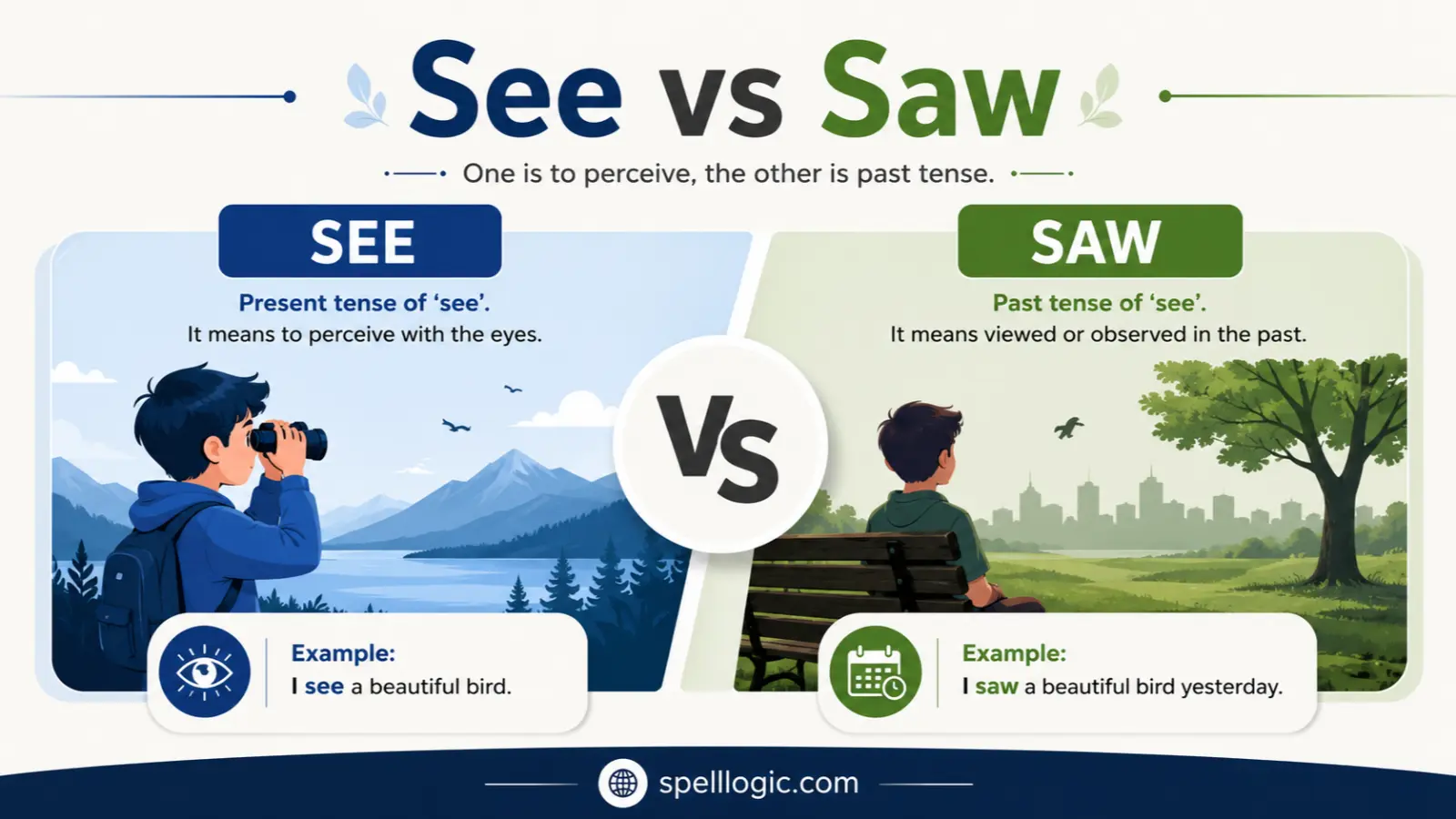
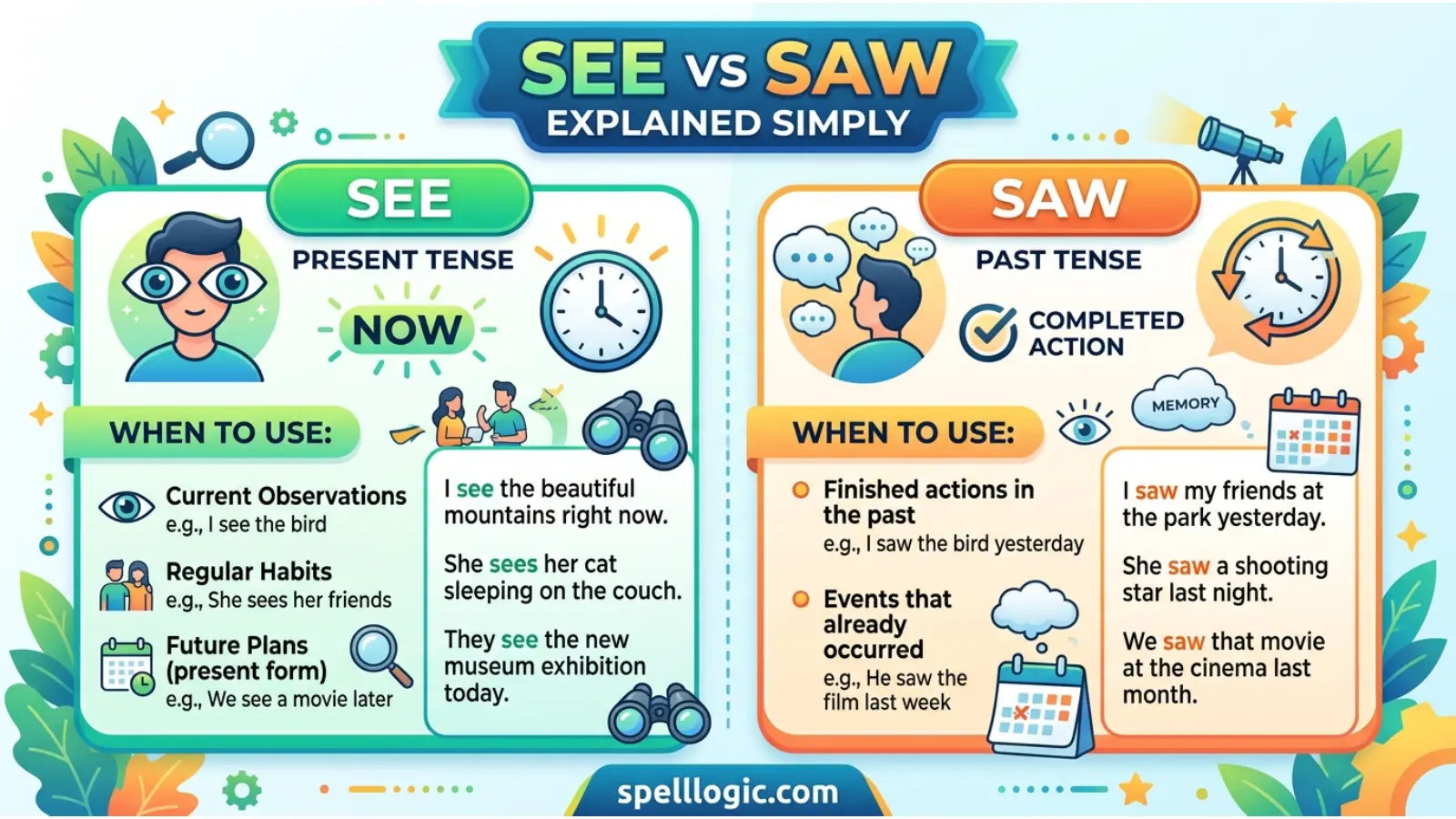
See means to perceive something with your eyes in the present, while saw is the past tense of see and refers to something viewed in the past.
One-Line Distinction
See = present tense; Saw = past tense.
Examples
- I see a bird outside my window.
- We see our neighbors every weekend.
- I saw a bird outside my window yesterday.
- We saw our neighbors last weekend.
See means experiencing vision now or generally, while saw means that the action happened before now.
Understanding Homophones in English
What Are Homophones?
Homophones are words that sound the same or very similar but have different meanings and spellings.
Example:
- Two
- Too
These words sound alike but have different meanings.
Why Homophones Cause Confusion
Homophones often confuse learners because they sound similar in spoken English. People may choose the wrong word when writing.
For example:
- There
- Their
- They’re
Even fluent speakers sometimes mix them up because pronunciation does not always reveal the correct spelling.
Although see and sea are true homophones, see and saw are not. However, learners still confuse see and saw because they are different forms of the same verb.
What Does “See” Mean?
Definition and Core Meaning
See is a verb that means to perceive something with your eyes or to understand something.
Origin and Historical Use
The word see comes from Old English seon, meaning “to observe” or “to perceive.” It has been used for centuries to describe vision and understanding.
Modern Usage and Synonyms
Modern meanings include:
- To look at something
- To notice something
- To understand an idea
- To meet someone
Synonyms:
- Observe
- Notice
- View
- Watch
- Perceive
Key Points
- Present tense verb
- Used for current or habitual actions
- Can refer to understanding as well as vision
- Common in everyday English
Example Sentences
- I see a rainbow in the sky.
- Do you see the difference?
- We see each other every week.
- I see what you mean.
What Does “Saw” Mean?
Definition and Core Meaning
Saw is the simple past tense of the verb see. It describes something that was observed in the past.
Origin and Historical Context
The past tense form saw developed from older Germanic verb patterns. It has long been used in English to indicate completed actions involving sight.
Modern Usage and Synonyms
Modern meanings include:
- Observed in the past
- Noticed previously
- Witnessed earlier
Synonyms:
- Observed
- Noticed
- Witnessed
- Viewed
- Watched
Key Points
- Past tense verb
- Refers to completed actions
- Used with past time expressions
- Common in spoken and written English
Example Sentences
- I saw a shooting star last night.
- She saw her friend at the mall yesterday.
- We saw the new movie last weekend.
- They saw the accident from across the street.
See vs Saw: Key Differences at a Glance
| Word | Part of Speech | Meaning | Example Context |
|---|---|---|---|
| See | Verb (present tense) | To perceive or understand now | I see the mountain. |
| Saw | Verb (past tense of see) | Observed something in the past | I saw the mountain yesterday. |
How to Remember the Difference Between See and Saw
Learning a simple memory trick can help.
Easy Memory Tricks
- See has double “e,” which can remind you of something happening currently.
- Saw contains “aw,” which can remind you of a reaction to something you already experienced.
Association Techniques
Think of time:
- See = Now
- Saw = Before
One Memorable Example
- Today I see the sunset.
- Yesterday I saw the sunset.
If the action happened yesterday or earlier, use saw.
Common Mistakes and Confusions
Wrong Example
❌ I see him yesterday.
Correct Version
✔ I saw him yesterday.
Explanation: “Yesterday” signals the past, so use saw.
Wrong Example
❌ Did you saw that movie?
Correct Version
✔ Did you see that movie?
Explanation: After did, use the base form see, not saw.
Wrong Example
❌ She saw her teacher every day.
Correct Version
✔ She sees her teacher every day.
Explanation: A repeated action in the present requires sees.
Wrong Example
❌ I have saw that before.
Correct Version
✔ I have seen that before.
Explanation: Present perfect tense uses seen, not saw.
Examples Section: Correct and Incorrect Usage
Example 1
✔ Correct: I see a cat in the garden.
✘ Incorrect: I saw a cat in the garden right now.
Example 2
✔ Correct: We saw a great show last night.
✘ Incorrect: We see a great show last night.
Example 3
✔ Correct: Did you see the announcement?
✘ Incorrect: Did you saw the announcement?
Example 4
✔ Correct: She saw her cousin during the holiday.
✘ Incorrect: She see her cousin during the holiday.
Example 5
✔ Correct: I see what you’re saying.
✘ Incorrect: I saw what you’re saying.
Example 6
✔ Correct: They saw the parade yesterday.
✘ Incorrect: They see the parade yesterday.
Self Assessment: Test Your Knowledge
Fill in the blanks with see or saw.
1.
Yesterday, I ______ a beautiful rainbow.
2.
I can ______ the mountains from my window.
3.
Did you ______ the email I sent?
4.
We ______ our grandparents last weekend.
Self Assessment Answers
1.
saw
2.
see
3.
see
4.
saw
FAQs
Is “saw” the past tense of “see”?
Yes. Saw is the simple past tense form of see.
Can I say “I see him yesterday”?
No. The correct sentence is “I saw him yesterday.”
What is the difference between “see” and “saw”?
See refers to the present or general situations, while saw refers to completed actions in the past.
Is “Did you saw?” grammatically correct?
No. After did, use the base verb. The correct form is “Did you see?”
What is the past participle of “see”?
The past participle is seen.
Example:
- I have seen that movie before.
Is “see” always related to eyesight?
Not always. It can also mean understanding.
Example:
- I see your point.
How can I remember when to use “saw”?
Remember: saw = past. If the action happened yesterday, last week, or earlier, use saw
Final Conclusion: Using “See” and “Saw” Correctly
Understanding the difference between see and saw is an important step toward mastering English grammar. While these words come from the same verb, they serve different purposes. See is the present-tense form used when talking about something you observe now, regularly, or generally. Saw, on the other hand, is the simple past-tense form and describes something you observed in the past. Knowing this distinction helps you create grammatically correct sentences and communicate more clearly.
In everyday conversations, you will often use see when discussing current situations or expressing understanding. You will use saw when talking about experiences, events, or observations that already happened. Paying attention to time markers such as today, now, yesterday, last week, and last year can help you choose the correct word quickly.
A useful memory tip is simple: see = present, saw = past. Whenever you are unsure, ask yourself when the action happened. If it happened before now, saw is usually the correct choice.
The more you read, write, and practice English, the easier these verb forms become. Keep learning from your mistakes, review examples regularly, and don’t be afraid to use new vocabulary in conversations. With consistent practice, using see and saw correctly will soon feel natural and effortless.