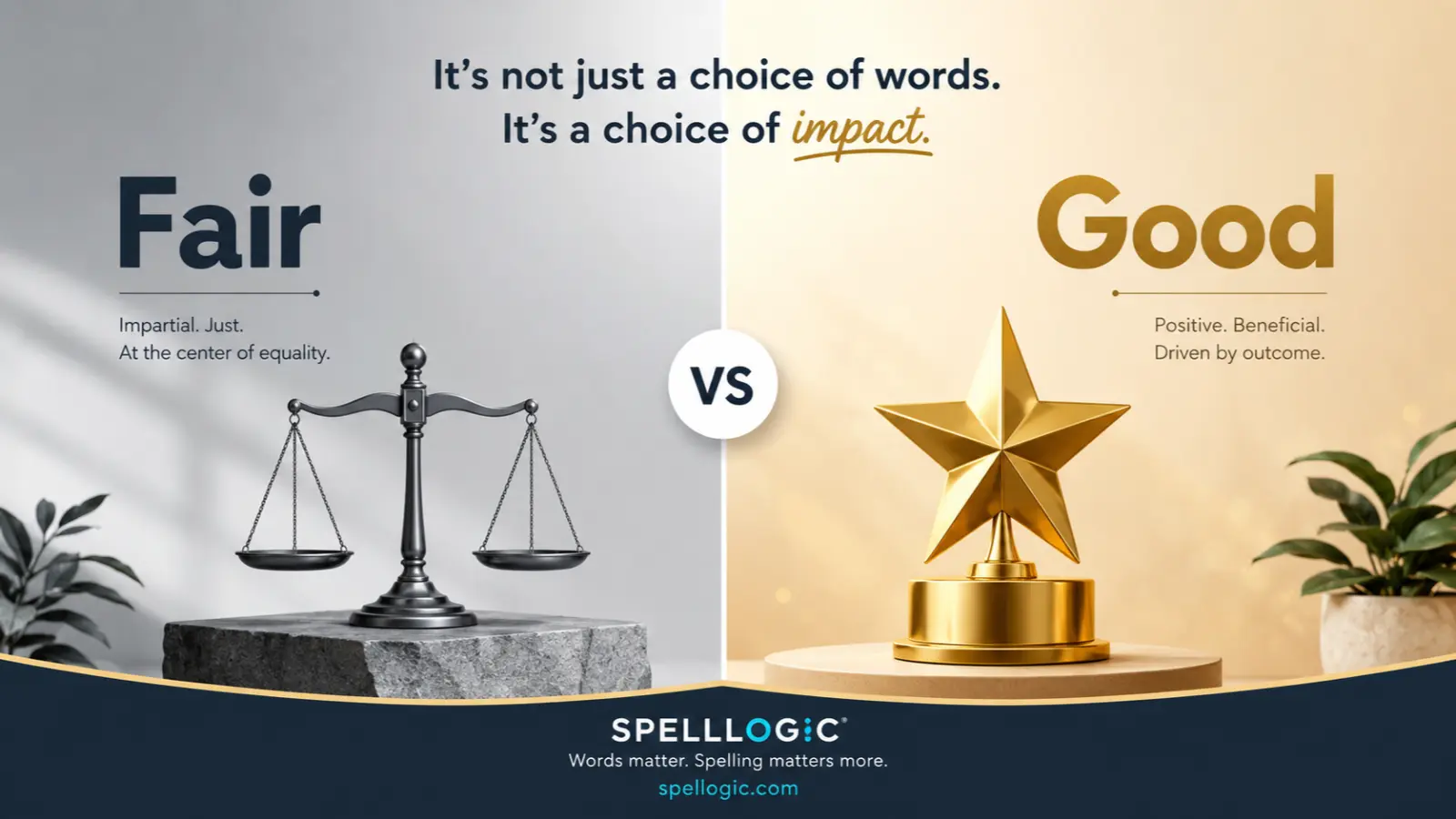
Fair vs Good Many English learners find fair and good confusing because both words can describe something positive. However, they do not mean the same thing and cannot always be used interchangeably. In some situations, fair refers to justice, equality, or something acceptable, while good describes quality, excellence, or positive characteristics.
Understanding the difference between these words can help you communicate more accurately and avoid common mistakes in speaking and writing. This guide explains the meanings, uses, examples, and key differences between fair and good in simple English so you can use them with confidence.
Table of Contents
- Introduction
- Why “Fair” and “Good” Are Confusing
- Fair vs Good Explained Simply
- Understanding Homophones in English
- What Are Homophones?
- Why Homophones Cause Confusion
- What Does “Fair” Mean?
- What Does “Good” Mean?
- Fair vs Good: Key Differences at a Glance
- How to Remember the Difference Between Fair and Good
- Common Mistakes and Confusions
- Examples Section: Correct and Incorrect Usage
- Self Assessment: Test Your Knowledge
- Self Assessment Answers
- FAQs About “Fair and Good”
- Final Conclusion: Using “Fair” and “Good” Correctly
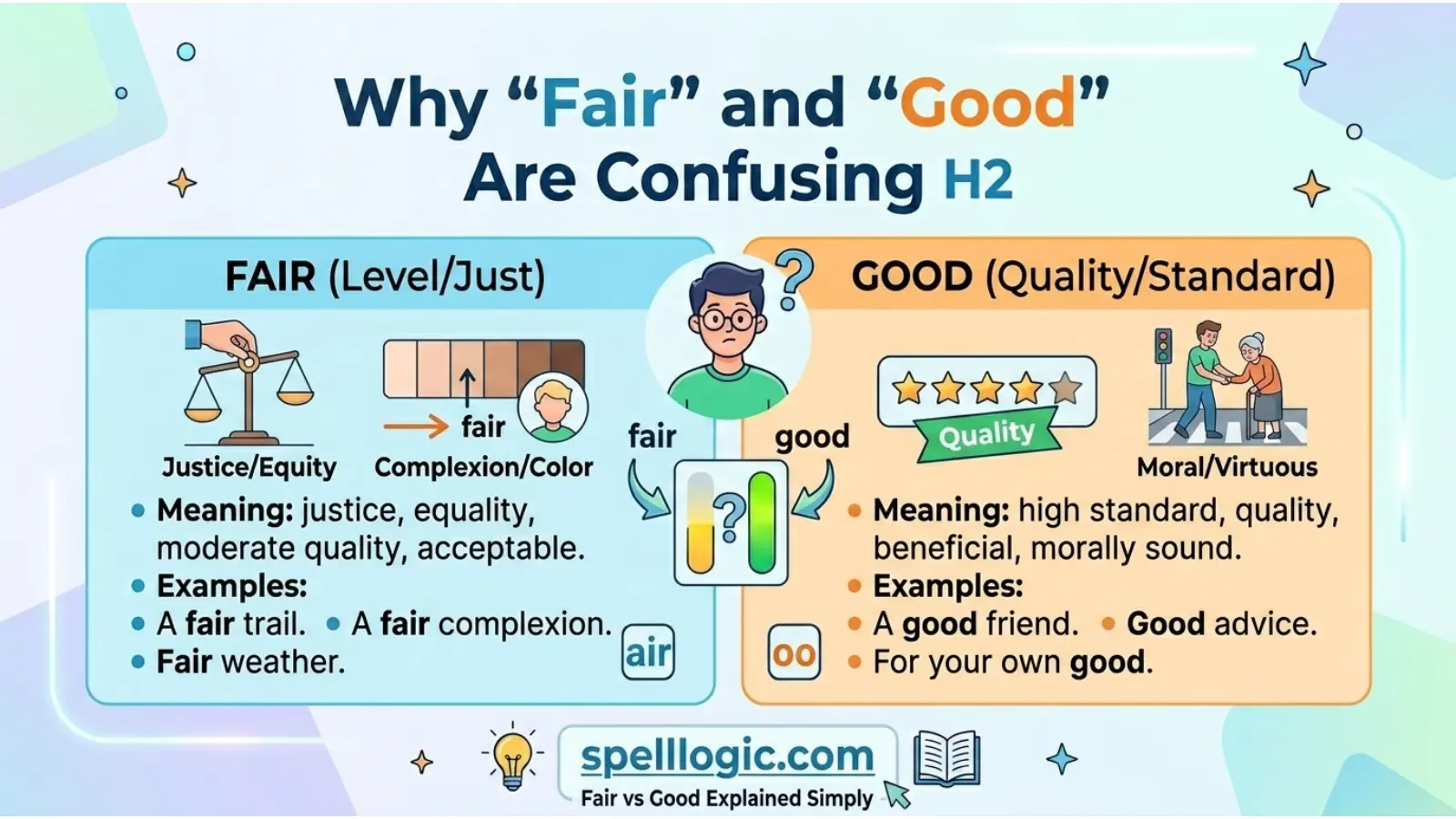
Why “Fair” and “Good” Are Confusing
Many learners mix up fair and good because both can express a positive idea. However, their meanings are different.
Similar Pronunciation
Although the words do not sound exactly alike, they are both short and commonly used in everyday English. This can cause confusion, especially for new learners.
Similar Spelling
The spellings are different, but both words are simple adjectives that frequently appear in conversations, books, and exams.
Context Confusion
Sometimes people use fair to mean “reasonably good” or “acceptable.” For example:
- The movie was fair.
- The movie was good.
These sentences have similar but not identical meanings.
Common Learner Mistakes
Learners often use good when talking about fairness or justice.
For example:
- Incorrect: The teacher was good to all students equally.
- Better: The teacher was fair to all students.
Understanding the context helps you choose the correct word.
Fair vs Good Explained Simply
Fair means reasonable, just, equal, or acceptable, while good means high quality, positive, or satisfactory.
One-Line Distinction
Fair focuses on justice or acceptability, while good focuses on quality or excellence.
Example Sentences
- The judge made a fair decision.
- Everyone deserves fair treatment.
- She did a good job on the project.
- This restaurant serves good food.
Understanding Homophones in English
What Are Homophones?
Homophones are words that sound the same or nearly the same but have different meanings and spellings.
Example:
- Sea and see
These words sound alike but mean different things.
Why Homophones Cause Confusion
Homophones can make writing and speaking difficult because learners may choose the wrong word based on sound alone.
For example:
- I can see the ocean.
- The sea is calm today.
Although fair and good are not homophones, English learners often confuse them because they can appear in similar contexts.
What Does “Fair” Mean?
Definition and Core Meaning
Fair means just, impartial, reasonable, or acceptable. It often relates to equality and proper treatment.
Origin and Historical Use
The word fair comes from Old English fæger, meaning beautiful, pleasing, or just. Over time, its meaning expanded to include equality and impartiality.
Modern Usage and Synonyms
Today, fair is commonly used when discussing justice, rules, treatment, and acceptable quality.
Synonyms:
- Just
- Equal
- Impartial
- Reasonable
- Honest
- Acceptable
Key Points
- Refers to justice and equality.
- Can describe average or acceptable quality.
- Common in legal, educational, and social contexts.
- Often used when discussing treatment of people.
Example Sentences
- The referee made a fair decision.
- All employees should receive fair pay.
- Her performance was fair, but not excellent.
- The competition was conducted in a fair manner.
What Does “Good” Mean?
Definition and Core Meaning
Good means positive, beneficial, high quality, or satisfactory.
Origin and Historical Context
The word good comes from Old English gōd, meaning desirable, virtuous, or favorable. It has been one of the most commonly used English words for centuries.
Modern Usage and Synonyms
Today, good describes quality, behavior, performance, or anything considered positive.
Synonyms:
- Excellent
- Positive
- Fine
- Great
- Beneficial
- Pleasant
Key Points
- Describes quality or value.
- Suggests positive characteristics.
- Common in everyday communication.
- Can describe people, actions, objects, and experiences.
Example Sentences
- She is a good teacher.
- We had a good time at the party.
- This book provides good advice.
- He earned a good grade on the test.
Fair vs Good: Key Differences at a Glance
| Word | Part of Speech | Meaning | Example Context |
|---|---|---|---|
| Fair | Adjective | Just, equal, reasonable, acceptable | The manager made a fair decision. |
| Good | Adjective | High quality, positive, beneficial | The manager did a good job. |
Quick Summary
- Fair = justice, equality, acceptability
- Good = quality, excellence, positivity
How to Remember the Difference Between Fair and Good
Learning a simple memory trick can help.
Easy Memory Tricks
Fair = Fairness
The word fair is closely connected to fairness and equal treatment.
Good = Great Quality
Think of good when something performs well or has positive qualities.
Association Techniques
- Fair judge → equal and impartial.
- Good teacher → skilled and effective.
One Memorable Example
Imagine a teacher grading exams.
- If the teacher treats every student equally, the teacher is fair.
- If the teacher explains lessons well, the teacher is good.
A teacher can be both fair and good.
Common Mistakes and Confusions
Mistake 1
❌ The judge made a good decision for both sides.
✔ The judge made a fair decision for both sides.
Explanation: The focus is on justice, not quality.
Mistake 2
❌ This pizza tastes fair.
✔ This pizza tastes good.
Explanation: Food quality is described as good, not fair.
Mistake 3
❌ She is a fair singer.
✔ She is a good singer.
Explanation: Singing ability relates to quality.
Mistake 4
❌ The company gives all workers good treatment equally.
✔ The company gives all workers fair treatment.
Explanation: Equal treatment requires the word fair.
Examples Section: Correct and Incorrect Usage
Example 1
✔ Correct: The referee was fair to both teams.
✘ Incorrect: The referee was good to both teams.
Example 2
✔ Correct: We enjoyed a good meal at the restaurant.
✘ Incorrect: We enjoyed a fair meal at the restaurant. (Unless you mean only average quality.)
Example 3
✔ Correct: The hiring process was fair and transparent.
✘ Incorrect: The hiring process was good and transparent. (Fair is more precise.)
Example 4
✔ Correct: Sarah did a good job on the presentation.
✘ Incorrect: Sarah did a fair job on the presentation. (This suggests average performance rather than strong performance.)
Example 5
✔ Correct: Everyone deserves fair treatment.
✘ Incorrect: Everyone deserves good treatment. (Possible but less precise when discussing equality.)
Example 6
✔ Correct: The weather was good today.
✘ Incorrect: The weather was fair today. (Fair weather has a specific meaning, but generally good describes pleasant weather.)
Self Assessment: Test Your Knowledge
Fill in the blanks with fair or good.
- The teacher was ______ to every student in the class.
- She received a ______ review for her performance.
- Everyone deserves ______ treatment at work.
- This is a very ______ book for learning English.
Self Assessment Answers
- fair
- good
- fair
- good
FAQs
1. Are fair and good synonyms?
No. Fair relates to justice or acceptable quality, while good relates to positive quality or excellence.
2. Can something be both fair and good?
Yes. A decision can be both fair and good if it is just and beneficial.
3. Is fair better than good?
Not necessarily. The words describe different qualities rather than levels of quality.
4. When should I use fair?
Use fair when discussing equality, justice, impartiality, or something reasonably acceptable.
5. When should I use good?
Use good when describing quality, value, performance, or positive characteristics.
6. Can fair mean average quality?
Yes. In some contexts, fair means acceptable or average rather than excellent.
7. Is “fair treatment” correct?
Yes. Fair treatment is a common phrase meaning equal and just treatment.
Final Conclusion: Using “Fair” and “Good” Correctly
Understanding the difference between fair and good is important for clear and accurate English communication. While both words often have positive meanings, they focus on different ideas. Fair usually refers to justice, equality, impartiality, or something that is reasonably acceptable. In contrast, good refers to quality, excellence, usefulness, or positive characteristics. This distinction helps you choose the right word in different situations.
For example, a teacher can be fair by treating all students equally and good by teaching lessons effectively. Likewise, a decision can be fair because it is just, while a meal can be good because it tastes delicious. Remember the simple memory tip: fair relates to fairness, while good relates to quality. Whenever you are unsure, ask yourself whether you are talking about equality or excellence.
The more examples you read and practice, the easier it becomes to recognize the correct word. Keep paying attention to how native speakers use these terms in conversations, books, and media. With regular practice, you’ll confidently use fair and good in everyday English and avoid one of the most common vocabulary mistakes made by learners. Happy learning and keep expanding your English skills one word at a time!