Understanding this subtle difference helps you write and speak more naturally in English. Whether you’re reading academic texts, business documents, or everyday conversations, knowing when to use each word will improve your vocabulary and prevent common mistakes.
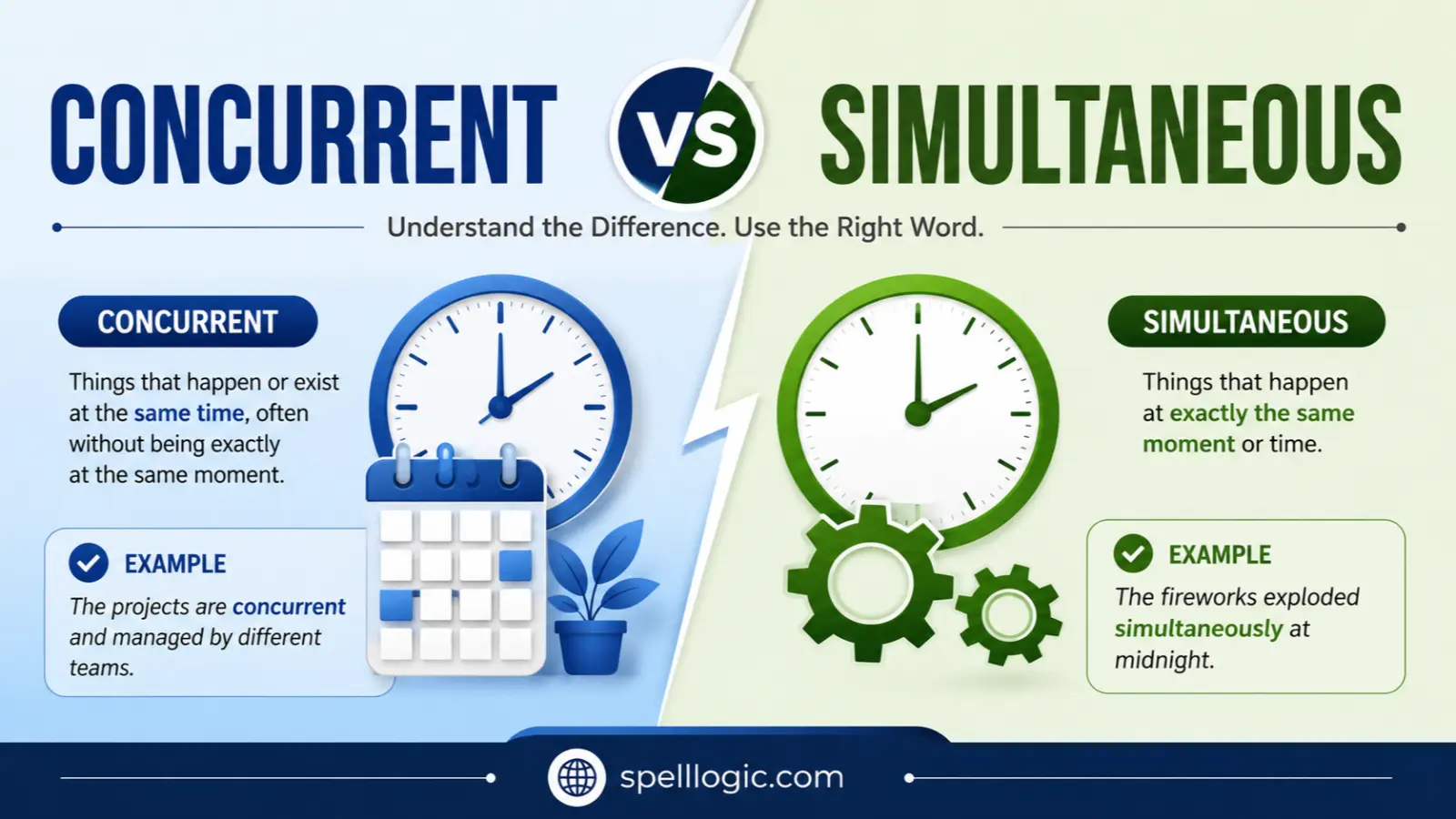
Many English learners struggle with concurrent and simultaneous because both words describe things happening at the same time. Although they share a similar idea, they are not always interchangeable. In some situations, concurrent refers to events that overlap during the same period, while simultaneous means events happen at the exact same moment.
Table of Contents
- Introduction
- Why “Concurrent” and “Simultaneous” Are Confusing
- Concurrent vs Simultaneous Explained Simply
- Understanding Homophones in English
- What Are Homophones?
- Why Homophones Cause Confusion
- What Does “Concurrent” Mean?
- What Does “Simultaneous” Mean?
- Concurrent vs Simultaneous: Key Differences at a Glance
- How to Remember the Difference Between Concurrent and Simultaneous
- Common Mistakes and Confusions
- Examples Section: Correct and Incorrect Usage
- Self Assessment: Test Your Knowledge
- Self Assessment Answers
- FAQs About “Concurrent and Simultaneous”
- Final Conclusion: Using “Concurrent” and “Simultaneous” Correctly
Why “Concurrent” and “Simultaneous” Are Confusing
Many learners mix up concurrent and simultaneous because both involve timing. However, they are used differently depending on the situation.
Similar Pronunciation
The words do not sound exactly alike, but they are both long, formal English adjectives. Their similar rhythm can make learners think they have identical meanings.
Similar Spelling
They are not spelled similarly. However, both words end with adjective suffixes and often appear in academic, legal, scientific, and technical writing.
Context Confusion
The biggest source of confusion is context.
- Concurrent often means happening during the same period.
- Simultaneous means happening at exactly the same time.
Sometimes both words fit a sentence, while in other cases only one is correct.
Common Learner Mistakes
Learners often:
- Use simultaneous when events only overlap.
- Use concurrent when events happen at the exact same second.
- Assume the words are complete synonyms.
Concurrent vs Simultaneous Explained Simply
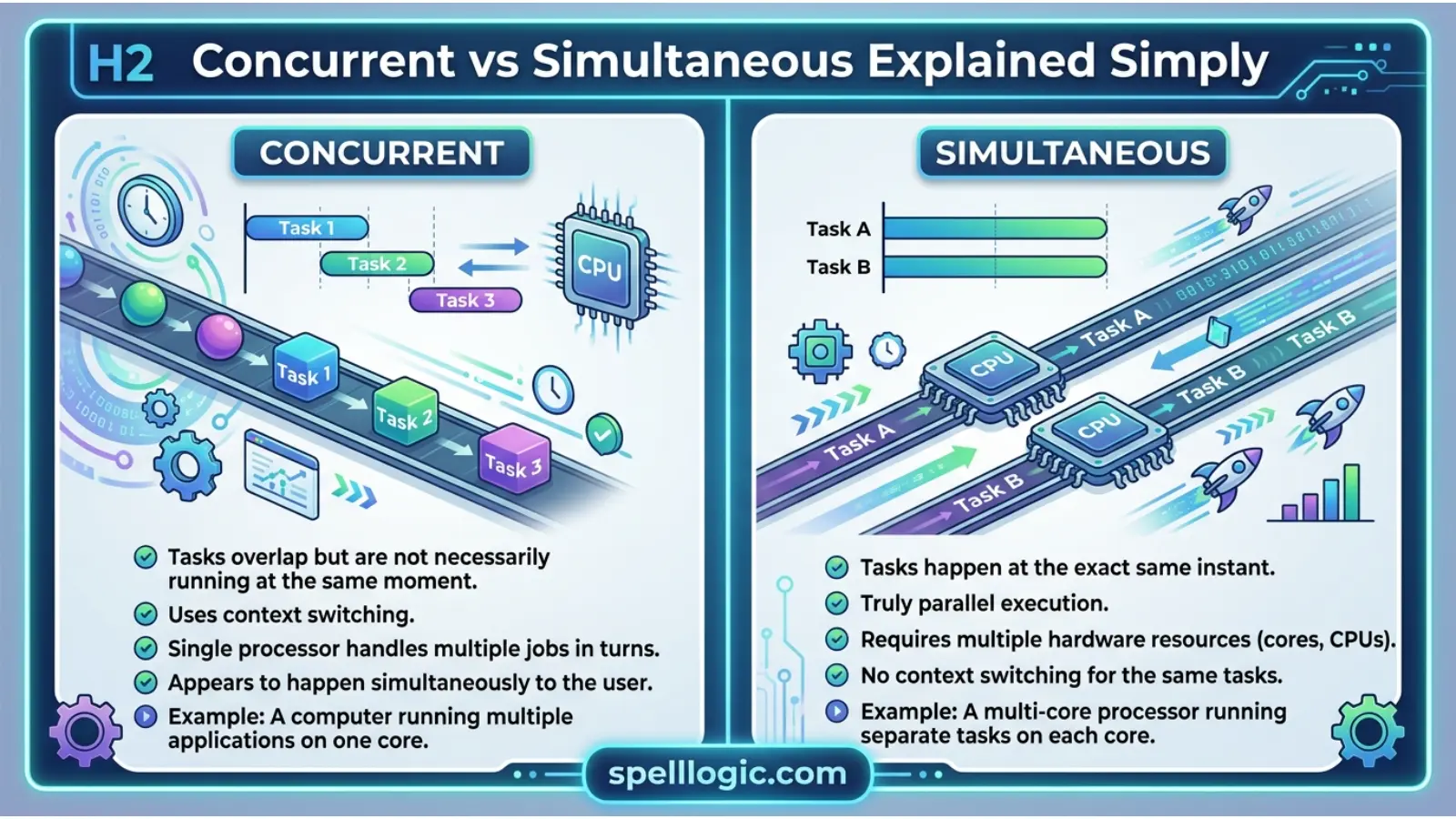
Concurrent means things happen during the same period, while simultaneous means things happen at the exact same moment.
One-line distinction
Concurrent = happening together over a period.
Simultaneous = happening at exactly the same time.
Examples
Concurrent
- She worked two concurrent jobs during the summer.
- The conference included several concurrent workshops.
Simultaneous
- Both runners crossed the finish line simultaneously.
- The alarms sounded simultaneously across the building.
Understanding Homophones in English
What Are Homophones?
Homophones are words that sound the same but have different meanings and spellings.
Example:
- Flower – a blooming plant
- Flour – powder used for baking
Although concurrent and simultaneous are not homophones, learners often confuse them because they express similar ideas.
Why Homophones Cause Confusion
English contains many words that sound alike or have related meanings. Learners sometimes choose the wrong word because they focus only on the general meaning instead of the exact usage.
For example:
- Their
- There
- They’re
These words sound alike but have different meanings and grammar.
Similarly, concurrent and simultaneous describe timing but are used differently.
What Does “Concurrent” Mean?
Definition and Core Meaning
Concurrent means existing, happening, or operating during the same period of time, even if events do not begin or end together.
It emphasizes overlapping duration rather than an exact moment.
Origin and Historical Use
The word concurrent comes from the Latin concurrere, meaning to run together.
It entered English in the 16th century and has long been used in legal, academic, business, and technical writing.
Modern Usage and Synonyms
Common uses include:
- Concurrent meetings
- Concurrent users
- Concurrent courses
- Concurrent engineering
- Concurrent responsibilities
Synonyms
- Overlapping
- Coinciding
- Parallel
- Coexisting
- Accompanying
Example Sentences
- She enrolled in two concurrent university programs.
- Several concurrent projects required careful planning.
- The company managed concurrent product launches.
- The software supports concurrent users.
What Does “Simultaneous” Mean?
Definition and Core Meaning
Simultaneous means happening at exactly the same time.
The focus is on the precise moment when two or more events occur together.
Origin and Historical Context
The word comes from the Latin simul, meaning together, and entered English during the 17th century.
It became common in science, mathematics, engineering, and everyday communication.
Modern Usage and Synonyms
Common uses include:
- Simultaneous translation
- Simultaneous equations
- Simultaneous broadcasts
- Simultaneous actions
Synonyms
- At the same time
- Synchronous
- Coincident
- Together
- Concurrent (in some contexts)
Example Sentences
- The fireworks exploded simultaneously.
- Both cameras captured the image simultaneously.
- They answered the question simultaneously.
- The announcements were made simultaneously.
Concurrent vs Simultaneous: Key Differences at a Glance
| Word | Part of Speech | Meaning | Example Context |
|---|---|---|---|
| Concurrent | Adjective | Happening during the same period; overlapping | Concurrent classes at a university |
| Simultaneous | Adjective | Happening at exactly the same moment | Two lights flashing simultaneously |
How to Remember the Difference Between Concurrent and Simultaneous
Here are some simple memory tricks.
Easy Memory Tricks
Concurrent = Current Time Period
Think of current inside concurrent.
If two events happen during the same time period, they are concurrent.
Simultaneous = Same Second
Think of simultaneous as same instant.
If two events happen at one exact moment, they are simultaneous.
Association Technique
- Concurrent → Overlapping calendars
- Simultaneous → One stopwatch
Memorable Example
Two online classes running between 9 AM and 11 AM are concurrent.
Everyone clapping exactly at 10:00 AM is simultaneous.
Common Mistakes and Confusions
Wrong
She attended two simultaneous university courses during the semester.
Correct
She attended two concurrent university courses during the semester.
Explanation: The courses overlapped over several weeks, not every second.
Wrong
The twins were born concurrent.
Correct
The twins were born simultaneously.
Explanation: Birth occurred at nearly the same exact time.
Wrong
The two bells rang concurrent.
Correct
The two bells rang simultaneously.
Explanation: Ringing occurred at one precise moment.
Wrong
The company handled simultaneous projects throughout the year.
Correct
The company handled concurrent projects throughout the year.
Explanation: The projects overlapped over months.
Examples Section: Correct and Incorrect Usage
1
✔ Correct: The hospital treated several concurrent emergencies.
✘ Incorrect: The hospital treated several simultaneous emergencies for six months.
2
✔ Correct: Both singers started performing simultaneously.
✘ Incorrect: Both singers started performing concurrently.
3
✔ Correct: She balanced concurrent responsibilities at work and home.
✘ Incorrect: She balanced simultaneous responsibilities all year.
4
✔ Correct: The clocks struck midnight simultaneously.
✘ Incorrect: The clocks struck midnight concurrently.
5
✔ Correct: The engineer managed concurrent construction projects.
✘ Incorrect: The engineer managed simultaneous construction projects for two years.
Self Assessment: Test Your Knowledge
Fill in the blanks with concurrent or simultaneous.
1.
The fireworks exploded __________.
2.
She managed three __________ projects at work.
3.
The students answered the teacher’s question __________.
4.
The university offers __________ degree programs.
Self Assessment Answers
- simultaneously
- concurrent
- simultaneously
- concurrent
FAQs
1. Are concurrent and simultaneous the same?
No. Concurrent refers to events that overlap during the same period, while simultaneous refers to events occurring at exactly the same moment.
2. Can concurrent and simultaneous be used interchangeably?
Sometimes, but not always. In many technical or academic contexts, choosing the correct word is important.
3. Which word is more common in business English?
Concurrent is more common when discussing projects, meetings, schedules, and responsibilities.
4. Which word is more common in science?
Simultaneous is often used in science, mathematics, engineering, and technology to describe events occurring at the exact same time.
5. Is concurrent always about time?
Usually, yes. It describes events, activities, or conditions that exist together during the same period.
6. Can simultaneous describe people?
Yes. It can describe people performing the same action at exactly the same time.
Example:
The audience stood up simultaneously.
7. How can I remember the difference easily?
Remember:
- Concurrent = overlapping period
- Simultaneous = exact same moment
Final Conclusion: Using “Concurrent” and “Simultaneous” Correctly
Although concurrent and simultaneous both relate to events happening together, they are not identical. Concurrent describes situations where two or more activities occur during the same general period, even if they start or end at different times. This makes it the preferred choice for discussing projects, classes, jobs, meetings, or responsibilities that overlap. Simultaneous, by contrast, emphasizes precision. It is the correct word when two or more actions occur at exactly the same moment, such as lights flashing, alarms sounding, or people speaking together. Remembering this distinction will help you choose the right word with confidence.
A useful memory trick is to think of concurrent as sharing the same time period and simultaneous as sharing the same instant. If the events overlap over minutes, hours, days, or longer, concurrent is usually the better option. If they happen at one precise point in time, simultaneous is the natural choice.
As you continue learning English, pay attention to how these words appear in books, articles, business documents, and conversations. Reading authentic examples and practicing with your own sentences will make the difference easier to remember. Every new distinction you master strengthens your vocabulary and helps you communicate more accurately. Keep practicing, and soon choosing between concurrent and simultaneous will become second nature.