Many English learners confuse overwrite and override because both words begin with over- and are often used in technology, business, and everyday communication. Although they look similar, they have very different meanings. Using the wrong one can change the meaning of your sentence, especially when talking about computers, rules, or decisions.
Learning the difference between overwrite and override will help you write and speak more accurately. In this guide, you’ll discover what each word means, when to use it, easy ways to remember the difference, and plenty of examples that make the distinction clear.
Table of Contents
- Introduction
- Why “Overwrite” and “Override” Are Confusing
- Overwrite vs Override Explained Simply
- Understanding Homophones in English
- What Are Homophones?
- Why Homophones Cause Confusion
- What Does “Overwrite” Mean?
- What Does “Override” Mean?
- Overwrite vs Override: Key Differences at a Glance
- How to Remember the Difference Between Overwrite and Override
- Common Mistakes and Confusions
- Examples Section: Correct and Incorrect Usage
- Self Assessment: Test Your Knowledge
- Self Assessment Answers
- FAQs About “Overwrite and Override”
- Final Conclusion: Using “Overwrite” and “Override” Correctly
Why “Overwrite” and “Override” Are Confusing
Many people mix up overwrite and override because they share the same prefix, over-, and are commonly used in technical and professional settings.
Here are the main reasons for the confusion:
Similar Pronunciation
Both words begin with the sound “over”, making them sound alike when spoken quickly.
Similar Spelling
The only difference is the ending:
- Overwrite
- Override
Since only a few letters change, learners often read or type the wrong word.
Context Confusion
Both words are frequently used in computer software and digital systems.
For example:
- A file may be overwritten.
- A setting may be overridden.
Without understanding the meanings, it’s easy to confuse these actions.
Common Learner Mistakes
Many learners incorrectly believe both words simply mean “replace.” In reality, each word describes a different kind of action.
Overwrite vs Override Explained Simply
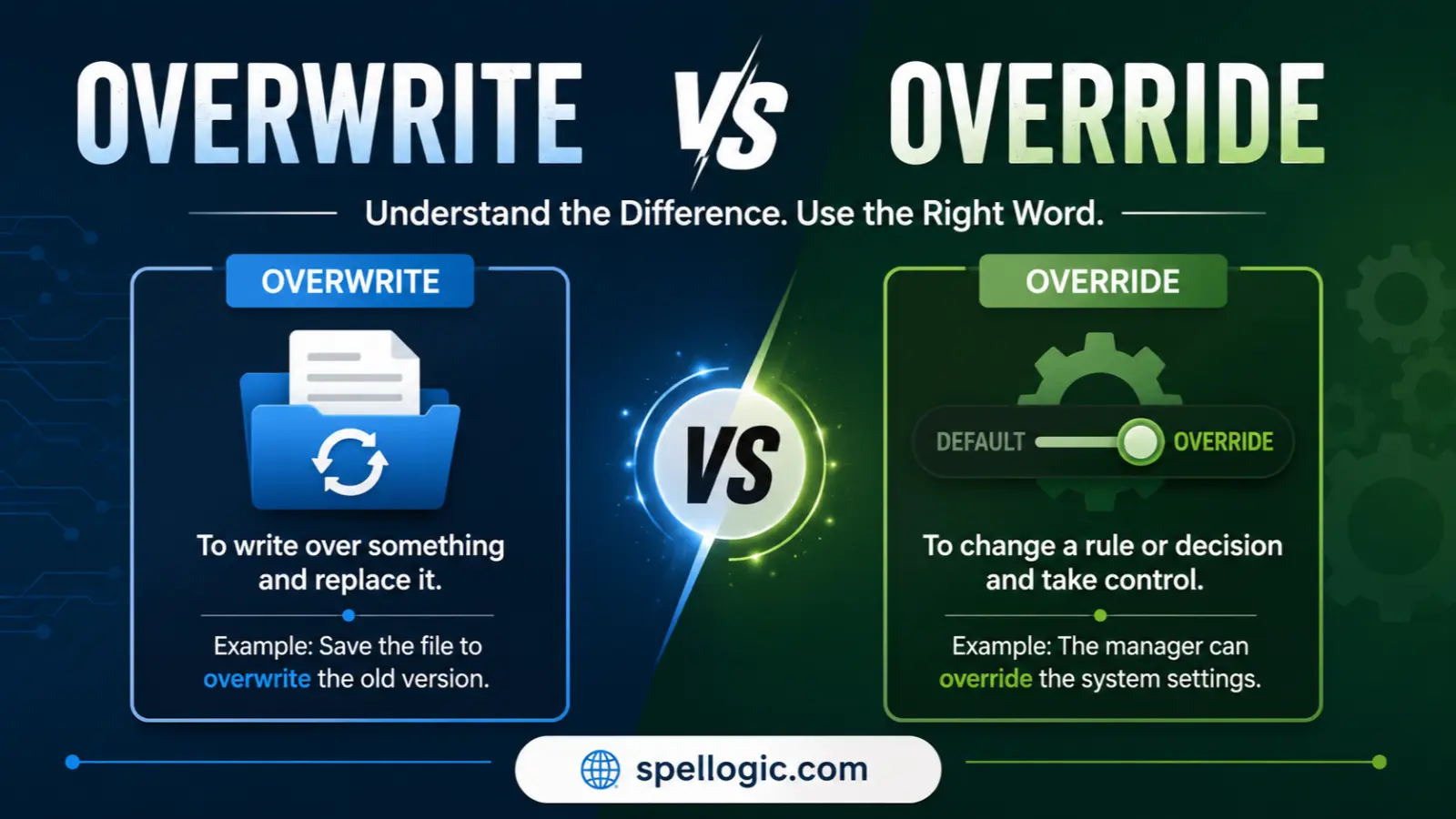
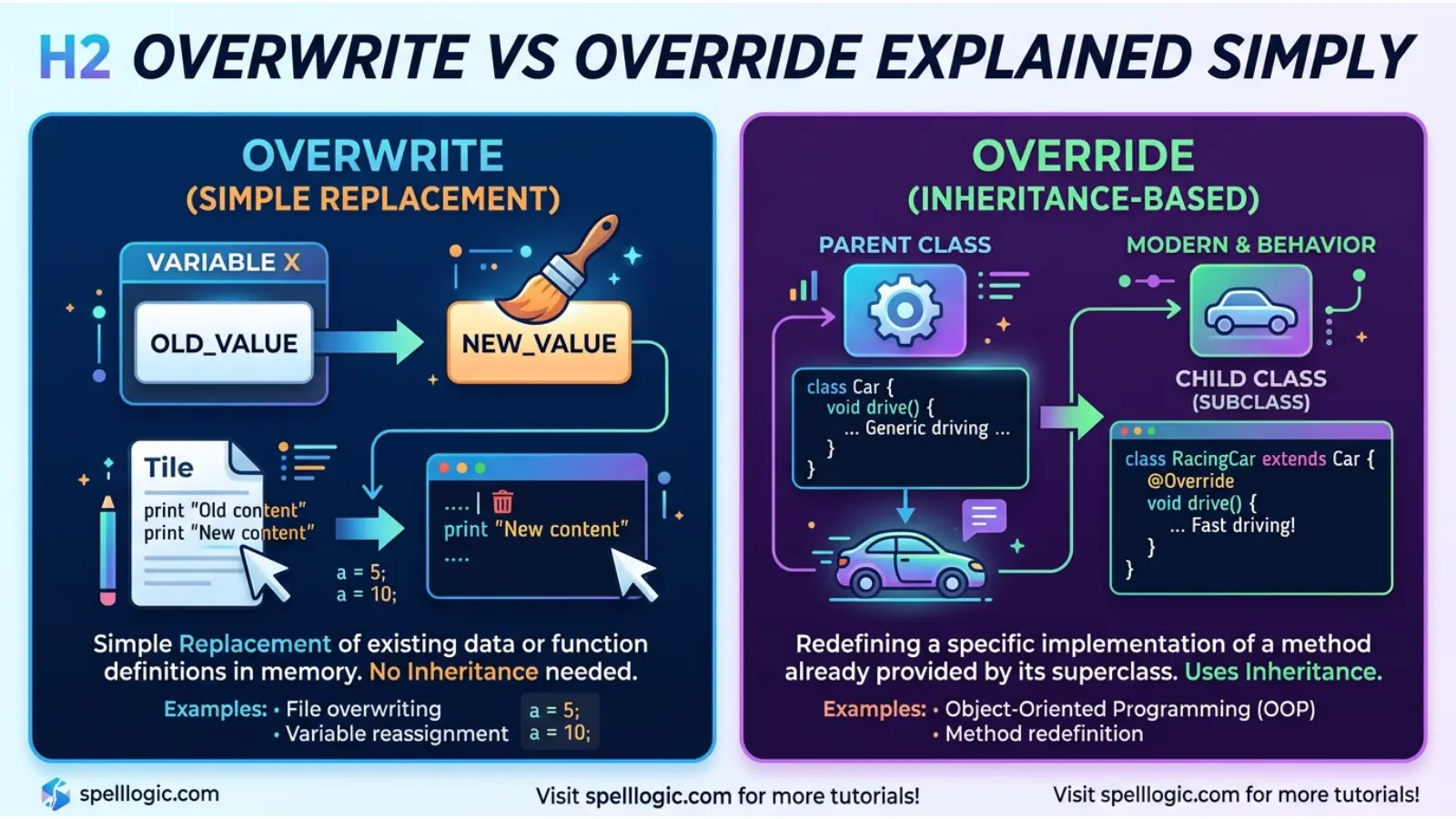
Overwrite means to replace existing data or text with new information, while override means to cancel, ignore, or take priority over something else.
One-Line Distinction
Overwrite changes existing content, while override cancels or takes control over an existing rule, decision, or setting.
Examples
Overwrite
- The program will overwrite the old file.
- Be careful not to overwrite your homework document.
Override
- The manager decided to override the automatic decision.
- You can override the default settings if necessary.
Understanding Homophones in English
What Are Homophones?
Homophones are words that sound the same but have different meanings and often different spellings.
Example:
- right
- write
These words are pronounced alike but mean different things.
Note: Overwrite and override are not true homophones. They simply sound somewhat similar and are often confused because of their spelling and usage.
Why Homophones Cause Confusion
When words sound alike or look similar, learners may choose the wrong one while speaking or writing.
For example:
- Their
- There
- They’re
Understanding each word’s meaning and context helps avoid mistakes.
What Does “Overwrite” Mean?
Definition and Core Meaning
Overwrite means to write new information over existing information, replacing the original content completely or partially.
It is most commonly used with:
- Computer files
- Documents
- Memory storage
- Digital records
Origin and Historical Use
The word combines:
- Over
- Write
It originally referred to writing over existing text. As computers became common, the word gained a technical meaning for replacing stored data.
Modern Usage and Synonyms
Common situations include:
- Saving files
- Editing documents
- Updating databases
- Replacing stored information
Synonyms
- Replace
- Rewrite
- Substitute
- Record over
- Update
Example Sentences
- Saving the document will overwrite the previous version.
- The software accidentally overwrote the image.
- Never overwrite important backups.
- The new recording will overwrite the old audio.
What Does “Override” Mean?
Definition and Core Meaning
Override means to cancel, reject, ignore, or take priority over another decision, command, rule, or system.
It often describes authority or higher priority.
Origin and Historical Context
The word comes from combining:
- Over
- Ride
Historically, it referred to riding over something. Today, it usually means exercising greater authority or taking precedence.
Modern Usage and Synonyms
Common situations include:
- Computer settings
- Company policies
- Management decisions
- Safety controls
- Legal authority
Synonyms
- Cancel
- Ignore
- Overrule
- Supersede
- Bypass
Example Sentences
- The administrator can override user permissions.
- The judge may override the jury’s recommendation in limited situations.
- Emergency controls can override automatic systems.
- Parents sometimes override screen-time limits.
Overwrite vs Override: Key Differences at a Glance
| Word | Part of Speech | Meaning | Example Context |
|---|---|---|---|
| Overwrite | Verb | Replace existing data or writing with new content | The software will overwrite the file. |
| Override | Verb | Cancel, ignore, or take priority over a rule or decision | The manager overrode the system’s recommendation. |
How to Remember the Difference Between Overwrite and Override
Here are some easy memory tricks.
Memory Trick 1
Write = Words or Data
If you’re replacing text, files, or information, use overwrite.
Memory Trick 2
Ride = Take Control
Think of someone riding over an obstacle or taking charge.
If something takes control of another rule or decision, use override.
Association Technique
- Overwrite → Write over existing information
- Override → Rule over another rule
Memorable Example
Imagine editing a computer file.
- Saving a new version overwrites the old file.
- Changing administrator settings overrides the default system rules.
Common Mistakes and Confusions
Here are mistakes learners often make.
Wrong
She overwrote the company’s decision.
Correct
She overrode the company’s decision.
Explanation: Decisions are overridden, not overwritten.
Wrong
The program overrode my document.
Correct
The program overwrote my document.
Explanation: Documents and files are overwritten.
Wrong
The teacher overwrote the school policy.
Correct
The teacher overrode the school policy.
Explanation: Policies are overridden.
Wrong
The software overrode the old photo.
Correct
The software overwrote the old photo.
Explanation: Digital files are overwritten.
Examples Section: Correct and Incorrect Usage
Example 1
✔ Correct: The new installation will overwrite the existing files.
✘ Incorrect: The new installation will override the existing files.
Example 2
✔ Correct: The administrator can override security restrictions.
✘ Incorrect: The administrator can overwrite security restrictions.
Example 3
✔ Correct: Be careful not to overwrite your backup.
✘ Incorrect: Be careful not to override your backup.
Example 4
✔ Correct: The CEO decided to override the earlier decision.
✘ Incorrect: The CEO decided to overwrite the earlier decision.
Example 5
✔ Correct: Saving this document again will overwrite the previous version.
✘ Incorrect: Saving this document again will override the previous version.
Self Assessment: Test Your Knowledge
Fill in the blanks with overwrite or override.
- Saving the file again will __________ the original version.
- The manager decided to __________ the automated approval.
- Do not accidentally __________ your important documents.
- Emergency controls can __________ the automatic system.
Self Assessment Answers
- overwrite
- override
- overwrite
- override
FAQs
1. What is the difference between overwrite and override?
Overwrite means replacing existing data, while override means canceling or taking priority over a rule, setting, or decision.
2. Is overwrite used only for computers?
No. Although it is most common in computing, overwrite can also describe replacing written information or recordings.
3. When should I use override?
Use override whenever a person, system, or authority cancels, ignores, or takes precedence over another rule or decision.
4. Can software override settings?
Yes. Many computer programs allow users or administrators to override default settings.
5. Can a file be overridden?
Usually, no. Files are generally overwritten, not overridden.
6. Are overwrite and override synonyms?
No. They describe different actions and should not be used interchangeably.
7. Which word is more common in technology?
Both are common. Overwrite is used for replacing data, while override is used for changing settings, permissions, commands, or system behavior.
Final Conclusion: Using “Overwrite” and “Override” Correctly
Understanding the difference between overwrite and override is easier once you focus on what each word actually does. Overwrite is all about replacing existing information with something new. You’ll commonly see it when working with computer files, documents, databases, recordings, and other stored data. If new content takes the place of old content, overwrite is the correct choice. Override, on the other hand, refers to taking control, canceling, or giving higher priority to a rule, setting, command, or decision. Managers override decisions, administrators override permissions, and software can override default settings.
A simple way to remember the distinction is this: write replaces data, while ride represents taking control. Keeping this small memory trick in mind can help you choose the correct word quickly. Whenever you’re unsure, ask yourself one question: Am I replacing information, or am I changing a rule or decision? If you’re replacing information, use overwrite. If you’re taking authority over something, use override.
The more you read, write, and practice these words in real-life situations, the more natural they will become. Every new example strengthens your understanding and improves your English vocabulary. Keep practicing, review these examples whenever needed, and you’ll soon use overwrite and override confidently and correctly in both everyday communication and professional writing.