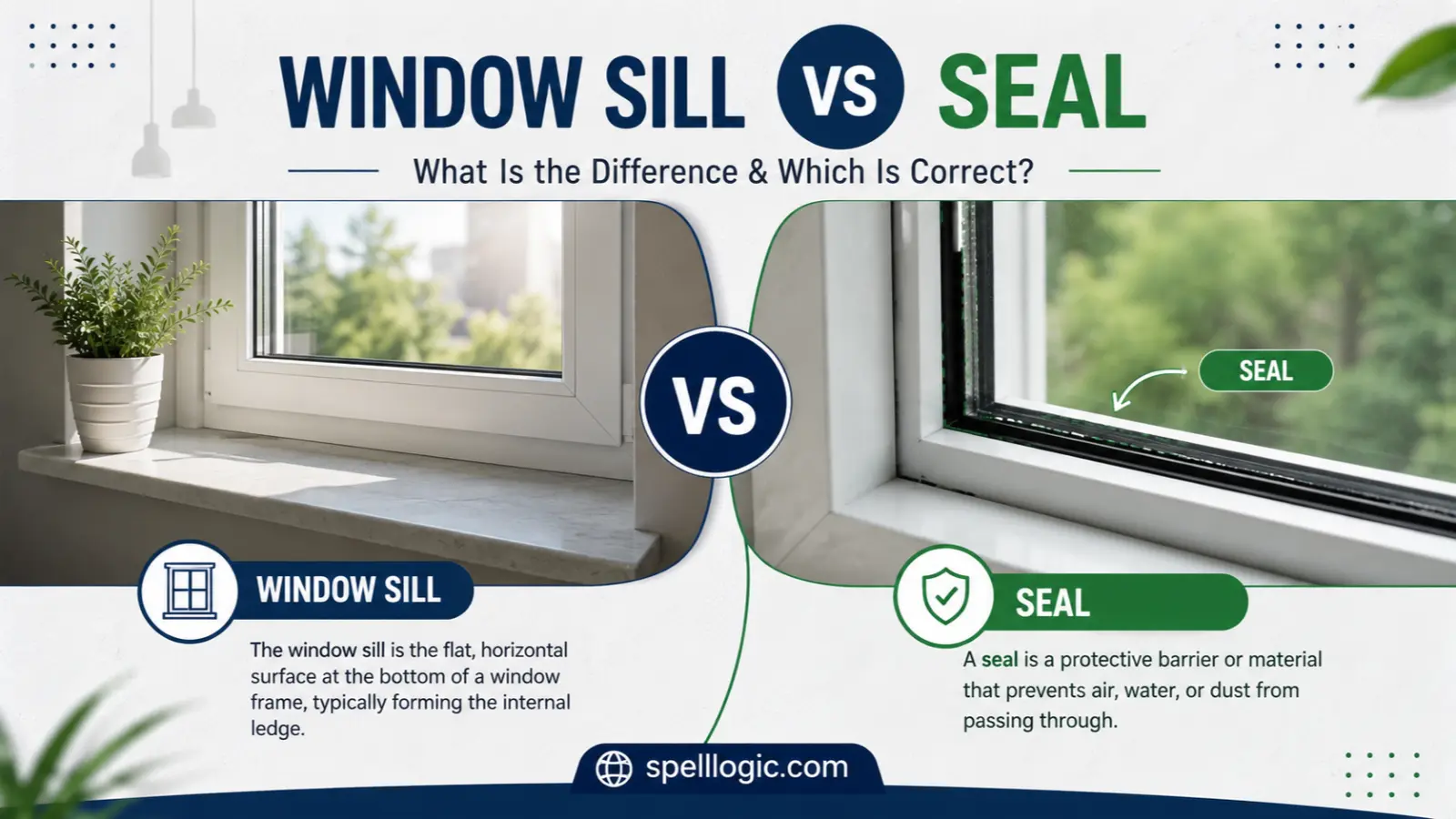
Many English learners become confused by window sill and seal because these terms are often discussed together when talking about windows. Although they are completely different words, they can seem related since both are parts of a window or are used when describing windows.
Understanding the difference is important because using the wrong word can change the meaning of your sentence entirely. In this guide, you’ll learn what window sill and seal mean, how they differ, when to use each one, and simple tricks to remember the correct word. By the end, you’ll feel much more confident using both terms correctly.
Table of Contents
- Introduction
- Why “Window Sill” and “Seal” Are Confusing
- Window Sill vs Seal Explained Simply
- Understanding Homophones in English
- What Are Homophones?
- Why Homophones Cause Confusion
- What Does “Window Sill” Mean?
- What Does “Seal” Mean?
- Window Sill vs Seal: Key Differences at a Glance
- How to Remember the Difference Between Window Sill and Seal
- Common Mistakes and Confusions
- Examples Section: Correct and Incorrect Usage
- Self Assessment: Test Your Knowledge
- Self Assessment Answers
- FAQs About “Window Sill and Seal”
- Final Conclusion: Using “Window Sill” and “Seal” Correctly
Why “Window Sill” and “Seal” Are Confusing
Many people assume window sill and seal are interchangeable because they both relate to windows. However, they refer to different parts and serve different purposes.
Here are the main reasons learners mix them up:
Similar Pronunciation
Although they don’t sound exactly alike, sill and seal have similar vowel sounds for many English learners, especially those whose native language does not distinguish these sounds clearly.
Similar Spelling
The words are short and begin with the letter S, making them easy to confuse while reading or writing.
Context Confusion
When discussing windows, both words often appear in the same conversation.
For example:
- The window seal needs replacing.
- The flower pot is sitting on the window sill.
Because both belong to window-related vocabulary, learners sometimes use the wrong one.
Common Learner Mistakes
Some common errors include:
- Saying window seal when referring to the ledge beneath the window.
- Saying window sill when talking about weatherproof rubber around the window frame.
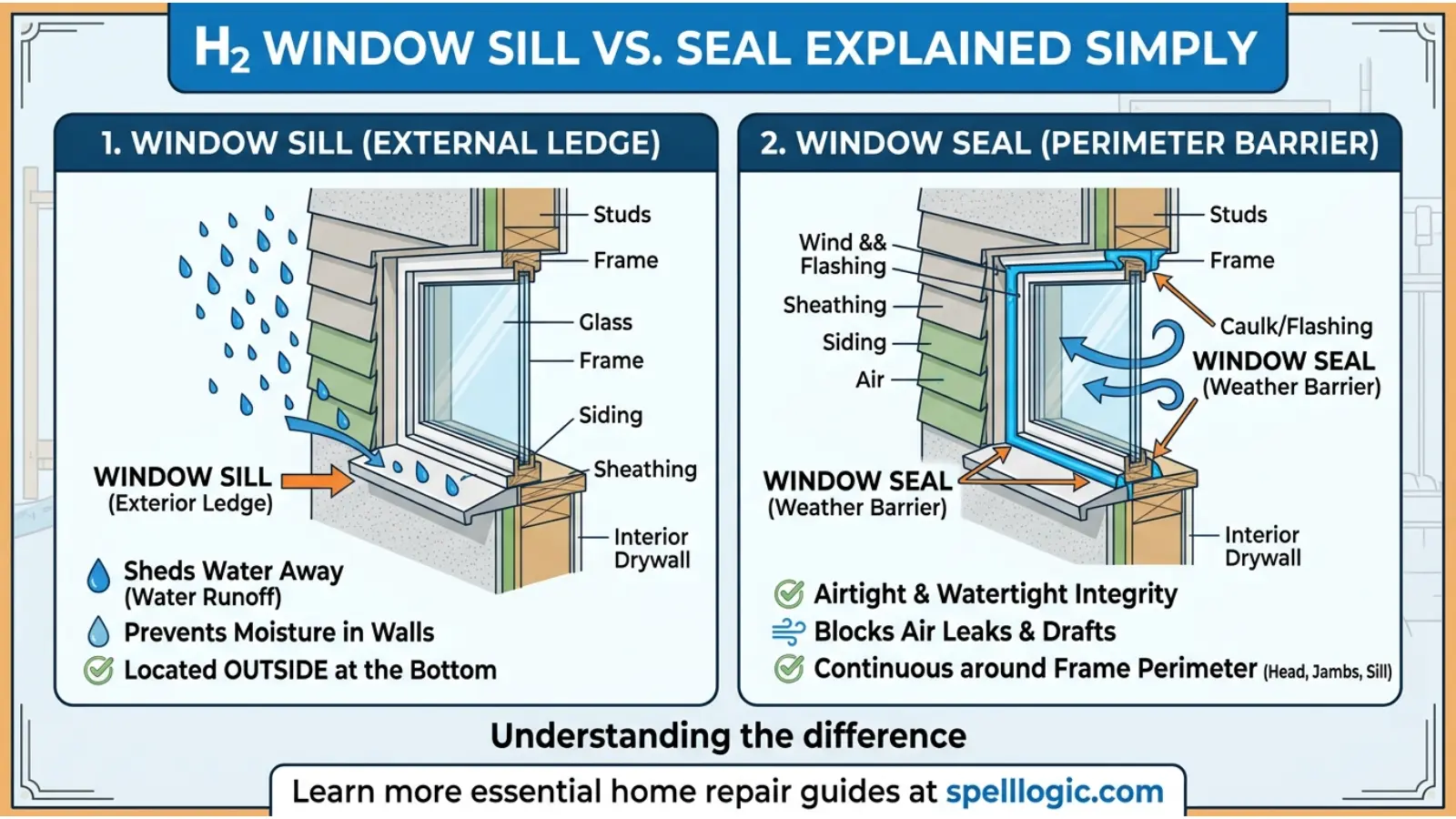
Window Sill vs Seal Explained Simply
Window sill means the flat horizontal ledge at the bottom of a window.
Seal means the material or barrier that prevents air, water, or dust from entering around a window.
One-line distinction
A window sill is part of the window structure, while a seal keeps the window airtight and watertight.
Examples
Window sill
- She placed a vase on the window sill.
- The cat enjoys sleeping on the sunny window sill.
Seal
- The window seal keeps cold air outside.
- We replaced the broken seal before winter.
Understanding Homophones in English
What Are Homophones?
Homophones are words that sound the same or nearly the same but have different meanings and spellings.
Example:
- Sea
- See
They sound alike but have completely different meanings.
Why Homophones Cause Confusion
English contains many words that sound similar, making them difficult for learners.
For example:
- Their
- There
- They’re
Likewise, sill and seal may sound similar depending on a speaker’s accent, even though they are different words.
What Does “Window Sill” Mean?
Definition and Core Meaning
A window sill is the flat horizontal surface located at the bottom of a window. It may be inside or outside a building and supports the window frame while providing a place to set objects.
Origin and Historical Use
The word sill comes from Old English and originally referred to a horizontal support beam in buildings. Over time, it became the standard name for the lower ledge of a window.
Modern Usage and Synonyms
Today, window sill is widely used in architecture, construction, and everyday conversation.
Possible related words include:
- Window ledge
- Ledge
- Bottom ledge
- Windowsill (written as one word is also common)
Key Points
- Flat surface beneath a window
- Can be made of wood, stone, vinyl, or metal
- Supports the window structure
- Often used for decoration
Example Sentences
- The children decorated the window sill with flowers.
- Dust collected on the window sill.
- She rested her coffee mug on the window sill.
- Birds landed outside the window sill.
What Does “Seal” Mean?
Definition and Core Meaning
A seal is a material or barrier that blocks air, water, insects, or dust from passing through openings around a window or door.
As a verb, seal means to close something tightly.
Origin and Historical Context
The word seal comes from Latin through Old French, meaning to close securely or authenticate. Today, it has several meanings, but in construction it refers to protective barriers.
Modern Usage and Synonyms
Common synonyms include:
- Gasket
- Weatherstrip
- Insulation
- Barrier
- Caulking (depending on context)
Key Points
- Prevents leaks
- Improves energy efficiency
- Blocks moisture and drafts
- Can wear out over time
Example Sentences
- The damaged seal allowed rainwater inside.
- We installed a new rubber seal.
- Please seal the package before mailing it.
- The technician checked every window seal.
Window Sill vs Seal: Key Differences at a Glance
| Word | Part of Speech | Meaning | Example Context |
|---|---|---|---|
| Window sill | Noun | Flat ledge beneath a window | The flowers sit on the window sill. |
| Seal | Noun / Verb | Barrier that prevents leaks, or to close tightly | The window seal prevents cold air from entering. |
How to Remember the Difference Between Window Sill and Seal
Learning a simple memory trick can make these words much easier to remember.
Easy Memory Tricks
- Sill = Sit
- Both begin with Si.
- Things sit on a sill.
- Seal = Stop
- A seal stops air and water.
Association Techniques
Imagine placing a flower pot on a sunny window ledge.
It sits on the window sill.
Now imagine heavy rain outside.
The seal keeps the rain from coming inside.
Memorable Example
Flowers sit on the sill. Rain stays out because of the seal.
Common Mistakes and Confusions
Wrong Example
❌ The bird landed on the window seal.
✅ The bird landed on the window sill.
Explanation: Birds land on the ledge, not the weatherproof barrier.
Wrong Example
❌ The cold air entered because the window sill was broken.
✅ The cold air entered because the window seal was damaged.
Explanation: Air leaks occur through damaged seals.
Wrong Example
❌ Replace the wooden seal under the window.
✅ Replace the wooden window sill under the window.
Explanation: The wooden part is usually the sill.
Wrong Example
❌ Clean the rubber window sill.
✅ Clean the rubber seal.
Explanation: Rubber components around windows are seals.
Examples Section: Correct and Incorrect Usage
Example 1
✔ Correct: She placed her books on the window sill.
✘ Incorrect: She placed her books on the window seal.
Example 2
✔ Correct: The broken seal caused a water leak.
✘ Incorrect: The broken window sill caused the leak.
Example 3
✔ Correct: We painted the wooden window sill.
✘ Incorrect: We painted the rubber seal with wood stain.
Example 4
✔ Correct: The installer replaced the old seal around the window.
✘ Incorrect: The installer replaced the old window sill around the frame.
Self Assessment: Test Your Knowledge
Fill in the blanks with window sill or seal.
- The flowers are sitting on the __________.
- The damaged __________ lets cold air enter the room.
- She wiped dust from the __________ before opening the curtains.
- The technician replaced the rubber __________ around the window.
Self Assessment Answers
- window sill
- seal
- window sill
- seal
FAQs
1. Is a window sill the same as a window seal?
No. A window sill is the flat ledge beneath the window, while a seal prevents air and water from entering around the frame.
2. Which spelling is correct: window sill or window seal?
Both are correct, but they refer to different things.
3. Can a window have both a sill and a seal?
Yes. Nearly every modern window has both.
4. What is a window seal made of?
Window seals are commonly made from rubber, silicone, vinyl, or other weather-resistant materials.
5. What is a window sill usually made from?
Window sills may be made of wood, stone, concrete, vinyl, metal, or composite materials.
6. Why is my window seal important?
A good seal improves insulation, reduces energy costs, and prevents water leaks.
7. Can I put decorations on a window sill?
Yes. Many people place plants, candles, books, or decorative items on their window sills.
Final Conclusion: Using “Window Sill” and “Seal” Correctly
Understanding the difference between window sill and seal is easier once you know the purpose of each term. A window sill is the flat ledge at the bottom of a window where you might place plants, books, or decorative items. In contrast, a seal is the protective material around the window that keeps out rain, wind, dust, and cold air. Although these words often appear together when discussing windows, they describe completely different parts and should never be used interchangeably.
One of the best ways to remember the distinction is with a simple association. Think of a sill as a place where things sit, and think of a seal as something that seals or blocks unwanted air and water. This mental image can help you choose the correct word even in everyday conversations or writing.
Using the right vocabulary is especially helpful when speaking with builders, reading home improvement guides, or describing household repairs. It also improves your overall English accuracy and helps you communicate more naturally.
As you continue learning English, don’t worry if you occasionally mix up similar-looking or similar-sounding words. Confusion is a normal part of language learning. Keep practicing with real-life examples, review these memory tricks, and pay attention to context. With regular practice, you’ll soon use window sill and seal correctly and confidently every time.