If you’ve ever wondered whether authorisation or authorization is the correct spelling, you’re not alone. Many English learners—and even native speakers—find these two words confusing because they look almost identical and have the same meaning. The main difference is not grammar or definition but the variety of English being used.
Understanding when to use each spelling helps you write more naturally, whether you’re creating business documents, academic papers, emails, or website content. In this guide, you’ll learn the difference between authorisation and authorization, discover where each spelling is preferred, and gain simple tips to remember the correct choice.
Table of Contents
- Introduction
- Why “Authorisation” and “Authorization” Are Confusing
- Authorisation vs Authorization Explained Simply
- Understanding Homophones in English
- What Are Homophones?
- Why Homophones Cause Confusion
- What Does “Authorisation” Mean?
- What Does “Authorization” Mean?
- Authorisation vs Authorization: Key Differences at a Glance
- How to Remember the Difference Between Authorisation and Authorization
- Common Mistakes and Confusions
- Examples Section: Correct and Incorrect Usage
- Self Assessment: Test Your Knowledge
- Self Assessment Answers
- FAQs About “Authorisation and Authorization”
- Final Conclusion: Using “Authorisation” and “Authorization” Correctly
Why “Authorisation” and “Authorization” Are Confusing
Many people mix up authorisation and authorization because they refer to exactly the same idea but use different spellings.
Here are the main reasons for the confusion:
Similar Pronunciation
Both words are pronounced almost identically:
aw-thuh-ruh-ZAY-shun
Since they sound the same, it’s impossible to know the correct spelling just by hearing them.
Similar Spelling
The only visible difference is:
- Authorisation ends with -isation
- Authorization ends with -ization
Everything else is identical.
Context Confusion
Both words appear in the same situations, such as:
- Banking
- Business
- Government documents
- Medical forms
- Computer security
- Legal contracts
Because the meaning never changes, learners often assume one spelling is wrong.
Common Learner Mistakes
Some frequent mistakes include:
- Mixing British and American spelling in one document.
- Believing one spelling is more formal.
- Thinking they have different meanings.
In reality, they simply belong to different varieties of English.
Authorisation vs Authorization Explained Simply
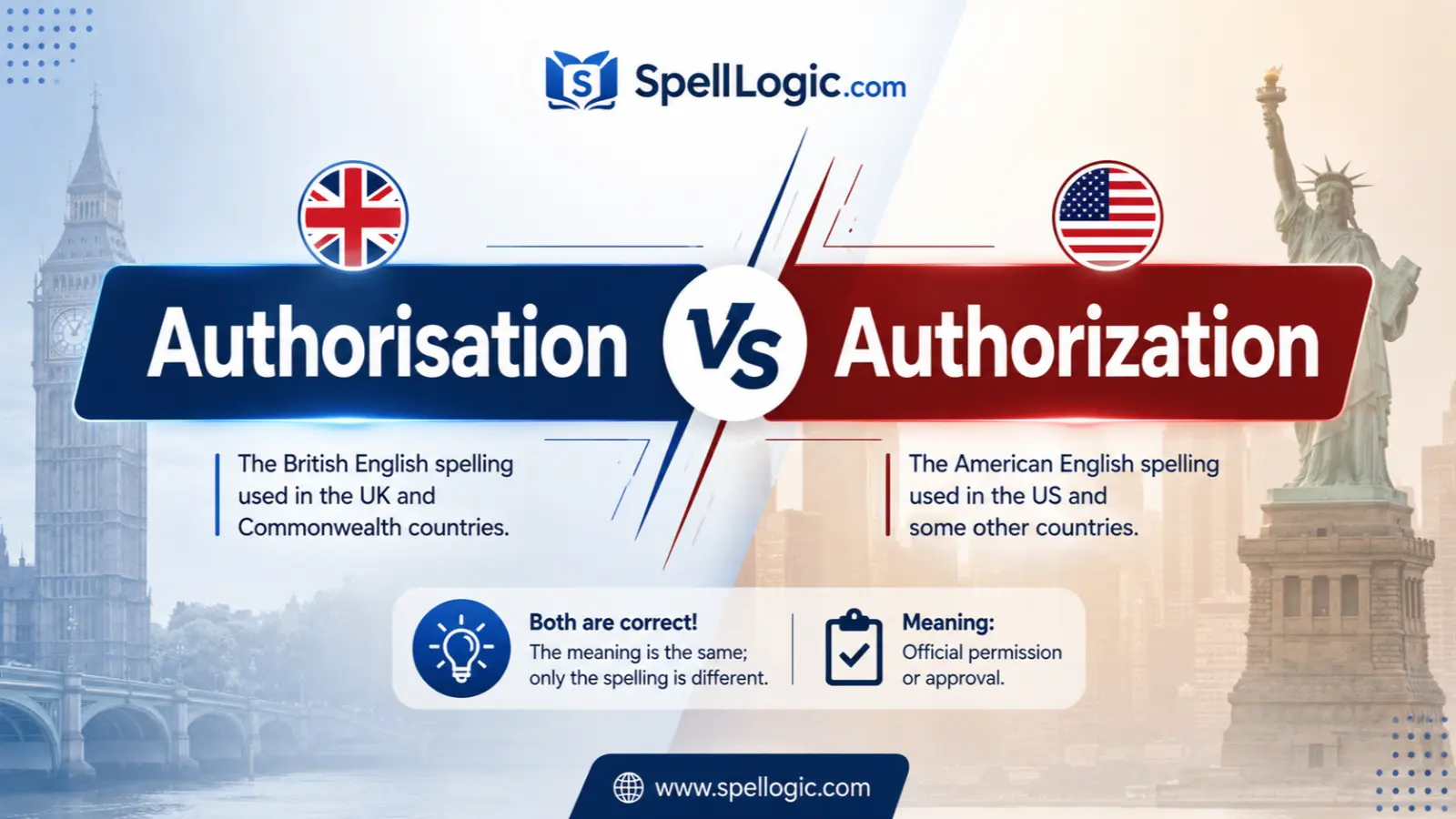
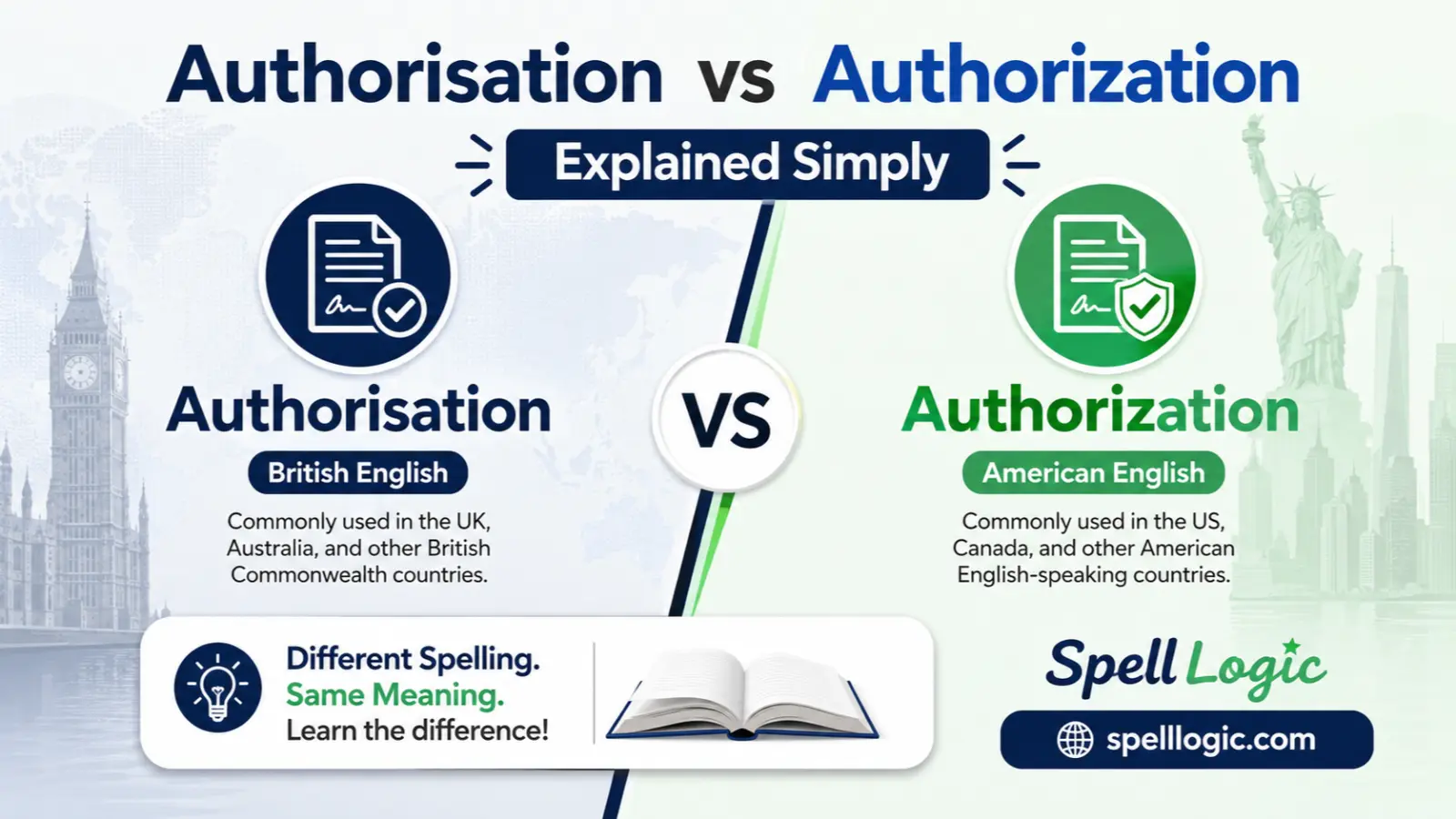
Authorisation means giving official permission in British English, while authorization means giving official permission in American English.
One-line distinction
Authorisation = British English spelling
Authorization = American English spelling
Example Sentences
Authorisation
- The manager gave written authorisation for the purchase.
- You need parental authorisation before joining the trip.
Authorization
- The bank requires authorization before processing the payment.
- Employees must receive authorization to access confidential files.
Understanding Homophones in English
What Are Homophones?
Homophones are words that sound the same but may have different spellings or meanings.
Example:
- Flower
- Flour
They are pronounced alike but have different meanings.
Although authorisation and authorization are alternative spellings rather than true homophones, they are often discussed together because they sound exactly alike.
Why Homophones Cause Confusion
When people hear words without seeing them written, they often guess the spelling.
For example:
Someone hears “authorization” but writes authorisation, depending on the English style they learned.
Knowing whether you’re writing in British or American English helps avoid this confusion.
What Does “Authorisation” Mean?
Definition and Core Meaning
Authorisation is the British English spelling of a noun that means official permission, approval, or legal authority to do something.
It describes the act of allowing someone to perform a particular action.
Origin and Historical Use
The word comes from the verb authorise, which entered English through French and Latin influences.
British English traditionally uses the -ise and -isation spelling pattern.
Modern Usage and Synonyms
Common situations include:
- Government approval
- Medical consent
- Security access
- Financial transactions
- Business permissions
Synonyms
- Permission
- Approval
- Consent
- Authority
- Clearance
- Sanction
Example Sentences
- The company received government authorisation.
- Your application requires manager authorisation.
- Written authorisation must be submitted before travel.
What Does “Authorization” Mean?
Definition and Core Meaning
Authorization is the American English spelling of the same noun.
It also means official permission or approval to carry out an action.
The meaning is exactly the same as authorisation.
Origin and Historical Context
American English gradually adopted -ize and -ization spellings, which became standard in dictionaries and style guides across the United States.
Modern Usage and Synonyms
You’ll commonly see authorization in:
- Credit card payments
- Software security
- Government forms
- Insurance claims
- Business agreements
Synonyms
- Permission
- Approval
- Consent
- Clearance
- Authority
- Permit
Example Sentences
- Credit card authorization usually takes a few seconds.
- The employee received written authorization.
- Police obtained judicial authorization before searching the building.
Authorisation vs Authorization: Key Differences at a Glance
| Word | Part of Speech | Meaning | Example Context |
|---|---|---|---|
| Authorisation | Noun | Official permission (British English spelling) | The school requested parental authorisation. |
| Authorization | Noun | Official permission (American English spelling) | The website requested payment authorization. |
How to Remember the Difference Between Authorisation and Authorization
Fortunately, remembering the difference is easy.
Easy Memory Tricks
- S = British Spelling
- Z = American Spelling
Association Technique
Think of:
- United Kingdom → S
- United States → Z
Memorable Example
Imagine two offices.
A company in London stamps documents with authorisation.
A company in New York stamps documents with authorization.
Both approve the same request—they simply spell it differently.
Common Mistakes and Confusions
Wrong
The American company requested authorisation.
Correct
The American company requested authorization.
Explanation
American English normally uses authorization.
Wrong
The British government issued authorization.
Correct
The British government issued authorisation.
Explanation
British English prefers authorisation.
Wrong
Using both spellings in one report.
Correct
Choose one spelling and use it consistently.
Wrong
Thinking the words have different meanings.
Correct
Both words have exactly the same meaning.
Examples Section: Correct and Incorrect Usage
Example 1
✔ Correct: The bank requested authorization before completing the payment.
✘ Incorrect: The bank requested authorisation in an American business report.
Example 2
✔ Correct: The hospital requires parental authorisation.
✘ Incorrect: The hospital requires parental authorization in a British government form.
Example 3
✔ Correct: The employee received written authorization to enter the building.
✘ Incorrect: The employee received written authorisation in a document written entirely in American English.
Example 4
✔ Correct: Our school needs your authorisation before the trip.
✘ Incorrect: Our school needs your authorization in a document following British English conventions.
Self Assessment: Test Your Knowledge
Fill in the blanks.
1.
British English usually spells the word as __________.
2.
American English usually spells the word as __________.
3.
Both words mean official __________.
4.
When writing one document, you should remain __________ with your spelling.
Self Assessment Answers
- Authorisation
- Authorization
- Permission (or approval)
- Consistent
FAQs
1. Is authorisation correct?
Yes. It is the standard British English spelling.
2. Is authorization correct?
Yes. It is the standard American English spelling.
3. Do these words have different meanings?
No. Both mean official permission or approval.
4. Which spelling should I use in academic writing?
Use the spelling that matches your required style guide or the variety of English requested by your school, university, or publisher.
5. Is one spelling more formal?
No. Both are equally formal within their respective varieties of English.
6. Can I mix both spellings in one article?
It is best not to. Choose either British English or American English and use it consistently throughout your writing.
7. Which spelling is more common worldwide?
Both are widely recognized. Authorisation is more common in countries that follow British English, while authorization is standard in the United States and many organizations that use American English.
Final Conclusion: Using “Authorisation” and “Authorization” Correctly
Understanding the difference between authorisation and authorization is much simpler than it first appears. These words share the same meaning—they both refer to official permission, approval, or legal authority to do something. The only real difference is spelling. Authorisation is the preferred form in British English, while authorization is the standard spelling in American English. Neither version is more correct than the other; the right choice depends entirely on the variety of English you are using.
A helpful way to remember the distinction is to associate S with British spelling and Z with American spelling. This simple memory trick can save you from mixing styles in professional documents, academic assignments, websites, and business communication. Whichever spelling you choose, the most important rule is consistency. Switching between British and American spellings within the same document can make your writing appear less polished and may confuse readers.
As you continue learning English, you’ll notice many similar spelling differences, such as organisation/organization, realise/realize, and recognise/recognize. Becoming familiar with these patterns will improve both your writing accuracy and your confidence. With regular reading and practice, choosing between authorisation and authorization will soon become second nature, helping you communicate clearly and professionally in any English-speaking environment.