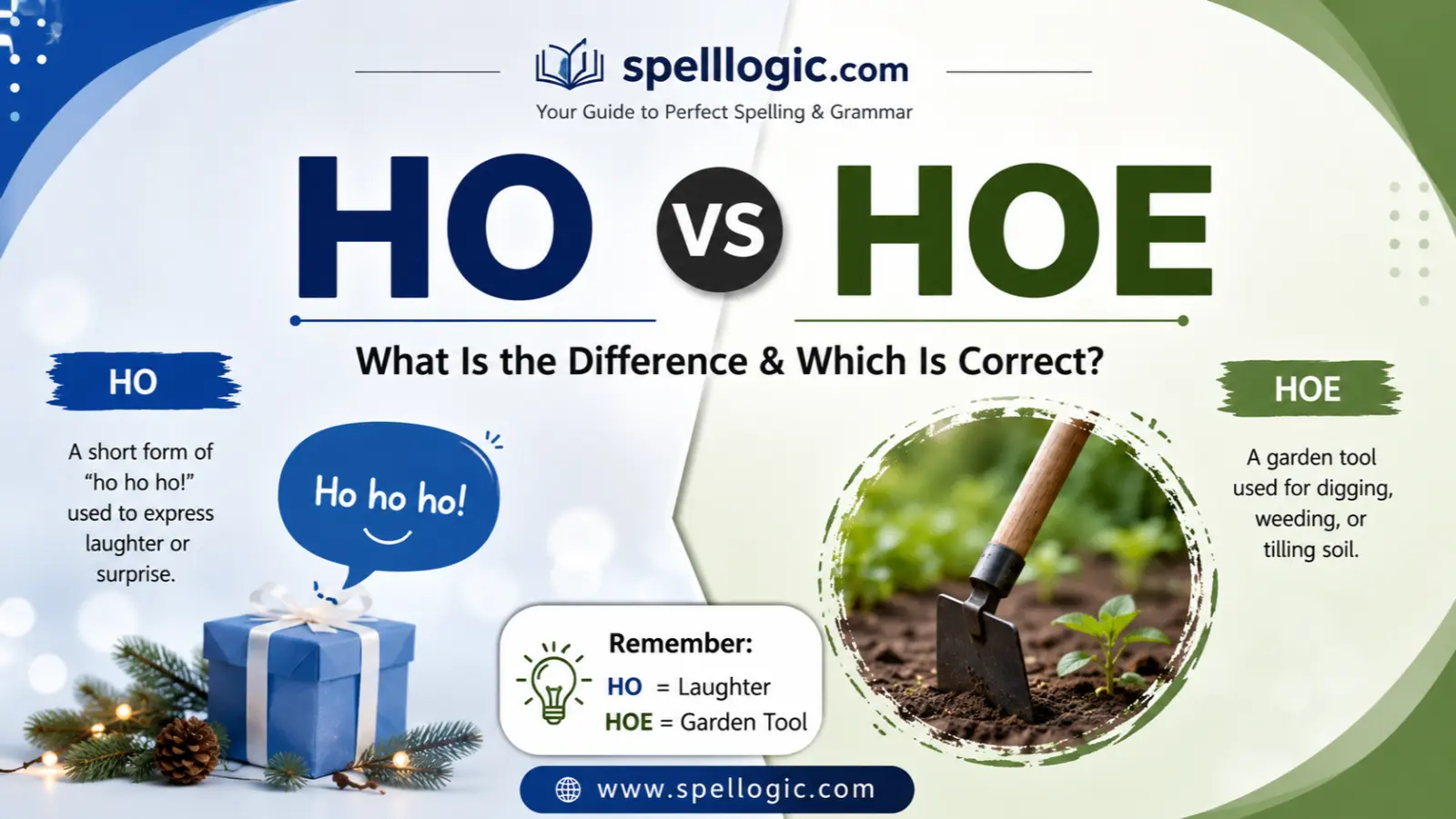
Many English learners become confused by ho and hoe because they sound almost the same in everyday speech. However, these two words have very different meanings and are used in completely different situations. One is a gardening tool, while the other has several meanings depending on context, including slang that can be offensive.
Understanding the difference is important because using the wrong word can cause confusion or even embarrassment. In this guide, you’ll learn the meanings, origins, examples, and easy memory tricks that will help you confidently choose the correct word every time.
Table of Contents
- Introduction
- Why “Ho” and “Hoe” Are Confusing
- Ho vs Hoe Explained Simply
- Understanding Homophones in English
- What Are Homophones?
- Why Homophones Cause Confusion
- What Does “Ho” Mean?
- What Does “Hoe” Mean?
- Ho vs Hoe: Key Differences at a Glance
- How to Remember the Difference Between Ho and Hoe
- Common Mistakes and Confusions
- Examples Section: Correct and Incorrect Usage
- Self Assessment: Test Your Knowledge
- Self Assessment Answers
- FAQs About “Ho and Hoe”
- Final Conclusion: Using “Ho” and “Hoe” Correctly
Why “Ho” and “Hoe” Are Confusing
People often confuse ho and hoe because they sound very similar when spoken. Despite their similar pronunciation, they have different spellings, meanings, and uses.
Here are the main reasons learners mix them up:
- Similar pronunciation: Both words are commonly pronounced as /hoʊ/.
- Similar spelling: The only difference is the extra e at the end of hoe.
- Context confusion: Both words appear in informal English, but in completely different contexts.
- Common learner mistakes: Some learners accidentally write ho when talking about gardening or use hoe when they actually mean the informal interjection ho.
Learning the correct meaning of each word helps you avoid awkward or incorrect communication.
Ho vs Hoe Explained Simply
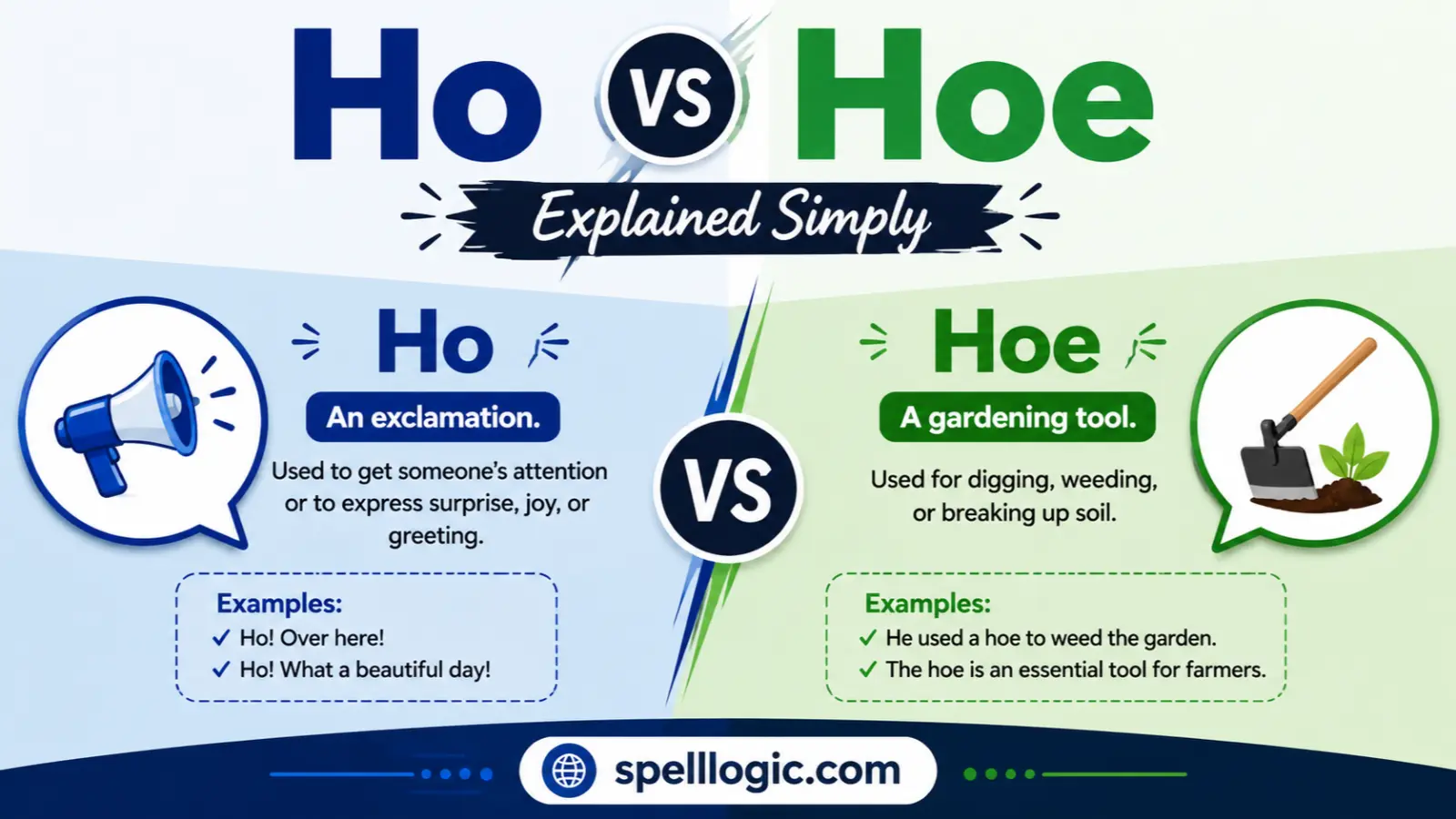
Ho means an interjection or a slang term in certain contexts, while hoe is a gardening tool used for digging, weeding, and cultivating soil.
One-line distinction
“Ho” is mainly an expression or slang, while “hoe” is a farming and gardening tool.
Example sentences
- Ho: Ho, ho, ho! Merry Christmas!
- Ho: The sailor shouted, “Ho there!”
- Hoe: She used a hoe to remove weeds from the garden.
- Hoe: The farmer carried a hoe across the field.
Understanding Homophones in English
What Are Homophones?
Homophones are words that sound the same but have different spellings and meanings.
Example:
- Sea — a large body of salt water
- See — to look at something
Although they sound alike, they have completely different meanings.
Why Homophones Cause Confusion
Homophones can be difficult because listeners hear the same sound but must understand the meaning from the sentence.
For example:
- She bought a new hoe for gardening.
- Ho, ho, ho! said Santa Claus.
Even though ho and hoe sound alike, the surrounding words clearly show which one is correct.
What Does “Ho” Mean?
Definition and Core Meaning
The word ho has several meanings depending on the context.
It may be:
- An old-fashioned call to attract attention.
- An exclamation expressing surprise or excitement.
- Part of the familiar Christmas expression “Ho, ho, ho!”
- A slang word in informal English that can be offensive when used to describe a person.
Because one meaning is considered disrespectful, learners should use this word carefully.
Origin and Historical Use
The interjection ho comes from Middle English and has been used for centuries to call someone’s attention or express surprise.
Over time, it also became associated with Santa Claus’s famous laugh: “Ho, ho, ho!”
In modern slang, ho developed as a shortened spelling of another insulting word. This slang meaning should generally be avoided in polite conversation.
Modern Usage and Synonyms
Depending on context, ho may mean:
- Hey!
- Stop!
- Listen!
- An exclamation
- Informal slang (often offensive)
Example sentences
- Ho there! Who goes there?
- Ho, ho, ho! Merry Christmas!
- The actor shouted, “Ho!” to get everyone’s attention.
What Does “Hoe” Mean?
Definition and Core Meaning
A hoe is a hand tool used in gardening and farming.
People use it to:
- Remove weeds
- Break up soil
- Dig shallow trenches
- Shape planting rows
It is one of the oldest agricultural tools in human history.
Origin and Historical Context
The word hoe comes from Old English and has been used for hundreds of years to describe farming tools.
Long before modern machines, farmers depended on hoes to prepare fields and grow crops.
Today, gardeners and farmers still use different kinds of hoes around the world.
Modern Usage and Synonyms
Common related words include:
- Garden tool
- Weeding tool
- Cultivator
- Hand hoe
- Farming implement
Example sentences
- She bought a new hoe for her vegetable garden.
- The gardener used the hoe to loosen the soil.
- Keep the hoe clean after each use.
Ho vs Hoe: Key Differences at a Glance
| Word | Part of Speech | Meaning | Example Context |
|---|---|---|---|
| Ho | Interjection; slang | An exclamation, call for attention, or informal slang | Ho, ho, ho! Merry Christmas! |
| Hoe | Noun | A gardening or farming tool | The farmer sharpened his hoe. |
How to Remember the Difference Between Ho and Hoe
Here are some easy memory tricks.
Easy memory tricks
- Hoe has an extra “E.”
- Think of E as standing for Earth, because a hoe works in the soil.
Association techniques
Imagine someone digging in the Earth with a hoe.
Whenever you see the extra E, think of Earth and gardening.
Memorable example
The hoe helps the Earth grow plants.
Extra E = Earth = Hoe
Common Mistakes and Confusions
Many learners accidentally switch these words.
Wrong
I bought a new ho for my garden.
Correct
I bought a new hoe for my garden.
Explanation: A gardening tool is always spelled hoe.
Wrong
The farmer carried his ho across the field.
Correct
The farmer carried his hoe across the field.
Explanation: Farmers use hoes, not hos.
Wrong
Hoe, hoe, hoe! Merry Christmas!
Correct
Ho, ho, ho! Merry Christmas!
Explanation: Santa’s laugh is spelled ho, not hoe.
Wrong
The gardener cleaned his ho after work.
Correct
The gardener cleaned his hoe after work.
Explanation: The tool is always called a hoe.
Examples Section: Correct and Incorrect Usage
Example 1
✔ Correct: She used a hoe to remove weeds.
✘ Incorrect: She used a ho to remove weeds.
Example 2
✔ Correct: Ho, ho, ho! Santa is coming.
✘ Incorrect: Hoe, hoe, hoe! Santa is coming.
Example 3
✔ Correct: The farmer sharpened his hoe before working.
✘ Incorrect: The farmer sharpened his ho before working.
Example 4
✔ Correct: Ho there! Please wait.
✘ Incorrect: Hoe there! Please wait.
Self Assessment: Test Your Knowledge
Fill in the blanks with ho or hoe.
- The gardener bought a new ______.
- ______, ho, ho! Merry Christmas!
- The farmer used a ______ to prepare the soil.
- ______ there! Please stop for a moment.
Self Assessment Answers
- hoe
- Ho
- hoe
- Ho
FAQs
1. Are ho and hoe pronounced the same?
Yes. They are usually pronounced the same, making them homophones.
2. Which spelling refers to a gardening tool?
Hoe is the correct spelling for the gardening and farming tool.
3. Is ho a real English word?
Yes. It is an interjection and also appears in certain slang contexts.
4. Is ho considered offensive?
In slang, ho can be offensive because it may be used as an insulting term for a person. It is best to avoid this meaning in formal or respectful communication.
5. Why does Santa say “Ho, ho, ho”?
It is a traditional way of representing Santa Claus’s cheerful laugh.
6. Can hoe be used as a verb?
Yes. Hoe can also be a verb meaning to cultivate or weed the soil with a hoe.
7. How can I easily remember the difference?
Remember that hoe has an extra E, which you can connect with Earth, since a hoe is used to work the soil.
Final Conclusion: Using “Ho” and “Hoe” Correctly
Although ho and hoe sound almost identical, they have completely different meanings and should never be used interchangeably. Hoe is the familiar gardening and farming tool used to dig, weed, and cultivate the soil. It can also function as a verb when referring to working the ground with that tool. Ho, on the other hand, is mainly an interjection used to attract attention or express excitement, as in the well-known Christmas greeting, “Ho, ho, ho!” It also has a slang meaning that many people consider offensive, so it should be used with caution and only when you clearly understand the context.
A simple way to remember the difference is to focus on the extra E in hoe. Think of E for Earth, because a hoe is used to work the earth in gardens and fields. This quick memory trick can help you choose the correct spelling whenever you write. Reading authentic English texts, practicing with example sentences, and paying attention to context will also strengthen your understanding over time.
Building a strong vocabulary takes practice, and confusing word pairs are a normal part of learning English. Every time you master a pair like ho and hoe, you become a more confident writer and speaker. Keep practicing, review new words regularly, and don’t be afraid to check a dictionary when you’re unsure. Small improvements each day lead to lasting fluency.